Category | Quality Management
Last Updated On 19/01/2026
Risks don’t arrive one at a time anymore. A supplier issue can trigger financial loss, regulatory attention, customer complaints, and reputational damage, all at once. That’s why many leaders are asking what does ERM mean in real business terms, not textbook definitions.
In risk management training sessions across industries, one common challenge keeps appearing: teams understand individual risks well, but struggle to see how those risks connect across the organization. ERM is usually introduced when leadership needs this bigger picture.
Enterprise Risk Management helps organizations stop reacting to surprises and start making informed decisions. This guide explains what ERM really means, how it works, the main frameworks behind it, and how ERM systems and tools support day-to-day risk decisions.
Modern risks move fast and cut across departments. Cyber threats affect operations. Regulatory changes impact strategy. Market shifts influence financial stability. Managing these risks in silos no longer works.
This is where Enterprise Risk Management makes a difference. Instead of fixing issues after they happen, ERM helps organizations:
By the end of this blog, you’ll clearly understand what does ERM mean, how ERM frameworks guide decisions, how an ERM system works, and how tools support risk-aware leadership.
So, what does ERM mean beyond formal definitions?
At its core, ERM is a structured way to identify, assess, and manage risks across the entire organization, not just within individual teams. ERM risk includes:
The ERM method is not about avoiding risk completely. It’s about understanding risk in relation to objectives. Leaders use ERM to decide:
This makes ERM a decision-support discipline, not a defensive one. In practice, effective ERM programs do not eliminate risk. They provide structured visibility so leadership can make consistent, well-informed decisions aligned with defined risk appetite.
Traditional risk management often lives inside departments. Finance tracks financial risk. IT handles cyber risk. Legal watches compliance. Each team works well, but separately.
ERM changes this approach by creating enterprise-wide visibility.
Key differences include:
Without ERM, risk registers remain fragmented. Leaders struggle to see how one issue affects multiple objectives. ERM solves this by creating:
This shift is what makes an ERM program valuable in complex organizations.
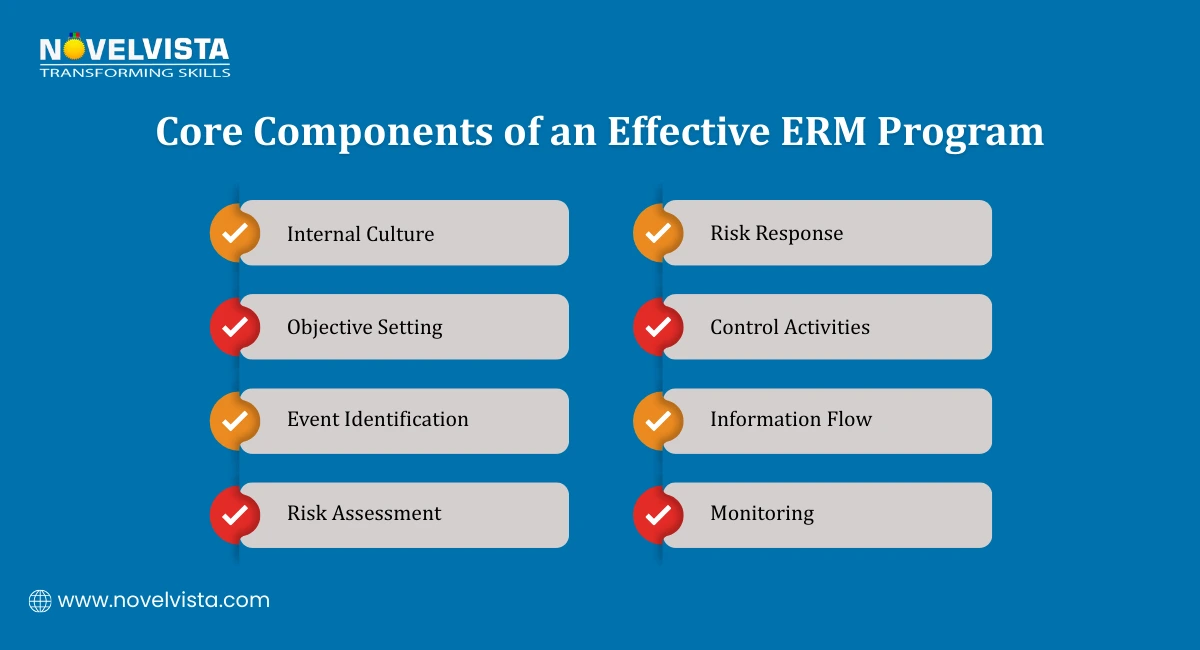
An effective ERM program works as a continuous cycle, not a checklist. The components flow into each other and evolve as conditions change. These components closely reflect how ERM is evaluated during governance reviews and board-level discussions, where clarity of objectives, ownership, and monitoring matter more than documentation volume.
This sets the foundation. It includes:
Without leadership support, ERM becomes paperwork.
Objectives guide risk decisions. Organizations align:
Risk appetite is defined here so decisions stay consistent.
Internal and external events are identified as:
This keeps ERM forward-looking.
ERM risk is evaluated based on:
This helps prioritize what truly matters.
Organizations choose how to handle risk:
The ERM method focuses on informed choice, not fear.
Policies and procedures support chosen responses and keep actions consistent.
Clear reporting ensures decision-makers understand risk exposure and trends.
Continuous monitoring allows ERM to adapt as the organization grows or changes.
An ERM framework provides structure and consistency. It helps organizations design, implement, and improve ERM in a repeatable way.
Two widely used frameworks guide ERM globally.
The COSO ERM framework integrates risk with:
It uses structured components to connect risk thinking with business objectives. Many regulated and large organizations prefer COSO ERM due to its depth and governance focus.
ISO 31000 offers a principles-based ERM framework. It focuses on:
Organizations that want adaptable, scalable risk management often choose ISO 31000.
Organizations select frameworks based on:
Some even combine elements of COSO ERM and ISO 31000 for a balanced approach.
For a deeper understanding of enterprise risk frameworks, explore our detailed comparison of ISO 31000 vs COSO ERM to see how each approach differs in structure, application, and real-world use.
Identify and prioritize risks with practical templates
Apply structured risk assessment methods with ease
Strengthen decision-making with ready-to-use tools
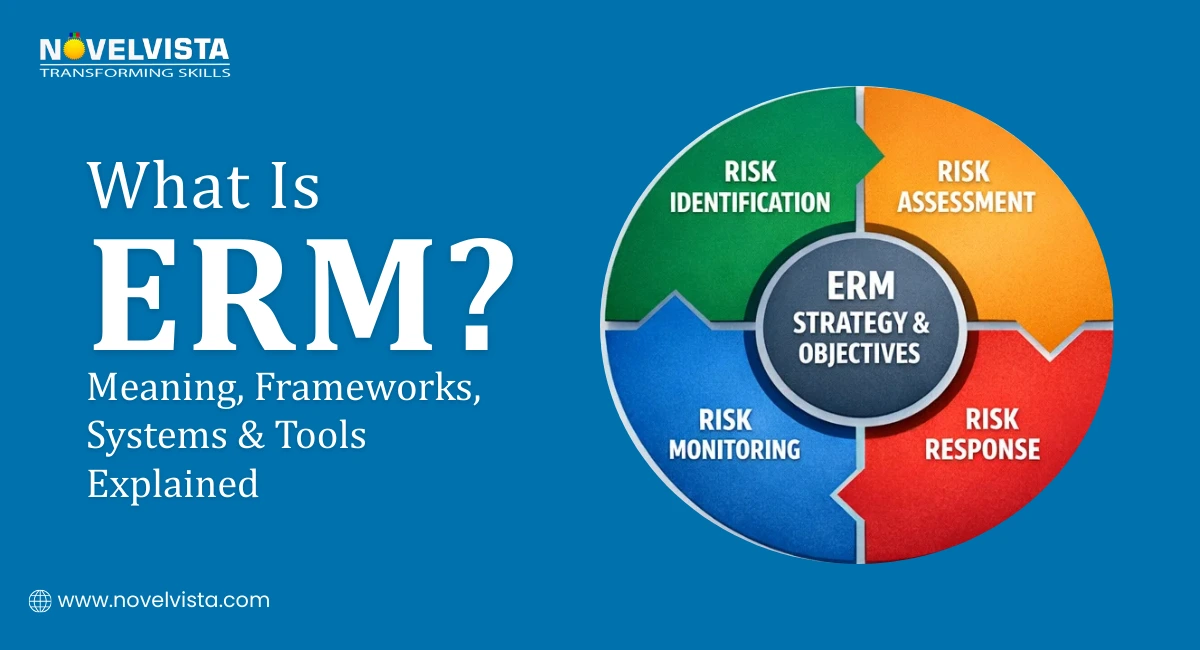
An ERM program is not a policy sitting on a shared drive. In practice, it works as a continuous cycle that supports leadership decisions.
Most organizations follow a rhythm like this:
Organizations that review ERM outputs at leadership and board levels tend to sustain ERM maturity longer than those where risk reporting remains operational or compliance-focused.
Frameworks guide thinking, but an ERM system turns that thinking into daily action.
An ERM system typically provides:
A strong ERM system connects objectives, risks, controls, and monitoring in one place. This helps teams understand how risks affect performance, not just compliance.
More mature organizations use the ERM system as a shared decision-support platform, not just a reporting tool.
Modern ERM system platforms help automate and standardize risk management without removing human judgment.
Common capabilities in ERM solutions include:
Technology strengthens ERM only when governance, ownership, and decision authority are clearly defined. Without this foundation, even advanced ERM platforms deliver limited value. The ERM system supports governance; it does not replace it.
Day-to-day ERM relies on practical ERM tools that support analysis and communication.
Commonly used ERM tools include:
These ERM tools help organizations understand ERM risk clearly, but accountability always stays with management.
Dive deeper into how risks are identified, assessed, and controlled. Explore our in-depth blog on powerful risk management tools and techniques to strengthen decision-making and resilience
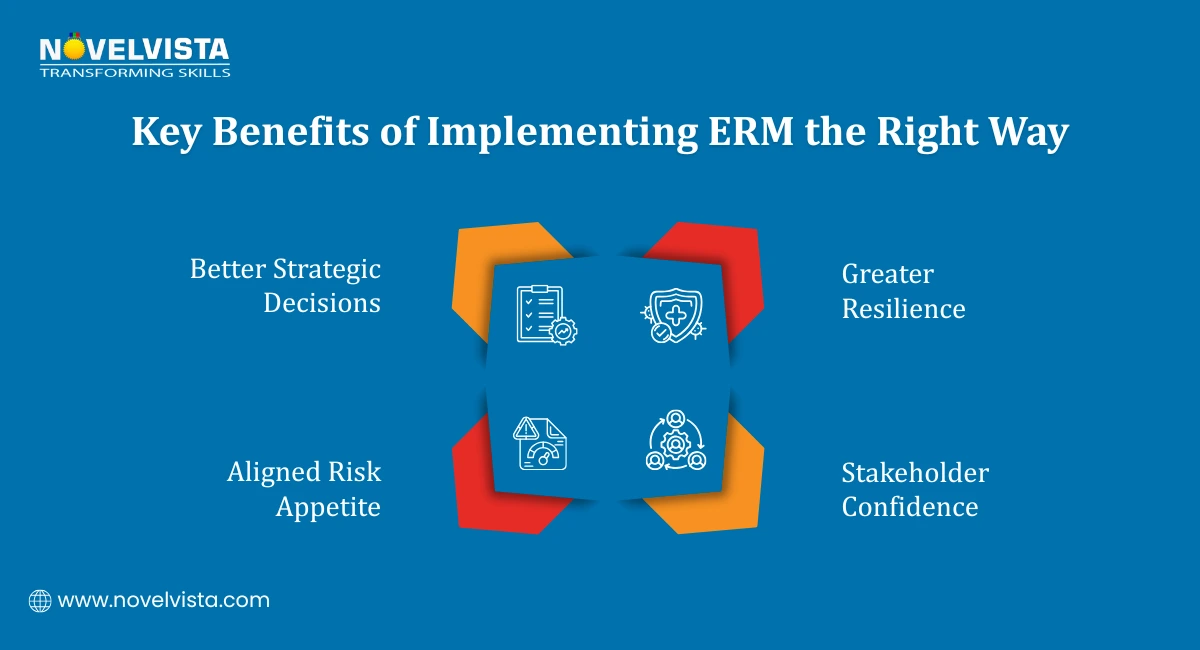
When ERM is applied correctly, benefits go beyond risk reporting.
Organizations experience:
A well-designed ERM framework, supported by an effective ERM system, helps organizations respond faster and with more confidence.
Enterprise Risk Management works best when treated as a mindset, not a document set. Understanding what does ERM mean in practice helps organizations connect strategy, execution, and uncertainty.
Across industries, ERM is increasingly viewed as a core management capability rather than a compliance requirement, especially in organizations facing regulatory scrutiny, rapid growth, or digital transformation.
Successful ERM brings together the ERM framework, a living ERM program, a practical ERM system, and supportive ERM tools. When these elements work together, ERM becomes a long-term capability that grows with the organization.
If you want to move beyond theory and apply ERM confidently, NovelVista’s ISO 31000 Risk Manager Certification Training is a strong next step. The course focuses on real-world ERM methods, risk assessment, governance, and decision-making. It helps professionals design, implement, and improve ERM systems that actually support business objectives, not just compliance requirements.
Author Details

Confused About Certification?
Get Free Consultation Call
Stay ahead of the curve by tapping into the latest emerging trends and transforming your subscription into a powerful resource. Maximize every feature, unlock exclusive benefits, and ensure you're always one step ahead in your journey to success.