Category | Quality Management
Last Updated On 28/05/2026
Organizations invest heavily in IT, yet many still struggle to deliver services that truly support business goals—why does this gap exist? In today’s fast-paced digital landscape, organizations cannot afford such disconnects. This is exactly where ISO 20000, the international standard for IT Service Management (ITSM), plays a crucial role.
But here’s the real question:
How well do you understand your organization’s environment before implementing IT service processes?
Are your IT services aligned with your business goals, stakeholders, and risks?
If you’re an IT manager, service delivery professional, auditor, or someone preparing for ISO certification, this blog is for you.
In this guide, we will break down the context of the organization ISO 20000, why it matters, and how to implement it effectively.
ISO/IEC 20000 is the international standard for IT Service Management (ITSM). It provides a framework that helps organizations deliver consistent, high-quality IT services aligned with business needs.
It focuses on:
However, before implementing any ITSM processes, ISO 20000 requires organizations to understand their environment. This is where the ISO 20000 context of organization comes into play.
The context of the organization ISO 20000 refers to understanding the internal and external factors that influence how your IT services operate. Defined under Clause 4 of ISO 20000, this requirement ensures that organizations identify relevant business conditions, understand stakeholder expectations, and define the scope of their Service Management System (SMS). In simple terms, it helps answer where your organization stands, what factors impact your IT services, and who your key stakeholders are. Without clearly defining the ISO 20000 context of organization, your ITSM implementation may lack direction and overall effectiveness.
Understanding the context of the organization ISO 20000 is not just a compliance requirement; it’s a strategic necessity.
When you understand your organizational context, your IT services are better aligned with overall business objectives.
Identifying internal and external factors helps in recognizing risks early and managing them proactively.
Understanding stakeholder expectations ensures better service delivery and improved customer experience.
A well-defined ISO 20000 context of organization makes audits smoother and supports long-term growth.
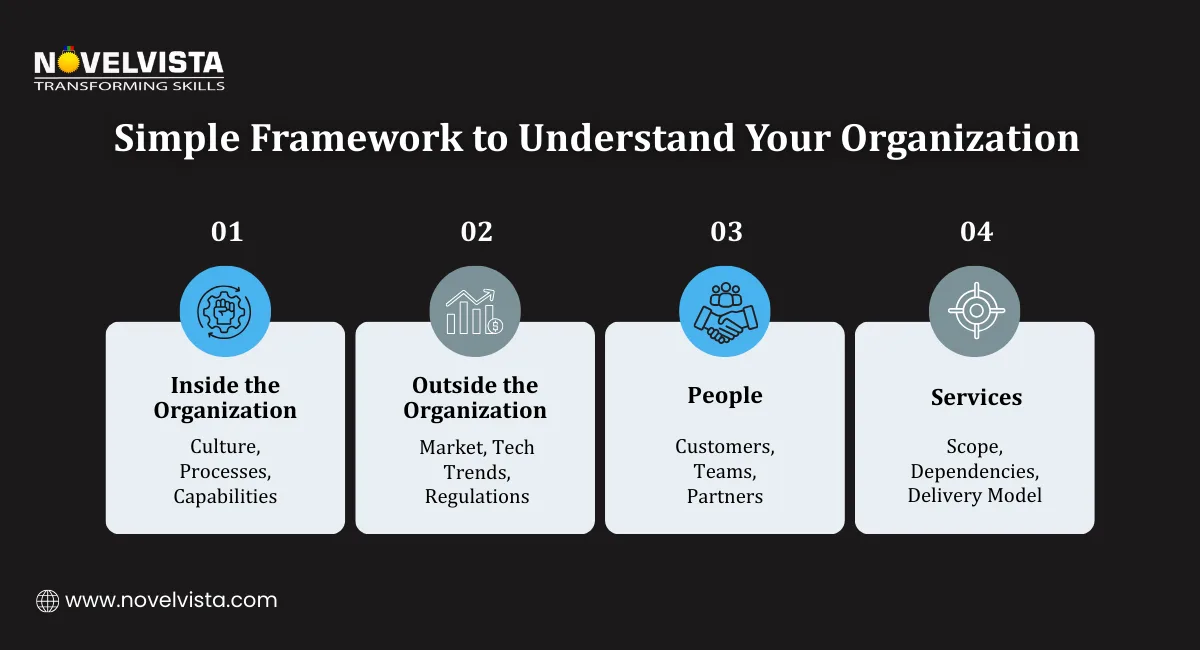
To fully implement the context of the organization ISO 20000, you must focus on four key components:
Internal issues include:
These factors directly impact how your IT services function.
External factors may include:
Ignoring these can lead to outdated or ineffective IT services.
Stakeholders (interested parties) may include:
The ISO 20000 context of organization requires you to identify their needs and expectations clearly.
Based on all the above, you define the scope of your Service Management System (SMS):
This step ensures clarity and avoids confusion during implementation.
Get Your Copy: Mastering Organizational Context in ISO 20000
Implementing the context of the organization ISO 20000 becomes easier with a structured approach:
Evaluate your organization’s:
A SWOT analysis can be helpful here.
Use tools like PESTLE analysis to identify:
This helps in understanding external risks and opportunities.
List all stakeholders and define:
This step is crucial for aligning services with user needs.
Clearly document:
A well-defined scope strengthens your ISO 20000 context of organization.
Finally:
Remember, the context of the organization ISO 20000 is not a one-time activity it’s continuous.
Despite its importance, many organizations struggle with defining their context.
Organizations often fail to clearly define internal and external factors.
Missing key stakeholders can lead to service gaps.
Many companies treat context as a one-time document instead of a dynamic process.
If your IT services don’t align with business goals, your implementation will fail.
To effectively manage the context of the organization ISO 20000, follow these best practices:
Update your context periodically to reflect business changes.
Leverage:
These tools make context identification structured and effective.
Regular communication ensures that stakeholder expectations are always met.
The ISO 20000 context of organization should evolve with your organization.
Imagine an IT services company implementing ISO 20000.
By analyzing the context of the organization ISO 20000, they:
Result?
Better customer satisfaction
Reduced downtime
Successful ISO 20000 certification
Understanding the context of the organization ISO 20000 is not just a starting point it is the strategic backbone of an effective IT Service Management System. When organizations clearly define their ISO 20000 context of organization, they create a strong foundation where IT services seamlessly align with business goals, risks are anticipated and controlled, and stakeholder expectations are consistently exceeded. In an era where service reliability defines competitive advantage, mastering the context of the organization ISO 20000 empowers businesses to deliver resilient, high-quality IT services and drive sustainable growth.
Ready to take your IT service management expertise to the next level?
Join NovelVista’s ISO/IEC 20000:2018 Lead Auditor Certification Training and gain hands-on auditing skills, practical insights into real-world ITSM scenarios, and globally recognized credentials. Designed for IT managers, auditors, and service professionals, this program empowers you to confidently assess, implement, and optimize the context of the organization ISO 20000 while driving service excellence.
Start your ISO 20000 auditor journey today!

Author Details

Course Related To This blog
ISO 20000:2018 Lead Auditor
Confused About Certification?
Get Free Consultation Call
Stay ahead of the curve by tapping into the latest emerging trends and transforming your subscription into a powerful resource. Maximize every feature, unlock exclusive benefits, and ensure you're always one step ahead in your journey to success.