Category | Quality Management
Last Updated On 25/03/2026

Auditing is no longer a back-office compliance function; it is a strategic pillar of organizational credibility. With over 1.6 million valid ISO certificates worldwide, global businesses are competing not just on products and services, but on certified trust. At the center of this trust ecosystem stands ISO 9001, the world’s most widely adopted quality management standard. As organizations race to achieve and maintain certification, the demand for competent auditors has never been higher.
But here’s the real question: where do you stand in this evolving landscape?
Are you currently working as an internal auditor, ensuring processes align with documented procedures?
Do you aspire to conduct certification audits for globally recognized standards like ISO 9001?
Are you actively planning your next move in your auditor career path?
Or are you trying to clearly understand the true difference between an internal auditor vs lead auditor before making your decision?
If these questions resonate with you, you’re exactly where you need to be.
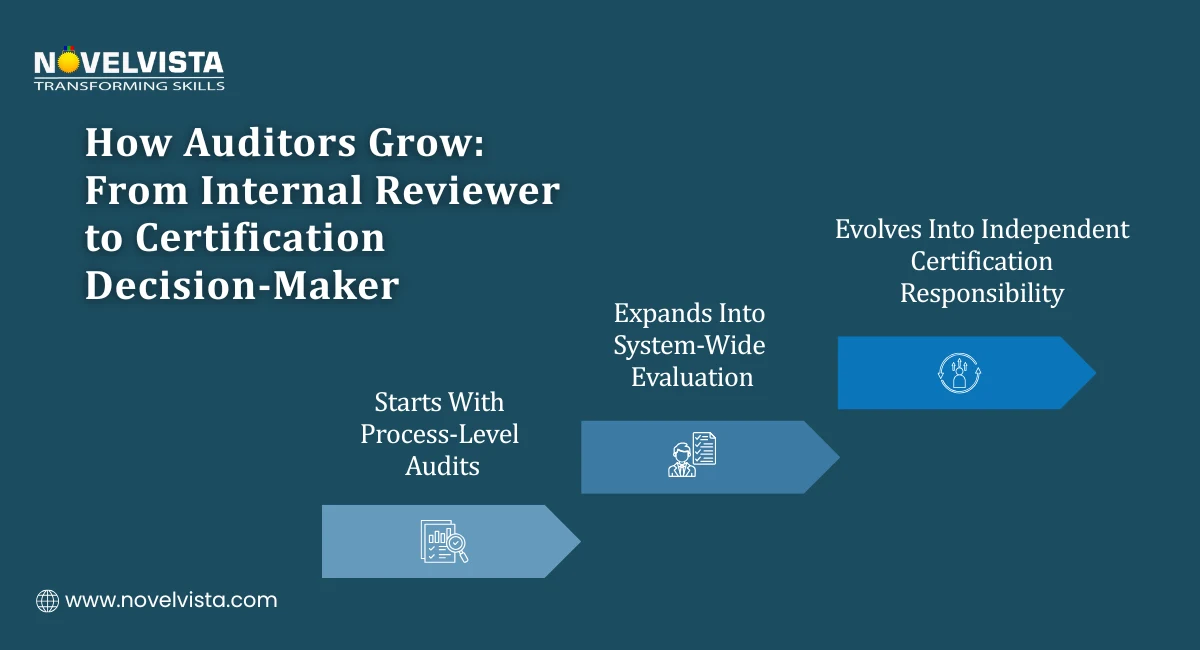
The transition from internal auditor to lead auditor is not simply a change in designation; it’s a shift in professional identity. While many discussions around internal auditor vs lead auditor focus on salary increments or job titles, the deeper distinction lies in expanded authority, elevated accountability, broader organizational impact, and the power to influence certification outcomes.
In today’s competitive compliance environment, understanding this difference is not optional it’s strategic. Let’s break down the five fundamental shifts that define this powerful career leap and help you confidently navigate your auditor career path.
To move forward confidently, we must first clarify the baseline.
An internal auditor evaluates processes within their own organization. They assess whether procedures align with internal policies and standards such as ISO 9001 or ISO 27001.
A lead auditor, however, conducts external certification audits typically under accredited certification bodies and determines whether an organization complies with international standards like ISO 9001 Quality Management Systems.
When comparing an internal auditor vs lead auditor, the biggest distinction is independence and certification authority.
| Internal Auditor | Lead Auditor |
|---|---|
| Conducts first-party audits | Conducts third-party certification audits |
| Reports findings internally | Recommends certification decisions |
| Focuses on improvement | Focuses on conformity and effectiveness |
| Limited organizational authority | External and independent authority |
For many professionals, understanding this distinction defines the next step in their auditor career path.
Internal auditors typically examine whether processes are being followed correctly.
For example, in an ISO 9001 environment, they may check:
A lead auditor goes deeper.
In the internal auditor vs lead auditor comparison, this shift represents moving from operational checking to strategic system evaluation.
Lead auditors assess:
When auditing ISO 9001, a lead auditor does not just verify documentation, they evaluate whether the Quality Management System (QMS) achieves intended outcomes and enhances customer satisfaction.
This requires a broader systems-thinking mindset and alignment with IRCA auditor competency standards.
Internal auditors submit reports with corrective action recommendations.
Lead auditors influence certification outcomes.
In third-party auditor roles, they:
Conduct Stage 1 (documentation review)
Conduct Stage 2 (implementation audit)
Identify major and minor nonconformities
Recommend certification approval or suspension
When discussing internal auditor vs lead auditor, accountability dramatically increases at this stage.
For example, during an ISO 9001 certification audit, a lead auditor’s decision can impact:
A company’s market reputation
Customer trust
Regulatory acceptance
Global competitiveness
The responsibility is no longer advisory, it becomes decisive.
This is why strong ethical conduct and audit impartiality are core to IRCA auditor competency requirements.
Internal audits often focus on individual departments procurement, production, HR, IT, or quality.
Lead auditors assess organization-wide conformity.
When auditing ISO 9001, they evaluate:
Context of the organization
Leadership commitment
Risk and opportunity management
Customer focus
Performance evaluation
In the internal auditor vs lead auditor evolution, this shift is about influence.
Lead auditors conduct:
Opening meetings with top management
Cross-functional interviews
Closing meetings summarizing system effectiveness
They must communicate findings clearly, diplomatically, and confidently.
This requires leadership presence, not just technical knowledge.
As you move forward in your auditor career path, your ability to influence senior management becomes a key differentiator.
Internal auditors often work independently but within a defined company structure.
Lead auditors manage entire audit teams.
They are responsible for:
Audit planning and scheduling
Assigning team roles
Reviewing audit evidence
Ensuring audit objectives are achieved
Maintaining impartiality
In third-party auditor roles, particularly for ISO 9001 certification audits, the lead auditor coordinates technical experts and ensures consistency in audit reporting.
The internal auditor vs lead auditor distinction becomes clear here, as leadership responsibility increases significantly.
IRCA auditor competency frameworks emphasize:
Audit planning expertise
Team coordination skills
Decision-making capability
Professional communication
A lead auditor is accountable for the integrity and credibility of the entire audit process.
Internal auditors ensure compliance within their organization’s internal framework.
Lead auditors validate compliance against globally recognized standards like ISO 9001.
This includes understanding:
Accreditation rules
Certification cycles (3-year cycle)
Surveillance audits
Re-certification audits
In the internal auditor vs lead auditor discussion, this shift represents moving from internal monitoring to global validation.
Lead auditors must remain updated with:
Amendments in ISO standards
International auditing guidelines
Risk-based auditing practices
Their decisions influence how organizations are perceived globally.
This global exposure significantly elevates your auditor career path.
If you're planning to move from internal auditor to lead auditor, follow this structured approach:
ISO 9001 is the foundation of quality management systems and one of the most widely audited standards globally.
Deep clause-level understanding is essential.
Choose accredited programs aligned with IRCA auditor competency frameworks.
Certification bodies require documented audit days and hands-on exposure.
Lead auditors must confidently manage teams and present findings to senior management.
Know the difference between first-party (internal), second-party (supplier), and third-party (certification) audits.
This structured preparation accelerates your growth in the internal auditor vs lead auditor transition.
Among all management system standards, ISO 9001 remains the most globally adopted.
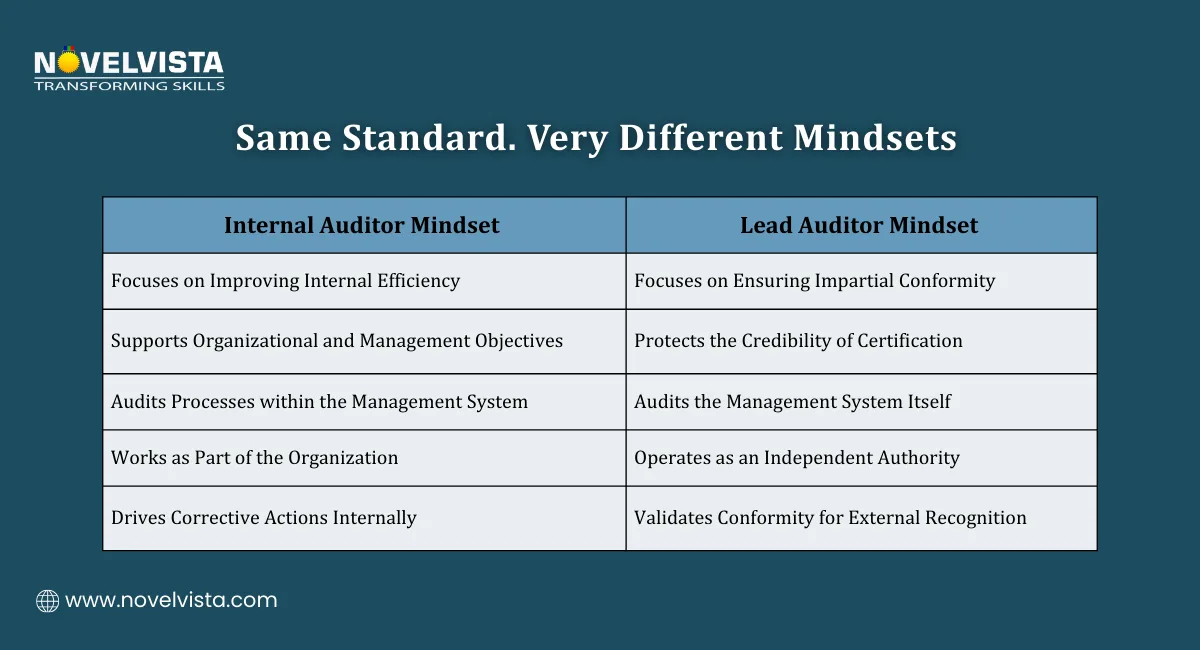
Organizations across manufacturing, IT, healthcare, logistics, and services pursue ISO 9001 certification to demonstrate quality commitment.
As a result:
Demand for ISO 9001 lead auditors remains consistently high
Certification bodies actively seek qualified professionals
Career mobility increases across industries
If you aim to move ahead in the internal auditor vs lead auditor journey, ISO 9001 Lead Auditor certification is one of the most strategic credentials you can pursue.
It not only validates your technical knowledge but also strengthens your credibility for third-party auditor roles. Practicing exam questions for ISO 9001 helps you understand clause interpretation, audit scenarios, and the practical application of quality management principles before attempting the certification exam.
The transition from internal auditor to lead auditor is not just a promotion, it is a professional transformation. It signifies a shift toward greater accountability, sharper strategic vision, stronger leadership presence, and global professional recognition. As a lead auditor, your role moves beyond reviewing processes to validating entire management systems and influencing certification decisions that shape organizational credibility. When you truly understand internal auditor vs lead auditor, the distinction becomes clear: internal auditors improve systems from within, while lead auditors validate them against international benchmarks.
If your ambition is to elevate your auditor career path, expand your influence beyond departmental audits, and step confidently into high-impact third-party auditor roles, then becoming a certified lead auditor is the defining next step, especially in ISO 9001, the world’s most widely adopted quality management standard. The market demand is accelerating, organizations are prioritizing certified expertise, and opportunities are expanding across industries. The only question that remains is not whether the opportunity exists but whether you are ready to rise, lead, and define the next chapter of your auditing career.
If you are ready to move from understanding the difference between an internal auditor vs lead auditor to actually becoming one, it’s time to take structured action.
Join NovelVista’s ISO 9001 Lead Auditor Certification Training and gain in-depth auditing knowledge, real-world case study exposure, and practical insights aligned with global standards. Designed for quality professionals, internal auditors, compliance managers, and aspiring lead auditors, this program equips you with the competencies required to conduct, lead, and manage ISO 9001 certification audits with confidence.
If your goal is to accelerate your auditor career path and successfully transition from internal auditor to lead auditor, this certification can be your defining step.
Start your ISO 9001 Lead Auditor journey today!
Author Details

Confused About Certification?
Get Free Consultation Call
Stay ahead of the curve by tapping into the latest emerging trends and transforming your subscription into a powerful resource. Maximize every feature, unlock exclusive benefits, and ensure you're always one step ahead in your journey to success.