Category | Quality Management
Last Updated On 21/02/2026
Every organization claims to “manage risk,” yet many still treat security risk assessments as a checklist exercise done once a year. That gap between intention and execution is where real problems begin. When security decisions are reactive, controls become scattered, and budgets get wasted.
In enterprise risk training engagements, we consistently see security risk assessments fail when they are treated as annual documentation exercises instead of decision-making tools used throughout the year.
This is where ISO 31000 changes the conversation. It provides structure, consistency, and alignment between business goals and protection efforts. In this guide, we’ll break down how security risk assessments work under ISO 31000 and how they strengthen enterprise-wide decision-making.
Focus Area |
What It Means in Practice |
Core Purpose |
Identify, analyze, and treat security risks consistently |
Framework |
Governance, accountability, integration into business |
Process |
Identify → Analyze → Evaluate → Treat → Monitor |
Business Impact |
Better prioritization and smarter security spending |
Outcome |
Proactive enterprise security risk management |
Modern organizations depend heavily on digital systems. That dependency increases exposure to cyber threats, insider misuse, third-party risks, and operational disruptions.
Well-structured security risk assessments help organizations:
Instead of reacting after incidents occur, companies can anticipate and manage risks earlier. That shift turns isolated checks into structured security and risk management.
ISO 31000 provides the foundation to make that shift sustainable.
At a practical level, security risk assessments are structured evaluations of potential threats and vulnerabilities that could harm information systems or business operations.
ISO 31000 strengthens this by standardizing how risks are described and compared. Instead of scattered spreadsheets, organizations use consistent criteria.
In real assessments we support, the most effective outcomes come when IT teams and business leaders jointly define scope and impact before any technical analysis begins.
In mature organizations, enterprise security risk management does not operate separately from business strategy.
This integration ensures that every IT security risk assessment influences executive decisions, not just IT controls.
When security findings are presented in business language, leadership engagement increases. That alignment strengthens overall security and risk management maturity.
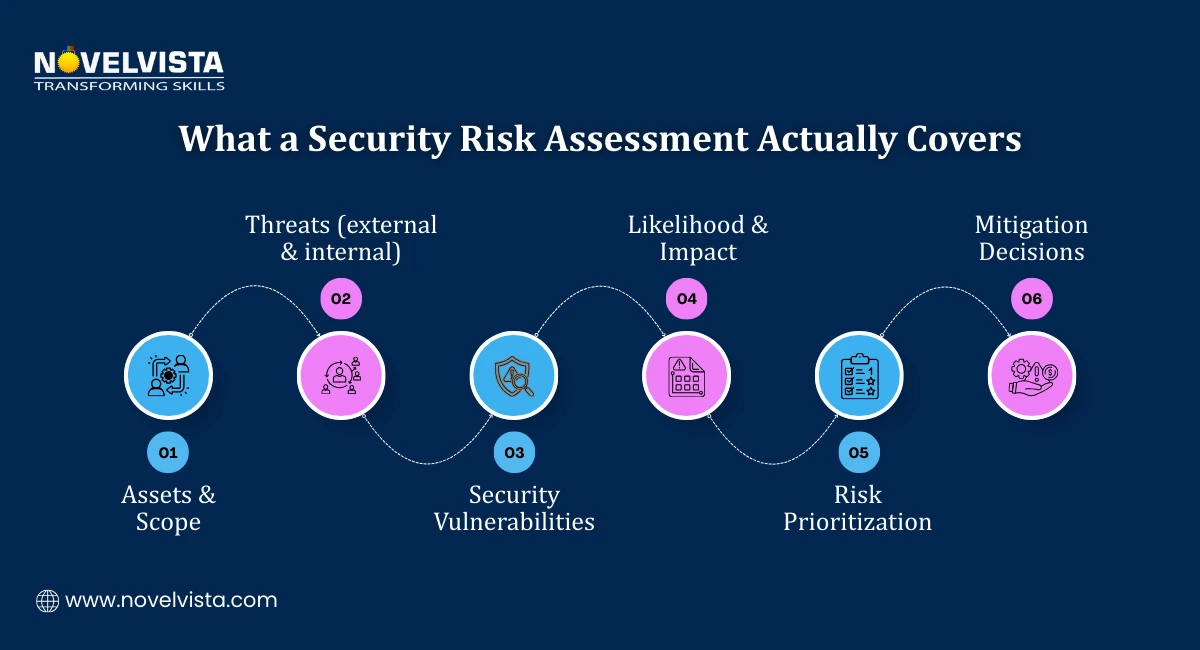
ISO 31000 defines a structured process that makes security risk assessments repeatable and defensible.
Risk discussions should involve IT, compliance, business units, and leadership. Shared understanding reduces blind spots.
This step clarifies:
Without clear criteria, comparisons become inconsistent.
This stage lists threats such as:
It also identifies vulnerabilities like weak authentication or outdated systems.
Here, organizations assess:
Analysis may be qualitative (high/medium/low) or quantitative (financial estimates).
Risks are compared against predefined criteria. High-priority risks move forward for treatment.
Organizations decide whether to:
Treatment can include technical, administrative, or physical safeguards.
This structured flow strengthens both risk and security management and consistency across departments.
For a clear breakdown of principles, steps, and practical application, explore our blog on Comprehensive ISO 31000 Risk Management Process Explained.
Security risks do not stay static. Threats change, systems evolve, and business priorities shift. That’s why security risk assessments must be reviewed regularly, not filed away.
Security risks that are reviewed and reported regularly are far less likely to escalate into unplanned incidents or regulatory findings. Clear reporting ensures risk decisions remain visible and defensible. This step closes the loop and keeps security and risk management active rather than reactive.
ready-to-use templates, scoring models, and checklists
That help risk managers quickly identify, assess, and
Prioritize enterprise risks with confidence.
Organizations apply different types of security risk assessments depending on maturity, size, and risk exposure.
These use simple ratings like high, medium, or low. They work well for early-stage programs or smaller environments.
These estimate the financial impact and likelihood. They are useful for high-value systems and executive-level decisions.
These provide an organization-wide view, supporting enterprise security risk management across IT, operations, and third parties.
ISO 31000 supports all three by providing a consistent structure and language.
ISO 31000 does not replace other standards. It connects them.
Together, they form a unified risk and security management ecosystem. ISO 31000 ensures decisions across these frameworks remain consistent and business-focused.
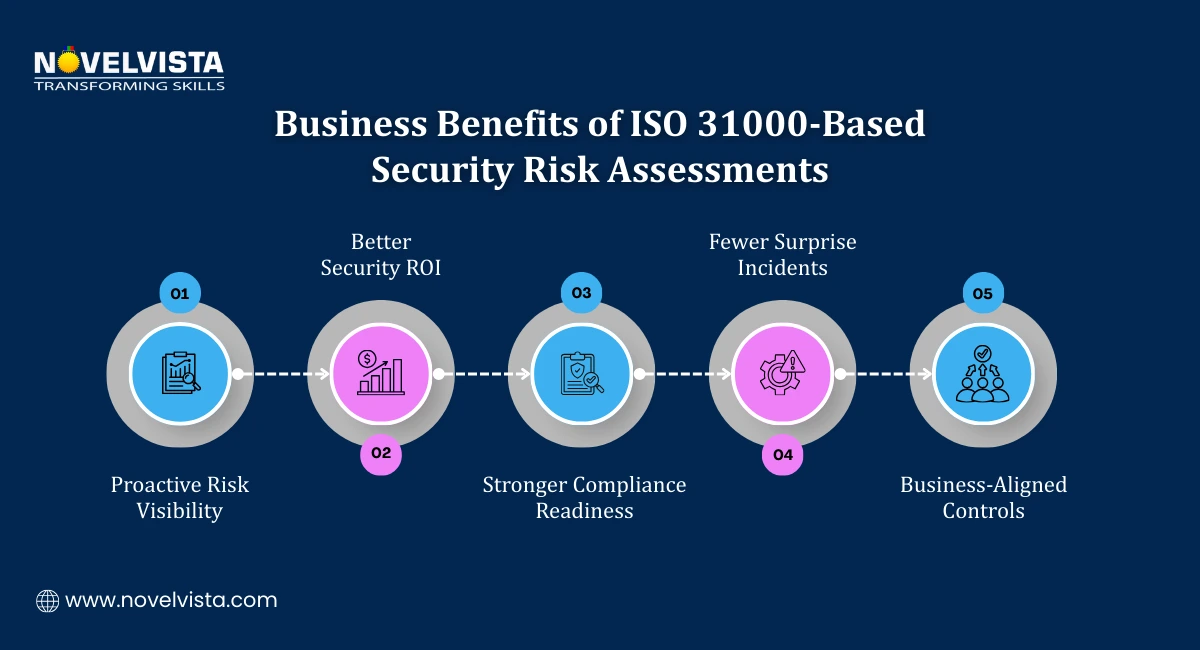
Organizations using ISO 31000-based security risk assessments experience clear advantages:
These benefits turn a security risk assessment into a strategic tool instead of a technical report. Organizations that adopt ISO 31000 typically report clearer justification for security spending and stronger alignment between risk teams and leadership.
To strengthen long-term enterprise security risk management, organizations should:
Consistent application improves maturity and trust in security decisions.
When treated seriously, security risk assessments become a foundation for strong, proactive defense. ISO 31000 helps organizations move beyond isolated checks and build structured, scalable security and risk management.
By integrating its security risk assessment outcomes into enterprise decision-making, organizations shift from reacting to incidents toward building long-term resilience. ISO 31000 provides the clarity and discipline needed to manage security risks today and adapt confidently for the future.
This guidance is based on practical training experience and alignment with internationally recognized risk management principles, not tool-specific or vendor-driven approaches.
Author Details

Confused About Certification?
Get Free Consultation Call
Stay ahead of the curve by tapping into the latest emerging trends and transforming your subscription into a powerful resource. Maximize every feature, unlock exclusive benefits, and ensure you're always one step ahead in your journey to success.