Category | Quality Management
Last Updated On 25/02/2026
Most organizations don’t fail at risk management because they ignore risks. They fail because no one agrees on how much risk is too much. That gap is exactly where risk tolerance in ISO 31000 becomes essential.
In risk management training workshops delivered across finance, IT, and operations teams, we consistently see that more than 60% of escalation delays occur because risk tolerance limits are either unclear or interpreted differently by each department.
When teams lack clear limits, decisions slow down, escalations turn subjective, and similar risks get treated very differently across departments. This article explains what risk tolerance really means, how ISO 31000 uses it, and how organizations turn strategy into clear, measurable boundaries.
Area |
What It Means in Practice |
Risk Tolerance |
Acceptable variation after risk treatment |
Purpose |
Set clear decision boundaries |
ISO 31000 Role |
Part of the risk criteria, not optional |
Key Benefit |
Consistent, faster decisions |
Common Gap |
Limits are defined vaguely or not at all |
Clear ISO 31000 risk tolerance turns abstract risk discussions into measurable, actionable limits.
Risk tolerance in ISO 31000 defines how much variation an organization is willing to accept after controls are applied. It is not about ambition or growth plans. It is about limits.
These limits help organizations:
ISO 31000 risk tolerance links directly to organizational objectives and risk criteria. Without it, risk management becomes opinion-based instead of evidence-based.
Even Aon's 2025 Global Risk Management Survey finds over 60% of leaders face accountability issues from unclear risk limits, echoing inconsistent treatment themes.
The definition of risk tolerance, as per ISO Guide 73, is:
An organization’s readiness to bear risk after risk treatment in pursuit of its objectives.
This definition highlights three important points:
Unlike high-level intent statements, risk tolerance is operational and measurable.
Earlier versions of ISO 31000 (notably the 2009 edition) used the term risk attitude. That describes how an organization generally approaches risk. Today, risk tolerance in ISO 31000 focuses on specific limits that guide real decisions.
This practical focus is what makes ISO 31000 risk tolerance usable on the ground.
Understanding risk appetite vs risk tolerance is one of the most common pain points in audits and workshops. In practical risk calibration sessions, nearly 7 out of 10 professionals initially confuse risk appetite with risk tolerance, leading to policies that describe ambition but fail to guide real operational decisions.
Example:
Entering a new market despite uncertainty.
Example:
Limiting financial loss to less than 10% of the project budget.
In simple terms:
Confusing risk appetite vs risk tolerance often leads to vague statements that look good on paper but fail during real decisions.
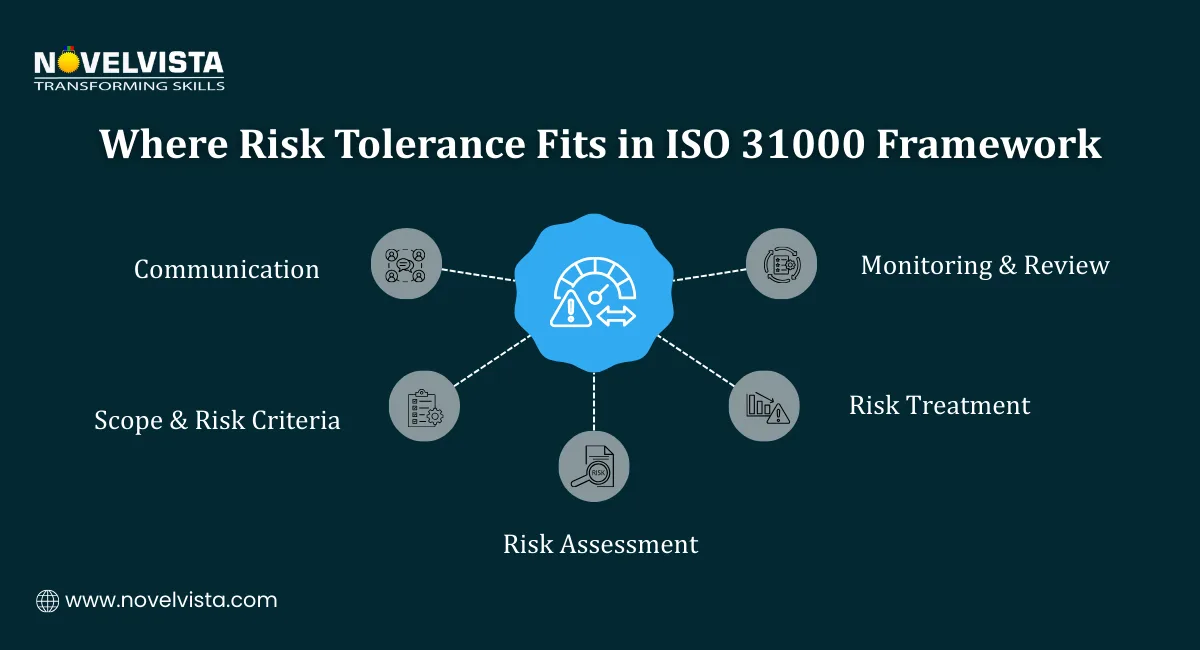
ISO 31000 embeds tolerance directly into risk criteria, not as a separate step.
The framework includes:
Organizations are expected to:
This is where ISO 31000 risk tolerance becomes visible during assessments and audits. Clear tolerance levels improve transparency, speed up decisions, and reduce debate.
Without a defined tolerance, escalation thresholds remain unclear and inconsistent.
Risk tolerance becomes useful only when it is measurable.
Typical tolerance limits include:
When these limits are exceeded:
Effective risk tolerance in ISO 31000 is not static. Limits must evolve when:
Clear boundaries turn strategy into daily guidance.
Applying risk tolerance in ISO 31000 is where many organizations either gain clarity or fall back into vague risk talk. The difference lies in turning limits into everyday decision rules.
In practice, organizations apply ISO 31000 risk tolerance by:
An organization may have a moderate-to-high appetite for growth. That does not mean unlimited exposure.
Instead:
Across enterprise case discussions, teams that define numerical tolerance limits (time, cost, performance) report noticeably fewer disputes during risk reviews and faster sign-off from leadership.
Defining effective tolerance levels is not guesswork. It follows a structured approach.
Key steps include:
Stakeholder consultation: Involving leadership, finance, operations, and risk owners ensures alignment.
Evaluating risk dimensions: Financial, operational, legal, reputational, and even psychological impacts must be considered.
Context-based limits: Tolerance levels should reflect business size, maturity, and external pressures.
Organizations that follow these steps report clearer accountability and fewer disputes. Data shows that 85% of firms using ISO 31000 improved decision-making consistency after adopting structured tolerance levels.
Despite its importance, many organizations struggle with implementation.
Common challenges include:
Vague criteria: Poorly defined limits cause around 41% of risk oversights.
Missing metrics: A lot of enterprises still lack measurable tolerance thresholds.
Human error and bias: Around 25% of risk criteria failures come from inconsistent judgment.
Without measurable limits, escalation becomes subjective. Teams argue whether a risk is “acceptable,” rather than checking whether it crossed a defined boundary.
These challenges are not theoretical. They are repeatedly observed during ISO 31000 maturity assessments where tolerance exists in policy documents but is not applied consistently in decision logs or escalation records.
This is where risk tolerance in ISO 31000 often exists on paper but fails in practice.
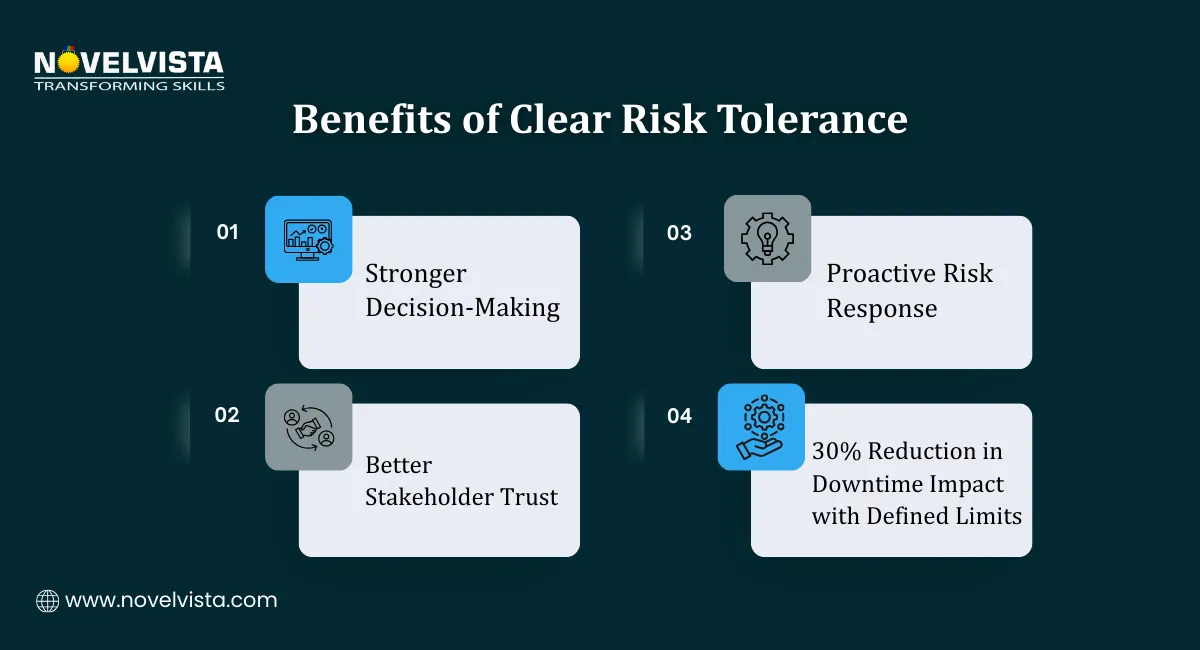
When properly defined and applied, ISO 31000 risk tolerance delivers real value.
Key benefits include:
Organizations with defined tolerance levels report:
Clear risk tolerance in ISO 31000 shifts risk conversations from opinion-based debates to measurable facts.
Concept |
Definition |
ISO 31000 Role |
Example |
Risk Appetite |
Risks an organization is willing to pursue |
Strategic direction |
Enter new markets |
Risk Tolerance |
Acceptable variation after treatment |
Operational boundaries |
<10% budget loss |
Risk Attitude |
General approach to risk (2009 term) |
Behavioral orientation |
Pursue with controls |
Understanding risk appetite vs risk tolerance through this lens prevents confusion and strengthens governance.
Risk strategy without limits leads to inconsistency. Limits without structure lead to confusion. Risk tolerance in ISO 31000 bridges that gap.
While appetite sets ambition, tolerance defines control. Organizations that formalize risk tolerance in ISO 31000 make faster, clearer, and more consistent decisions, especially during uncertainty.
The insights shared here are drawn from structured ISO 31000 training programs, real organizational risk assessments, and practical governance reviews, not from theoretical interpretations of the standard.

If you want to apply risk tolerance and decision limits with confidence, NovelVista’s ISO 31000 Risk Manager Certification Training offers practical, hands-on learning aligned with real business scenarios. The course helps professionals design risk criteria, define tolerance levels, support leadership decisions, and embed ISO 31000 across the organization. It’s ideal for managers and risk practitioners looking to move from theory to consistent, measurable risk management.
Author Details

Confused About Certification?
Get Free Consultation Call
Stay ahead of the curve by tapping into the latest emerging trends and transforming your subscription into a powerful resource. Maximize every feature, unlock exclusive benefits, and ensure you're always one step ahead in your journey to success.