Category | Quality Management
Last Updated On 22/07/2026
If you've been searching for the cost of ISO 31000, you've probably noticed the frustrating part already: no two sources seem to agree. One site quotes one figure, another lists something completely different, and none of them explain why. So the simple question you came here with — how much does ISO 31000 actually cost in 2026? — somehow stays unanswered.
Here's why the numbers jump around so much: ISO 31000 pricing depends on what you're actually paying for. Training versus the exam, self-paced versus instructor-led, your region, your provider, and any extras bundled in — each of these shifts the total. That's exactly what makes budgeting harder than it should be.
This guide clears that up. We break down every part of the cost — training, exam, certification, and the hidden extras — so you walk away with a realistic figure and can plan your investment with confidence.
Here's the honest picture. Your total comes down to one main cost — training and the exam — plus a few extras worth planning for so nothing catches you off guard later.
This is the bulk of what you'll pay, and it usually bundles your structured learning sessions with exam access.
In India, you'll most often see ISO 31000 Risk Management fees land around ₹30,000 – ₹35,000. Just know that what's inside that figure can differ between providers — so it's worth checking exactly what your fee covers before you commit.
Globally, the ISO 31000 Risk Manager fee sits around $400 – $500, and pricing stays fairly consistent wherever you are.
None of these are hidden — but knowing them upfront means your final number won't surprise you.
Study materials. Some providers fold these into your fee; others charge separately, which can add ₹4,000 – ₹7,000. Think digital guides, printed books, reference standards, and practice exercises — genuinely useful for prep, but they do nudge the total up.
Travel & accommodation (only if your training is in-person and out of town). If the session isn't in your city, factor in travel, hotel, and meals, usually ₹5,000 – ₹15,000 depending on distance and how many days you're there.
For example: heading from Pune to Chennai for a two-day workshop might add roughly ₹8,000 – ₹12,000.
Renewal / re-validation. Good news — ISO 31000 itself doesn't expire. That said, many providers suggest re-validating every few years so your knowledge keeps pace with how risk practices evolve. The fee varies by provider.
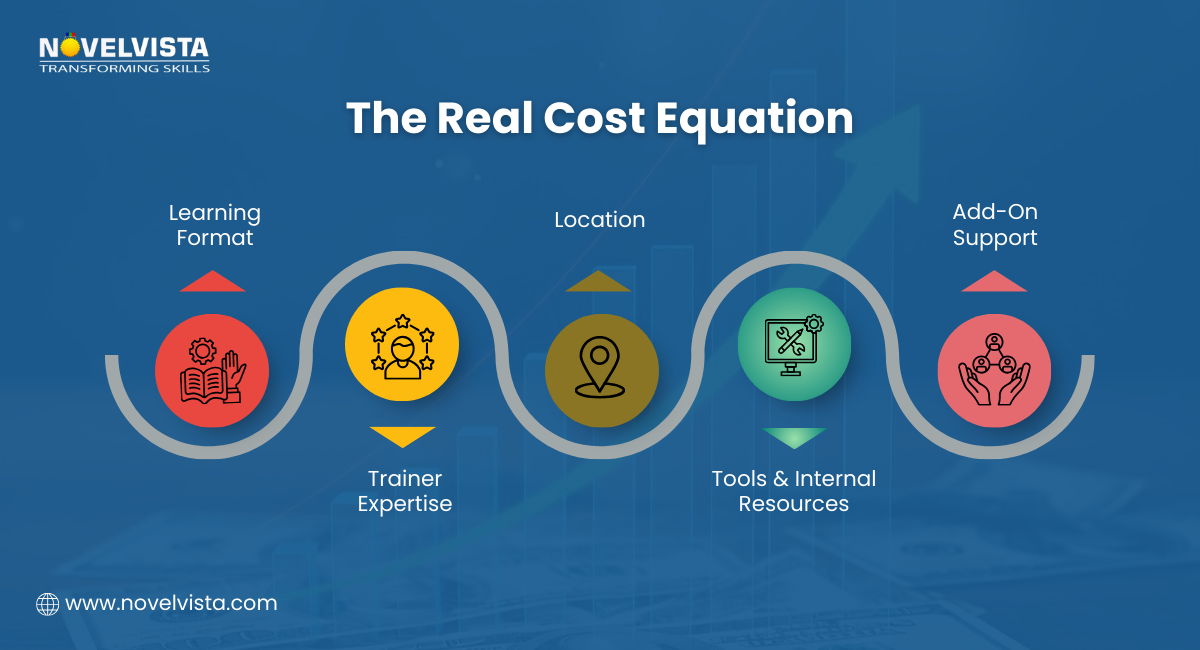
If you've noticed ISO 31000 costs jumping around from site to site, it's not random — a handful of practical factors decide where your final number lands. Once you know them, you can usually predict which end of the range you'll fall on.
1. How you learn: online vs. in-person
Online is usually the more economical route, generally ₹30,000–₹40,000. Where you land within that depends on a few things worth checking before you book:
- Course duration
- Who's teaching (instructor experience)
- Live sessions vs. self-paced
- Whether you get recordings to revisit
- Included practice modules
In-person trades a bit of convenience for a more immersive, hands-on experience — you're in the room, asking questions in real time, learning alongside others. It runs ₹30,000–₹40,000, and where you land often depends on the city.
For example, a two-day program in a metro like Mumbai or Bengaluru tends to sit at the higher end, simply because running an event in a major city costs more.2. Where your provider is based
Location moves the price more than most people expect. Metro hubs like Mumbai, Bengaluru, and Delhi usually run higher — more demand, higher overheads — which lifts the overall ISO 31000 price in India. Smaller and non-metro providers are often noticeably friendlier on budget. International programs, meanwhile, may charge a premium for global branding or accreditation — worth it if that recognition matters for your career or region.
3. How much support you want
This is the factor you actually control. Some providers bundle in extra help to get you exam-ready:
- Mock exams
- Extra practice sessions
- Case study workshops
- Q&A forums
- One-on-one mentoring
Expect these to add ₹5,000–₹10,000, depending on how much hand-holding you want. And it's not money spent for a certificate's sake — this is the support that builds real fluency in the ISO 31000 risk management process, so you walk away actually able to identify, assess, and treat risk, not just pass a test.
Get a clear breakdown of every cost that matters
Avoid hidden expenses with simple, practical insights
Plan your certification journey with confidence and clarity
Here's where a lot of budgets go wrong. Most people add up the training fee and the exam fee, call it a total, and move on. That works fine if you're certifying yourself. But if you're rolling ISO 31000 out across a team or an organization, there's a second layer of cost that rarely shows up in the brochure — and it's the part that surprises people later.
1. Your team's time is a real cost
This is the big one nobody puts on the invoice. Making ISO 31000 work means your people actually doing it — running risk assessments, sitting in workshops, reviewing documentation, building out the framework. Every one of those hours is an hour they're not spending on their day job.
In a busy team, that trade-off is real: the analyst mapping risks this week is the same analyst who'd otherwise be closing the quarter. It won't show up as a line item, but it's a genuine cost — and worth naming honestly when you're planning capacity, so the rollout doesn't quietly stall because everyone's "too busy."
2. It's not one-and-done
ISO 31000 is built around continuous improvement, which is a polite way of saying: your risk processes need to keep up as your business changes. In practice that means periodic internal audits, refresher sessions, process tweaks, and onboarding each new hire into the framework.
Budget roughly ₹5,000–₹15,000 per year for this upkeep. It's modest, but it's ongoing — and forecasting it now means the program stays alive instead of fading the moment the initial excitement wears off.
Seeing these hidden pieces is exactly what separates a realistic ISO 31000 budget from an optimistic one. And it's easier to plan for once you see how each cost maps onto the broader ISO 31000 model — because then every rupee is clearly buying you a stronger, more structured way of managing risk, not just a certificate on the wall.
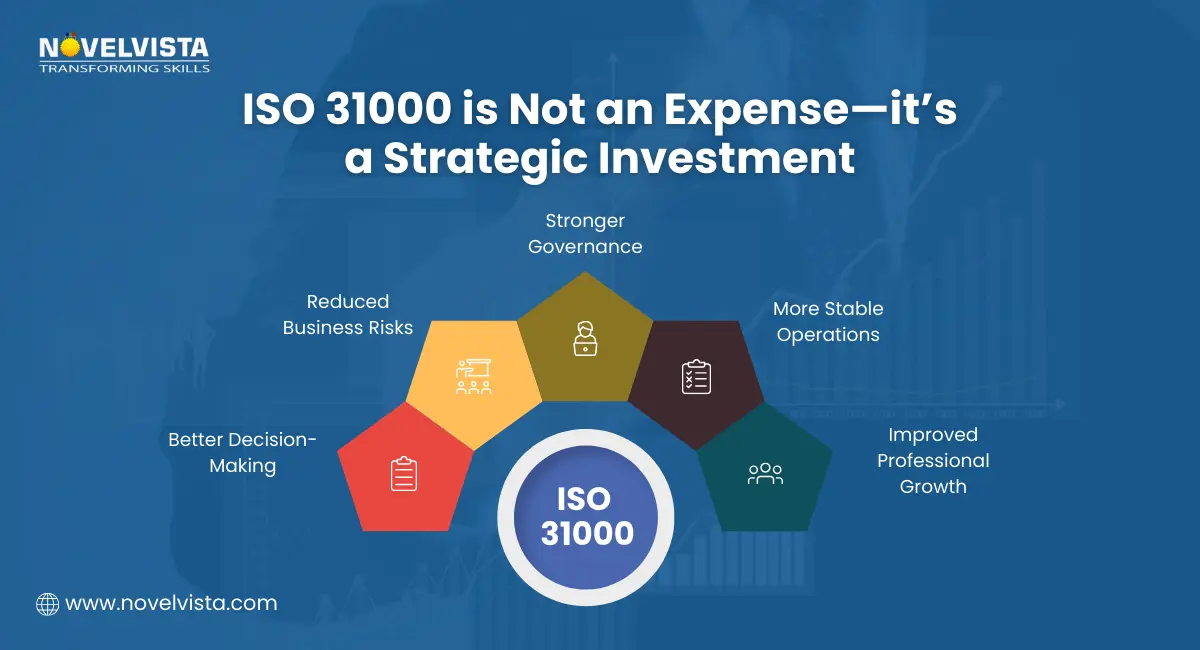
You've seen the full picture now — so here's the good news. A little planning can meaningfully lower what you actually pay, without cutting into the learning that matters.
1. Book early
This is the easiest saving to grab. Most providers run early-bird pricing, so locking in your slot a few weeks ahead — rather than signing up at the last minute — can trim a noticeable chunk off the fee. The catch is simply that these rates are time-limited, so the earlier you decide, the more there is to save.
2. Enrol as a group
If you're certifying more than one person, don't book them separately. Providers almost always offer better per-person pricing for teams, and bulk enrollment is the single most effective way to bring down the cost per participant. Even a small group of three or four is usually enough to unlock a better rate — so it's worth asking before anyone books individually.
Is It Worth the Cost?
It's worth stepping back from the rupees for a second, because ISO 31000 was never really about passing an exam — it's about building the ability to see risk coming and handle it well. That's where the money quietly pays itself back: fewer nasty surprises, sharper planning, steadier operations, and for individuals, a real edge in your career. Seen that way, the fee stops looking like a cost and starts looking like the cheapest part of the whole equation.
Your all-in checklist
Before you commit, make sure your budget accounts for: the core training + exam fee, study materials, travel (only if you're going in-person), any add-on support you want, and the small recurring upkeep if you're rolling it out across a team. Tick those five off and there are no surprises left.
The overall ISO 31000 compliance fees in 2026 depend on your chosen format, provider, location, and support needs. By reviewing the iso 31000 risk management pricing in India, you can budget with clarity and avoid unexpected expenses.
When you factor in materials, travel, tools, internal effort, and ongoing updates, the financial picture becomes clearer and easier to plan for. With smart choices like early enrollment and group discounts, the investment becomes more manageable and delivers long-term value.
ISO 31000 isn’t just a Price; it’s a practical investment in better decision-making and stronger risk resilience.
Turn Risk Into Your Advantage
Everything you've just read comes down to one decision: do you want to understand ISO 31000, or do you want to be the person in the room who can actually lead with it?
NovelVista's ISO 31000 Risk Manager Certification Training is built for the second kind of professional. You won't just memorise a framework for an exam — you'll walk out able to spot risk before it becomes a problem, make sharper decisions under pressure, and carry a credential that tells employers you can be trusted with it.
Here's what you're stepping into:
The professionals who move ahead aren't the ones who knew about risk management. They're the ones who got certified, got confident, and got recognised for it.
Explore the Certification →

Author Details

Confused About Certification?
Get Free Consultation Call
Stay ahead of the curve by tapping into the latest emerging trends and transforming your subscription into a powerful resource. Maximize every feature, unlock exclusive benefits, and ensure you're always one step ahead in your journey to success.