Category | Quality Management
Last Updated On 08/05/2026
Artificial Intelligence has moved from innovation labs to the core of business strategy. Today, it powers everything from real-time decision-making and predictive analytics to customer experience and risk management. In fact, recent industry insights suggest that more than 80% of enterprises are actively investing in or scaling AI systems across their operations. But as AI adoption accelerates, so do the risks unexplained decisions, hidden bias, lack of accountability, and increasing regulatory scrutiny.
As an auditor, the first thing I look for isn't the policy document itself, but how the policy's objectives permeate the organization. If the policy isn't known by the developers and product teams, you've already failed Clause 5.2
This is where Clause 5.2 of ISO/IEC 42001 steps in as a defining control point.
Organizations are no longer asking whether to adopt AI they are under pressure to prove that their AI is governed responsibly, ethically, and transparently. Without a clear framework, AI can quickly shift from a competitive advantage to a compliance and reputational risk.
This raises some critical questions for business leaders and AI practitioners alike:
In this blog, we will unpack Clause 5.2 of ISO/IEC 42001 in a practical and structured way, helping you understand how to establish strong AI governance, align leadership responsibilities, and build a policy framework that supports both innovation and compliance.
ISO/IEC 42001 is the world’s first international standard specifically designed for AI Management Systems. It provides a structured framework for organizations to manage AI responsibly across its lifecycle, from design to deployment and monitoring.
At its core, the standard ensures that AI systems are:
Unlike traditional IT governance frameworks, ISO/IEC 42001 focuses specifically on the unique risks and complexities of AI systems, such as algorithmic bias, data dependency, and autonomous decision-making.
A key foundation of this standard is the AI management system policy, which sets the tone for how AI is governed across the organization.
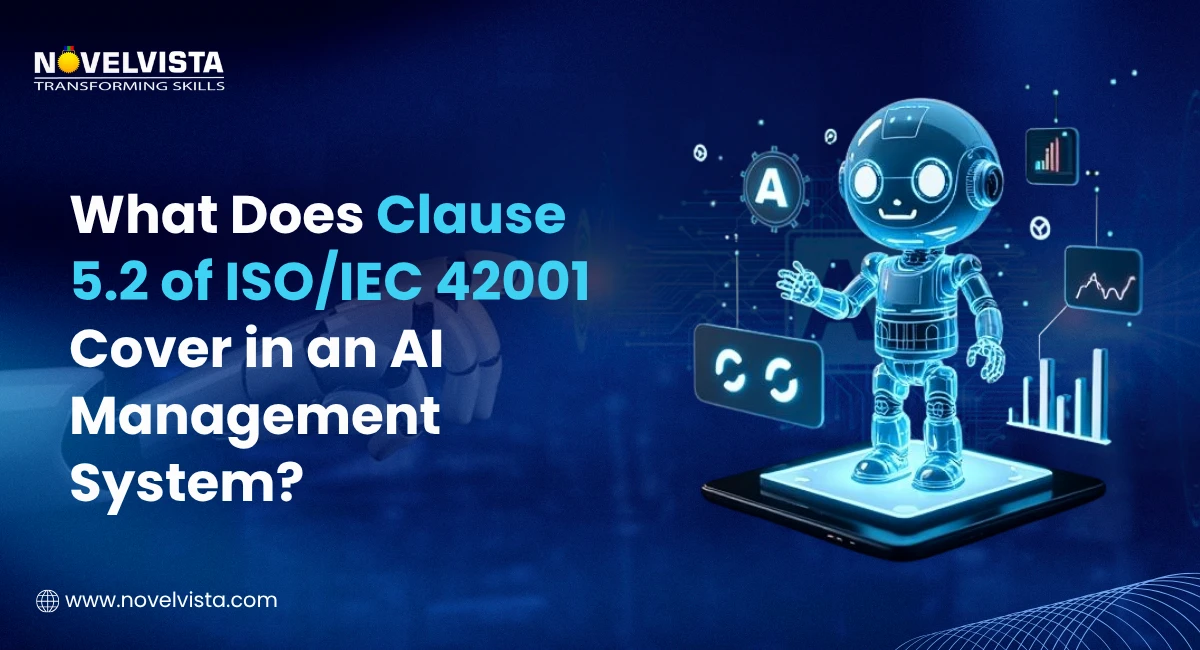
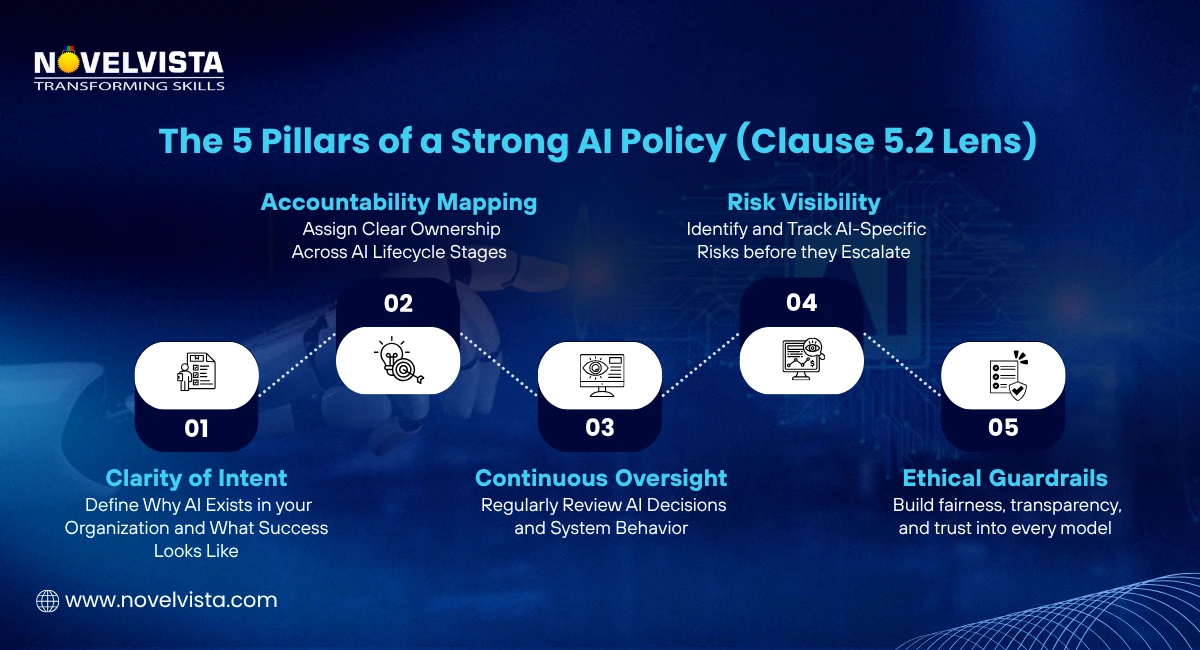
Clause 5.2 is one of the most important leadership-related requirements in ISO/IEC 42001. It focuses on establishing, maintaining, and communicating an organizational policy for AI management.
In simple terms, it requires organizations to define a clear AI management system policy that guides how AI is developed, deployed, and monitored.
This policy must:
The purpose of Clause 5.2 is not just documentation it is about setting a leadership-driven direction for AI governance.
Without a structured policy, organizations risk fragmented AI usage, inconsistent decision-making, and increased exposure to regulatory and ethical risks.
The ISO 42001 AI policy requirements are designed to ensure that organizations establish a formal and actionable framework for AI governance.
A compliant AI policy must include:
Organizations must clearly define why AI is being used and where it applies. This includes internal operations, customer-facing systems, and automated decision-making processes.
The policy must include how AI-related risks such as bias, hallucination, or data misuse are identified and controlled.
Organizations must ensure their AI systems comply with applicable laws, industry regulations, and ethical guidelines.
Clear rules must be defined for data usage, data quality, and explainability of AI outputs.
Auditor’s Evidence Checklist: Proving Compliance for Clause 5.2
| Policy Requirement | What an Auditor Expects to See (Evidence) |
| Purpose & Scope | A clear AI Register defines which systems are included and which are excluded, along with the reasons for those exclusions. |
| Risk Management | A documented link to the AI Risk Treatment Plan showing risks are formally assessed and managed. |
| Compliance | A "Regulatory Landscape" map. Maintain a list of applicable laws (e.g., EU AI Act, NIST AI RMF, local data privacy laws) and how they map to your specific AI controls. |
| Data Governance | Proof of data lineage and explainability, showing data quality checks and transparent output validation. |
These requirements ensure that AI systems are not only efficient but also safe, transparent, and aligned with organizational accountability standards.
A critical element of Clause 5.2 is the role of leadership in AI management. ISO/IEC 42001 places responsibility directly on top management to define and support the AI governance framework.
Leadership must ensure that:
Without leadership involvement, AI governance often becomes fragmented and ineffective.
Strong leadership ensures that AI is not just a technical initiative but a strategic business capability. It also reinforces trust, accountability, and long-term sustainability in AI adoption.
While leadership can delegate the day-to-day management of AI systems to a Head of AI or Data Governance Officer, the ultimate accountability for the policy remains with top management. They must demonstrate 'active engagement'—usually evidenced by signed-off management review minutes.
One of the most important aspects of Clause 5.2 is embedding ethics into AI governance. The AI ethics and compliance policy ensures that AI systems operate in a fair, transparent, and accountable manner.
Key ethical principles include:
Compliance is equally important, as organizations must align AI usage with global and regional regulatory frameworks.
When ethics and compliance are integrated into the AI policy, organizations build trust not only with regulators but also with customers and stakeholders. Practicing with real-world ISO 42001 Exam Questions can help you better understand AI governance concepts, policy requirements, and leadership responsibilities outlined in the standard.
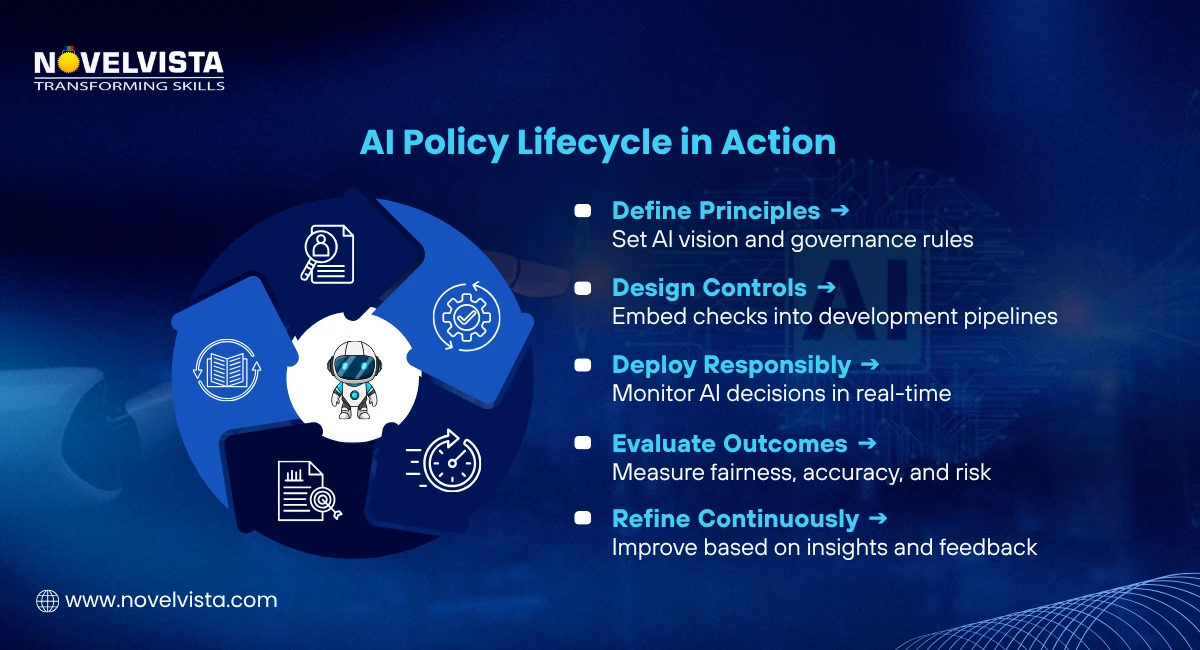
Many organizations fail their audits by treating Clause 5.2 as a "set-and-forget" documentation task. In reality, an effective AI policy is a living document that operates within the PDCA (Plan-Do-Check-Act) cycle. By mapping your policy implementation to this cycle, you ensure that AI governance is not just a document, but a repeatable, verifiable operational process.
Use this framework to align your AI governance activities with auditor expectations:
| Phase | Clause 5.2 Action | Auditor Goal |
| Plan | Establishing the Policy & Objectives | Does the policy align with your organization’s long-term AI strategy and risk appetite? |
| Do | Communicating & Training | Is there tangible proof of policy awareness among developers, legal, and operational teams? |
| Check | Monitoring Policy Metrics | Are your Key Performance Indicators (KPIs) tied directly to the policy's stated objectives? |
| Act | Reviewing & Updating | How does the policy evolve? Auditors look for updates following major AI incidents or technological shifts. |
Implementation is not the finish line. The true test of a robust AI Management System is how the 'Act' phase feeds back into the 'Plan' phase. When your policy is updated based on real-world incident data or internal audit findings, you demonstrate that your governance framework is not just compliant—it is mature.
Organizations that implement Clause 5.2 effectively experience several benefits:
In the long term, compliance also improves brand reputation and stakeholder confidence.
Despite its importance, organizations often face challenges such as:
Overcoming these challenges requires a structured governance culture and continuous leadership engagement. Strengthen your preparation with a practical ISO 42001 Exam Strategy Guide that helps you align concepts like AI governance, policy requirements, and leadership responsibilities for certification success.
To ensure successful implementation of Clause 5.2, organizations should follow these best practices:
These practices ensure that AI governance remains practical, scalable, and future-ready.
The "Static Document" Trap: Policies created at certification time and never revisited.
Lack of Integration: Treating AI policy as a separate silo from existing ISO 27001 (Security) or ISO 9001 (Quality) policies.
Generic Language: Using "corporate-speak" rather than specifics related to the organization's unique AI lifecycle.
Clause 5.2 of ISO/IEC 42001 goes far beyond a checkbox for compliance it defines how organizations bring discipline, accountability, and intent into their AI journey. By establishing a well-defined AI management system policy, businesses create a unified direction for how AI is designed, deployed, and governed across the enterprise.
More importantly, it reinforces the role of leadership in AI management, ensuring that AI is not left solely to technical teams but is guided by strategic oversight and organizational responsibility. When combined with a strong AI ethics and compliance policy, this approach helps organizations move from fragmented AI adoption to a model that is transparent, auditable, and aligned with both regulatory expectations and stakeholder trust.
As AI continues to influence critical business decisions, the real differentiator will not just be how advanced your AI systems are but how responsibly they are managed. Clause 5.2 provides the structure to achieve exactly that, enabling organizations to scale innovation with confidence, without compromising on ethics, compliance, or accountability.
Ready to take the lead in AI governance and compliance?
Join NovelVista’s ISO/IEC 42001 Lead Auditor Certification Training and gain hands-on expertise in auditing AI management systems, implementing ISO 42001 AI policy requirements, and strengthening your organization’s approach to ethical AI. Designed for professionals looking to master the role of leadership in AI management and build robust AI ethics and compliance policy frameworks, this course equips you with practical skills and globally recognized credentials to lead with confidence.
Start your ISO/IEC 42001 auditor journey today!
Author Details

Confused About Certification?
Get Free Consultation Call
Stay ahead of the curve by tapping into the latest emerging trends and transforming your subscription into a powerful resource. Maximize every feature, unlock exclusive benefits, and ensure you're always one step ahead in your journey to success.