Category | Quality Management
Last Updated On 20/03/2026
Processes break down. Waste builds up. Teams work harder, but results stay the same. Most organizations know something is inefficient but struggle to pinpoint exactly where and why.
Lean Tools give you a structured way to find those problems, fix them, and keep improving over time. They are used across manufacturing, healthcare, IT, and project management to cut waste, speed up workflows, and build consistency into how work gets done.
This guide covers the most important Lean tools across manufacturing, Six Sigma, management, and process improvement, with real stats, clear explanations, and practical context for each one.
| Topic | Key Point |
| What are Lean Tools | Structured techniques to eliminate waste and drive continuous improvement |
| Efficiency impact | 67% of manufacturers using Lean tools achieved 20 to 30% efficiency gains in 2024 |
| VSM benefit | Value Stream Mapping reduces lead times by 15 to 25% |
| JIT impact | Just-in-Time reduces inventory levels by up to 50% |
| OEE benchmark | Leading companies achieve 85% OEE using Six Sigma and Lean Tools |
| SMED goal | Reduce equipment changeover times to under 10 minutes |
| Kanban and VSM combined | 25% improvement in throughput reported in recent benchmarks |
| Industries covered | Manufacturing, construction, software, healthcare, and IT services |
Most efficiency problems in organizations are not caused by a lack of effort. They are caused by processes that were never properly designed or have not been reviewed in years.
In our Lean training programs, over 60% of participants identify at least one critical process bottleneck within the first week of applying basic Lean assessment techniques.
Lean Tools are structured techniques built to solve exactly that. They help teams identify waste, understand where it comes from, and put practical fixes in place that stick over time.
The four main categories used today are:
Industry data backs up the value. According to recent reports, 67% of manufacturers using Lean tools in 2024 achieved 20 to 30% efficiency improvements. That is not a marginal gain. It is a structural shift in how well an organization operates.
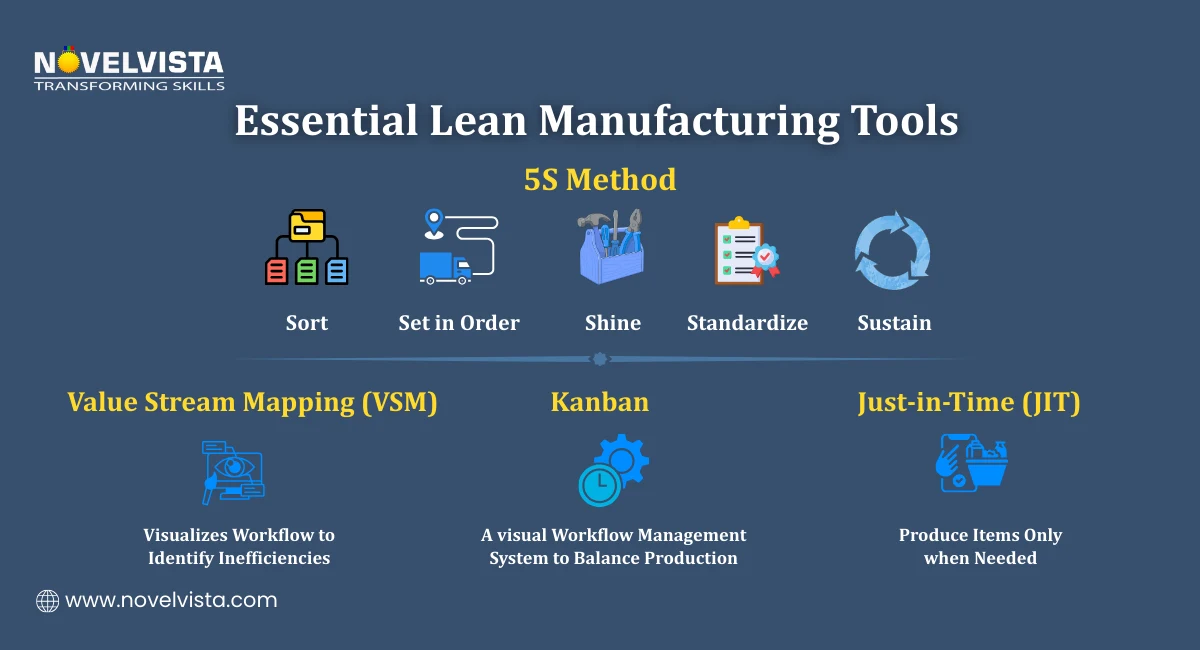
Lean Manufacturing Tools are the foundation of the Lean methodology. Originally developed for production environments, they are now applied across industries wherever process waste is a problem.
The 5S framework is one of the most widely used Lean Tools for workplace organization. It follows five clear steps:
Why it works:
In workplace audits we conduct, 5S implementation alone reduces search and retrieval time by 20–30% within the first month when properly sustained.
VSM gives teams a visual picture of their entire workflow from start to finish. Every step, every handoff, and every delay gets mapped out so inefficiencies become visible at a glance.
Key facts:
Kanban uses visual signals to control the flow of work through a process. It prevents overproduction by ensuring new work only starts when there is actual capacity to handle it.
How it helps:
Teams we train typically achieve improved workflow predictability within 2–3 sprint cycles after introducing Kanban-based work-in-progress limits.
JIT means items are produced or procured only when they are actually needed. Nothing sits waiting. Nothing is made ahead of demand.
Impact:
Where Lean Manufacturing Tools focus on speed and waste elimination, Lean Six Sigma Tools add a layer of quality control. They reduce defects and process variation, not just speed things up.
Poka-Yoke designs processes so that mistakes are physically impossible or immediately obvious. The process itself prevents errors rather than relying on people to catch them.
Key benefits:
In quality improvement projects, simple Poka-Yoke implementations have reduced recurring defects by over 40% without increasing inspection effort.
Simple example: A USB connector that only fits one way is a basic Poka-Yoke. In manufacturing, it could be a jig that prevents a component from being installed incorrectly.
SMED is designed to reduce equipment changeover times to under ten minutes.
Why it matters:
Jidoka gives machines the ability to detect defects and stop automatically when something goes wrong.
How it works:
Result: Defects are caught early when they are cheap to fix rather than reaching the customer when they are expensive.
OEE measures how productively equipment is being used compared to its theoretical maximum. It tracks three factors:
Benchmark: Leading companies using Six Sigma and Lean Tools together consistently achieve 85% OEE. For most organizations, closing the gap between current performance and that benchmark represents a significant productivity gain.
In operational audits, most organizations start with OEE levels between 50–65%, highlighting significant improvement potential before reaching the 85% benchmark.
Learn how to apply Lean tools like 5S, VSM, Kanban, and SMED with step-by-step
guidance to eliminate waste, improve flow, and achieve measurable operational results.
Lean Management Tools focus on how teams are led, how problems are identified, and how improvement becomes part of everyday work rather than a periodic initiative.
Kaizen is the practice of making small, consistent improvements rather than waiting for major overhauls.
Core principles:
Gemba means "the actual place" in Japanese. A Gemba Walk means managers observe work directly where it happens rather than reviewing reports from a distance.
What it achieves:
In leadership training sessions, regular Gemba walks reduce reporting gaps and improve issue identification accuracy by nearly 35% within the first quarter.
Standardized Work documents the best-known way to perform a task and makes it the consistent standard across the team.
Benefits:
The 5 Whys is one of the most practical Lean Problem Solving Tools used across every industry. When a problem occurs, you ask "Why?" repeatedly until you reach the actual root cause rather than a surface symptom.
Example walkthrough:
| Step | Question and Answer |
| Problem | The machine stops working |
| Why 1 | A fuse blew |
| Why 2 | The motor was overloaded |
| Why 3 | Running beyond rated capacity |
| Why 4 | A maintenance change altered the load |
| Why 5 | The change was not reviewed against equipment specs |
Real fix: Review the change management process, not just replace the fuse. That is exactly what Lean Problem Solving Tools like the 5 Whys reveal.
Once the foundational Lean Tools are in place, organizations start looking at more advanced techniques that drive deeper efficiency gains. These Lean Process Improvement Tools are designed for teams that have already built a basic Lean practice and want to take it further.
At a foundational level, OEE measures equipment productivity. At an advanced level, it becomes a continuous improvement driver.
How mature teams use OEE:
Why it matters at this level:
Basic SMED reduces changeover times. Advanced SMED embeds that speed into the production system at scale.
What advanced SMED looks like:
Impact:
As organizations scale their Lean practice, they need a way to manage multiple improvement projects running simultaneously across different departments. This is where Lean Portfolio Management Tools come in.
What Lean Portfolio Management Tools do:
Key capabilities:
| Capabilit | What It Means in Practice |
| Strategic alignment | Every improvement project connects to a business objective |
| Portfolio visibility | Leadership sees all active initiatives in one place |
| Prioritization | Resources go to the highest-value improvements first |
| Performance tracking | Results are measured against defined targets |
Why organizations need Lean Portfolio Management Tools:
Without portfolio management, Lean improvement efforts often become fragmented. Individual teams run their own initiatives without coordination, which leads to duplicated effort, conflicting priorities, and limited overall impact.
Lean Portfolio Management Tools solve this by creating a structured system for managing improvement at the organizational level rather than the team level. The result is a Lean practice that scales effectively as the organization grows.
These tools also connect directly to Lean Process Improvement Tools used at the operational level. Frontline improvement work feeds into the portfolio view, and strategic priorities flow down to guide where teams focus their improvement efforts.
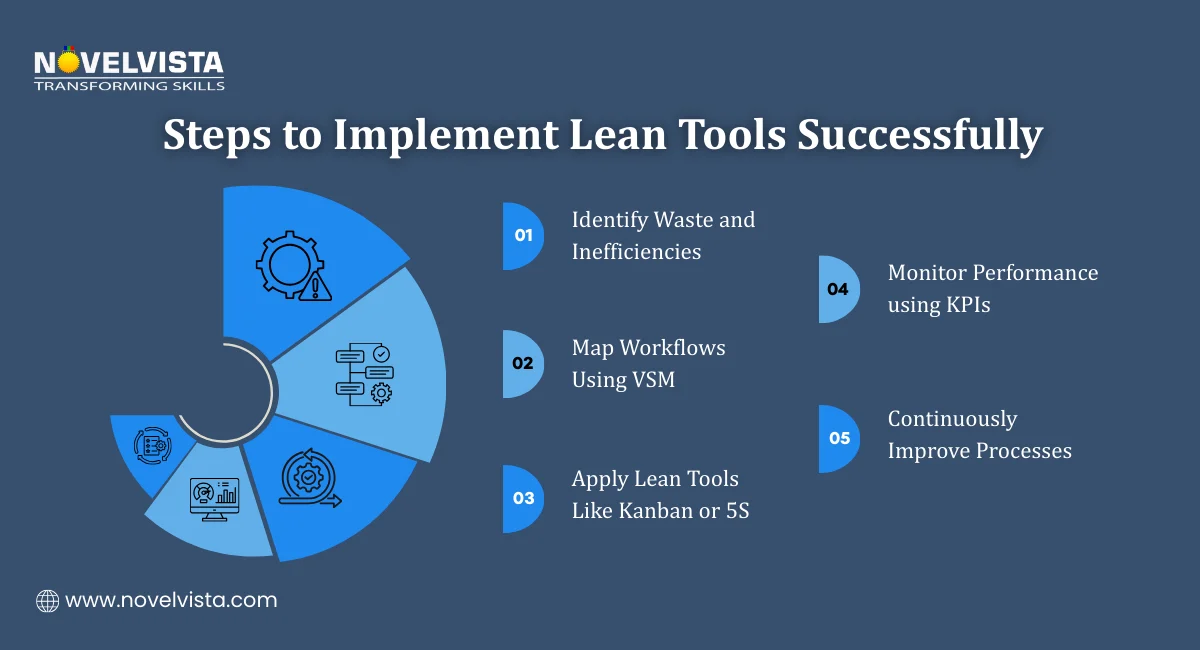
Knowing the tools is one thing. Getting them to work together inside a real organization takes a structured approach. Here is how modern organizations are combining Lean Tools to get measurable results.
Individual Lean tools deliver results on their own. Combined thoughtfully, they deliver significantly more.
Proven combinations:
Lean Six Sigma Tools and Six Sigma and Lean Tools are no longer limited to traditional manufacturing. Teams across industries are adapting them to their specific environments.
Construction teams use Daily Huddles as a Lean communication tool. Short daily stand-up meetings keep crews aligned, surface blockers early, and reduce miscommunication that causes delays and rework on site.
Software development teams use Lean tools to manage workflow and reduce bottlenecks in development pipelines. Kanban boards, Value Stream Mapping of development workflows, and Kaizen retrospectives after each sprint are all common applications.
Healthcare organizations use Lean Process Improvement Tools to reduce patient wait times, streamline administrative processes, and improve the reliability of clinical procedures.
To improve efficiency and reduce waste, explore our blog on 10 Tips for Lean Six Sigma and how to apply them in real-world processes.
Digital tools are expanding how Lean Process Improvement Tools are applied in 2026.
Key developments include:
The underlying principles of Lean stay the same. Digital tools simply make them faster to implement, easier to maintain, and more visible across larger organizations.
In Lean maturity assessments we conduct, organizations applying a structured combination of Lean and Six Sigma tools consistently outperform those using isolated techniques.
To choose the most effective approach for your process improvement goals, explore our guide on Choosing the Right Six Sigma Tool and how to apply it in real scenarios.
Lean Tools work because they address the actual causes of inefficiency rather than just treating the symptoms. From the workplace organization of 5S to the strategic oversight of Lean Portfolio Management Tools, each tool in this guide targets a specific type of waste or operational gap.
The results are consistent across industries. Organizations that apply Lean Manufacturing Tools, Lean Six Sigma Tools, and Lean Management Tools together report meaningful improvements in productivity, quality, and cost efficiency. The data supports it and the practical track record backs it up.
Lean Problem Solving Tools like the 5 Whys and Kaizen keep those improvements compounding over time. Six Sigma and Lean Tools add the quality control layer that ensures faster processes are also more reliable ones.
The organizations getting the most value from Lean in 2026 are not the ones that picked one tool and ran with it. They are the ones who built a connected practice where multiple tools reinforce each other across every level of the organization.

NovelVista's Lean Six Sigma Green Belt and Black Belt combo certification training gives you end-to-end expertise across the full range of Lean and Six Sigma tools. From foundational process improvement to advanced data-driven problem solving, the course is built for professionals who want practical skills they can apply immediately across any industry.
Explore NovelVista's Lean Six Sigma Green Belt and Black Belt Combo Certification Training and start building your process improvement expertise today.
Author Details

Confused About Certification?
Get Free Consultation Call
Stay ahead of the curve by tapping into the latest emerging trends and transforming your subscription into a powerful resource. Maximize every feature, unlock exclusive benefits, and ensure you're always one step ahead in your journey to success.