Category | Quality Management
Last Updated On 13/01/2026

Audit day arrives. Documents look fine. Plans are approved. Yet the audit report still shows ISO 22301 nonconformities. This is a common experience for many organizations and auditors working with Business Continuity Management Systems.
ISO 22301 nonconformities don’t mean your BCMS has failed. They point to gaps between intent and execution. When handled properly, they become one of the strongest tools for improving resilience and audit readiness.
Across ISO 22301 Lead Auditor training programs, nonconformities appear most often in organizations that rely heavily on documentation but rarely test or review continuity arrangements in real scenarios.
This guide explains what ISO 22301 nonconformities really mean, the most common findings auditors raise, and how Clause 10.1 expects organizations to respond. You’ll also see how auditors view these findings and what makes corrective actions effective.
ISO 22301 Non-conformities are deviations from BCMS requirements identified during internal, certification, or surveillance audits. They are based on objective evidence, not assumptions.
Auditors use nonconformities to:
Assess how well the BCMS works in real conditions
Check alignment with ISO 22301 clauses
Measure maturity and consistency across processes
These findings play a major role during:
Initial certification audits
Surveillance audits
Recertification cycles
In practical audits, nonconformities are rarely raised due to missing documents alone. They are raised when evidence shows that documented processes are not followed, reviewed, or improved consistently. Handled well, ISO 22301 nonconformities strengthen resilience and long-term compliance instead of becoming repeated issues year after year.
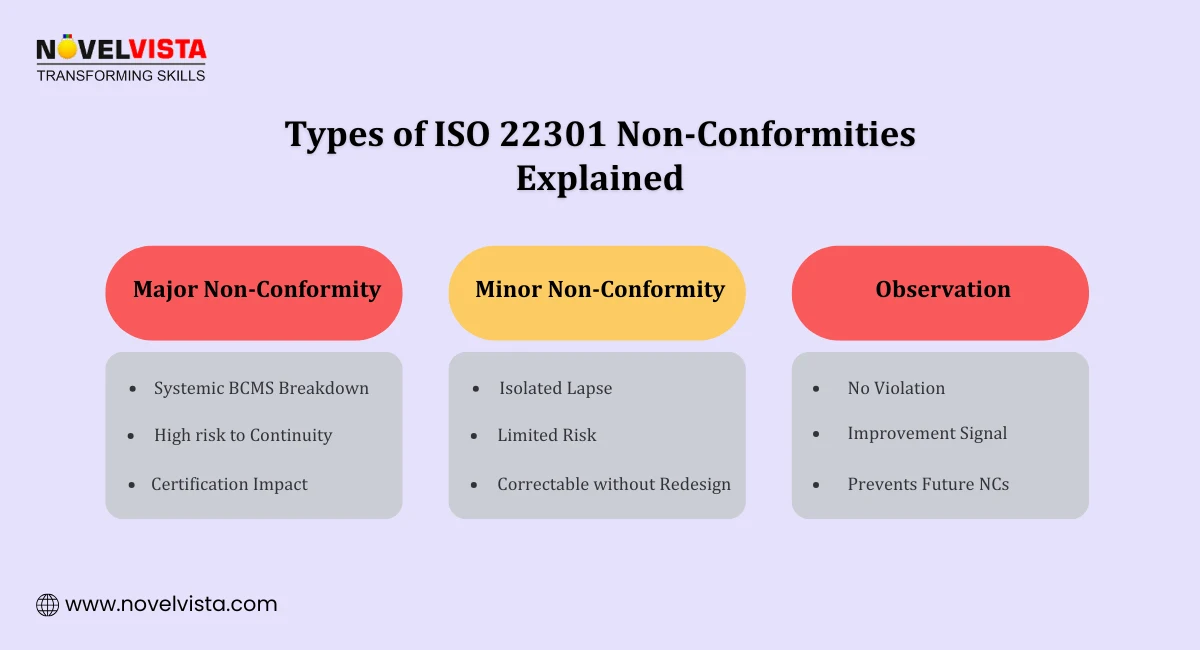
Auditors classify ISO 22301 Non-conformities based on impact and risk. Understanding these types helps teams respond correctly and prioritize actions.
Major nonconformities indicate serious or systemic BCMS failures.
Common examples include:
No internal audit program in place
Management reviews missing or ineffective
Repeated minor findings showing a pattern
Major findings suggest the BCMS cannot reliably meet ISO 22301 requirements.
Minor nonconformities are isolated lapses that don’t indicate system-wide failure.
Examples include:
Outdated documents
Missing signatures or incomplete records
If ignored, minor findings can grow into major ISO 22301 nonconformities over time.
Observations are not formal nonconformities. They highlight improvement opportunities.
Auditors often use them as early warnings of:
Emerging risks
Weak controls
Practices that may fail under stress
Addressing observations early helps prevent future ISO 22301 Non-conformities.
See the most common ISO 22301 audit findings
auditors raise again and again. Understand where organizations fail,
what clauses get flagged, and how to
stay audit-ready before your next assessment.
Across industries, auditors repeatedly raise similar ISO 22301 nonconformities. These patterns make it easier to prepare and fix issues proactively.
No evidence of regular management reviews
Business continuity is treated as an IT-only task
Generic or incomplete BIAs
Missing dependencies
Unrealistic RTOs and RPOs
Risk assessments are not updated
Business continuity plans not reviewed or tested
No records showing corrective actions or tracking
Infrequent or ineffective exercises
No documented lessons learned
No defined KPIs
Missing or weak internal audit programs
These findings account for a large portion of ISO 22301 nonconformities raised during audits. Training case studies show that BIA-related nonconformities often repeat because assumptions are reused year after year without validation through exercises or operational changes.
Want to avoid common pitfalls during audits? Explore our blog on ISO 22301 Lead Auditor audit mistakes to learn what often goes wrong and how experienced auditors handle them effectively.
Clause 10.1 defines how organizations must handle ISO 22301 Non-conformities. Auditors look closely at how each step is applied.
Control the immediate impact of the issue to reduce risk.
Perform root cause analysis to understand why the issue happened, not just what happened.
Implement corrective actions with:
Clear ownership
Defined timelines
Measurable outcomes
Verify effectiveness and update the BCMS to ensure the issue does not repeat.
Auditors expect to see this full cycle applied to ISO 22301 nonconformities, not partial fixes.
Many ISO 22301 nonconformities repeat because organizations fix symptoms instead of causes. Auditors look for corrective actions that are practical, owned, and effective over time.
| Audit Finding |
Root Issues |
Corrective Actions |
Leadership gaps |
No engagement, weak accountability |
Schedule regular management reviews, define BCM ownership, and train senior leaders |
Risk/BIA gaps |
Generic analysis, outdated inputs |
Perform a full BIA, map dependencies, review RTOs, and update annually |
Documentation issues |
Missing or outdated records |
Standardize templates, apply version control, and maintain audit trails |
Testing weaknesses |
Infrequent or poor-quality exercises |
Run regular drills, document outcomes, and track lessons learned |
Monitoring failures |
No KPIs or audits |
Define metrics, plan internal audits, and report results to management |
Effective corrective actions are realistic, owned, and tracked. Overly complex action plans often fail because teams cannot sustain them between audits. When these actions are applied correctly, ISO 22301 nonconformities reduce sharply in follow-up and surveillance audits.
During reviews, auditors focus on quality, not volume. For ISO 22301 Non-conformities, they expect:
Strong handling of ISO 22301 nonconformities shows maturity and builds auditor confidence in the BCMS.
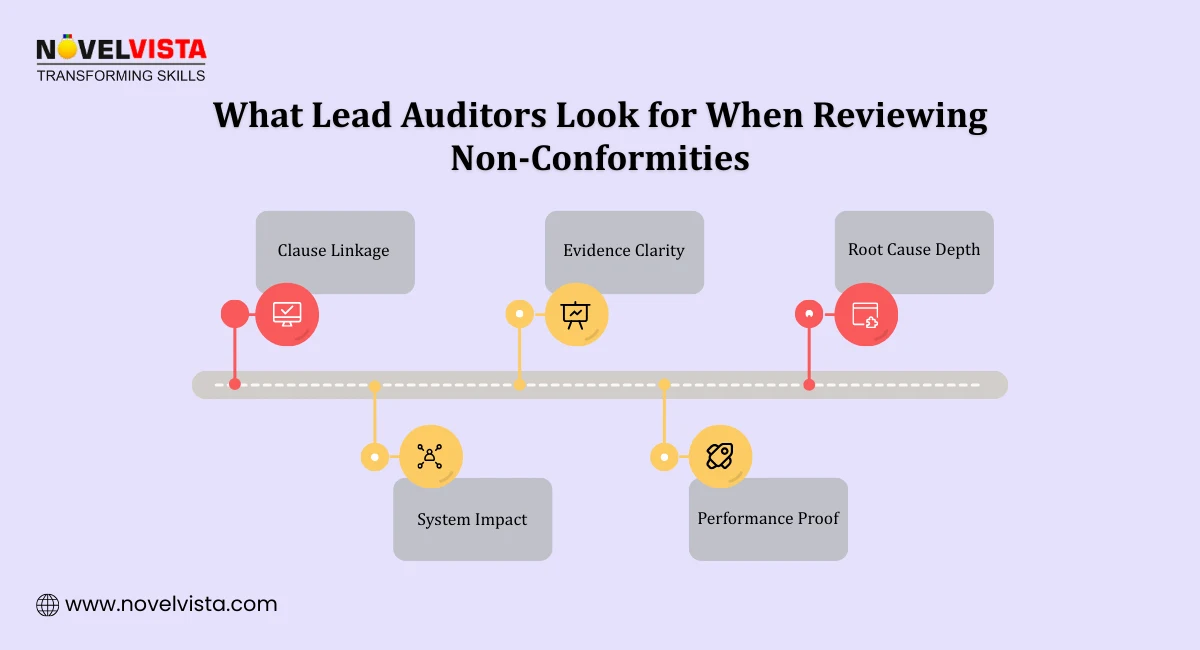
Raising findings requires judgment and professionalism. Skilled auditors demonstrate:
Poorly written findings create confusion. Well-written ones drive improvement.
The best audits are the ones where the same findings don’t come back. Preventing repeat ISO 22301 nonconformities depends on daily discipline.
Effective practices include:
This approach turns audits into a continuous improvement cycle.

ISO 22301 nonconformities are not signs of failure. They highlight where resilience can improve. When Clause 10.1 is applied fully, react, evaluate, correct, and review, findings become long-term controls.
Organizations with mature BCMS programs treat nonconformities as operational feedback. This mindset shift is a strong indicator of long-term audit success and real resilience capability.
Organizations that focus on root causes build stronger, audit-ready BCMS. Skilled auditors ensure ISO 22301 Non-conformities drive improvement, not fear.
Author Details

Course Related To This blog
ISO 22301:2019 Lead Auditor
Confused About Certification?
Get Free Consultation Call
Stay ahead of the curve by tapping into the latest emerging trends and transforming your subscription into a powerful resource. Maximize every feature, unlock exclusive benefits, and ensure you're always one step ahead in your journey to success.