NovelVista logo

ISO 22301 Audit Mistakes: What Auditors and Organizations Commonly Miss

Category | Quality Management

Last Updated On 08/01/2026
ISO 22301 Audit Mistakes: What Auditors and Organizations Commonly Miss | Novelvista

Many organizations walk into an ISO 22301 audit feeling confident. Policies are written, plans are approved, and folders look complete. Yet audits still fail, or worse, systems collapse during real disruptions. These ISO 22301 Audit Mistakes don’t usually happen because teams ignore the standard. They happen because business continuity looks good on paper but isn’t truly embedded.

In ISO 22301 Lead Auditor training sessions, we regularly see organizations that appear audit-ready but struggle when auditors probe real recovery capability. Most failures are not due to missing documents, but because teams haven’t practiced continuity under real pressure. This gap becomes visible very quickly during audits.

This guide breaks down the most common ISO 22301 Audit Mistakes seen across industries. It clearly separates where organizations go wrong from where Lead Auditors miss the mark and shares practical ways to fix both.

Where Organizations Go Wrong in ISO 22301 Audits

Most BCM audit mistakes start long before the auditor arrives. They are rooted in mindset, ownership, and how continuity is treated day to day.

1. Leadership and Governance Failures

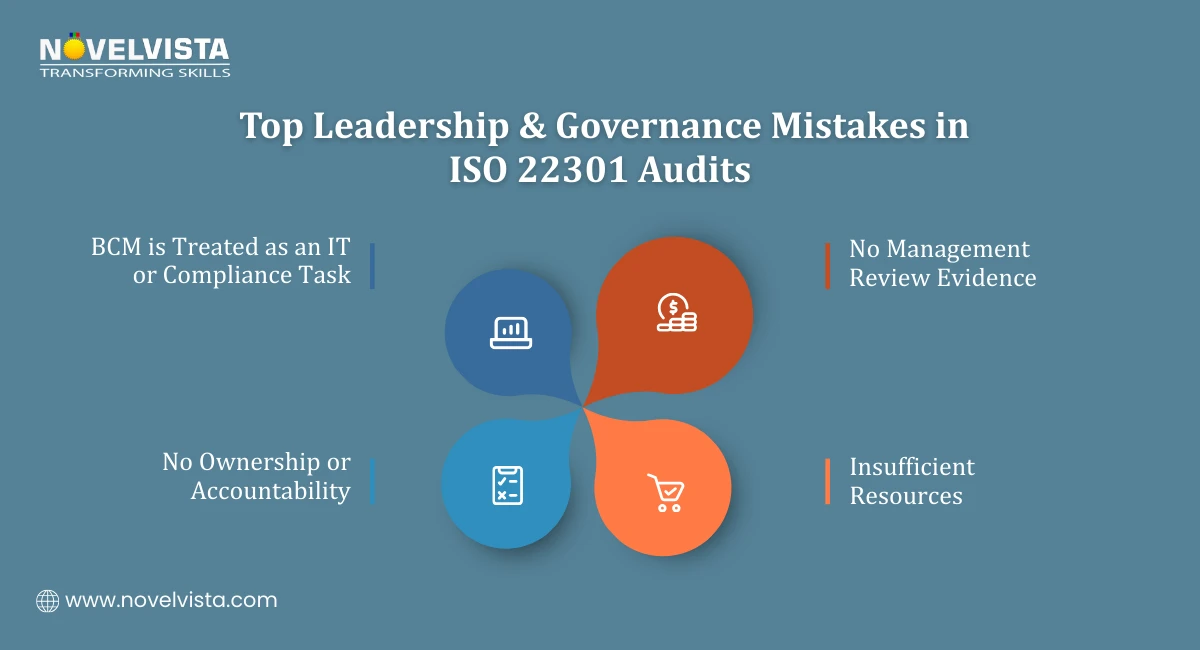
One of the most repeated ISO 22301 Audit Mistakes is weak leadership ownership. Across continuity training programs, leadership disengagement is one of the most consistent audit blockers. When top management treats BCM as a delegated task, audits quickly reveal missing direction, weak ownership, and poor follow-through, leading to repeat ISO 22301 audit findings.

Common problems include:

  • BCM treated as an IT or compliance task: Business continuity is pushed to IT or risk teams instead of being owned as a business-wide strategy.
     
  • No visible top-management involvement: Auditors often see missing or outdated management review evidence, especially for Clause 5 leadership requirements.
     
  • Poor resource allocation: BCM responsibilities exist on paper, but teams lack time, budget, or authority to maintain the system properly.

These gaps frequently appear as major ISO 22301 compliance issues, even in organizations that believe they are “audit ready.”
Top Leadership & Governance Mistakes in ISO 22301 Audits

2. Risk Assessment and BIA Gaps

If audits fail, the Business Impact Analysis is often the reason. These are some of the most common ISO 22301 audit gaps.

Typical findings include:

  • Incomplete BIAs: Critical services, realistic RTOs, dependencies, or recovery priorities are missing or guessed instead of validated.
     
  • Outdated risk assessments: Organizational changes, new suppliers, mergers, or cloud migrations are not reflected in risk registers.
     
  • Ignored external and third-party risks: Supplier failures, utilities, cyber threats, and geopolitical risks are not assessed seriously.

These gaps are among the most common ISO 22301 Audit Mistakes and frequently lead to major nonconformities.

3. Weak Planning and Documentation Practices

Documentation is where many ISO 22301 audit errors quietly hide. 

Auditors often find:

  • Generic or copied BCM plans: Plans exist, but they don’t match how the organization actually operates during disruptions.
     
  • Poor document control: Missing version history, unclear ownership, outdated procedures, and no approval trail.
     
  • Mismatch between plans and practice: What employees do during incidents does not match what the documents say, especially under Clauses 7 and 8.

These weaknesses directly lead to repeated ISO 22301 Audit Mistakes, even across multiple audit cycles. In practical audit simulations, we teach auditors to validate plans against real operational behavior. When documents don’t reflect how teams actually respond during incidents, the BCM system fails both audits and real disruptions regardless of how polished the documentation looks.

Want to know which documents truly matter for ISO 22301 compliance? Read our blog on Core ISO 22301 Documentation to understand what organizations must have in place for a strong BCMS.

4. Testing and Exercise Deficiencies

A BCM system that is never tested is a system that cannot be trusted. This is where many BCM audit mistakes surface.

Common issues include:

  • Infrequent or unrealistic exercises: Tabletop drills that are rushed, predictable, or designed only to “tick the box.”
     
  • No post-exercise analysis: Missing reports, no lessons learned, and no improvement actions after exercises (Clause 8.5).
     
  • Weaknesses found only during real incidents: Auditors often hear, “We discovered this during an outage,” which signals poor testing discipline.

This is a classic source of ISO 22301 audit errors.

5. Training and Awareness Breakdowns

Even strong plans fail when people don’t know their role.

Auditors frequently observe:

  • Employees unaware of BCM responsibilities: Staff cannot explain what to do during disruptions or who to contact.
     
  • No role-based training programs: Everyone receives the same generic awareness, regardless of their recovery role.
     
  • Missing or incomplete training records: Lack of evidence often results in nonconformities.

These are avoidable ISO 22301 compliance issues that continue to appear across audits. From a training standpoint, role-based BCM awareness makes a measurable difference. Auditors trained to interview operational staff, not just managers, can quickly identify whether continuity responsibilities are understood or exist only in training slides.

6. Third-Party and Communication Oversights

Modern organizations depend heavily on suppliers, yet this is one of the most overlooked areas.

Auditors often find:

  • Supplier continuity risks not assessed: Vendors are critical, but BCM expectations are undocumented or assumed.
     
  • Contracts missing continuity clauses: No defined recovery obligations or response expectations.
     
  • Unclear communication and escalation paths: During incidents, teams are unsure who communicates with whom and when.

This remains a frequent and costly category of ISO 22301 Audit Mistakes.

7. Continual Improvement and Metrics Gaps

A BCM system that doesn’t improve will fail eventually.

Typical findings include:

  • No BCM performance metrics or KPIs: No monitoring data to show whether continuity controls actually work.
     
  • Weak corrective action tracking: Issues are fixed informally, without root-cause analysis or documentation (Clause 10).
     
  • Repeated nonconformities: Showing a compliance-only mindset instead of real improvement.

These patterns clearly signal unresolved ISO 22301 audit gaps.

Download: ISO 22301 Business Continuity Audit Checklist

Audit BCMS with confidence using a structured, clause-by-clause checklist.
Ensure consistency, spot gaps early, and deliver stronger, evidence-based ISO 22301 audits.

Where ISO 22301 Lead Auditors Go Wrong

Not all audit failures are caused by organizations. Some ISO 22301 Audit Mistakes happen because audits are rushed, shallow, or overly checklist-driven. These errors weaken audit value and allow real resilience issues to remain hidden.

1. Over-Reliance on Templates and Checklists

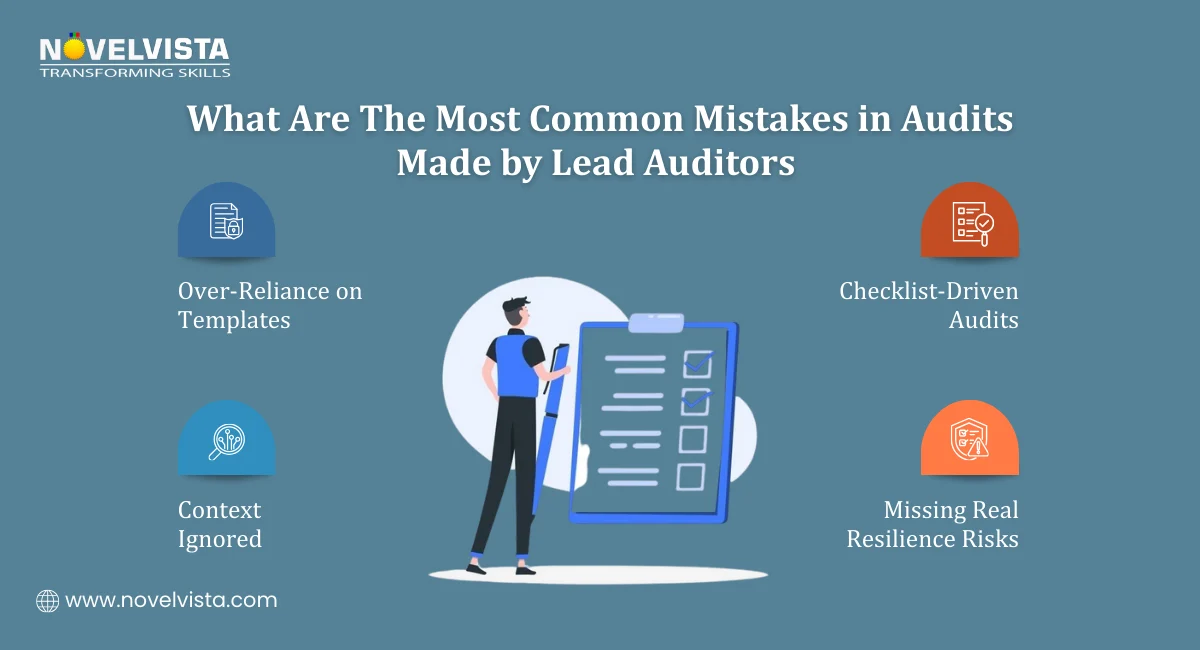
One of the most common ISO 22301 audit errors made by auditors is treating audits like form-filling exercises.

Typical issues include:

  • Blindly following templates: Auditors focus on document presence instead of understanding whether continuity controls actually work in real situations.
     
  • Ignoring organizational context: Business size, complexity, risk appetite, and industry realities are not considered during assessments.
     
  • Missing real resilience gaps: Documents look compliant, but recovery capability is weak, and the audit fails to detect it.

This leads to audits that pass on paper but fail during real disruptions.
What Are The Most Common Mistakes in Audits Made by Lead Auditors
 

2. Weak Audit Planning and Time Management

Poor planning creates weak audits, even when auditors are experienced.

Common problems include:

  • Unrealistic audit schedules: Too many clauses and sites covered in too little time.
     
  • Rushed interviews: Key staff are interviewed briefly, missing critical insights.
     
  • Incomplete sampling: Important processes, locations, or suppliers are skipped entirely.

These weaknesses directly contribute to ISO 22301 audit errors and unreliable conclusions.

3. Misinterpretation of ISO 22301 Requirements

Another frequent cause of ISO 22301 Audit Mistakes is misunderstanding the standard itself. 

Issues often include:

  • Incorrect clause interpretation: Auditors apply personal opinions instead of the standard intent.
     
  • Inconsistent grading of findings: Similar issues receive different severity levels across audits.
     
  • Ignoring ISO 19011 principles: Evidence-based auditing, objectivity, and consistency are not followed.

In auditor qualification programs, misinterpretation of clauses is a common root cause of audit disputes. Consistent clause interpretation, aligned with standard intent rather than personal judgment, is a key focus area in competent Lead Auditor development.

Want a clearer picture of what ISO 22301 actually expects? Read our blog that breaks down the ISO 22301 certification requirements in a simple, practical way.

4. Poor Evidence Collection and Reporting

Even when issues are identified, weak reporting reduces audit value.

Common failures include:

  • Incomplete audit notes: Findings are vague, with missing evidence references.
     
  • Weak linkage between evidence and clauses: Organizations don’t clearly understand why an issue was raised.
     
  • Unhelpful audit reports: Reports list problems but don’t guide improvement.

These reporting gaps turn audits into compliance events instead of improvement opportunities. Fixing ISO 22301 Audit Mistakes requires clarity on what auditors expect and how organizations can prevent repeat findings.

Actionable Checklist to Prevent ISO 22301 Audit Mistakes


Area

Evidence Auditors Expect

Prevention Action

Leadership

Management review minutes

Conduct annual BCM governance reviews

BIA & Risk

Updated registers

Review and update quarterly

Plans & Docs

Version-controlled files

Assign RACI-based ownership

Testing

Exercise reports

Run scenario-based drills

Training

Attendance records

Provide role-based BCM training

Third Parties

Vendor assessments

Add BCM clauses to contracts

Improvement

KPI dashboards

Track CAPA and trends

Using this checklist helps address ISO 22301 audit gaps before they become nonconformities.

Conclusion: Turning ISO 22301 Audit Findings into Real Resilience

Avoid Critical Audit Errors And Become A Confident ISO 22301 Lead Auditor

Most ISO 22301 Audit Mistakes come from weak governance, outdated analysis, and audits that focus more on paperwork than real capability. BCM only works when leadership is involved, risks are current, plans are tested, and people know their roles.

Strong resilience needs both prepared organizations and competent Lead Auditors. Proactive reviews, realistic exercises, and evidence-based audits prevent failure far better than last-minute fixes after an audit or incident.

These insights are drawn from real audit scenarios, training simulations, and certification readiness reviews across multiple industries. The focus is always on helping both auditors and organizations move from paper compliance to operational resilience.

Next Step: Build Strong ISO 22301 Audit Capability

If you want to avoid repeating the same audit findings and lead meaningful BCM assessments, NovelVista’s ISO 22301 Lead Auditor Certification Training is the right next step. The program builds a deep understanding of ISO 22301 requirements, ISO 19011 auditing principles, and real-world audit execution. You gain practical skills to assess resilience, identify real gaps, and guide organizations toward stronger, audit-ready business continuity systems.

Frequently Asked Questions

You must confirm that recovery time objectives and maximum tolerable periods of disruption are derived from validated operational requirements rather than arbitrary assumptions to ensure the strategy is technically feasible.

A major nonconformity is often found when senior management is unable to demonstrate their role in determining strategic recovery priorities or if they have failed to provide necessary resources for exercising.

Beyond verifying that tests occurred, you must examine evidence that the organization systematically identified gaps during the simulation and implemented documented corrective actions to refine their recovery procedures thereafter.

Auditors must check that critical supplier recovery capabilities have been formally mapped to the organization's own recovery time objectives and that there are clear communication protocols for managing vendor disruptions.

Review the management review records and corrective action logs to see if the organization proactively updates the system based on changing external risks like evolving cyber threats or major operational shifts.

Author Details

Mr.Vikas Sharma

Mr.Vikas Sharma

Principal Consultant

I am an Accredited ITIL, ITIL 4, ITIL 4 DITS, ITIL® 4 Strategic Leader, Certified SAFe Practice Consultant , SIAM Professional, PRINCE2 AGILE, Six Sigma Black Belt Trainer with more than 20 years of Industry experience. Working as SIAM consultant managing end-to-end accountability for the performance and delivery of IT services to the users and coordinating delivery, integration, and interoperability across multiple services and suppliers. Trained more than 10000+ participants under various ITSM, Agile & Project Management frameworks like ITIL, SAFe, SIAM, VeriSM, and PRINCE2, Scrum, DevOps, Cloud, etc.

Confused About Certification?

Get Free Consultation Call

Sign Up To Get Latest Updates on Our Blogs

Stay ahead of the curve by tapping into the latest emerging trends and transforming your subscription into a powerful resource. Maximize every feature, unlock exclusive benefits, and ensure you're always one step ahead in your journey to success.


Topic Related Blogs
 
Common ISO 22301 Audit Mistakes and How to Avoid Them