Category | Quality Management
Last Updated On 29/09/2026
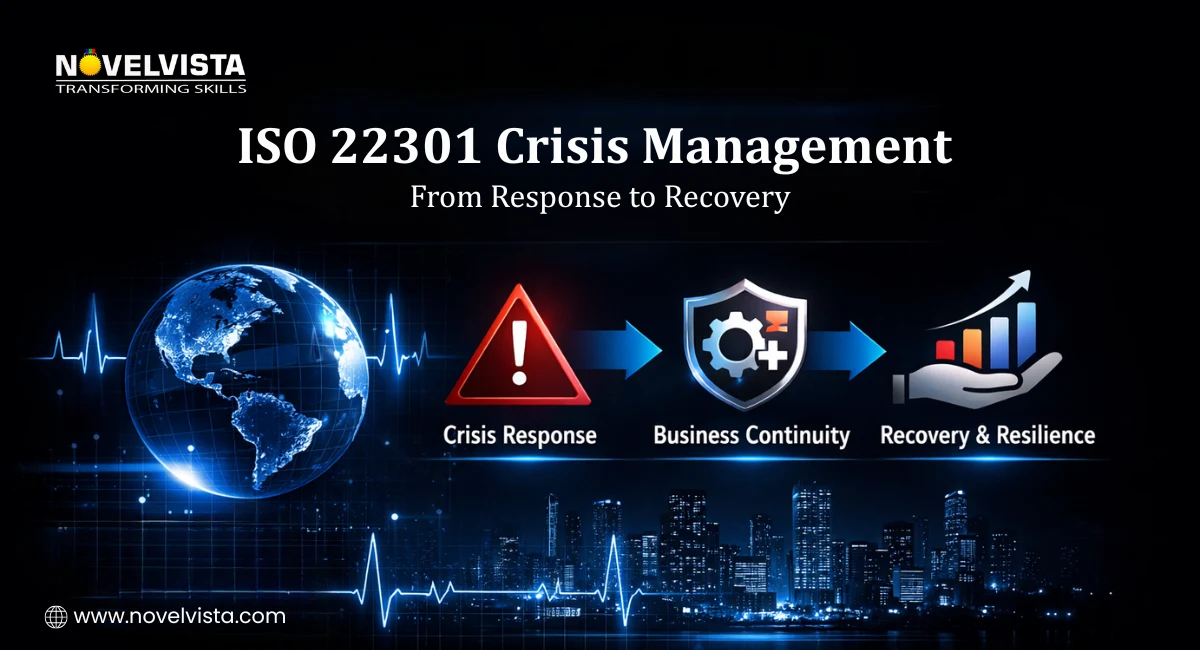
A disruption never gives advance notice. Systems go down. Offices become unavailable. Customers start asking questions before teams even know what’s happening. That’s why ISO 22301 Crisis management matters. It gives organizations a clear, structured way to respond under pressure instead of reacting in chaos.
This guide explains how Crisis management works in real life, how planning and leadership shape response capability, and how organizations build repeatable resilience using a structured approach rather than ad-hoc decisions.
Crisis management is not just about extreme disasters. Cyberattacks, supplier failures, infrastructure outages, and sudden staff unavailability all qualify as crises when they threaten critical operations.
Crisis management provides a formal structure to handle these situations through a Business Continuity Management System (BCMS). It starts with:
Clearly defining the BCMS scope
Understanding organizational context
Securing leadership commitment
These elements ensure crisis planning reflects real risks, not assumptions. From an implementation perspective, the strength of ISO 22301 crisis management lies in how early leadership accountability, scope clarity, and context analysis are established. These elements determine whether crisis plans work in practice or fail during execution.
A key strength of Crisis management ISO 22301 is its use of the Plan–Do–Check–Act (PDCA) lifecycle. This keeps crisis preparedness alive, tested, and continuously improved instead of sitting unused until something goes wrong.
PDCA is the engine that keeps crisis capability effective over time. In ISO 22301 Crisis management, PDCA ensures that plans are built, tested, reviewed, and refined continuously.
Here’s how PDCA supports crisis management maturity:
Plan: Define crisis scenarios, response objectives, roles, and decision criteria.
Do: Implement response procedures, communication protocols, and coordination mechanisms.
Check: Test plans through exercises, audits, and reviews to validate readiness.
Act: Improve plans based on lessons learned, performance gaps, and changing risks.
This PDCA-driven approach ensures crisis response does not depend on individual heroics. Instead, Crisis management embeds consistency, governance, and repeatability into decision-making. For a deeper understanding of continual improvement in action, explore our blog that takes a deep dive into the PDCA lifecycle and shows how it drives consistent, measurable improvement.
Audit crisis management beyond paperwork. Use clause-wise checkpoints, decision-based questions, and real evidence cues to assess true readiness under pressure.
Every crisis starts with risk. That’s why risk assessment and Business Impact Analysis form the backbone of Crisis management.
Risk assessment identifies threats that could trigger a crisis, such as:
Technology failures
Cyber incidents
Natural hazards
Supply chain disruptions
It helps organizations understand what could happen, not what is convenient to plan for.
BIA focuses on impact rather than probability. It answers questions like:
Which activities are truly critical?
How long can operations be disrupted?
What are acceptable Recovery Time Objectives (RTOs)?
What Recovery Point Objectives (RPOs) apply to data and systems?
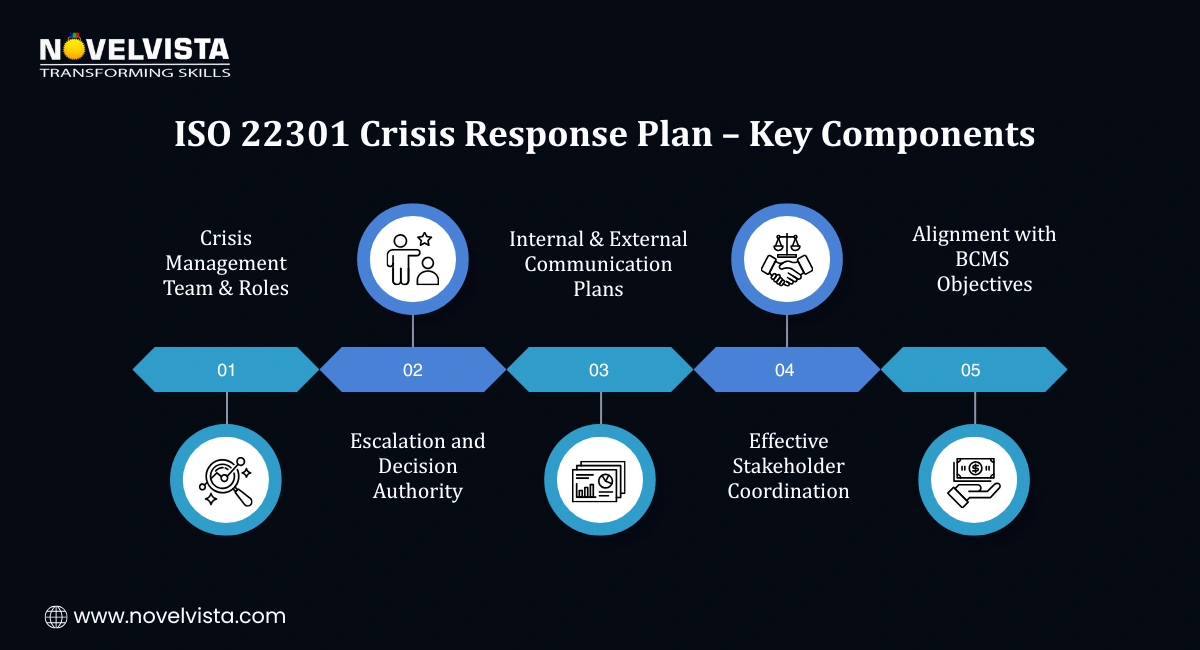
The crisis response plan is the operational heart of crisis management. It guides teams on what to do when normal controls no longer apply.
A strong crisis response plan clearly defines:
In Crisis management, the crisis response plan must align with BCMS objectives. This ensures response actions protect priority services rather than reacting emotionally or politically during pressure situations.
When a crisis hits, the first hours matter most. This is where the emergency management system plays a critical role.
The emergency management system coordinates immediate actions such as:
Incident assessment and classification
Situation monitoring and information flow
Stakeholder coordination
Resource allocation and logistics
Rather than relying on informal calls or assumptions, the emergency management system provides structure during high-pressure moments. It supports fast but informed decisions, one of the key strengths of Crisis management ISO 22301.
Clear situational awareness, disciplined communication, and defined authority prevent confusion when time is limited and consequences are high.
Crisis response helps you stabilize the situation. Disaster recovery planning helps you get the business back on its feet. In Crisis management ISO 22301, recovery is not treated as an IT-only activity or a last-minute scramble.
Effective disaster recovery planning focuses on restoring what matters most, not everything at once.
Key areas covered in a strong recovery approach include:
Physical location recovery: Plans should define how teams relocate or operate when offices, plants, or facilities are unavailable. This may include alternate sites, remote working arrangements, or shared locations.
IT systems and data recovery: Systems must be restored based on business priority, not technical convenience. Backup strategies, replication methods, and restore procedures must align with agreed RTOs and RPOs.
Process and service restoration: Recovery procedures should explain the order in which services are brought back online, including dependencies between teams, suppliers, and systems.
Temporary workarounds: When full recovery takes time, manual processes or reduced service modes help maintain continuity.
In ISO 22301 Crisis management, disaster recovery planning works best when IT recovery annexes are clearly linked to the wider BCMS. This prevents situations where systems are restored, but the business still cannot operate.
Plans that are not tested usually fail when needed most. That’s why ISO 22301 Crisis management places strong emphasis on exercises, training, and regular reviews.
Organizations should maintain readiness through:
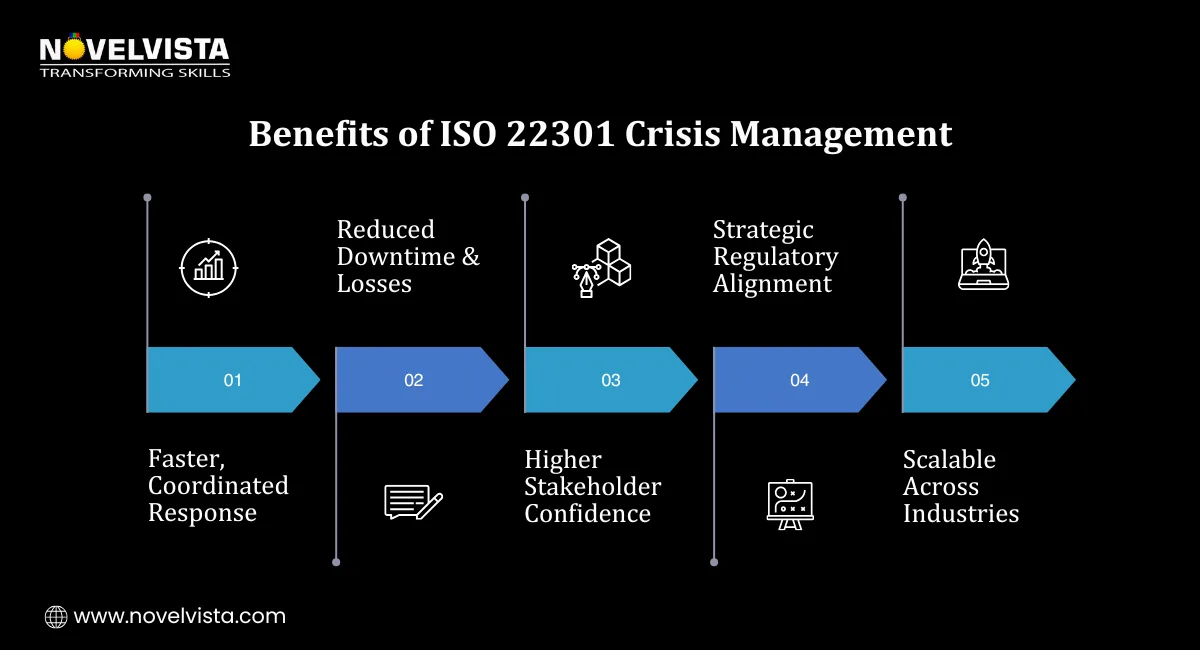
When implemented properly, ISO 22301 Crisis management delivers benefits that extend well beyond compliance or certification.
Organizations experience:
Clear and calm crisis response: Teams know who leads, who decides, and how information flows, reducing confusion during pressure situations.
Reduced downtime and faster recovery: Prioritized recovery actions minimize operational and financial impact.
Stronger stakeholder confidence: Customers, regulators, partners, and employees trust organizations that communicate clearly and act decisively during disruption.
Adaptability across industries and sizes: The framework works for small organizations as well as complex, multi-location enterprises.
These benefits come from preparation, discipline, and regular testing, not from documentation alone.
Building ISO 22301 Crisis management capability works best when done in manageable stages instead of a big one-time effort.
A practical roadmap includes:
This staged approach ensures ISO 22301 Crisis management remains practical, scalable, and sustainable over time.

ISO 22301 Crisis management strengthens organizational resilience by replacing uncertainty with structure. It connects risk assessment, crisis response planning, emergency coordination, and disaster recovery into one integrated system.
The real value lies in preparedness that never stops. When PDCA drives continual improvement, organizations respond faster, recover smarter, and protect what matters most, even under extreme pressure. Crisis management is not about predicting every event; it’s about being ready for the unexpected.
The Crisis Management Team leads an organization's response during a disruption—putting the business continuity plan into action, protecting people's safety, limiting damage, and keeping communication flowing throughout the incident.
Author Details

Course Related To This blog
ISO 22301:2019 Lead Auditor
Confused About Certification?
Get Free Consultation Call
Stay ahead of the curve by tapping into the latest emerging trends and transforming your subscription into a powerful resource. Maximize every feature, unlock exclusive benefits, and ensure you're always one step ahead in your journey to success.