Category | Quality Management
Last Updated On 15/01/2026

In an era of constant disruption, business continuity is no longer a “nice-to-have.” According to global risk studies, nearly 75% of organizations experience at least one major disruption every year, and the average cost of downtime now exceeds $300,000 per hour for mid-to-large enterprises. From cyberattacks and supply chain breakdowns to natural disasters and system outages, interruptions are becoming more frequent and more expensive.
This raises some critical questions:
This is where the ISO 22301 BCM Lifecycle becomes essential. Designed to help organizations systematically plan, implement, operate, and improve business continuity, ISO 22301 provides a structured approach to resilience.
This blog is for business leaders, BCM managers, risk professionals, compliance teams, IT leaders, and auditors who want a clear, practical understanding of how the Business Continuity Management lifecycle works, and how it aligns with ISO 22301 audits.
Before breaking down the lifecycle stages, let’s briefly understand how ISO 22301 audits fit into this picture.
An ISO 22301 audit is a structured assessment that evaluates whether an organization’s Business Continuity Management System (BCMS) meets the requirements of the ISO 22301 standard. The audit checks not only documentation but also the effectiveness of implementation across the organization.
Auditors closely examine how well the ISO 22301 BCM Lifecycle is defined, implemented, maintained, and continually improved. They look for evidence that business continuity is embedded into daily operations, not treated as a one-time compliance exercise.
Understanding the lifecycle approach is critical because ISO 22301 is built around continuous improvement, not static planning.
The ISO 22301 BCM Lifecycle represents a structured sequence of interconnected stages that ensure business continuity remains relevant, effective, and aligned with organizational goals. Rather than focusing on isolated activities, the lifecycle approach ensures continuity capabilities evolve as risks, technologies, and business priorities change.
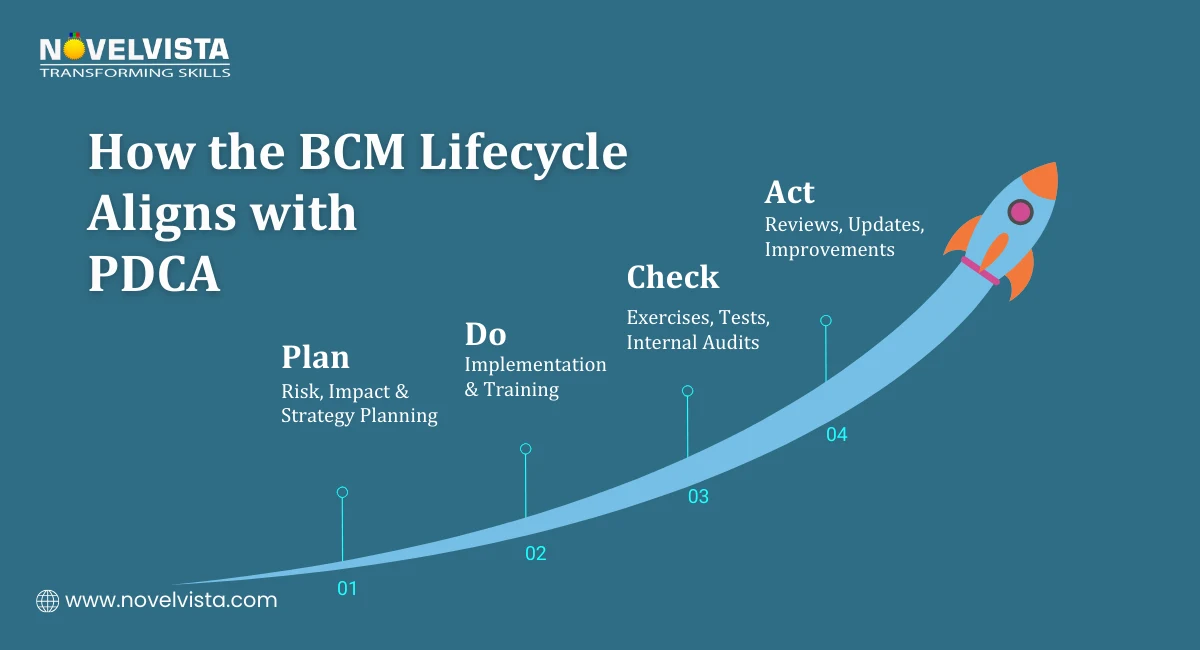
Closely aligned with the Plan-Do-Check-Act (PDCA) model, the lifecycle integrates governance, risk management, operational resilience, and continual improvement. These BCM process stages collectively form the backbone of an effective Business Continuity Management System. These lifecycle stages form the core knowledge areas covered in any practical ISO 22301 Exam Strategy Guide.
Stage 1 of the Business Continuity Management lifecycle focuses on understanding the organization and its operating environment. It establishes the foundation of the BCM Lifecycle by identifying internal and external issues that may impact business continuity objectives.
This stage includes understanding regulatory, contractual, and market expectations, identifying interested parties such as customers, regulators, and suppliers, and clearly defining the scope of the BCMS.
Auditors often find gaps when business continuity objectives are not aligned with strategic priorities, leading to weaknesses in the overall Business Continuity Management lifecycle.
Understand how business continuity works in real-world situations, not just during audits
Learn practical ways to build, run, and improve your BCM lifecycle with confidence
The Business Impact Analysis (BIA) is one of the most critical BCM process stages, as it identifies essential activities required to deliver products and services and evaluates the impact of disruptions over time. A strong BIA defines critical business activities, Maximum Tolerable Disruption (MTD), Recovery Time Objectives (RTO), and Recovery Point Objectives (RPO), providing clear recovery priorities. Within the ISO 22301 BCM Lifecycle, a well-executed BIA ensures recovery decisions are business-driven rather than technology-driven, which is a key audit expectation.
Risk assessment complements the BIA by identifying threats that could disrupt critical activities. These may include cyber incidents, supplier failures, infrastructure outages, or natural disasters.
This stage evaluates:
The business continuity strategy stage defines how the organization will maintain or restore critical activities within acceptable timeframes.
Strategies may involve:
ISO auditors expect strategies to be realistic, cost-justified, and aligned with BIA and risk assessment results. Weak or undocumented strategies are a common nonconformity.
Business continuity plans translate strategy into actionable procedures, ensuring people know what to do, when to act, and who is responsible during a disruption. These plans typically include incident response procedures, crisis management and communication plans, and step-by-step recovery instructions. Within the ISO 22301 BCM Lifecycle, business continuity plans must be documented, easily accessible, and regularly updated, rather than relying on generic templates reused from past audits. Proper documentation across the lifecycle is simplified with a 22301 Documents Checklist for BCMS.
Even the best plans fail if people do not understand them, which is why this stage focuses on building organizational competence and confidence. Key activities include BCM awareness sessions, role-based training, and tabletop exercises and simulations to validate response capability. Auditors often find this stage underestimated, leading to weak real-incident response, while effective testing significantly strengthens the Business Continuity Management lifecycle.
The final stage ensures the BCMS remains effective over time through ongoing performance monitoring, internal audits, and management reviews. Key elements include KPI tracking, analysis of audit findings and corrective actions, and capturing lessons learned from incidents and exercises. This stage closes the loop of the ISO 22301 BCM Lifecycle, reinforcing continuous improvement and long-term organizational resilience.
Certification bodies assess whether organizations understand and apply the lifecycle holistically. Fragmented implementation, where plans exist but are not tested or reviewed, often leads to audit findings.
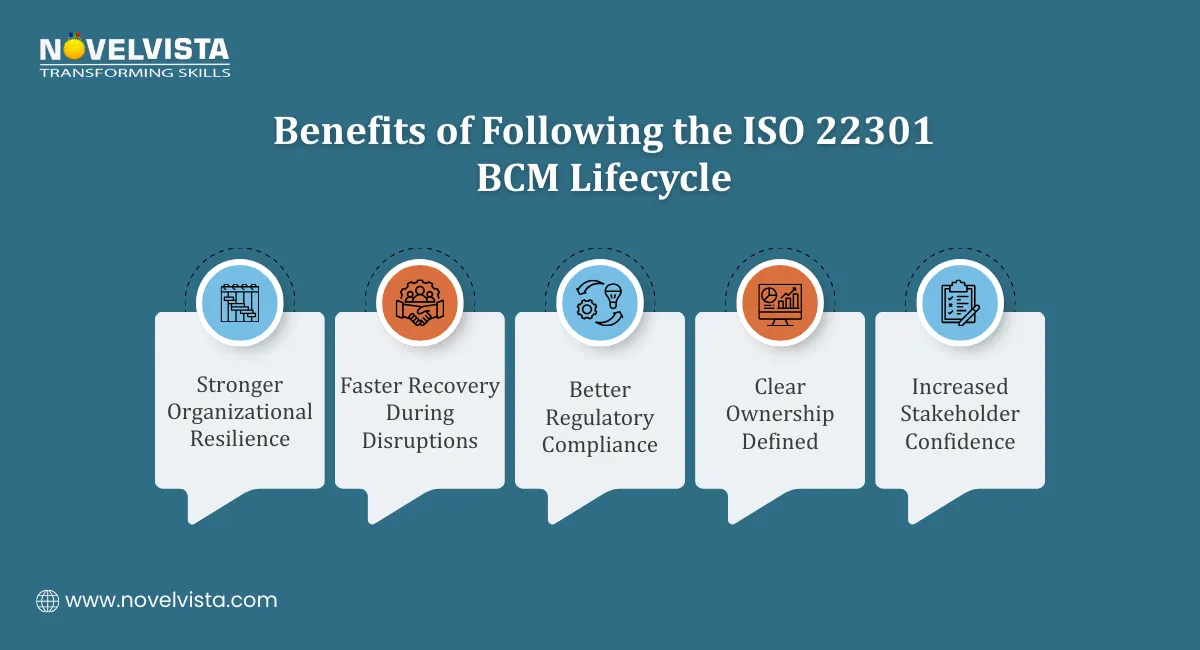
Organizations aligned with the ISO 22301 BCM Lifecycle benefit from:
Ultimately, the lifecycle approach transforms BCM from a compliance task into a strategic capability. This lifecycle-based approach reflects the core principles and clauses of the ISO 22301 Standard.

The ISO 22301 BCM Lifecycle provides a structured, practical framework for managing disruptions in an unpredictable world. By integrating governance, risk assessment, planning, testing, and continual improvement, organizations can move beyond reactive crisis management.
When implemented effectively, the Business Continuity Management lifecycle strengthens resilience, improves audit outcomes, and protects long-term business value. ISO 22301 is not just about certification; it’s about ensuring your organization can survive and thrive, no matter what disruption comes next.
Author Details

Course Related To This blog
ISO 22301:2019 Lead Auditor
Confused About Certification?
Get Free Consultation Call
Stay ahead of the curve by tapping into the latest emerging trends and transforming your subscription into a powerful resource. Maximize every feature, unlock exclusive benefits, and ensure you're always one step ahead in your journey to success.