Category | Quality Management
Last Updated On 04/09/2026
Let’s start by breaking a pattern many people follow when learning about business continuity. Instead of diving straight into templates and checklists, let’s look at what usually goes wrong, most teams think they already have enough documents, but during an audit everything suddenly feels incomplete. That’s why understanding ISO 22301 Documents becomes the real turning point.
This blog gives you a simple walkthrough of every document you need for BCMS compliance. You’ll know what’s mandatory, what’s helpful, and how auditors review your paperwork.
ISO 22301:2019 expects clear, well-structured documented information. It includes policies, plans, records, and evidence that show your BCMS is not just written but actually practiced. These documents help your team stay ready for disruptions and make audits feel predictable instead of stressful.
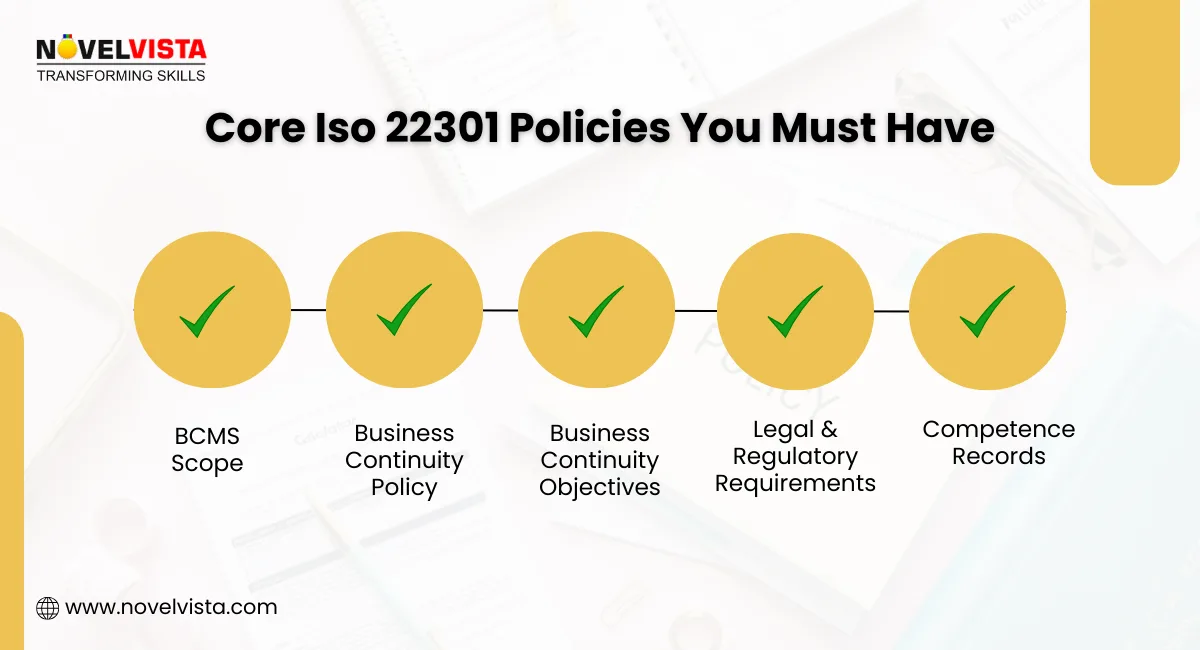
These are the foundation of the BCMS. Without them, nothing else fits together
This document defines the boundaries of your BCMS by clearly explaining which locations, services, and processes fall under business continuity coverage. It also states exclusions so everyone knows exactly what is included or not.
This policy sets the direction from top management by explaining how the organization commits to protecting operations, people, and customers during any disruption. It shows leadership’s approval and their promise to support the BCMS.
These are measurable goals that help track BCMS performance, such as reducing downtime, improving response time, or increasing team readiness. Each objective must be monitored and supported with actions so progress can be reviewed.
These core documents set the tone for everything else you build and help everyone understand what the BCMS should achieve.
Want a clearer breakdown of every requirement in the standard? Check out our full guide on ISO 22301 clauses and understand each clause in a simple, practical way.
Making your BCMS compliant means proving that your organization understands its legal duties and has competent people managing continuity tasks.
This includes all laws, industry rules, client obligations, and government guidelines that impact your business continuity responsibilities. It helps ensure you don’t miss any compliance obligation during planning.
These records show that the people involved in BCMS activities are trained and capable. It includes training logs, skill assessments, certificates, role descriptions, and any proof that staff can perform continuity duties effectively.
During our training programs, legal registers and competence records are two areas where teams struggle the most. The examples included here reflect the same methods we teach while preparing internal teams for compliance and audit readiness.
These documents become useful during fresh disruptions, unexpected downtime, or emergency situations. Auditors focus a lot on whether these are tested and understood by teams.
This outlines who does what when something goes wrong. It explains authority levels, decision paths, escalation steps, and teams responsible for handling incidents. It makes roles clear so people don’t get confused during pressure situations.
These plans explain how the organization responds, recovers, and restores services after a disruption. They may include IT disaster recovery steps, alternate site details, manual workarounds, and team-specific continuity actions. These must be updated regularly to reflect real-world scenarios.
This includes logs of who was informed, how they were contacted, and what updates were shared during incidents or drills. This helps show that communication is organized and traceable.
These documents reflect what actually happens during disruptions. We’ve watched teams manage incidents far more confidently when these plans are tested during drills, simulations, and training exercises. The listed documents align with the operational models we help organizations build.
Follow a clear, step-by-step path to implement ISO 22301.
Understand each stage—from initiation to certification,
without feeling overwhelmed.
These records help auditors understand whether your BCMS is improving, stable, or outdated. They also show that you take disruptions seriously, learn from them, and fix weaknesses.
This includes details of what happened during interruptions, how the team responded, and what decisions were made. These records also help analyze patterns and reduce future risks.
This covers KPIs, RTO and RPO tracking, exercise results, system performance logs, and any analytics that show how well continuity arrangements work. These results help teams adjust plans based on evidence.
Internal audit records show strengths and gaps in the BCMS, while management review outputs reflect leadership actions, decisions, and improvements planned for the BCMS.
These records explain what went wrong, why it happened, what corrective actions were taken, and how the issue was prevented from happening again.
These documents provide transparency and help strengthen continuity practices through regular improvements.
Even though the standard doesn’t require these documents, they are extremely helpful for improving BCMS clarity and performance.
This report identifies which processes matter most to the business, how long they can be paused, and what impact downtime will have on operations, customers, and finances.
This documents risks that may disrupt the organization and shows how those risks will be managed, reduced, or monitored.
These describe the methods the organization will use to stay operational during disruptions. It includes alternate site options, backup strategies, and resource planning.
These show how teams are prepared through training, drills, tabletop exercises, awareness sessions, and ongoing BCMS education.
These documents are optional on paper but extremely valuable in practice. We recommend them because every organization that prepares these supporting documents during our training ends up running a more stable and predictable BCMS.
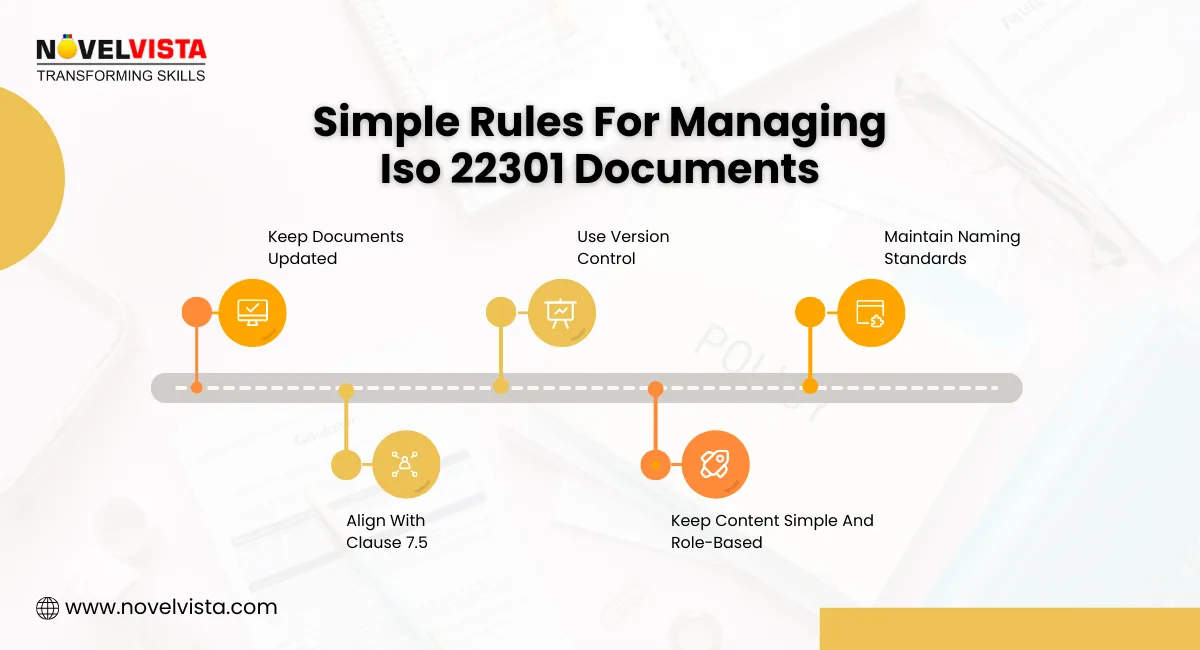
Good documentation is not about creating huge binders. It’s about making your ISO 22301 Documents easy to use, easy to update, and easy to present during audits. A clean structure saves time, reduces confusion, and keeps your teams aligned.
Here are some friendly and practical ways to manage all your documents:
Make sure every document has a unique name, version number, approval record, and owner so that no one mixes old files with updated ones during daily work or during audits.
Use short instructions, clean templates, and quick summaries so teams don’t feel lost while reading or using your continuity plans during real disruptions or training sessions.
If you also follow ISO 27001 or ISO 9001, build your documents using a similar structure to make compliance easier, reduce duplication, and help teams manage fewer templates across three systems.
Good document practices save time and help everyone feel confident during real incidents and during certification audits.
Here’s a simple, scannable list you can use to verify your BCMS documentation. It helps you stay organized and gives a quick view of what’s mandatory and what’s supportive.
Category |
Key Documents |
Purpose |
Policies |
Scope, BC Policy, BC Objectives |
Define boundaries, leadership commitment, and performance targets for your BCMS. |
Records |
Competence Records, Legal & Regulatory List, Internal Audit Records, Management Review Records |
Show compliance, team capability, and continuous monitoring through audits and reviews. |
Procedures |
Business Continuity Plans (BCPs), Incident Response Procedures |
Provide step-by-step guidance for responding to disruptions and restoring operations. |
Supportive Documents |
Business Impact Analysis (BIA), Risk Assessment Reports, Training & Testing Procedures |
Strengthen planning, improve team readiness, and enhance the design of your BCMS. |
This checklist alone helps many teams prepare for certification without feeling overwhelmed.
Lead auditors rely heavily on documentation because it tells the entire story of how your BCMS works behind the scenes. They want to see proof that the system isn’t just written, it’s active, maintained, and used.
Here’s what they look for during documentation reviews:
Completeness and relevance: They check whether all required documents exist and whether the content actually reflects your operations and continuity approach instead of being copied from generic templates.
Version control and updates: They verify if all documents have proper version history, approvals, and updates so the BCMS remains accurate and doesn’t depend on outdated practices or missing information.
Evidence and traceability: They look for records that connect decisions, actions, and results, like linking BIA findings to continuity strategies or linking training sessions to competence logs.
Real-world readiness: Auditors check if your plans and procedures can actually work during disruptions, which becomes clear when your documents are clean, aligned, and easy for teams to follow.
These insights reflect what our lead auditor faculty members emphasise during audit simulations. When documents link decisions, evidence, roles, and results clearly, auditors find it easier to verify compliance and understand the maturity of your BCMS.
People preparing for lead auditor roles often underestimate how important good documentation skills are. Clear documents not only help companies get certified, they help auditors understand gaps and assess systems correctly.
Here’s how documentation supports training and skill-building:
Working with structured documents makes it easier to understand how each clause connects with real BCMS activities and why the standard expects certain controls and evidence.
When you review well-designed documents, it becomes easier to identify what's missing, what needs improvement, and what qualifies as effective compliance during audits.
People preparing for lead auditor roles often help companies fix gaps. Clean documentation makes this process smoother and boosts confidence during stakeholder discussions.
A well-organized documentation set helps auditors easily trace evidence, verify controls, and make clear decisions without confusion or delays.
Learning documentation the right way gives auditing professionals a stronger base and helps them perform with more clarity.

Strong ISO 22301 documentation isn’t just about passing an audit, it’s what keeps your teams steady when things go wrong. When your scope, policies, plans, and records are clear, everyone knows what to do, how to respond, and how to recover without panic. A well-built document set turns your BCMS into something people can actually follow, not something that just sits in a folder.
It brings structure, confidence, and predictability to your continuity efforts. With the right documents in place, your organization becomes more prepared, more resilient, and far easier to audit. It’s one of the simplest ways to strengthen your entire business continuity journey.
Everything shared in this guide reflects the documentation challenges, audit findings, and improvement methods we’ve seen across multiple BCMS training and implementation projects. These practices help organizations build documentation that works in daily operations, not just for certification.
Essential ISO 22301 documents include a Business Continuity Policy, a defined BCMS scope, risk assessment and Business Impact Analysis (BIA) reports, business continuity strategies, incident response and recovery procedures, communication plans, resource allocation records, testing and exercise reports, performance monitoring records, and internal audit and management review documentation. Together, these documents help establish, implement, maintain, and continually improve an effective Business Continuity Management System (BCMS).
Essential ISO 22301 records include Business Impact Analysis (BIA) reports, risk treatment plans, exercise and testing results, incident logs, competency records, supplier evaluation reports, and evidence of continual improvement. Together, these records demonstrate the effectiveness of the Business Continuity Management System (BCMS) and provide auditors with the evidence needed to assess compliance.
Procedures should provide clear, practical guidance so teams know exactly how to respond during disruptions. While ISO 22301 does not require a specific format, auditors expect procedures to clearly define roles and responsibilities, activation criteria, and step-by-step recovery actions.
While ISO 22301 does not prescribe a fixed documentation template, all documents must be properly controlled, traceable, and regularly reviewed. To maintain consistency and ensure audit readiness, most organizations use standardized templates for policies, Business Impact Analyses (BIAs), risk registers, and business continuity plans.
Author Details

Course Related To This blog
ISO 22301:2019 Lead Auditor
Confused About Certification?
Get Free Consultation Call
Stay ahead of the curve by tapping into the latest emerging trends and transforming your subscription into a powerful resource. Maximize every feature, unlock exclusive benefits, and ensure you're always one step ahead in your journey to success.