Category | Quality Management
Last Updated On 23/01/2026
Audits don’t usually fail because someone forgot to upload a document. ISO 20000 audit failures happen when deeper Service Management System problems stay hidden for too long. By the time a certification or surveillance audit happens, those gaps surface all at once.
Across ISO 20000 Lead Auditor training programs and real certification audits, a consistent pattern emerges: organizations rarely fail because of missing templates. Failures surface when governance gaps and weak lifecycle control go unnoticed across multiple audit cycles.
For Lead Auditors, ISO 20000 audit failures are no surprise. They are signals that governance, ownership, and process integration were weak long before the audit began. This article explains why failures still happen, what patterns auditors see repeatedly, and how Lead Auditors can spot and prevent them early.
An ISO 20000 audit failure typically means repeated or systemic nonconformities that show the SMS is not working as intended. It’s not about one missed clause. It’s about a system that looks compliant on paper but breaks under audit scrutiny.
Most failures come from familiar root causes:
This is where Lead Auditors matter most. Through risk-based judgment and early gap detection, they can prevent small weaknesses from turning into ISO 20000 audit failures that threaten certification.
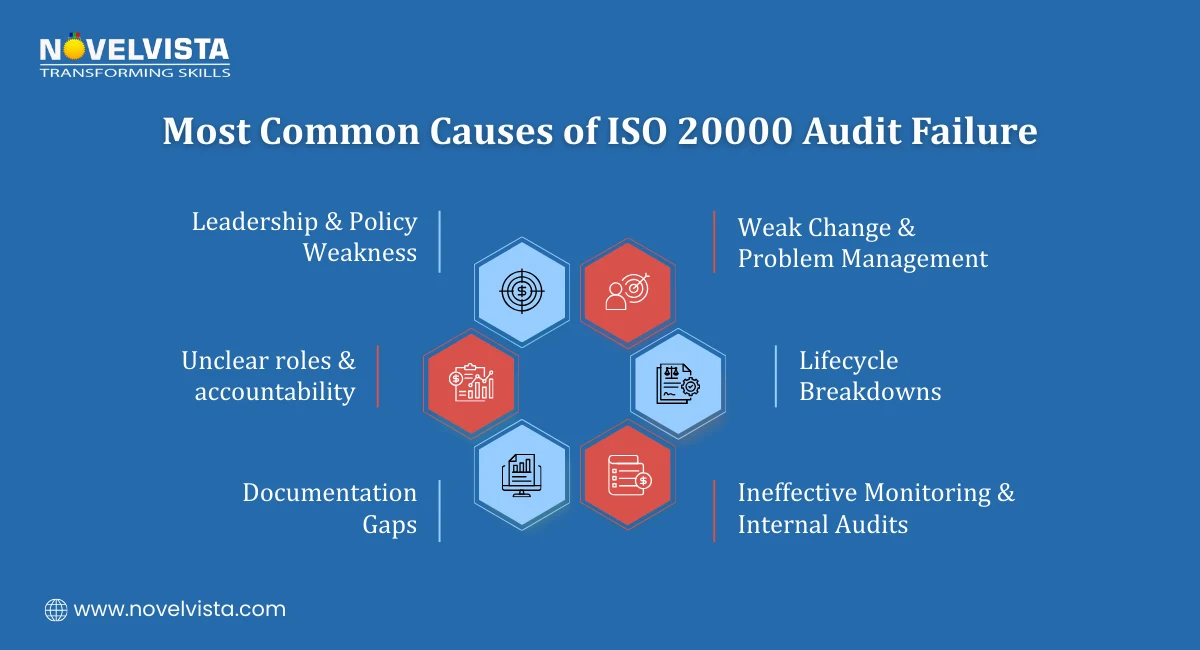
Across industries, auditors see the same patterns again and again. These common ISO 20000 audit failures usually fall into a few clear categories.
When leadership treats ITSM as an operational detail, audits suffer.
Typical signs include:
These gaps weaken direction and accountability, leading directly to ISO 20000 audit failures.
Audits quickly expose confusion around ownership.
Common issues include:
Without ownership, issues move sideways instead of being fixed. This is one of the most common ISO 20000 audit failures.
Documentation is still important, but only when it reflects reality.
Auditors often find:
When documentation cannot support audit trails, it increases the risk of ISO 20000 audit failures even if operations seem stable.
Processes that exist but don’t add control are a major risk.
Examples include:
These weaknesses signal that the SMS is reactive, not managed.
Lifecycle gaps are among the most serious causes of audit failure.
Auditors see:
Lifecycle disconnects almost always escalate into ISO 20000 audit failures.
Monitoring exists, but action doesn’t.
Typical findings include:
These are classic common ISO 20000 audit failures that repeat across audits. In real-world audits, leadership and ownership gaps almost always appear before documentation issues. When process accountability is unclear, corrective actions tend to be superficial, leading to repeated findings across audits.
When ISO 20000 audit failures occur, the impact goes beyond the audit report.
Auditors may raise:
If issues persist, organizations face:
Operationally, failures often lead to:
This is why Lead Auditors focus so strongly on how to avoid ISO 20000 audit failures, not just how to report them. Experienced Lead Auditors understand that major nonconformities rarely stand alone. They usually reflect accumulated weaknesses in monitoring, internal audits, and continual improvement mechanisms.
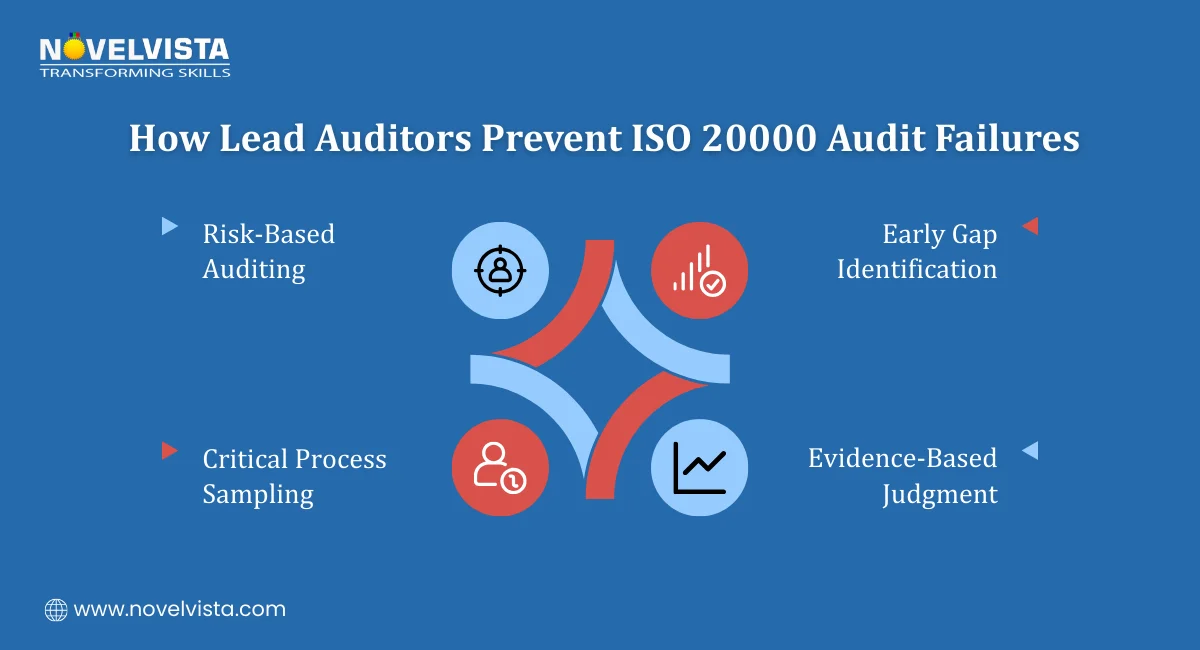 Preventing ISO 20000 audit failures is not about being stricter. It’s about being smarter. Strong Lead Auditors look beyond surface compliance and focus on risk, integration, and effectiveness.
Risk-based auditing is the strongest defense against ISO 20000 audit failures.
Effective Lead Auditors:
This approach helps uncover systemic weaknesses early and is one of the most reliable ways to understand how to avoid ISO 20000 audit failures.
Audits don’t start on audit day. Experienced auditors rely heavily on early insight.
Good practices include:
Reviewing the effectiveness of previous corrective actions is one of the strongest indicators of SMS maturity. Auditors trained in this approach can often predict audit outcomes before formal testing begins.
Documentation should explain how services actually work, not how they are supposed to work.
Lead Auditors should:
This mindset prevents one of the most common ISO 20000 audit failures: “documented but not implemented.”
Leadership involvement is often claimed but rarely tested.
Auditors should look for:
Auditor guidance increasingly highlights leadership-driven governance as a deciding factor in audit outcomes, especially when determining whether SMS issues are systemic or isolated.
Processes don’t exist in isolation.
Lead Auditors should verify:
Integration gaps are a clear signal of common ISO 20000 audit failures waiting to surface.
Training records alone don’t prove competence.
Auditors should confirm:
Gaps between training and performance often explain why audits fail repeatedly.
Want a deeper look at what really blocks successful audits? Explore our in-depth blog on ISO 20000 audit challenges and how to overcome them with practical insights and proven solutions.
Real audit failures follow patterns.
Common examples include:
In many cases, structured training, automation, and monthly internal audits corrected these issues. These examples show where Lead Auditors should probe deeper to prevent ISO 20000 audit failures instead of reacting to them.
See the ISO 20000 nonconformities auditors raise most often. Understand why they happen, what evidence auditors expect, and how to prevent repeat findings before your next audit.
Preventing ISO 20000 audit failures requires judgment, not enforcement.
Strong Lead Auditors:
The goal is not to catch mistakes. It’s to ensure the SMS can sustain control under pressure.
This mindset is central to understanding how to avoid ISO 20000 audit failures while maintaining audit independence.
Lead Auditors can use this simple checklist during audits:
This checklist directly addresses common ISO 20000 audit failures and helps auditors stay focused on what really matters.
For a clearer, more confident audit approach, explore our detailed blog on the ISO 20000 audit checklist to see what to verify, prepare, and review at every stage.
ISO 20000 audit failures are rarely about missing documents. They signal deeper weaknesses in governance, integration, and system effectiveness. Lead Auditors play a critical role in prevention by focusing on risk, lifecycle control, and real evidence.
Preventing ISO 20000 audit failures depends on auditor judgment, not rigid checklists. Strong Lead Auditors combine technical knowledge, real audit experience, and evidence-based decision-making to protect both certification value and service reliability.
When audits go beyond checklists, they protect certification value, service stability, and organizational trust. That’s the real purpose of auditing, and the strongest way to prevent failure before it happens.

If you want to prevent ISO 20000 audit failures before they happen, NovelVista’s ISO 20000 Lead Auditor Certification Training is the right next move. The program focuses on risk-based auditing, lifecycle evaluation, evidence assessment, and real audit scenarios. You’ll gain the judgment and confidence needed to lead audits, identify systemic risks early, and deliver audits that strengthen service management, not just pass certification checks.
Author Details

Course Related To This blog
ISO 20000:2018 Lead Auditor
Confused About Certification?
Get Free Consultation Call
Stay ahead of the curve by tapping into the latest emerging trends and transforming your subscription into a powerful resource. Maximize every feature, unlock exclusive benefits, and ensure you're always one step ahead in your journey to success.