Checklist for ISO 20000 Audit – What Auditors Look For

Category | Quality Management

Last Updated On

Checklist for ISO 20000 Audit – What Auditors Look For | Novelvista

Someone asks, “Are we ready for the ISO 20000 audit?”
Everyone nods. Documents are shared. Tools look active.
Then the auditor asks a simple follow-up question — “Show me how this actually works.”

That’s where most teams pause.

A Checklist for ISO 20000 Audit is not about ticking boxes. It helps you check whether your Service Management System is truly working across Clauses 4 to 10, the same way auditors will check it.

This blog gives you a clear, auditor-focused Checklist for ISO 20000 Audit, explaining clause-wise expectations, real evidence auditors ask for, common gaps, and practical preparation tips, so your audit feels controlled, not stressful.

Why an ISO 20000 Audit Checklist Matters

In our audit preparation workshops, teams often realize that documentation alone does not build audit confidence. Auditors consistently test awareness, ownership, and execution. This checklist mirrors that reality, helping organizations prepare for how auditors validate service management in practice.

A strong Checklist for ISO 20000 Audit helps you:

  • Check SMS readiness beyond documents: It ensures your Service Management System is understood, followed, and measured in daily operations, not just written down to satisfy audit requirements.
     
  • Align teams before the auditor arrives: Everyone, from leadership to service desk staff, understands their role, responsibilities, and what evidence they may be asked to explain.
     
  • Reduce last-minute surprises: You identify gaps early, missing records, unclear ownership, and weak reviews, so fixes happen before audit day, not during it.

Auditors verify three things together: what you planned, what you implemented, and what results you achieved. That same thinking shapes the checklist used throughout this blog.

ISO 20000 Audit Checklist by Clauses

This section walks through what auditors typically verify clause by clause during certification and surveillance audits, using a practical Checklist for ISO 20000 Audit approach.

Clause 4 – Context of the Organization

Auditors start here to understand whether your SMS is built for your actual business environment, not copied from a template.

  • Defined internal and external issues: Auditors check whether business goals, regulatory needs, customer expectations, and internal challenges are clearly identified and reviewed, showing that the SMS is designed for real organizational conditions.
     
  • Interested parties and their needs identified: Evidence should show customers, suppliers, regulators, and internal teams are identified, with their service expectations understood and considered while designing and improving the SMS.
     
  • Clear and approved SMS scope: The scope must clearly state which services, locations, and teams are included, approved by management, and consistent with what is actually delivered and audited.

This clause sets the foundation. If context is weak, auditors often expect issues in later clauses too.

Clause 5 – Leadership

Auditors don’t just ask if leadership exists. They check if leadership is visible.

  • Top management commitment and policy: Auditors verify that leadership has approved the service management policy, understands it, and supports SMS objectives through decisions, reviews, and resource allocation.
     
  • Defined roles, responsibilities, and authority: Job roles must clearly show who owns services, processes, approvals, and decisions, with staff able to explain their responsibilities without confusion or guessing.
     
  • Evidence of leadership involvement: Meeting minutes, reviews, approvals, and actions should show leaders actively guiding the SMS, not only signing documents created by operational teams.

From an auditor’s viewpoint, leadership evidence carries more weight than process documents. In lead auditor training sessions, we emphasize that visible leadership involvement often determines whether an audit progresses smoothly or raises early concerns, even when operational controls appear strong.

Clause 6 – Planning

Planning tells auditors whether your SMS is proactive or reactive.

  • Measurable service management objectives: Objectives should be clear, measurable, monitored, and aligned with business goals, not vague statements that cannot be tracked or evaluated for performance.
     
  • Risk and opportunity assessment with actions: Auditors expect to see risks identified, evaluated, and addressed with actions, owners, and follow-ups, showing risk-based thinking is actually practiced.
     
  • Change planning integrated into the SMS: Planning for changes should consider service impact, risks, approvals, and communication, proving that changes are controlled and not handled informally.

A solid planning approach makes the rest of the audit smoother because it explains why processes exist the way they do.

Clause 7 – Support

This clause checks whether your SMS is properly supported by people, tools, and information.

  • Competence and training records: Auditors verify staff competence through training records, certifications, onboarding plans, and role-based learning, ensuring people managing services are capable and prepared.
     
  • Adequate resources and tools: Tools like service desks, monitoring systems, and reporting platforms should be suitable, available, and actually used as defined within service management processes.
     
  • Controlled documented information: Policies, procedures, and records must be approved, version-controlled, accessible, and updated, ensuring teams use the right information consistently.

Support weaknesses often show up during interviews, when staff struggle to explain tools, procedures, or escalation paths.

Evidence Auditors Expect During an ISO 20000 Audit

This is where many teams get surprised. Having documents is good, but auditors look for proof that things actually work in real life. A solid Checklist for ISO 20000 Audit always connects documents with real execution.
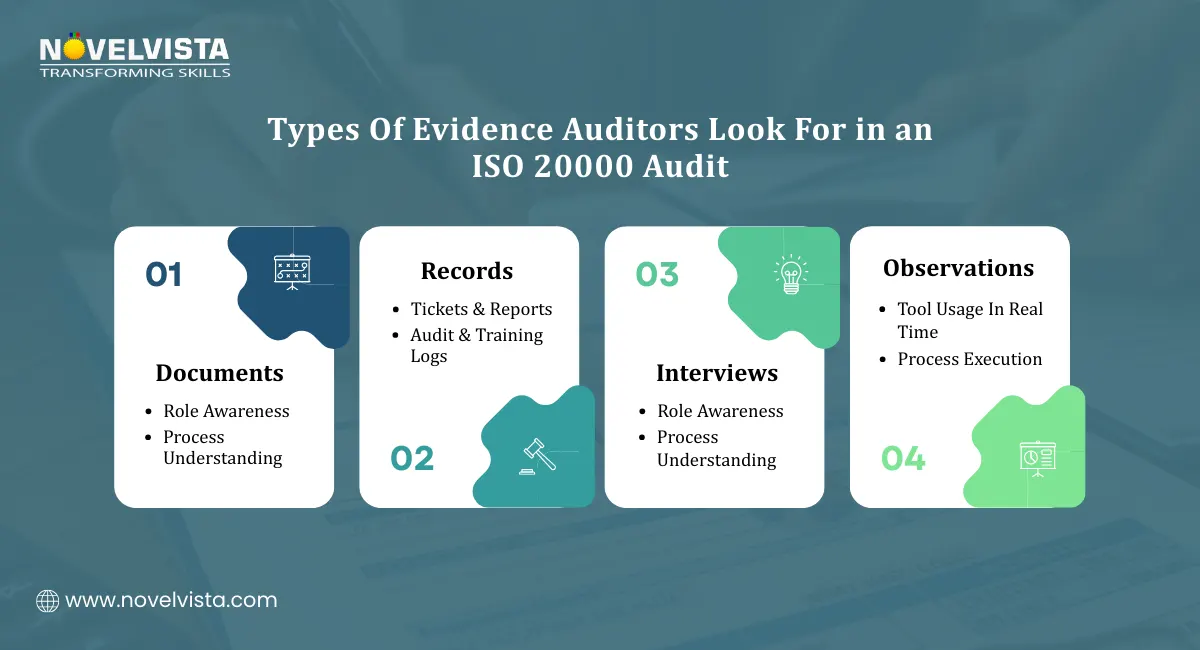
Types Of Evidence Auditors Look For in an ISO 20000 AuditAuditors usually rely on four main types of evidence. Let’s break them down in a simple way.

1. Documents

Documents show how your Service Management System is designed.

Auditors commonly check:

  • Policies and procedures: These explain how IT services are planned, delivered, monitored, and improved. Auditors verify that documents are approved, current, and aligned with ISO 20000 requirements, not copied templates.
     
  • Service Level Agreements (SLAs): SLAs must clearly define service targets, responsibilities, and review mechanisms. Auditors check whether SLAs are realistic, measurable, and actually used for monitoring performance.
     
  • Process definitions: Incident, change, problem, and supplier processes should be clearly defined. Auditors compare these documents with how teams actually work day to day.

Confused about ISO 20000 documentation? Check out our blog on Mandatory vs Optional Documents to see which records are essential, which are optional, and how to streamline your ITSM system.

2. Records

Records are often the strongest evidence because they show what really happened.

Auditors usually review:

  • Tickets and service records: Incident, service request, problem, and change tickets must show consistent usage, proper categorization, priority handling, and closure with evidence of resolution.
     
  • Reports and dashboards: SLA reports, availability reports, capacity trends, and supplier scorecards help auditors see whether monitoring is regular and meaningful.
     
  • Training and competence records: These records prove that people performing SMS roles are trained, aware, and competent, not just assigned a role on paper.

3. Interviews

Interviews help auditors understand awareness and ownership across the organization.

During interviews, auditors check:

  • Role clarity: People should clearly explain their responsibilities within the SMS. Confusion here often leads to nonconformities.
     
  • Process understanding: Team members should explain how they follow incident, change, or problem processes, not just say “we have a tool for that.”
     
  • Policy awareness: Staff should know key policies, service objectives, and how their work supports service quality.

4. Observations

Observations connect everything together.

Auditors may:

  • Watch tool usage: They observe how tickets are logged, changes are approved, or incidents are escalated in real time.
     
  • Check process flow: Auditors compare documented workflows with actual execution to ensure there are no shortcuts or gaps.
     
  • Verify consistency: They look for consistent behavior across teams, not one team doing things differently without justification.

Auditors rarely rely on a single type of evidence. In our auditor training programs, we stress that documents, records, interviews, and observations must support the same story. This section is structured exactly the way auditors are trained to validate evidence consistency. A solid Checklist for ISO 20000 Audit always connects documents with real execution.
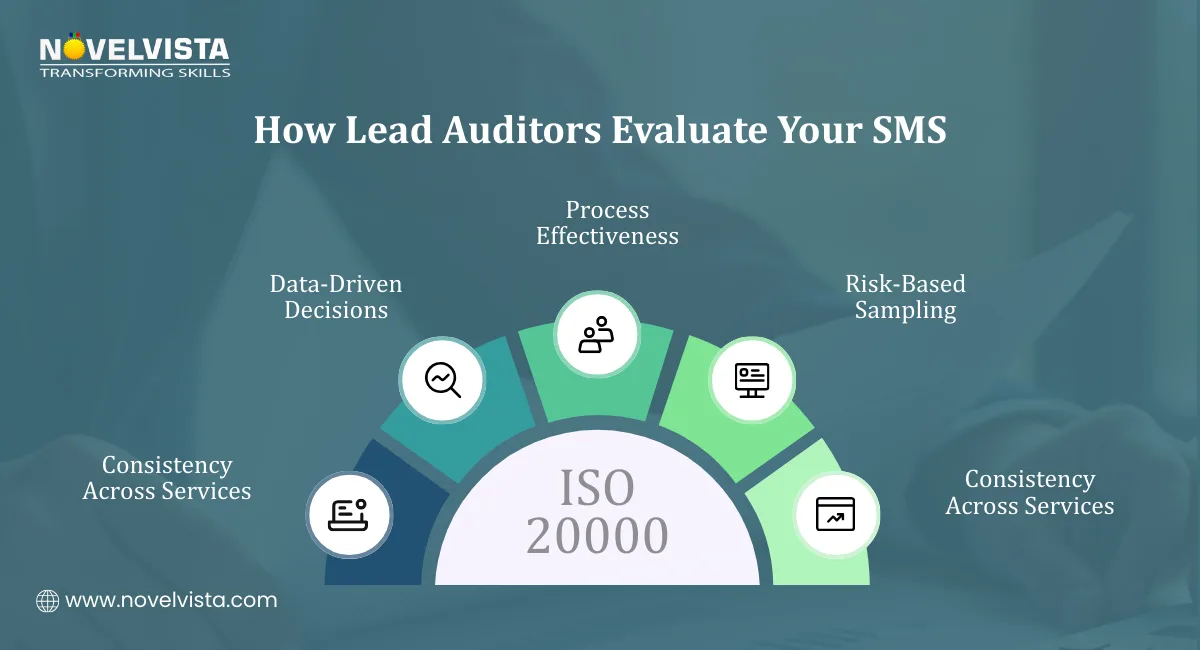
Lead Auditor Perspective: How ISO 20000 Audits Are Evaluated

How Lead Auditors Evaluate Your SMSUnderstanding how auditors think can completely change how you prepare.

Auditors are not looking for perfection. They are looking for confidence, consistency, and control.

Here’s what typically matters most from a lead auditor’s view.

Process Consistency Over One-Off Success

  • Auditors look for patterns, not isolated examples
     
  • A few good incidents don’t help if most tickets lack proper evidence
     
  • Regular SLA reviews matter more than a single strong report
     
  • Consistency across teams and time builds audit confidence

Risk-Based Audit Sampling

  • Auditors sample based on risk, not volume
     
  • High-impact services get deeper attention
     
  • Repeated SLA failures attract closer review
     
  • Changes to critical systems are prioritized

Evidence of Continual Improvement

  • Recurring issues should trigger root cause analysis
     
  • SLA breaches must lead to corrective actions
     
  • Management reviews should result in tracked improvements

Policy, Practice, and Results Alignment

  • Policies define intent
     
  • Processes show execution
     
  • Results prove effectiveness

Auditors connect these three points during Stage 1, Stage 2, and surveillance audits.

Common Nonconformities Seen in ISO 20000 Audits

Many nonconformities repeat across organizations. Knowing them early helps you avoid last-minute stress.

Here are some common gaps auditors report.

  1. Unclear Role Ownership: Roles exist, but responsibilities aren’t clearly defined or understood. This often leads to overlaps, gaps, or over-reliance on individuals instead of structured ownership.

  2. Weak Problem Management: Problems are closed without proper root cause analysis. As a result, the same incidents keep repeating, and corrective actions lack evidence of follow-through.

  3. Poor SLA and Supplier Monitoring: SLAs and supplier agreements are documented but rarely reviewed. Performance issues don’t lead to clear actions or improvements.

  4. Incomplete Internal Audits and Reviews: Audits cover limited areas, and management reviews become routine meetings without tracked outcomes.

These nonconformities are not theoretical. They are repeatedly observed during internal audits, certification audits, and surveillance assessments. We highlight them during training so organizations can address systemic weaknesses before auditors formally record them.

Enhance your ISO 20000 readiness! Read our guide on Internal Audit Requirements to understand key steps, checklists, and best practices that ensure smooth audits and compliance.

Top ISO 20000 Nonconformities & Prevention Guide

See the most common ISO 20000 audit findings and why they keep repeating. Learn what auditors really expect as evidence and how to prevent issues before they appear.

Audit Preparation Tips Using an ISO 20000 Checklist

Preparation works best when it’s focused and practical. Here’s how to keep it simple and effective:

  • Use a structured ISO 20000 checklist: Align it with Clauses 4–10, map documents and records, and keep it updated after audits or changes. This becomes your single source of truth.

  • Run mock audits before certification: Practice interviews, sample records like an auditor, and spot gaps early. Mock audits reduce surprises and build confidence.

  • Prioritize high-risk processes: Focus on incident, change, SLA, supplier, and continuity management. Auditors always start where impact is highest.

  • Show effectiveness, not just documents: Highlight trends, improvements, and corrective actions. Explain how processes work in practice, not just on paper.

Conclusion: Passing the ISO 20000 Audit with Confidence

An ISO 20000 audit becomes far less stressful when preparation matches auditor expectations. A well-structured Checklist for ISO 20000 Audit helps you connect policies, processes, and real evidence. When your SMS shows consistency, awareness, and improvement, auditors see confidence, not chaos.

This checklist is designed to support practical audit readiness, not shortcut compliance. It aligns with ISO 20000 requirements, certification body expectations, and ethical audit practices taught during professional auditor training programs.

Become A Certified ISO 20000 Lead Auditor And Lead High-Impact ITSM Audits

Next Step: Strengthen Your Auditor Readiness with NovelVista

If you want to understand audits from an auditor’s perspective, NovelVista’s ISO 20000 Lead Auditor Certification Training is a strong next step. The course focuses on real audit scenarios, evidence evaluation, and practical checklists. You learn how auditors think, sample, and decide, so you can prepare smarter, reduce nonconformities, and lead ISO 20000 audits with confidence.

Frequently Asked Questions

An ISO 20000 audit is a formal, certification-based audit conducted against mandatory requirements of the ISO 20000-1 standard, while an ITIL assessment is an informal evaluation of how well ITIL best practices are applied. ISO 20000 results in certification, whereas ITIL assessments are used mainly for improvement and maturity benchmarking.
Preparation typically takes 3 to 6 months, depending on process maturity, documentation readiness, and team involvement. The certification audit itself usually takes a few days, followed by time to close any nonconformities.
Yes, internal audits are mandatory under ISO 20000 and help identify gaps before the certification audit. However, the final certification audit must always be conducted by an accredited external certification body.
Common reasons include weak documentation, unclear service scope, poor incident and change records, lack of management review, and ineffective continual improvement practices. In many cases, failures occur due to processes existing on paper but not being consistently followed.
ISO 20000 certification follows a three-year cycle, with surveillance audits conducted annually and a full recertification audit at the end of the cycle. These audits ensure ongoing compliance and continual improvement of the IT service management system.

Author Details

Mr.Vikas Sharma

Mr.Vikas Sharma

Principal Consultant

I am an Accredited ITIL, ITIL 4, ITIL 4 DITS, ITIL® 4 Strategic Leader, Certified SAFe Practice Consultant , SIAM Professional, PRINCE2 AGILE, Six Sigma Black Belt Trainer with more than 20 years of Industry experience. Working as SIAM consultant managing end-to-end accountability for the performance and delivery of IT services to the users and coordinating delivery, integration, and interoperability across multiple services and suppliers. Trained more than 10000+ participants under various ITSM, Agile & Project Management frameworks like ITIL, SAFe, SIAM, VeriSM, and PRINCE2, Scrum, DevOps, Cloud, etc.

Enjoyed this blog? Share this with someone who'd find this useful

Confused About Certification?

Get Free Consultation Call

Sign Up To Get Latest Updates on Our Blogs

Stay ahead of the curve by tapping into the latest emerging trends and transforming your subscription into a powerful resource. Maximize every feature, unlock exclusive benefits, and ensure you're always one step ahead in your journey to success.
Topic Related Blogs