Category | IT Service Management
Last Updated On 21/08/2026
Many teams still do “a lot of IT work” and yet struggle to show real outcomes. Tickets get closed. Changes get deployed. Reports look fine. But business value feels delayed or diluted. That gap is exactly where the ITIL (Version 5) Service Value Chain comes in.
Instead of asking teams to follow fixed processes, ITIL (Version 5) asks a better question: How does value actually move from demand to outcomes? The shift is subtle but powerful. It moves thinking away from activity and toward flow.
In ITIL training sessions, teams often recognize this gap immediately, with high activity levels but delayed business outcomes. Real-world discussions show that value flow breaks down when work is optimized locally instead of end-to-end.
This guide explains the ITIL (Version 5) Service Value Chain, its six core activities, how it fits inside the ITIL Value System, and how it improves on ITIL 4. The goal is simple, help you understand how services create value in real delivery, not just on paper.
So, what exactly is it?
The ITIL 5 Service Value Chain is a set of activities used to create value when a demand or an opportunity arises. It is deliberately not a process, a lifecycle, or a fixed sequence.
Here’s what it is not:
Here’s the key idea: activities are combined dynamically to form value streams. Each situation pulls only the activities it needs.
During practitioner workshops, value streams become clearer when teams map real work instead of diagrams. This exercise consistently highlights why the value chain must remain flexible rather than sequential.
That flexibility is the heart of ITIL (Version 5). The ITIL Service Value System supports many different value streams, and the value chain provides the building blocks to create them.
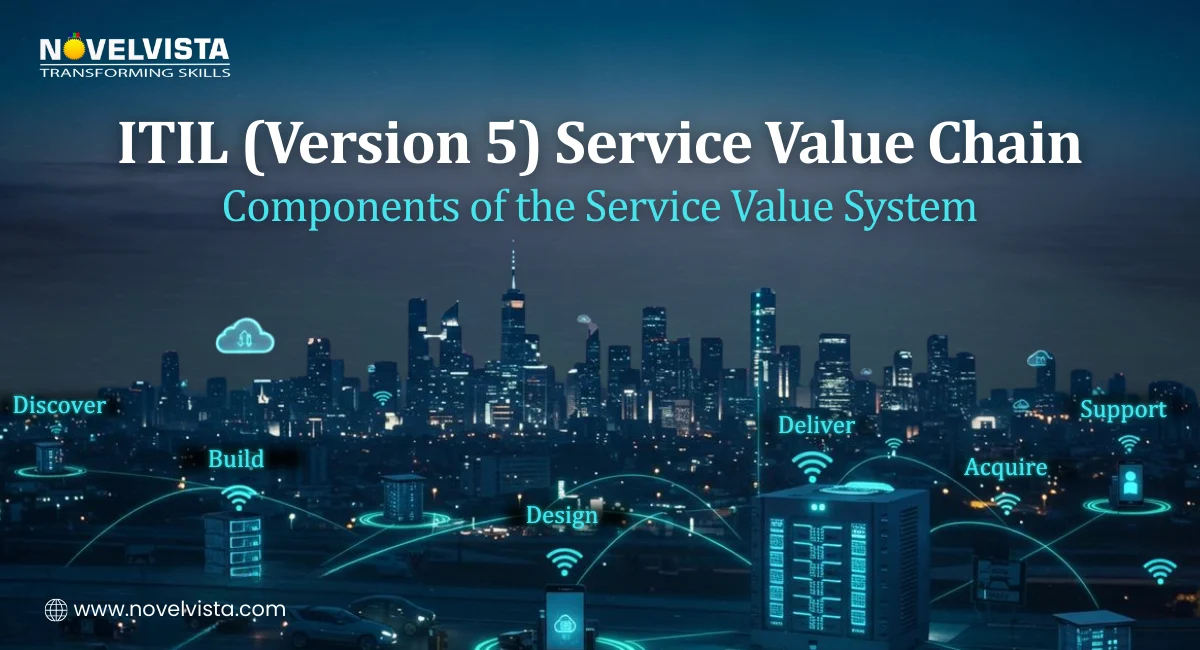
ITIL 5 defines six clear, action-based activities. These ITIL 5 Value Chain Components answer practical questions teams face every day.
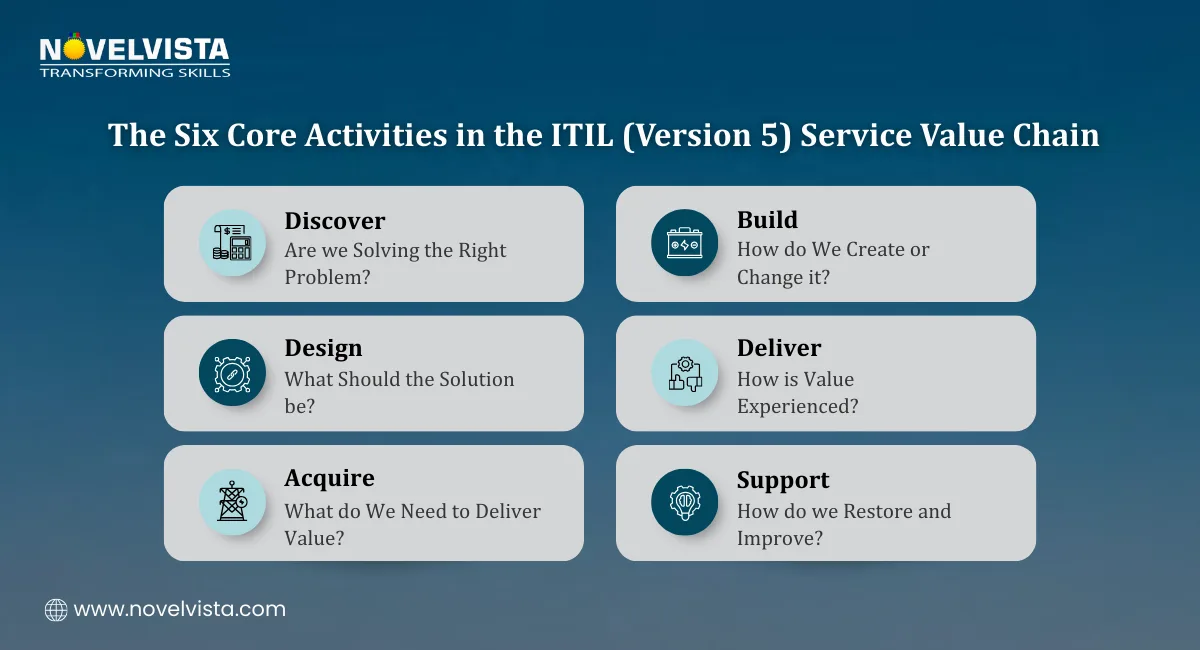
Discover focuses on understanding demand, opportunities, and stakeholder needs.
In real delivery environments, weak discovery is a frequent cause of rework and misaligned priorities. Teams that invest time here consistently reduce downstream change and incident volumes. Strong discovery improves everything that follows in the ITIL (Version 5) Service Value Chain.
Design shapes how value will be delivered.
Good design decisions reduce rework and incidents later. This activity connects strategy to execution inside the ITIL Value System.
Acquire answers to sourcing questions.
In ITIL (Version 5), sourcing is part of value creation, not an afterthought. This is why Acquire is a core part of the ITIL (Version 5) Service Value Chain.
Build is where development and change happen.
Speed matters, but alignment matters more. Building without clarity upstream creates technical output, not business value.
Deliver is where users actually feel the service.
Even a well-designed service fails if delivery is poor. This activity is critical to trust and satisfaction across the ITIL Service Value System.
Support focuses on stability and learning.
Support feeds learning back into Discover and Design, closing the loop inside the ITIL (Version 5) Service Value Chain.
The real strength of the ITIL (Version 5) Service Value Chain shows up when you see how it works day to day. Instead of forcing work through the same steps every time, value streams are created based on the situation.
A value stream is simply a path through the chain that fits the need. There is no fixed order for activities. Teams pull only what they need:
This flexibility is intentional. The ITIL (Version 5) Service Value Chain allows work to adapt to context, urgency, and risk. Instead of optimizing individual processes, teams optimize flow across the ITIL Service Value System. This adaptive use of activities aligns with modern service management models, where flow efficiency matters more than strict process adherence.
The value chain and lifecycle often get confused, but they answer different questions.
The ITIL (Version 5) Service Value Chain explains how value is created when demand exists. It shows how work flows in response to opportunities or needs.
The product and service lifecycle explains ongoing responsibilities, such as:
Some activities continue even when there is no new demand. That’s lifecycle work.
Both models complement each other:
Together, they strengthen the ITIL Value System without overlapping or competing.
Understand why busy IT teams still delay business value and how ITIL (Version 5) Service Value Chain fixes broken value flow to deliver real outcomes.
Aspect |
ITIL 4 Service Value Chain |
ITIL (Version 5) Service Value Chain |
Core intent |
Introduced value-based thinking and flexibility |
Clarified how value-based work should actually flow |
Primary shift |
Moved away from rigid lifecycle stages |
Moved from abstract concepts to practical execution |
Activity naming |
Abstract (Plan, Engage, Improve) |
Action-oriented (Discover, Design, Build, Deliver, Support) |
Ease of interpretation |
Difficult for many teams to interpret |
Easier to understand across IT and non-IT roles |
Use in practice |
Often treated as a fixed sequence |
Explicitly positioned as a flexible toolkit |
Mixing of work types |
Multiple types of work are grouped into a single activity |
Clearer separation of responsibilities |
Product alignment |
Weak and implicit |
Stronger alignment with product and service management |
Lifecycle connection |
Implied, not clearly defined |
Explicitly aligned with product and service lifecycle concepts |
Risk of misuse |
High (diagram-driven, checklist behavior) |
Reduced risk |
Real-world adoption |
Conceptually strong, operationally inconsistent |
More practical and harder to misinterpret |
ITIL (Version 5) improves practical application in several ways:
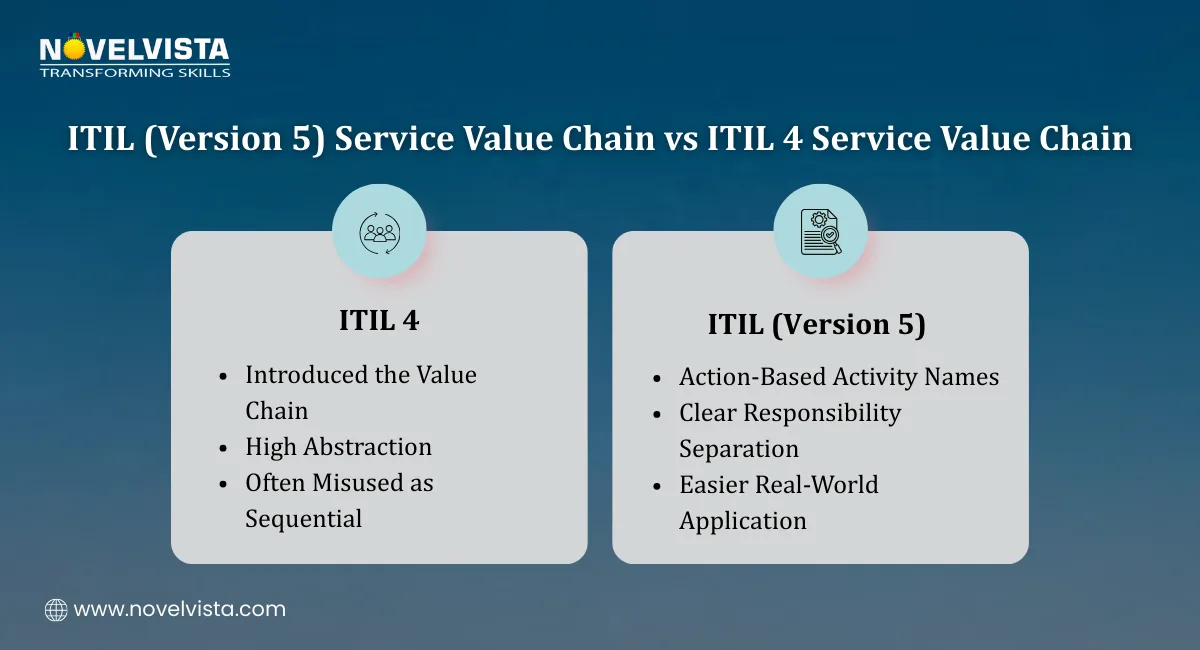
These changes help organizations move from “following ITIL” to actually delivering value through the ITIL Service Value System.
See what else changed in ITIL 4 and what’s new in ITIL (Version 5) in our comprehensive article, which covers a comprehensive comparison of ITIL 4 vs. ITIL (Version 5)
Several myths still exist around the ITIL (Version 5) Service Value Chain:
The value chain is designed to be flexible. Teams collaborate across activities, and value streams evolve based on need. This adaptability is what makes the ITIL Value System work in modern environments. Organizations also use ITIL 5 Value Stream Mapping & Management practices to streamline workflows, eliminate inefficiencies, and improve service delivery outcomes.
The ITIL (Version 5) Service Value Chain is not a diagram to memorize. It’s a way of thinking about how value flows across an organization.
ITIL (Version 5) didn’t reinvent value creation. It clarified it. By focusing on flow, context, and outcomes, the ITIL Service Value System becomes easier to use and easier to trust.
Understanding how value truly flows helps teams move beyond compliance-driven ITSM. Structured learning and practical application together make the ITIL (Version 5) Service Value Chain meaningful and usable. The real shift is moving away from process compliance and toward delivering outcomes that matter.
If you want to understand ITIL (Version 5) beyond theory, NovelVista’s ITIL Foundation (Version 5) Certification Training Course can help. The program focuses on real-life value streams, practical examples, and exam readiness. You’ll gain a clear understanding of the ITIL (Version 5) Service Value Chain, the ITIL Value System, and how to apply them confidently in real service environments.
Author Details

Course Related To This blog
ITIL® 4 Foundation Certification
ITIL V5 Foundation
Confused About Certification?
Get Free Consultation Call
Stay ahead of the curve by tapping into the latest emerging trends and transforming your subscription into a powerful resource. Maximize every feature, unlock exclusive benefits, and ensure you're always one step ahead in your journey to success.