Category | IT Service Management
Last Updated On 27/08/2026
ITIL certifications have always raised one basic question for learners: Where do I start on the ITIL 5 Certification Path, and where does this actually lead?
With ITIL (Version 5), that question matters even more because the structure is no longer a straight ladder. It is designed around roles, depth, and long-term growth.
ITIL has evolved into Version 5 to reflect how service management is practiced today. Work no longer sits neatly inside one team. Services connect to products, platforms, suppliers, and business outcomes. The framework has adjusted to support that reality without throwing away what already works.
This is important to understand early: ITIL 5 is an evolution, not a reset. The ideas are familiar, but the way certifications are organized is clearer and more role-focused.
This article explains:
The goal is clarity, not pressure.
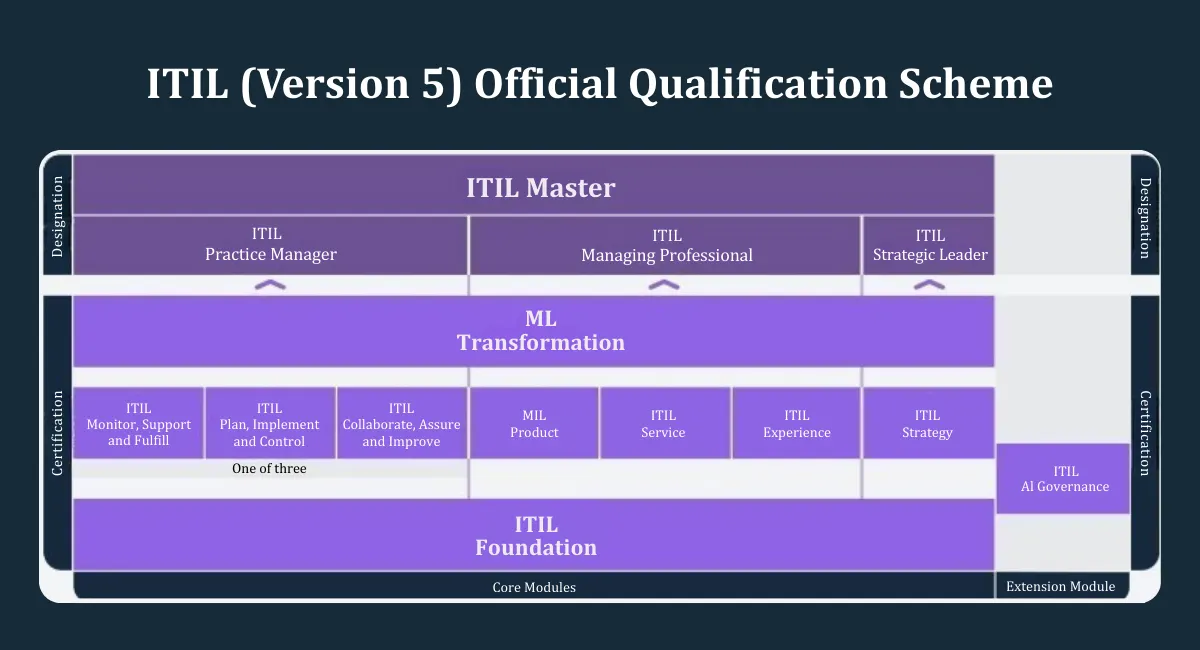
Source: Peoplecert
The ITIL qualification scheme and ITIL (Version 5) Certification Path are built to be simple at the start and flexible as you progress.
At a high level, the structure looks like this:
This design avoids forcing everyone down the same path. Instead, it allows professionals to build depth where it actually matters for their role.
Not all ITIL professionals do the same work. Some focus on operations, some on service delivery, and others on strategy and direction. The ITIL 5 scheme reflects this by offering different streams rather than a single fixed sequence.
This means:
This structure also makes the scheme easy to explain visually, which is why it is often shown as the simplest ITIL (Version 5) Certification roadmap rather than a straight line.
ITIL Version 5 is an evolution that builds on everything professionals already know from ITIL 4, updating the framework to reflect today's digital, product-centric, and AI-enabled reality. Existing knowledge, experience, and certifications remain fully relevant as part of this evolution. The table below shows the key structural differences between the two paths:
| Factor | ITIL 4 Certification Path | ITIL 5 Certification Path |
| Entry Point | ITIL 4 Foundation | ITIL 5 Foundation |
| Streams Available | Managing Professional + Strategic Leader | Practice Manager + Managing Professional + Strategic Leader |
| Practice Coverage | 34 practices tested across modules | 15 practices grouped into 3 specializations under the Practice Manager |
| Transformation Module | Not a standalone requirement | Shared core module required across all three streams |
| AI Coverage | Not included | ITIL AI Governance is available as an extension module |
| Upgrade Route | N/A | ITIL 4 holders are recognized as a valid prerequisite for the Bridge course available |
| Highest Designation | ITIL 4 Master | ITIL 5 Master |
| Certificate Validity | 3 years | 3 years — ITIL 5 certification also renews existing ITIL 4 certifications |
ITIL 4 Foundation is recognized as a valid prerequisite for all upper-level ITIL 5 qualifications. Professionals holding ITIL 4 Foundation do not need to retake the Foundation. The optional Bridge course covers only the Version 5 updates in a 20-question, 30-minute format, making it the most efficient upgrade route for existing ITIL 4 holders.
Every ITIL 5 journey starts in the same place: ITIL 5 Foundation
Foundation is the mandatory entry point, regardless of background, role, or experience. Its purpose is to create a shared understanding before any specialization begins.
At a high level, Foundation focuses on:
The emphasis is on understanding, not depth.
Know More: Official ITIL foundation (version 5) Certification Exam Syllabus
The Practice Manager stream is designed for professionals who work closely with day-to-day service management activities.
This stream is meant for:
The focus is on building depth in selected practice areas, rather than broad coverage across everything.
Instead of asking candidates to learn all practices, the stream allows focused specialization.
In the Practice Manager stream, candidates choose one of the three specializations, with each specialization covering 5 practices grouped by how work is performed.
The three available specializations are:
A. Monitor, Support and Fulfil (MSF)
This group focuses on keeping services running smoothly and meeting user needs.
Practices covered:
B. Plan, Implement and Control (PIC)
This group focuses on planning and controlling service work effectively.
Practices covered:
C. Collaborate, Assure and Improve (CAI)
This group focuses on assurance, collaboration, and ongoing improvement.
Practices covered:
Candidates select one of these specializations based on their role and responsibilities.
To complete the Practice Manager stream, candidates must also complete ITIL Transformation.
Key points to understand:
This requirement ensures that practice expertise is supported by the ability to work through change.
The Managing Professional stream is designed for people who are responsible for managing services and products from end to end. This stream moves beyond day-to-day operations and looks at how different parts of service management come together in real environments.
This stream is meant for:
The focus is on delivery, coordination, and experience. It reflects roles where decisions affect customers, teams, and outcomes at the same time.
Rather than going deep into individual practices, this stream looks at how services and products are designed, delivered, supported, and improved as a whole.
The Managing Professional stream consists of four Certifications:
Together, these certifications build the capability to manage services and products across teams, suppliers, and platforms. Transformation plays a key role here by helping professionals apply learning during change, not just steady-state operations.
The Strategic Leader stream is focused on direction, decision-making, and long-term alignment.
This stream is meant for:
The emphasis is on strategy, oversight, and alignment rather than execution. It helps leaders understand how service management supports organizational goals.
The Strategic Leader stream includes two required modules:
Transformation connects planning with execution, helping leaders move from intent to action without losing control or clarity.
ITIL Transformation sits at the center of the ITIL qualification scheme for a reason. Change is no longer occasional. It is continuous.
Transformation represents:
Key points to remember:
This shared module creates a common understanding of how change is managed, regardless of role.
ITIL AI Governance is offered as an extension module. Extension modules allow professionals to add focused knowledge without changing the core certification structure.
This module focuses on:
Important clarifications:
AI Governance supports professionals who oversee or guide the use of AI in service management environments. There are no prerequisites, including Foundation.
Stop guessing which ITIL 5 path fits your role.
Match your real responsibilities to the right ITIL 5 stream and move forward with confidence, without rushing or restarting.
ITIL 5 Master represents the highest level within the qualification scheme. It signals both breadth and depth of understanding.
To achieve ITIL 5 Master, candidates must complete:
This combination shows the ability to:
ITIL 5 Master is not about speed. It reflects progression, experience, and application.
The ITIL 5 certification path has no fixed timeline or mandatory sequence. The entry point is ITIL 5 Foundation, which launched on 12 February 2026. From there, progression depends entirely on role, availability, and employer support. The table below reflects realistic durations based on the official module structure:
| Certification Level | Estimated Duration | Notes |
| ITIL 5 Foundation | 2 – 3 days training + exam | Mandatory entry point for all streams |
| ITIL 5 Foundation Bridge | 1-day training + exam | For ITIL 4 holders only — covers Version 5 updates |
| ITIL Transformation | 2 – 3 days training + exam | Required across all three advanced streams |
| Practice Manager (one specialization) | 3 – 4 days training + exam | Choose MSF, PIC, or CAI based on role |
| Managing Professional (3 modules + Transformation) | 4 – 6 months | Product, Service, Experience + Transformation |
| Strategic Leader (Strategy + Transformation) | 2 – 3 months | Transformation counts once across all streams |
| ITIL 5 Master | 12 – 24 months total | Completion of all three streams is required |
ITIL 5 certificates are issued with a three-year renewal date. Earning an ITIL 5 certification can also renew existing ITIL 4 certifications within the same product suite. Most professionals working full-time complete the full path over 18 to 24 months, depending on pace and organizational support.
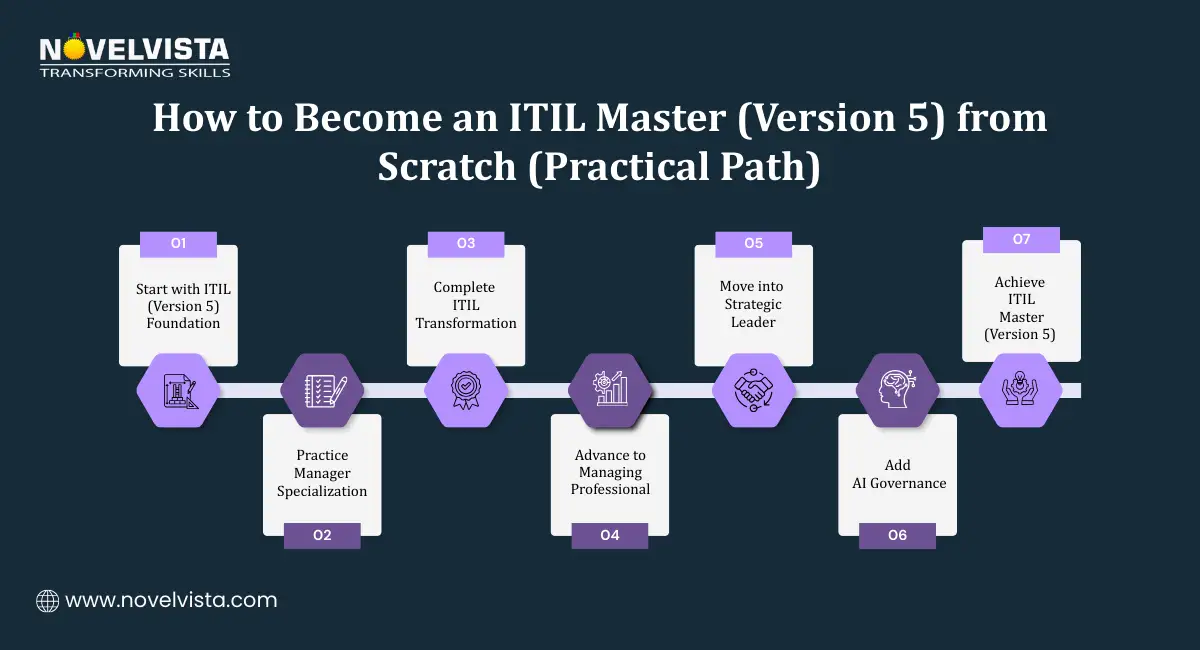
For someone starting fresh, the path to ITIL (Version 5) Master can be approached in a simple, realistic way.
A practical progression looks like this:
Important reminders:
This ITIL (Version 5) Certification path is designed to grow with your career, not pressure it.
Already an ITIL 4 Professional? Know how to move from ITIL 4 to ITIL (Version 5) smoothly without spending any extra cost in our comprehensive ITIL (Version 5) Transition Guide.
ITIL (Version 5) offers a clear and well-organized certification structure. It supports role-based growth, practical learning, and long-term development.
Becoming an ITIL (Version 5) Master is not about collecting certifications quickly. It is about moving through the scheme with purpose, choosing the right depth at the right time, and building capability step by step.
With a strong foundation and thoughtful progression, ITIL (Version 5) provides a flexible and achievable ITIL (Version 5) Certification path to mastery, starting from scratch and growing with experience.

The ITIL 5 certification path starts at Foundation, branches into three role-aligned streams—Practice Manager, Managing Professional, and Strategic Leader, each supported by the Transformation module, and culminates in the ITIL 5 Master designation. The path has no fixed timeline or mandatory sequence and is designed to grow alongside a career rather than pressure it.
For professionals already holding ITIL 4, the path forward is clear. Existing Foundation credentials are recognized as valid prerequisites, and the Bridge course provides a focused upgrade route without repeating previously covered material.
There is no pressure to move quickly. The scheme rewards deliberate, informed progression, and understanding the full structure before starting is itself the most practical first step.
If ITIL foundation (version 5) is part of your certification path, preparing the right way makes a difference. NovelVista’s ITIL foundation (version 5) Certification training course is designed to explain the framework clearly, connect concepts logically, and stay closely aligned with the exam.
Author Details

Course Related To This blog
ITIL® 4 Foundation Certification
ITIL V5 Foundation
Confused About Certification?
Get Free Consultation Call
Stay ahead of the curve by tapping into the latest emerging trends and transforming your subscription into a powerful resource. Maximize every feature, unlock exclusive benefits, and ensure you're always one step ahead in your journey to success.