Category | IT Service Management
Last Updated On 05/09/2026
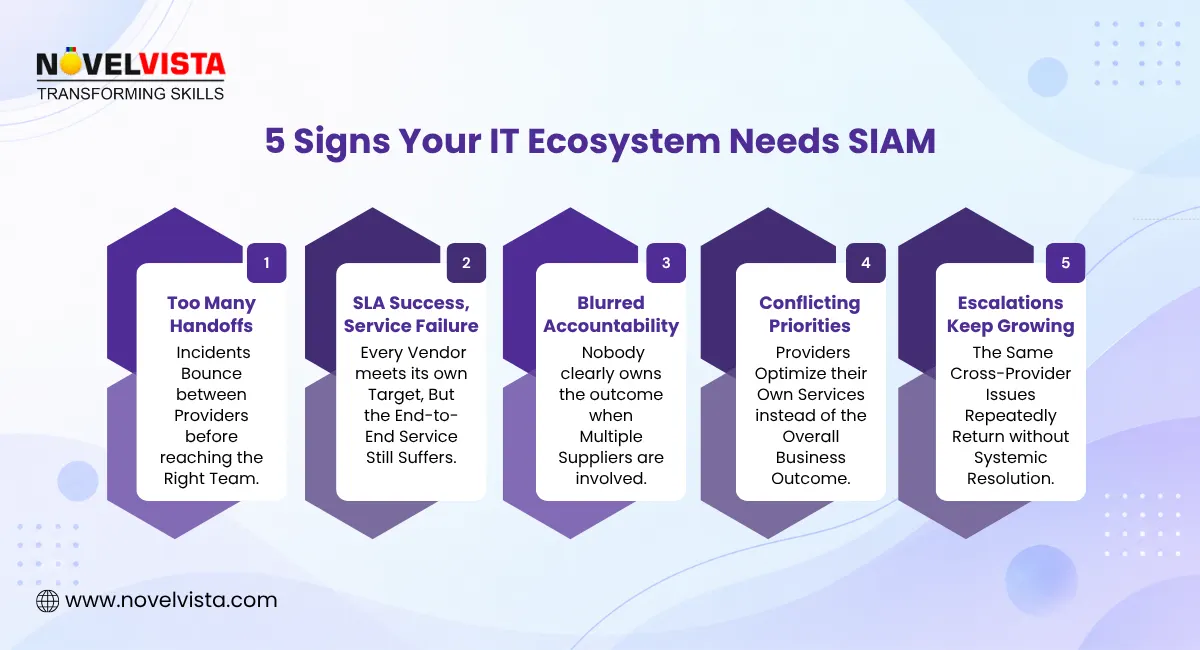
What happens when an organization has five, ten, or even dozens of IT service providers but nobody truly owns the end-to-end service experience?
One provider manages the cloud. Another handles cybersecurity. A third runs the service desk. A fourth manages applications, while another looks after infrastructure.
Individually, each provider may meet its SLA. Yet the customer can still experience a slow, fragmented, and frustrating service.
This is where Service Integration and Management (SIAM) becomes important.
But if you are considering a career in service integration, supplier management, ITSM governance, or digital service management, an important question comes next: What does it actually take to become SIAM Professional certified?
Understanding the siam professional requirements is important before you invest time in training or book an exam.
The certification is positioned at an advanced level and focuses on applying SIAM practices, analyzing real situations, designing governance, and managing complex multi-provider environments. EXIN's updated SIAM Professional certification based on Scopism's SIAM Body of Knowledge (BoK) V3 covers the complete SIAM lifecycle, from Discovery & Strategy through Plan & Build, Implement, and Run & Improve.
So, do you need years of experience? Is Foundation certification mandatory? Do you need an ITIL background? What skills should you have before starting?
Let's break down the siam professional requirements step by step.
SIAM Professional is an advanced certification designed for professionals who need to apply and analyze Service Integration and Management concepts, rather than simply understand SIAM terminology.
The certification focuses on the challenges created when organizations depend on multiple internal and external service providers.
A SIAM professional needs to understand how to:
The updated EXIN SIAM Professional based on Scopism BoK V3 emphasizes real-world decision-making, governance, service-provider integration, sourcing, implementation, and continuous improvement.
In simple terms, SIAM is not about managing one vendor better. It is about making multiple providers work together as one business-facing service ecosystem.
This is one of the most important questions candidates ask.
For the established EXIN SIAM Professional certification, SIAM Foundation is a prerequisite. EXIN's certification structure places Foundation before Professional, with Professional building on the underlying SIAM knowledge.
However, candidates should pay attention to the 2026 transition to the updated Scopism SIAM BoK V3 certification.
EXIN launched the updated SIAM Professional based on BoK V3 in February 2026, and the English exam is available. The previous SIAM Professional exam is scheduled to retire on December 31, 2026.
That means candidates should verify the exact certification route with their accredited training provider before enrolling.
At a glance
| Requirement | Importance |
|---|---|
| SIAM Foundation knowledge/certification | Essential foundation for the Professional path |
| SIAM training | Required by EXIN |
| ITSM knowledge | Strongly recommended |
| Supplier/vendor management knowledge | Highly useful |
| Governance understanding | Highly relevant |
| Service management experience | Strong advantage |
| Project/change management knowledge | Useful |
| Practical multi-provider exposure | Valuable |
The key takeaway is simple: do not treat SIAM Professional as an entry-level certification.
It is designed to test your ability to apply SIAM concepts in realistic situations.
A common misconception is that candidates must have a specific number of years of experience before pursuing SIAM Professional.
The more important issue is relevant professional exposure.
EXIN identifies roles such as Service Managers, Service Management Practitioners, Service Provider Portfolio Managers, Process Managers, Project Managers, and other professionals as suitable audiences for SIAM Professional.
The updated BoK V3 certification also targets roles including:
This tells you something important about the siam professional requirements: practical understanding matters.
For example, experience dealing with supplier SLAs, escalations, service reviews, contracts, incident management, governance meetings, or cross-team coordination can make SIAM concepts much easier to understand.
You do not necessarily need to already have the job title "SIAM Manager."
Instead, you should ideally understand how IT services are delivered across organizational and supplier boundaries.
ITIL and SIAM are closely related, but they are not the same thing.
ITIL provides guidance for managing IT-enabled products and services. SIAM focuses specifically on integrating and governing services delivered through multiple providers.
Think of it this way:
ITIL = How services are managed
SIAM = How multiple providers delivering those services are integrated and governed
This is why an ITIL background can be extremely useful.
Knowledge of incident management, problem management, change enablement, service level management, continual improvement, and service relationships gives you a strong foundation for understanding SIAM.
However, candidates should distinguish between recommended knowledge and formal certification requirements. The exact prerequisite should always be checked against the current EXIN certification route and exam preparation guide.
A certificate alone does not make someone effective at service integration.
SIAM professionals need a combination of technical, operational, governance, analytical, and interpersonal skills.
Multi-provider environments can quickly become confusing when accountability is unclear.
A SIAM professional needs to understand governance structures, decision rights, escalation mechanisms, performance management, and accountability.
You may need to coordinate several providers with different contracts, processes, KPIs, technologies, and organizational cultures.
Vendor management and contract awareness are therefore valuable skills.
The Professional certification goes beyond memorizing definitions.
The updated certification explicitly emphasizes application and analysis, requiring candidates to think through realistic SIAM scenarios and make appropriate decisions.
SIAM operates at the intersection of customers, suppliers, service integrators, internal teams, and business stakeholders.
Strong communication and stakeholder management are essential.
Implementing SIAM can change roles, responsibilities, processes, supplier relationships, and organizational behavior.
That makes organizational change management an important part of the SIAM skill set.
A mature SIAM model should not simply coordinate providers.
It should continuously identify opportunities to improve service quality, collaboration, performance, and business outcomes.
Understanding the exam structure is another important part of the siam professional requirements.
The current EXIN SIAM Professional certification is an advanced, closed-book assessment. EXIN lists the exam at 90 minutes with 40 multiple-choice questions and a 65% pass mark for the existing Professional certification. Training is mandatory.
The updated BoK V3 certification continues to focus on application and analysis rather than simple recall.
The knowledge areas span the SIAM roadmap:
| SIAM Stage | What You Should Understand |
| Discovery & Strategy | Business drivers, strategy, governance and ecosystem considerations |
| Plan & Build | Sourcing, contracts, processes, tooling and performance |
| Implement | Transition, onboarding, organizational change and implementation |
| Run & Improve | Operations, provider performance, audit, compliance and improvement |
The goal is not simply to remember what each stage means.
You should be able to apply SIAM thinking to a business situation and determine an appropriate course of action.
The official SIAM Professional certification draws on the SIAM Body of Knowledge, developed by Scopism. The Professional BoK provides the source material for the EXIN SIAM Professional certification.
Your preparation should therefore focus on understanding concepts rather than memorizing isolated definitions.
A practical preparation approach is:
Step 1: Build your SIAM Foundation knowledge
Understand SIAM terminology, principles, ecosystem structures, roles, governance, and the SIAM roadmap.
Step 2: Understand multi-supplier environments
Learn how different sourcing models, contracts, providers, processes, and technologies interact.
Step 3: Study the SIAM lifecycle
Focus on Discovery & Strategy, Plan & Build, Implement, and Run & Improve.
Step 4: Practice scenario-based thinking
Ask yourself: "What would I do if two providers dispute ownership of an incident?" or "How should governance change when a new provider joins the ecosystem?"
Step 5: Use the official preparation material
EXIN provides preparation guides, case studies, sample exams, and other certification resources.
Before committing to your certification journey, it is also worth understanding the investment involved. Our guide to SIAM Certification Cost breaks down the expenses you may need to consider, including training and certification-related costs, so you can plan your SIAM certification journey with greater clarity.
The siam professional requirements make this certification particularly relevant to professionals already working around service management and multi-provider environments.
It can be valuable for:
It can also be relevant if your organization is moving toward a multi-sourcing, hybrid IT, cloud, or ecosystem-based operating model.
The broader market context is also interesting. EXIN cites a Scopism Kinetic IT State of SIAM survey in which more than 36% of surveyed SIAM practitioners reported earning $80,000 or more. This is survey data rather than a universal salary benchmark, but it illustrates the potential value organizations place on specialized SIAM capability. As SIAM becomes a more specialized capability within IT service management, professionals naturally want to understand its career and earning potential. If you are considering SIAM as a long-term career path, explore our detailed guide on SIAM Professional Salary to see what compensation can look like across different markets and experience levels.
Before starting your certification journey, ask yourself:
If most of these answers are "yes," you are likely approaching the certification from the right direction.
IT environments are becoming increasingly interconnected.
Organizations rarely depend on a single technology provider anymore. Cloud platforms, SaaS providers, managed service providers, cybersecurity vendors, application teams, infrastructure teams, and specialist partners can all contribute to one business service.
This creates a new management challenge.
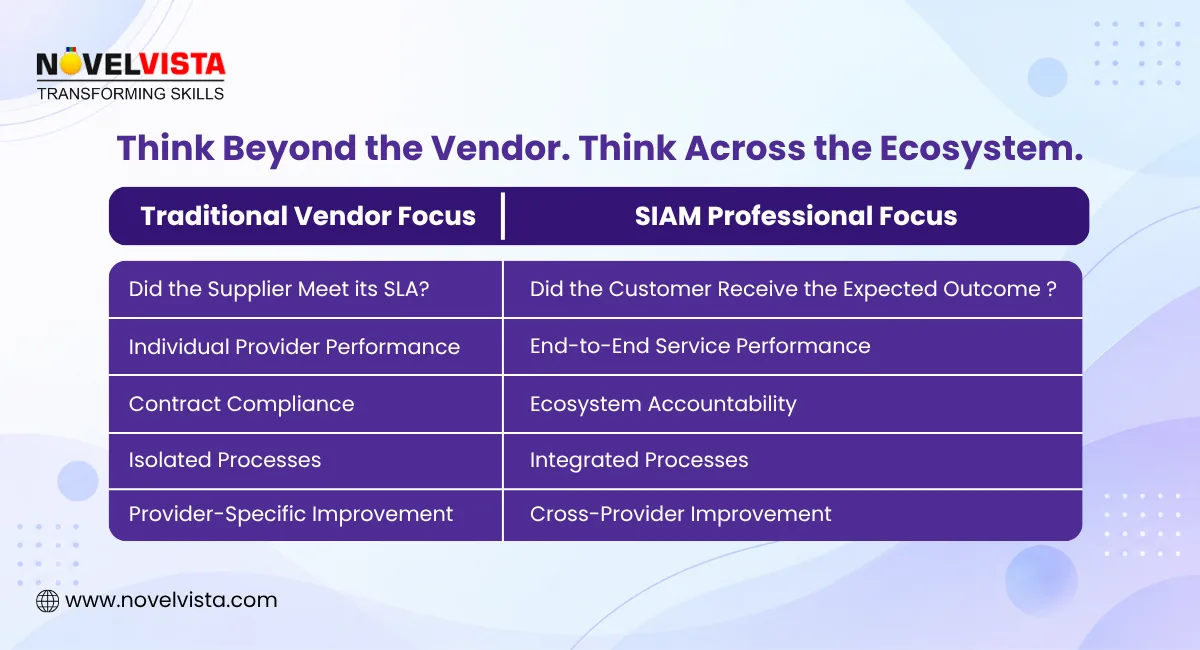
The question is no longer simply:
"Is each provider performing well?"
It becomes:
"Is the entire ecosystem delivering the expected business outcome?"
That shift is at the heart of modern SIAM.
The updated SIAM BoK V3 reflects this broader ecosystem perspective, emphasizing collaboration, end-to-end accountability, governance, sourcing decisions, and continuous improvement.
For professionals, that creates an opportunity to move beyond traditional vendor management into service integration, governance, transformation, and strategic service management.
The siam professional requirements are about more than simply checking boxes before an exam. You need the right foundation, relevant ITSM understanding, formal training, and, most importantly, the ability to analyze and manage complex multi-provider environments.
If you already work in service management, supplier management, IT governance, architecture, projects, or transformation, SIAM Professional can help formalize and strengthen the skills you need to manage today's increasingly connected IT ecosystems.
With the SIAM certification landscape moving toward the updated Scopism BoK V3 in 2026, it is also important to prepare against the current certification route and exam version rather than relying on outdated material. For professionals looking to build these capabilities through structured learning, NovelVista's SIAM Professional Training & Certification offers a focused path to develop the knowledge needed for the certification journey.
The future of IT service management is increasingly about connecting providers, processes, technology, and people. SIAM professionals are positioned right at that intersection turning a collection of service providers into a coordinated service ecosystem.
The main siam professional requirements include the appropriate Foundation pathway, mandatory training, and preparation for an advanced exam focused on applying SIAM concepts. Relevant ITSM and supplier-management knowledge is highly beneficial.
For the established EXIN SIAM Professional route, SIAM Foundation is a prerequisite. Candidates should check the current EXIN requirements when choosing the updated BoK V3 pathway.
ITIL certification is not the same as a SIAM prerequisite. However, ITIL and ITSM knowledge can provide a strong foundation because SIAM operates closely with service-management practices.
SIAM Professional is an advanced certification and is better suited to professionals with ITSM, supplier management, project, transformation, or related experience. Starting with SIAM Foundation is a sensible route.
Important skills include service integration, governance, supplier management, stakeholder management, organizational change, analytical thinking, and continual improvement.
Author Details

Course Related To This blog
SIAM Professional Training & Certification
Confused About Certification?
Get Free Consultation Call
Stay ahead of the curve by tapping into the latest emerging trends and transforming your subscription into a powerful resource. Maximize every feature, unlock exclusive benefits, and ensure you're always one step ahead in your journey to success.