Category | IT Service Management
Last Updated On 22/09/2026

Here is a number worth sitting with: organizations running mature Service Integration and Management practices report significantly fewer service outages and faster vendor issue resolution than those without a formal SIAM structure in place. As multi-vendor IT ecosystems become the norm rather than the exception, the people who can hold those ecosystems together are being paid accordingly. That is exactly why the SIAM Professional salary conversation has become one of the most searched topics among IT service management practitioners this year.
If you are weighing whether to pursue this certification, or you already hold it and want to know what you should be negotiating for, you are not alone. Is a SIAM Professional certification actually worth the investment? Does the SIAM Professional salary differ meaningfully from what a SIAM Foundation holder earns? And how much does geography change the picture? This guide answers all three questions with real numbers, real role titles, and a framework you can use to benchmark your own worth in todays market.
Before breaking down numbers, it helps to understand what separates the two certification tiers, since this distinction shapes every SIAM Professional salary figure you will see in job postings and salary surveys.
SIAM Foundation is the entry point. It establishes core vocabulary, the SIAM roadmap, and a working understanding of how integrated service management functions across an ecosystem of providers. SIAM Professional, by contrast, goes deeper into practical application: designing SIAM models, managing multi-vendor governance structures, and handling the organizational change required to embed SIAM practices. Employers hiring for strategic or leadership-track roles overwhelmingly prefer candidates with the Professional-level credential, which is reflected clearly in compensation data.
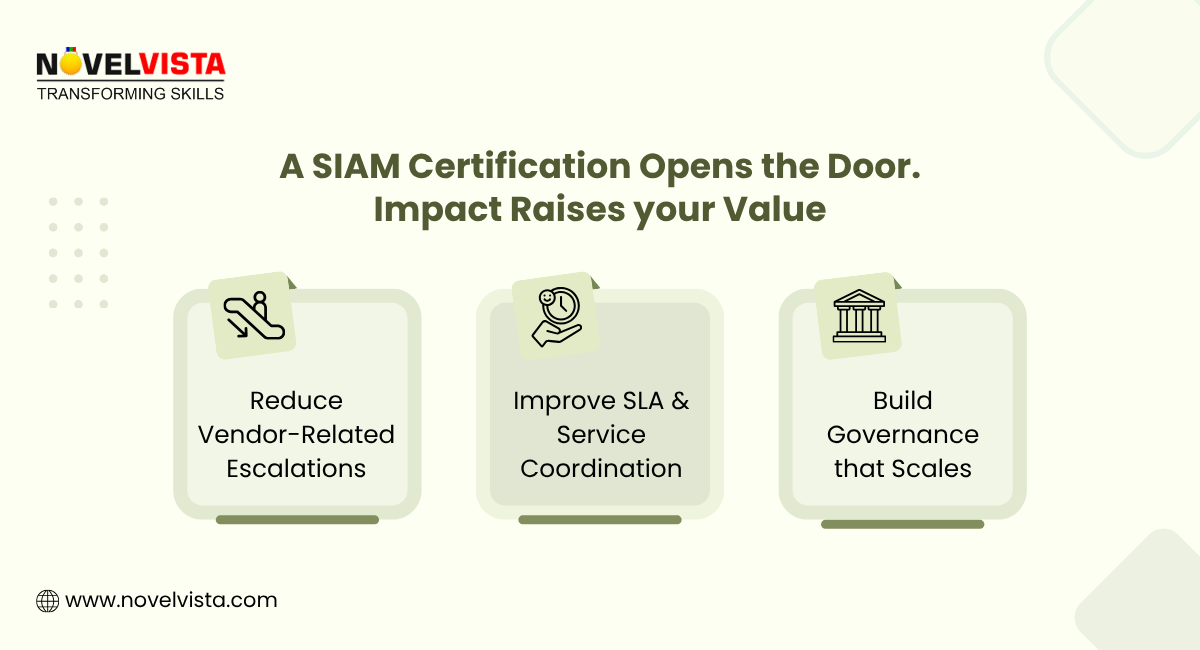
Enterprises today rarely run IT services through a single vendor. A typical mid-sized organization might have one partner managing infrastructure, another handling application support, a third running security operations, and an internal team trying to make sense of it all. Service Integration and Management exists precisely to orchestrate that complexity, and professionals certified in the discipline are the ones organizations trust to do it.
This growing dependency on multi-sourced IT delivery is a direct driver of the SIAM Professional salary trend. Employers are not just paying for a certificate on a resume; they are paying for the ability to reduce vendor friction, enforce SLAs across parties, and prevent the kind of finger-pointing that stalls incident resolution. That operational value translates directly into compensation, and it is why the gap between SIAM Foundation and SIAM Professional pay widens so noticeably as experience increases. Before looking at the career and salary benefits, it helps to understand the foundation of the discipline itself. If you are new to Service Integration and Management, this guide on What is SIAM? explains how SIAM brings multiple service providers together under a coordinated service management approach.
The table below summarizes current base salary ranges across three major markets, alongside the corporate roles typically associated with each stage. Use it as a benchmarking reference rather than a fixed rulebook, since actual SIAM Professional salary figures vary by industry, company size, and negotiation.
| Experience and Certification Level | United States (USD) | United Kingdom (GBP) | India (INR) | Typical Corporate Roles |
| Entry-Level (0–2 Years), SIAM Foundation | $55,000 – $75,000 | £30,000 – £40,000 | ₹5,00,000 – ₹8,00,000 | Service Integration Assistant, Junior Service Manager, Service Desk Coordinator |
| Entry-Level (0–2 Years), SIAM Professional | $60,000 – $85,000 | £34,000 – £50,000 | ₹4,50,000 – ₹8,00,000 | Junior Integrator, Contract Analyst, Operations Support Specialist |
| Mid-Level (2–5 Years), SIAM Foundation | $80,000 – $100,000 | £40,000 – £55,000 | ₹8,00,000 – ₹12,00,000 | Service Integration Manager, SIAM Consultant, SLA Coordinator |
| Mid-Level (2–5 Years), SIAM Professional | $85,000 – $110,000 | £50,000 – £95,000 | ₹10,00,000 – ₹20,00,000 | SIAM Consultant, ITIL Governance Lead, Vendor Relationship Specialist |
| Senior-Level (5+ Years), SIAM Foundation | Above $110,000 | £55,000 – £75,000 | ₹12,00,000 – ₹18,00,000 | Service Integration Lead, SIAM Architect, Head of Service Integration |
| Senior-Level (5+ Years), SIAM Professional | $110,000 – $145,000+ | £55,000 – £95,000+ | ₹25,00,000 – ₹50,00,000+ | Lead Integration Consultant, Head of Service Integration, Program Director |
A few patterns stand out. First, the SIAM Professional salary advantage over Foundation-level pay is modest at entry level but compounds sharply by the senior stage, where Professional-certified leaders in India can earn nearly triple their Foundation-level counterparts. Second, the UK market shows the widest salary band at the mid and senior levels, reflecting how much variation exists between smaller consultancies and large enterprise employers. Third, US figures remain the most consistently upward-trending across every tier, suggesting steady demand for multi-vendor governance expertise.
Certification level and years of experience are the two biggest levers, but they are not the only ones. Industry matters: financial services and telecommunications firms, which run some of the most complex vendor ecosystems, tend to pay above the ranges shown here. Company size matters too, since large enterprises managing dozens of service providers place a higher premium on SIAM Professional expertise than smaller organizations with simpler vendor landscapes.
Location within a country also plays a role. A SIAM Professional salary in London or New York typically sits above the national average shown in broad ranges, while regional hubs may trail slightly behind. Finally, complementary credentials influence pay. Professionals who pair their SIAM Professional certification with ITIL, PRINCE2, or vendor management training often command salaries at the higher end of their bracket, since employers value the combination of service integration skill with broader governance and delivery knowledge.
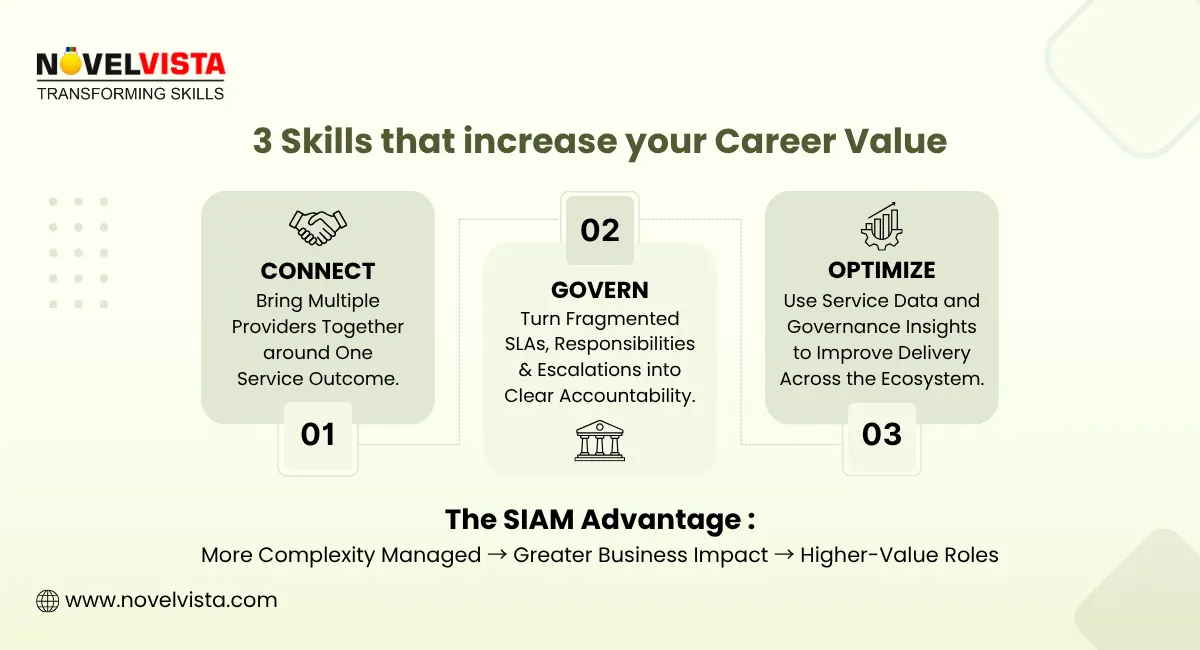
If you are early in your career, the fastest way to move your SIAM Professional salary upward is not simply waiting out the years, it is targeting roles that expose you to real multi-vendor governance work. Coordinating SLAs across three or more providers, sitting in on vendor escalation meetings, and contributing to service integration design documents all build the practical evidence that hiring managers look for when evaluating Professional-level candidates.
Mid-career professionals should focus on demonstrating measurable outcomes: reduced escalation times, improved vendor SLA compliance, or successful SIAM model transitions. These outcomes are the strongest negotiating tool when discussing a SIAM Professional salary increase, far more persuasive than certification alone.
For senior professionals eyeing roles like Head of Service Integration or Program Director, the conversation shifts toward strategic impact. At this stage, a SIAM Professional salary is less about technical execution and more about your ability to shape governance frameworks that scale across an enterprise's entire vendor ecosystem.
Looking at the data holistically, the SIAM Professional salary trajectory rewards patience and deliberate skill-building far more than it rewards the certificate itself. Entry-level gaps between Foundation and Professional holders are narrow, which means new practitioners should not expect an immediate windfall. But the compounding effect at mid and senior levels, particularly in India and the UK, makes a strong long-term case for investing in the Professional-level credential early in one's career.
Organizations are not going to simplify their vendor ecosystems anytime soon. If anything, the rise of AI-driven operations, cloud-native infrastructure, and specialized managed service providers is making multi-vendor environments more common, not less. That structural trend underpins the entire SIAM Professional salary outlook and suggests the current pay ranges are more likely to rise than plateau in the coming years. Of course, salary potential is only one side of the certification decision. Before making an investment, it is equally important to understand the training and exam expenses involved. You can explore the SIAM Certification Cost to get a clearer picture of the investment required and weigh it against your long-term career goals.

The SIAM Professional salary landscape reflects a straightforward reality: as IT ecosystems grow more fragmented across vendors and service providers, the professionals who can integrate and govern them well become more valuable, not less. Whether you are comparing Foundation and Professional certification paths, benchmarking your current pay against US, UK, and India ranges, or planning your next career move, the data points in one clear direction. A SIAM Professional salary is not just a reflection of a credential; it is a reflection of the operational trust an organization places in you to keep its service delivery running smoothly across every vendor at the table.
If you are ready to build that expertise and position yourself for greater responsibility in service integration, NovelVista’s SIAM Professional Training & Certification can be a practical next step toward strengthening your SIAM career.
Mid-level professionals typically earn between $85,000 and $110,000 in the US, £50,000 to £95,000 in the UK, and ₹10,00,000 to ₹20,00,000 in India, depending on employer and industry.
Yes, especially at senior levels. Entry-level gaps are small, but Professional-certified senior practitioners often earn substantially more than Foundation-level peers in the same role.
Senior positions like Head of Service Integration, SIAM Architect, and Program Director command the top end of the SIAM Professional salary range, often exceeding $110,000 in the US and ₹25,00,000 in India.
Yes. Professionals who combine SIAM Professional certification with ITIL or vendor management training typically negotiate a higher SIAM Professional salary than those with SIAM alone.
Generally yes. While the SIAM Professional salary advantage is modest early on, it compounds significantly by the mid and senior career stages, making it a strong long-term investment.
Author Details

Course Related To This blog
SIAM Professional Training & Certification
Confused About Certification?
Get Free Consultation Call
Stay ahead of the curve by tapping into the latest emerging trends and transforming your subscription into a powerful resource. Maximize every feature, unlock exclusive benefits, and ensure you're always one step ahead in your journey to success.