Category | DevOps
Last Updated On 28/07/2026
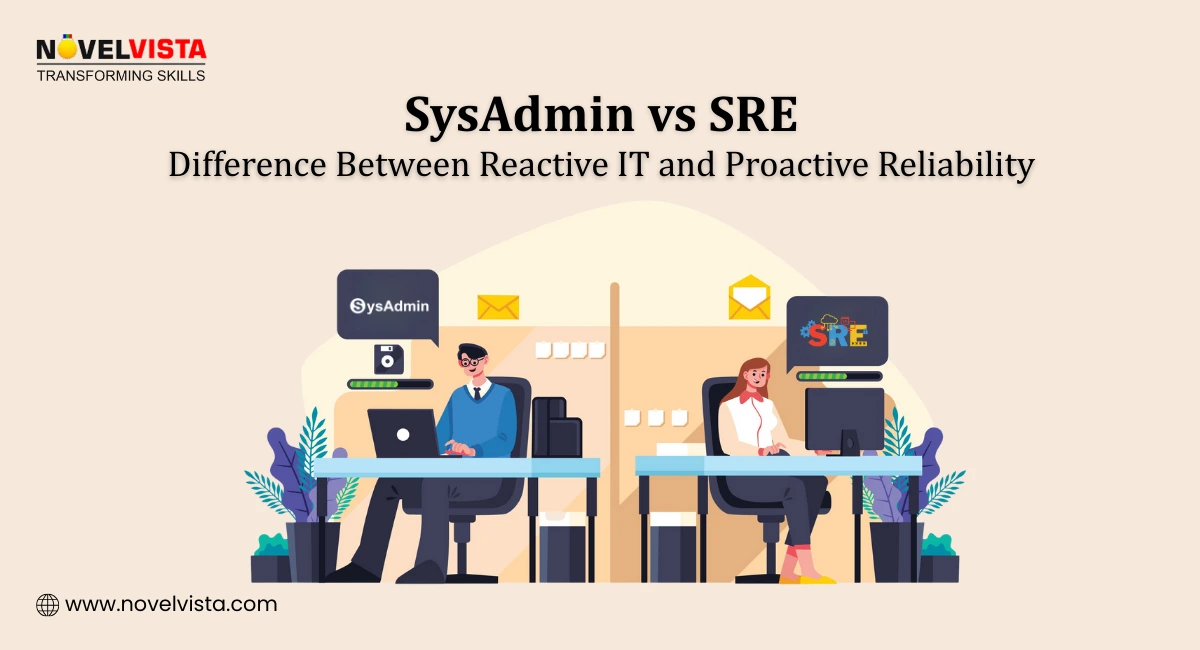
The SysAdmin vs SRE debate shows up almost everywhere today in team meetings, job boards, and even performance reviews. Many professionals feel stuck between keeping systems running the traditional way and being asked to automate, scale, and think like engineers. What used to be a clear SysAdmin role is slowly blending into something bigger and more technical.
In SRE upskilling programs, many participants come from traditional SysAdmin backgrounds. The most common challenge observed is not learning new tools, but shifting from reactive system handling to reliability-first thinking.
This blog breaks down the SysAdmin vs SRE discussion in a simple, honest way. You’ll understand how the roles differ, what skills matter, how tools have changed, and how career paths evolve from SysAdmin to SRE without confusion or hype.
Site Reliability Engineering changes how operations are viewed. Instead of treating outages as routine events, SRE treats reliability as a design problem that can be solved using code.
An SRE applies software engineering thinking to operations. The goal is not just to fix issues, but to prevent them from happening again at scale.
SREs focus on:
Unlike SysAdmins, SREs spend less time clicking around systems and more time writing code that manages systems automatically. Professionals transitioning into SRE roles often struggle initially with defining SLOs and error budgets. With guided practice, they learn that SRE is less about firefighting and more about making reliability measurable and repeatable.
This difference is at the heart of the SysAdmin vs SRE evolution.
The SysAdmin has always been the backbone of IT operations. When systems go down, users can’t log in, backups fail, or servers act up, the SysAdmin is the first person everyone calls.
A traditional SysAdmin typically handles:
The work is mostly reactive. Problems happen first, and then the SysAdmin fixes them. Configuration changes are often manual, and automation is limited to basic scripts.
SysAdmins are a great fit for:
In these environments, hands-on control and quick fixes matter more than scale. This is where the SysAdmin role still shines, even as the SRE vs SysAdmin conversation grows louder.
To really understand the SysAdmin vs SRE discussion, it helps to see the differences side by side.
Aspect |
SysAdmin |
SRE |
Primary Focus |
Day-to-day system maintenance |
Scalable reliability |
Approach |
Reactive, manual fixes |
Proactive, code-driven |
Infrastructure Scale |
Any size environment |
Large-scale systems |
Operational Toil |
High manual workload |
Less than 50% time on ops |
Mindset |
Keeping systems running |
Operations as software problems |
This table highlights why SRE vs SysAdmin is not just a title change. It’s a shift in how work is done and how problems are solved.
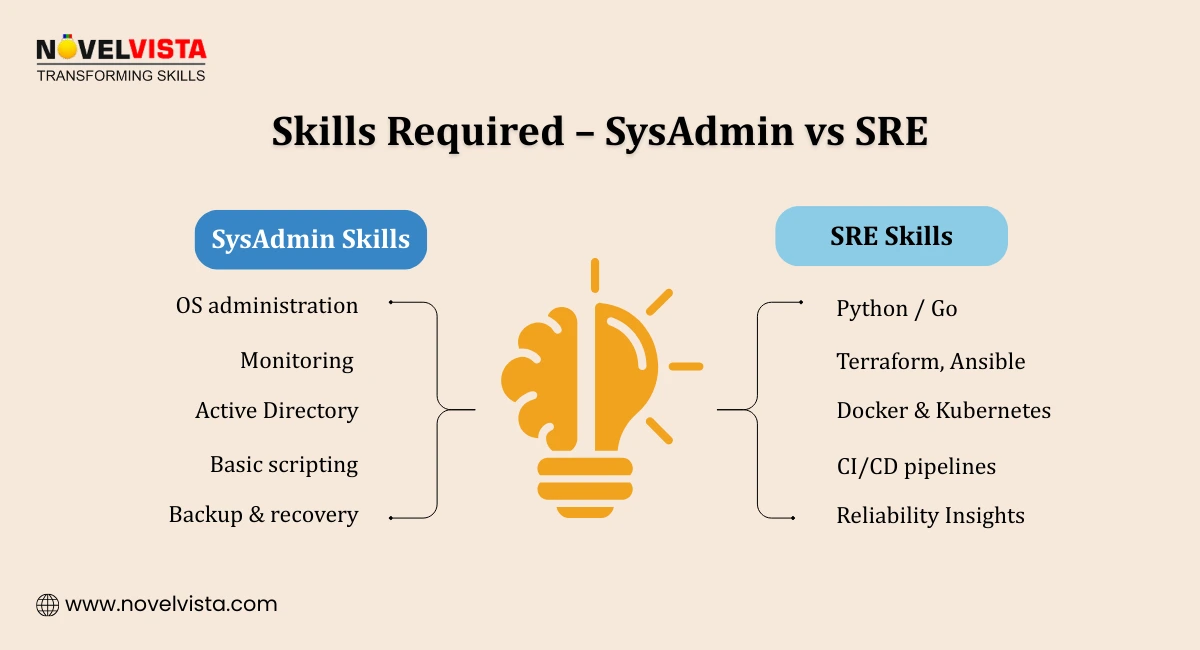
Skills are where the gap becomes very clear. The SysAdmin vs SRE difference is not about who works harder; it’s about what kind of skills the role demands.
A SysAdmin typically focuses on:
These skills are practical and hands-on, perfect for stable environments where systems don’t change often.
An SRE needs a broader, more engineering-focused skill set:
This skill shift explains why many see SRE vs SysAdmin as a natural career progression rather than a replacement. Training assessments show that SysAdmins who already use scripting and basic automation adapt faster to SRE skill requirements. Programming familiarity significantly reduces the learning curve during SRE role transitions.
Want to know which skills set top SREs apart? Explore our guide on SRE skills to understand the technical and leadership capabilities driving success in reliability engineering.
 Modern systems don’t behave like traditional servers anymore. Cloud platforms scale fast, traffic spikes unexpectedly, and manual fixes don’t hold up under pressure.
The SysAdmin vs SRE transition is happening because:
This doesn’t mean SysAdmins are becoming irrelevant. It means the role is evolving. Many strong SREs started their careers as SysAdmins and gradually moved toward automation and engineering.
Tools clearly show how the SysAdmin vs SRE shift has happened over time. One role focuses on maintaining systems, while the other focuses on building systems that maintain themselves.
SysAdmins usually work with tools designed for monitoring, stability, and routine operations, such as:
These tools work well when environments are smaller and changes are controlled. They support reliability, but mostly through hands-on effort.
SREs rely on tools that support automation, scale, and repeatability:
Effective SRE adoption requires controlled automation. Training labs consistently reinforce human-in-the-loop controls to ensure automation improves reliability without introducing unmanaged risk.
Career growth looks very different depending on which path you follow. Understanding this helps professionals plan their next move instead of feeling stuck.
A typical SysAdmin path looks like this:
This path suits organizations with stable systems and limited scale, where operational reliability matters more than rapid change.
The SRE path often builds on SysAdmin experience:
This is why many professionals view SysAdmin vs SRE as an evolution rather than a career reset.
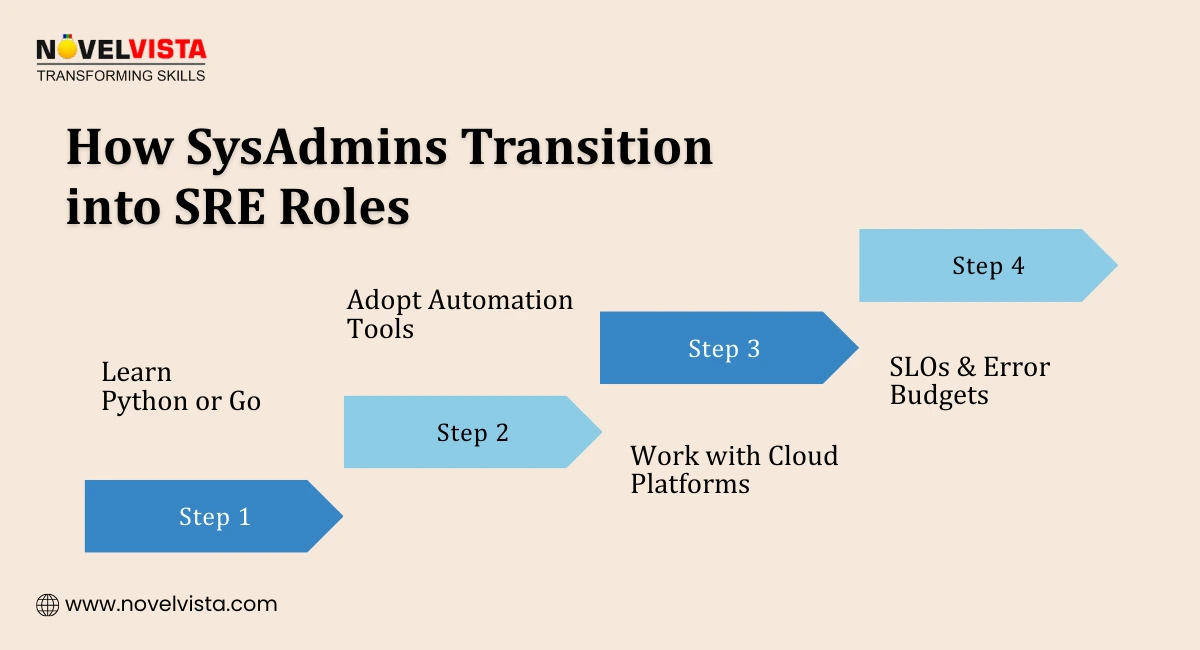
SysAdmins can move into SRE roles by:
This transition is now one of the most common paths in the SRE vs SysAdmin conversation.
Stop guessing your SRE path.
Follow a clear plan to shift from reactive ops to reliability thinking.
Both roles still matter, but the market values them differently based on scale and complexity.
Factor | SysAdmin | SRE |
Market Demand | Steady | High in cloud-native companies |
Compensation | Steady | High in cloud-native companies |
Environment Fit | Small to mid-sized setups | Large-scale, cloud-driven systems |
Growth Potential | Limited at scale | Strong long-term growth |
SRE roles usually command higher pay because they combine software engineering with operations. This market reality fuels the ongoing SysAdmin vs SRE debate.
Curious about earning potential in reliability engineering? Explore our blog on SRE salary trends to understand compensation ranges, key factors, and how experience impacts growth.
Choosing between SysAdmin and SRE is a personal decision, not a race.
Choose SysAdmin if you:
Choose SRE if you:
For many professionals, the journey starts in SysAdmin and gradually moves toward SRE as skills grow. That’s why the SysAdmin vs SRE discussion feels so familiar across the industry.
The SysAdmin vs SRE discussion isn’t about one role replacing the other. It’s about how operations evolve as systems grow larger and more complex. SysAdmins keep systems running. SREs build systems that stay reliable even as scale increases.
Organizations increasingly evaluate reliability roles based on system outcomes, not job titles. A clear understanding of SysAdmin and SRE responsibilities helps teams align expectations, reduce friction, and build trust in operations.
The real question is not SysAdmin vs SRE, but where you are today and where you want your career to go. Align your choice with your interests, skills, and long-term goals—and let your role evolve naturally.
If you’re ready to move toward automation, reliability, and large-scale systems, NovelVista’s SRE Foundation and SRE Practitioner Certification Training can help. These programs focus on real-world SRE concepts like SLOs, error budgets, automation, and incident response. It’s a practical way to transition from traditional operations into modern reliability engineering with confidence.

Author Details

Confused About Certification?
Get Free Consultation Call
Stay ahead of the curve by tapping into the latest emerging trends and transforming your subscription into a powerful resource. Maximize every feature, unlock exclusive benefits, and ensure you're always one step ahead in your journey to success.