Category | AI And ML
Last Updated On 24/07/2026
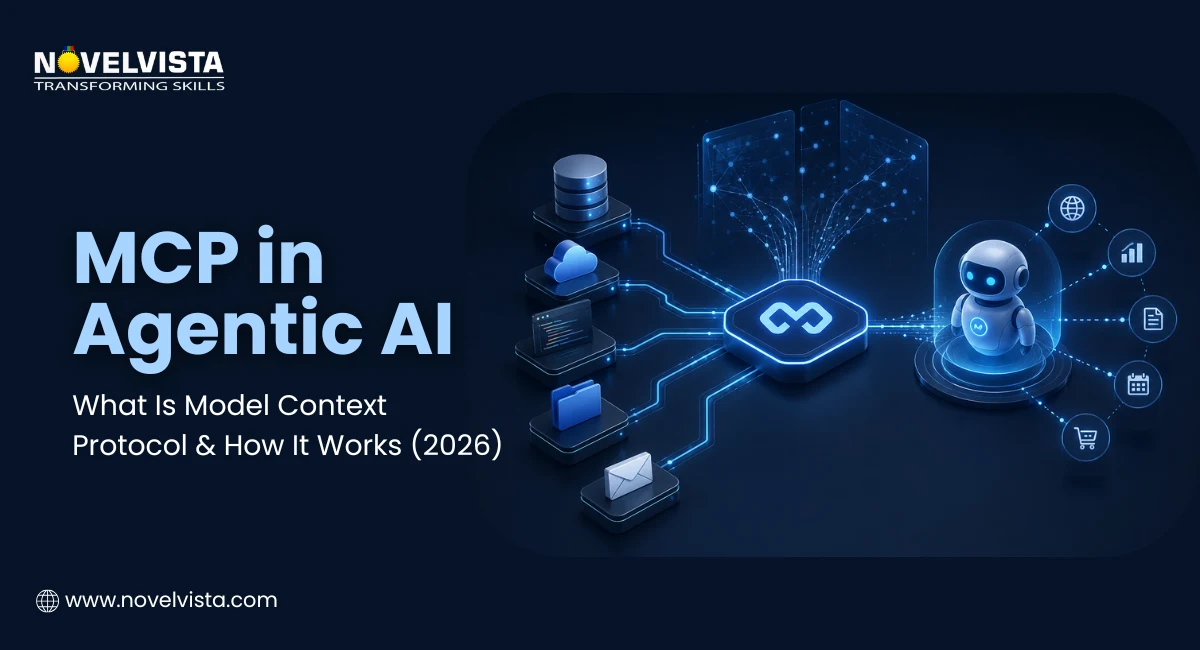
Artificial Intelligence is rapidly shifting from passive chat systems to autonomous digital agents capable of reasoning, tool usage, and workflow execution.
MCP stands for Model Context Protocol, an open standard released by Anthropic in November 2024. It enables AI systems to securely communicate with external tools, APIs, databases, and enterprise applications through a standardized protocol.
One of the biggest reasons behind this transformation is the explosive growth of the Model Context Protocol ecosystem. According to SSNTPL industry data, MCP crossed 97 million monthly SDK downloads in March 2026, up from just 2 million at launch in November 2024, representing nearly 4,750% growth in only 16 months.
(Source: https://sl1nk.com/r1a2bu0)
Yet despite the rise of advanced AI models, one critical challenge still exists.
Can your AI assistant securely access your company database?
Can it read files from your local machine?
Can it automatically update Jira tickets, search GitHub repositories, or send Slack notifications without custom integrations?
In most cases, the answer is still no.
Large Language Models (LLMs) are intelligent, but they often remain disconnected from enterprise systems, applications, and live operational environments. In November 2024, Anthropic released MCP to solve this problem. By March 2025, both OpenAI and Google had adopted the protocol across their AI ecosystems.
This guide explains the definition, architecture, transport layers, MCP vs RAG differences, limitations, enterprise use cases, and how developers are building production-ready agentic AI systems using MCP.
| Topic | Summary |
| MCP | Open standard for connecting AI to external systems |
| Purpose | Enables AI to perform actions, not just generate responses |
| Key Benefit | Simplifies integration with tools, APIs, and databases |
| MCP vs RAG | RAG retrieves data; MCP enables real-world interactions |
| Enterprise Value | Supports automation, scalability, and Agentic AI adoption |
| Future Outlook | Emerging as a core technology for connected AI ecosystems |
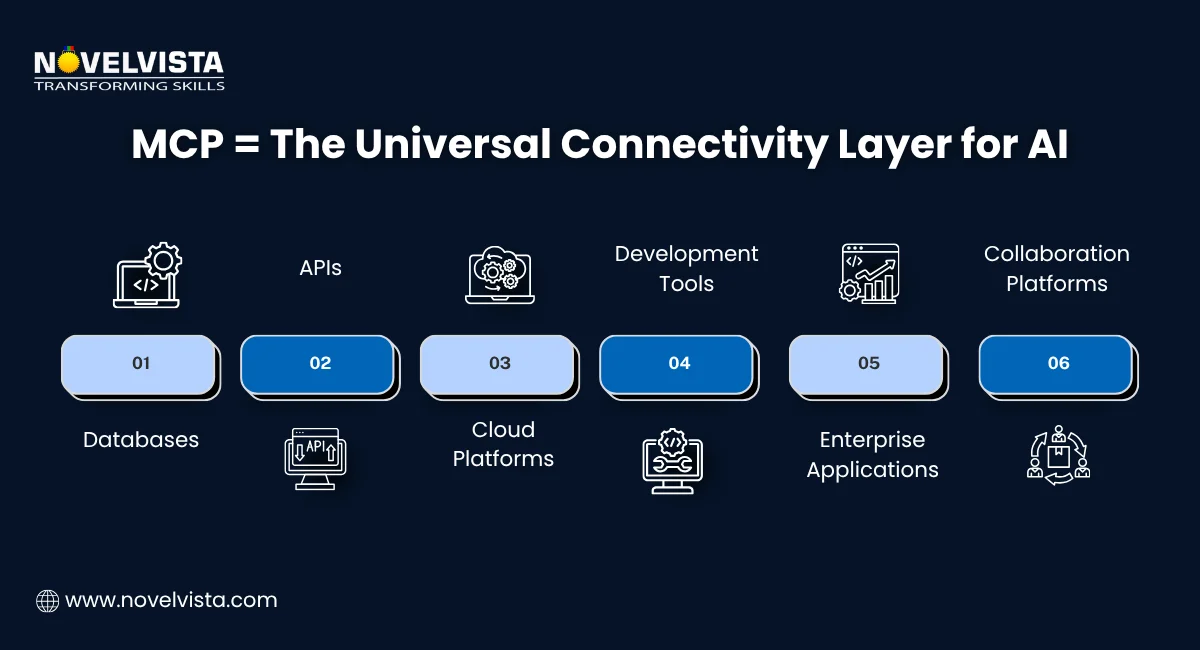
The Model Context Protocol (MCP) is an open-source communication framework designed to help AI systems interact with external applications, tools, databases, APIs, and enterprise platforms through a standardized architecture.
In simple terms, MCP creates a universal connectivity layer between AI models and real-world systems.
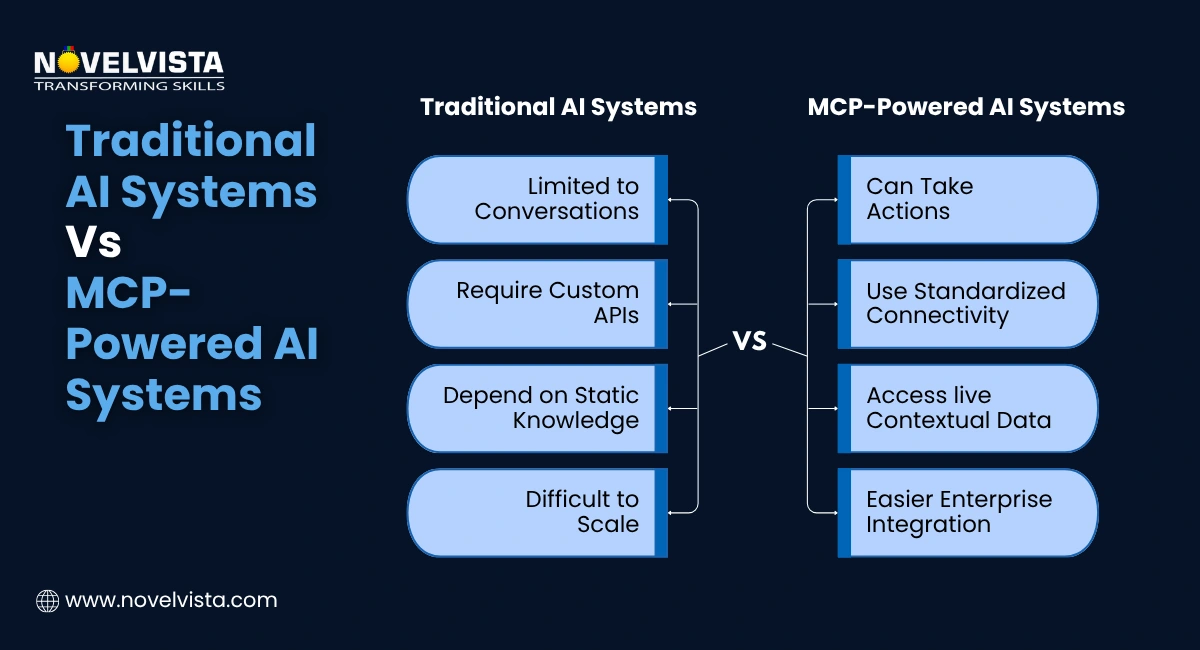
Without MCP, developers traditionally build separate integrations for every tool an AI assistant needs to access. This becomes expensive, difficult to maintain, and nearly impossible to scale across large enterprise environments.
The model context protocol MCP AI open standard solves this problem by introducing a shared communication layer that standardizes how AI systems access external tools and services.
IBM describes MCP as:
“A standardization layer for AI applications to communicate effectively with external services such as tools, databases, and predefined templates.”
You can think of MCP as a translator between AI models and operational systems.
For example, an AI agent may need access to:
Instead of building unique integrations for every service, MCP-compatible servers expose these systems through one standardized protocol.
This creates interoperability across AI ecosystems and dramatically simplifies AI deployment at enterprise scale.
The growing importance of mcp in agentic ai comes from the fact that autonomous agents need more than reasoning capabilities. They need live contextual access to tools, workflows, and operational systems.
By 2026, hundreds of MCP-compatible servers are available across developer, productivity, analytics, and enterprise ecosystems.
MCP Server | Description |
| GitHub MCP Server | Repository indexing, pull request access, code search, issue analysis |
| PostgreSQL MCP Server | Direct SQL query execution and database interaction |
| Google Drive MCP Server | File access, document retrieval, and content indexing |
| Slack MCP Server | Messaging, notifications, and channel interactions |
| Brave Search MCP Server | Real-time web search and internet retrieval |
| Amazon Bedrock AgentCore | Enterprise multi-agent orchestration and AI workflow coordination on AWS |
Modern AI models are highly capable at reasoning, summarization, and generation. However, most systems still operate in isolation.
An LLM may understand software development concepts generally, but it cannot inspect your live repository unless connected securely to enterprise infrastructure.
This creates a massive gap between intelligence and execution.
| Traditional AI Limitation | What Businesses Actually Need |
| Can explain coding concepts | Can inspect live repositories |
| Can summarize generic content | Can access enterprise files |
| Can discuss project workflows | Can create Jira tickets automatically |
| Can answer database questions theoretically | Can query live databases |
| Can explain MCP generally | Can use MCP to dynamically discover and connect to tools at runtime |
This is where mcp agentic ai systems become transformational.
Before MCP, a company using 10 AI models and 20 enterprise tools potentially required 200 custom integrations (10 × 20). With MCP, this complexity collapses into one standardized protocol layer.
This dramatically reduces:
The rise of mcp in agentic ai is fundamentally about bridging reasoning and execution.
Traditional AI mostly generates responses.
Agentic AI systems powered by MCP can perform actions.
For example:
“Analyze the production bug in this repository, identify the root cause, create a Jira issue, notify the engineering team on Slack, and summarize the findings.”
This workflow combines:
That is the core value of MCP-enabled agentic systems.
To understand what is mcp in agentic ai, it is important to understand the MCP architecture itself.
The protocol operates using three core components.
| Component | Role | Real Examples |
| MCP Host | Environment where the AI system operates | Claude Desktop, Cursor IDE, VS Code with Copilot |
| MCP Client | Built into the host — manages discovery, authentication, and request routing | Handles tool discovery and secure communication |
| MCP Server | Exposes external systems or tools | GitHub MCP Server, PostgreSQL MCP Server |
The host is the environment where users interact with the AI system.
Examples include:
The host acts as the interface layer between humans and AI agents.
The client manages communication between the AI model and MCP servers.
Its responsibilities include:
The MCP server exposes external systems in a standardized way.
Examples include:
Each server exposes structured tools and data access methods.
| Step | Workflow |
| 1 | User submits request |
| 2 | LLM interprets intent |
| 3 | MCP Client identifies required tools |
| 4 | MCP Server accesses external system |
| 5 | AI processes retrieved information |
| 6 | Actions are executed |
| 7 | Final result is delivered |
This architecture enables AI systems to operate dynamically across enterprise environments.
One of the most important architectural discussions in 2026 involves MCP stdio vs HTTP transport.
stdio transport uses local processes for communication.
It is ideal for:
HTTP transport exposes MCP servers as remote cloud services.
It is preferred for:
According to 2026 developer ecosystem data, over 80% of top MCP servers offered remote HTTP deployment options by March 2026.
This shift is accelerating MCP adoption in cloud-native enterprise environments.
The following simplified example shows how an AI application can call an MCP server to retrieve information from an external tool. While actual implementations vary by SDK, the overall request–response flow remains similar.
# Simplified MCP example (conceptual)
# Connect to an MCP server
mcp_client.connect("http://localhost:8080")
# Ask the server to use a GitHub tool
response = mcp_client.call_tool(
tool="github.search_repositories",
arguments={
"query": "agentic ai"
}
)
print(response)
In production environments, MCP servers typically expose tools for platforms such as GitHub, PostgreSQL, Slack, Google Drive, and internal enterprise systems, allowing AI agents to securely interact with real-world applications without requiring custom integrations for every service.
One of the biggest misconceptions in enterprise AI is treating MCP and RAG as competing technologies.
They solve different problems.
MCP | RAG |
| Connects AI to tools and live systems | Retrieves documents for contextual understanding |
| Enables actions and execution | Improves response accuracy |
| Supports workflow automation | Supports knowledge retrieval |
| Real-time system interaction | Context augmentation |
| Operational orchestration | Semantic retrieval |
| Use together? Yes | Yes, MCP can serve as retrieval layer for RAG |
RAG (Retrieval-Augmented Generation) improves model responses by retrieving relevant documents during inference.
MCP goes further by enabling AI systems to directly interact with operational systems, applications, APIs, and enterprise workflows.
In production agentic systems, the agent may use MCP to connect to a live vector database such as Pinecone or Weaviate through an MCP server.
The workflow often looks like this:
MCP provides the connection layer.
RAG provides the knowledge layer.
Together, they create highly capable enterprise AI systems.
Despite its rapid growth, MCP is not without criticism.
One major concern in 2026 is efficiency.
At the Ask 2026 conference on March 11, 2026, Perplexity CTO Denis Yarats announced that Perplexity was moving away from MCP in certain production systems, citing excessive overhead.
According to Yarats, some MCP implementations consumed 40–50% of the model’s context window before agents performed meaningful work.
This created several concerns:
Y Combinator CEO Garry Tan also publicly discussed building direct CLI-based systems instead of relying heavily on MCP orchestration.
This sparked a wider debate across the AI ecosystem.
By 2026, an emerging industry consensus began to form:
Best Use Case | Recommended Approach |
| Dynamic tool discovery | MCP |
| Rapid prototyping | MCP |
| Multi-tool experimentation | MCP |
| High-scale production optimization | APIs or CLI tools |
| Ultra-low latency workflows | Direct integrations |
The discussion is not about MCP “failing.”
Instead, it reflects the growing maturity of the ecosystem.
For agentic AI where dynamic tool discovery is the priority, especially enterprise environments with changing tool ecosystems, MCP remains the leading standard.
MCP adoption is accelerating across development, operations, analytics, and enterprise automation.
Modern coding tools increasingly rely on MCP-powered architectures.
Platforms like Cursor and Replit use MCP integrations to:
This significantly improves developer productivity.
You can also explore related Agentic AI Tools that support autonomous workflow automation.
Organizations often struggle with fragmented analytics workflows.
Using MCP, AI agents can directly connect to:
Instead of manually exporting data, AI systems can analyze live business information instantly.
MCP-powered agents can automate workplace collaboration.
For example:
“Summarize the last three meetings from Notion and post the updates in Slack.”
This creates seamless enterprise workflow automation.
You can explore more Agentic AI Examples across industries.
Agentic AI systems powered by MCP can support:
This enables more intelligent operational ecosystems.
Amazon Bedrock AgentCore uses MCP as a context management layer for enterprise multi-agent orchestration on AWS infrastructure.
This allows multiple AI agents to coordinate tasks securely across cloud-native enterprise systems.
Another major area of growth is langchain mcp integration.
LangChain is one of the most widely used orchestration frameworks for AI agents and autonomous workflows.
As of 2026, LangChain’s MCP Adapters library enables direct integration between LangChain agents and MCP servers, allowing MCP tools to function as native LangChain tools without custom glue code.
This simplifies:
Organizations building enterprise AI ecosystems are increasingly combining MCP with orchestration libraries and Agentic AI Frameworks to scale autonomous systems efficiently.
The future of AI is no longer just about larger models.
It is about connected models capable of reasoning, retrieving context, interacting with enterprise systems, and autonomously executing workflows.
MCP has rapidly emerged as the infrastructure layer powering this transformation.
The 2026 MCP roadmap, published by core maintainer David Soria Parra, focuses heavily on transport scalability, governance maturation, enterprise readiness, and agent-to-agent communication.
As organizations continue investing in autonomous AI systems, MCP will likely remain central to enterprise interoperability and connected AI ecosystems. The rapid evolution of connected autonomous systems is also closely aligned with emerging Agentic AI Trends 2026 shaping the future of enterprise AI adoption.
The Agentic AI Certification from NovelVista teaches MCP architecture, LangChain MCP integration, and how to build agentic systems that connect to enterprise tools using the Model Context Protocol. GSDC-accredited. Hands-on. Designed for technical and non-technical professionals alike.
MCP stands for Model Context Protocol. It is an open standard introduced by Anthropic that enables AI models to securely connect with external tools, APIs, databases, and enterprise applications through a standardized communication protocol, making Agentic AI systems more capable of performing real-world tasks.
Author Details

Confused About Certification?
Get Free Consultation Call
Stay ahead of the curve by tapping into the latest emerging trends and transforming your subscription into a powerful resource. Maximize every feature, unlock exclusive benefits, and ensure you're always one step ahead in your journey to success.