Category | AI And ML
Last Updated On 21/05/2026
| Synopsis : This blog provides a structured and in-depth guide to agentic AI interview questions, covering fundamentals, architecture, multi-agent systems, reliability, and product thinking. It helps both technical and product-focused professionals understand how autonomous AI systems work in real-world scenarios. With practical explanations and expert insights, it prepares you for modern AI interviews. Whether you're a beginner or experienced, this guide builds clarity and confidence in agentic AI concepts. |
| Section | Key Takeaway |
| Fundamentals | Agentic AI focuses on autonomy, planning, and decision-making |
| Architecture & Memory | Efficient memory and smart retrieval are critical for performance |
| Multi-Agent Systems | Use multiple agents only when tasks require specialization |
| Reliability & Safety | Monitoring, validation, and fail-safes ensure stable systems |
| Optimization & Product Thinking | Focus on ROI, scalability, and cost efficiency |
| Advanced Concepts | Real-time systems, explainability, and future roles are key trends |
Artificial Intelligence is entering a new phase one where systems don’t just respond, but plan, decide, and act autonomously. By 2026, over 70% of enterprise AI deployments are expected to include agent-based architectures, making agentic AI interview questions a critical focus for modern AI, ML, and product roles.
So, what are agentic AI interview questions and answers?
They are interview questions designed to evaluate your understanding of autonomous AI systems covering how agents reason, plan, use tools, manage memory, and operate in real-world environments. Unlike traditional AI questions, these focus on decision-making, system design, and practical execution, not just models and algorithms.
But here’s the challenge most candidates still prepare for conventional ML topics, not agent-based systems.
If you're unsure, you're not alone and that’s exactly why this guide exists.
In this blog, we go beyond basics and explore agentic AI interview questions and answers in depth covering architecture, reasoning, multi-agent systems, reliability, and product thinking. So let’s get started with the basics.
A system becomes truly agentic when it moves beyond predefined execution and demonstrates autonomous decision-making over time. Traditional automation follows static rules if X happens, do Y. In contrast, an agentic system evaluates its environment, defines intermediate steps, and adapts its actions dynamically.
For example, a chatbot answering FAQs is not agentic. However, an AI that receives a vague instruction like “plan a business trip,” then searches flights, compares prices, checks calendars, and books tickets that’s agentic behavior.
The defining traits include:
In interviews, simply saying “it’s autonomous” is not enough you must explain how autonomy is achieved through planning, reasoning, and feedback loops.
Instruction-driven systems operate on explicit commands. They execute exactly what is asked, step by step, without deviation. These systems are predictable but limited in flexibility.
Goal-driven systems, on the other hand, are given an objective, not a method. The system itself determines:
For example:
The second requires planning, reasoning, and iteration core elements tested in agentic AI interview questions.
Stopping criteria is one of the most overlooked yet critical aspects of agent design. Without proper termination logic, agents may:
Agents typically use:
In production systems, combining multiple stopping conditions ensures reliability. This is a common topic in agentic AI technical interview questions.
Reasoning is what enables agents to move from input-output systems to decision-making systems. It allows the agent to:
For example, instead of directly answering a question, an agent might:
This layered thinking is what differentiates agentic AI from simple LLM usage.
Expert Insight
In most agentic AI interview questions, candidates lose marks by focusing only on “what” an agent does. Strong answers always explain how and why decisions are made.
Memory design directly impacts performance, cost, and scalability. Agentic systems typically use two types:
Short-term memory:
Stored within the model’s context window. It includes:
Long-term memory:
Stored externally (vector DB, document store). It includes:
The challenge is balancing:
Effective systems use summarization, filtering, and retrieval thresholds.
Retrieval gating ensures that external data is fetched only when necessary. Without it, agents may:
A well-designed agent first attempts internal reasoning and only calls retrieval tools when:
This is a common real-world challenge. Solutions include:
This ensures that only high-quality, relevant information enters the decision process.
Expert Insight
When answering agentic AI technical interview questions, always mention trade-offs like latency, cost, and accuracy this shows real-world understanding. Explore leading Agentic AI frameworks to understand how modern agents are built, orchestrated, and scaled in real-world applications.
Multi-agent systems are useful when:
However, overusing agents can create:
In many cases, a single agent with well-designed tools is more effective.
Communication can happen through:
Unstructured communication often leads to confusion and inefficiency.
Deadlock occurs when agents wait indefinitely for each other. Prevention strategies include:
Expert Insight:
For agentic AI product manager interview questions, focus on when NOT to use multi-agent systems this shows strategic thinking.
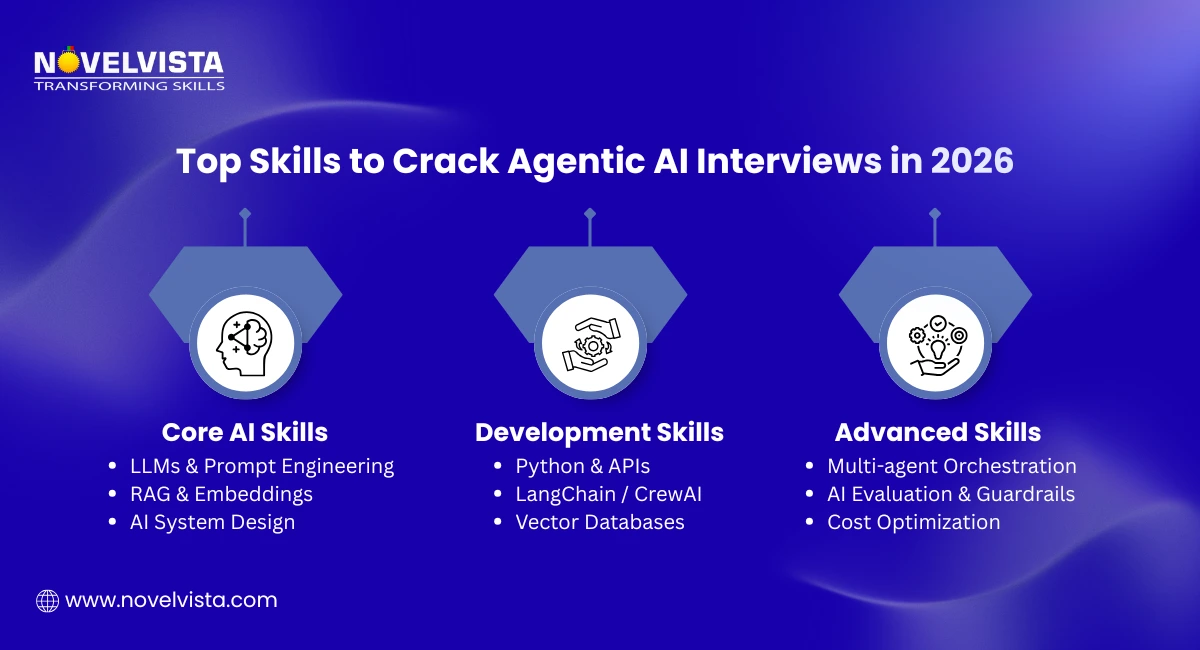
Ensuring reliability in agentic systems means making them consistent, predictable, and controlled, even in dynamic environments. This is achieved through multiple layers.
Overall, reliability comes from combining monitoring, constraints, and recovery strategies so the agent behaves safely even under uncertainty.
Debugging agentic systems requires understanding the entire decision flow, not just the final output.
Traceability is key having detailed logs and step-by-step visibility makes it much easier to identify and fix issues.
Fail-safe design ensures that when something goes wrong, the system defaults to safe behavior instead of risky actions.
The goal is to ensure that even in failure scenarios, the system remains controlled, predictable, and risk-free.
Deep-dive interview questions with clear, practical explanations
Covers advanced, real-world agentic AI concepts and scenarios
Build confidence and get interview-ready for 2026 AI roles
ROI is measured through:
Key strategies include:
Caching repeated results
Designing agents for real-time systems requires a strong focus on speed, efficiency, and responsiveness. This involves using low-latency architectures, streaming data pipelines, and optimized workflows to reduce delays. Techniques like caching frequent results, minimizing token usage, and limiting multi-step reasoning help ensure the agent can make quick decisions without compromising accuracy.
Adaptive workflow optimization refers to an agent’s ability to continuously improve its processes based on feedback and past performance. Instead of following fixed steps, the agent learns which actions lead to better outcomes and adjusts its workflow accordingly. Over time, this results in more efficient execution, reduced errors, and better decision-making.
Scalability in agentic systems is achieved by designing them to handle increasing workloads efficiently. This includes using distributed architectures, stateless processing units, and external storage for memory and state management. Load balancing, parallel execution of tasks, and efficient resource utilization also help maintain performance as demand grows.
Explainability refers to the ability to understand and interpret how an agent arrives at its decisions. This can be achieved by providing reasoning steps, structured outputs, and logs of actions taken. It is important for building trust, debugging issues, and ensuring transparency in real-world applications.
The future of agentic AI roles is rapidly expanding beyond traditional development. Professionals will be expected to work across system architecture, AI governance, and product strategy. Roles will increasingly combine technical expertise with business understanding, making skills in design, scalability, and ethical AI critical for long-term growth.
You can explore leading Agentic AI platforms to understand the tools and frameworks powering autonomous AI systems and modern intelligent agents.
As organizations move toward autonomous systems, mastering agentic AI interview questions is no longer optional it’s essential. This guide covered a complete range of agentic AI interview questions and answers, helping you build both foundational knowledge and advanced expertise.
Whether you're preparing for your first AI role or aiming for senior positions, practicing these agentic AI technical interview questions will give you a strong competitive edge. The future belongs to intelligent agents and now, you’re ready for it.
Join the NovelVista Agentic AI Certification Training and gain hands-on experience in building autonomous AI agents, understanding real-world architectures, and solving practical business problems. Designed for AI professionals, developers, and technology leaders, this program equips you with industry-relevant skills, real-world case studies, and a globally recognized certification to stand out in the competitive AI job market.
Start your agentic AI journey today and take a confident step toward becoming a future-ready AI professional!
Author Details

Course Related To This blog
Generative AI Professional
Agentic AI Certification
Confused About Certification?
Get Free Consultation Call
Stay ahead of the curve by tapping into the latest emerging trends and transforming your subscription into a powerful resource. Maximize every feature, unlock exclusive benefits, and ensure you're always one step ahead in your journey to success.