Category | AI And ML
Last Updated On 12/06/2026
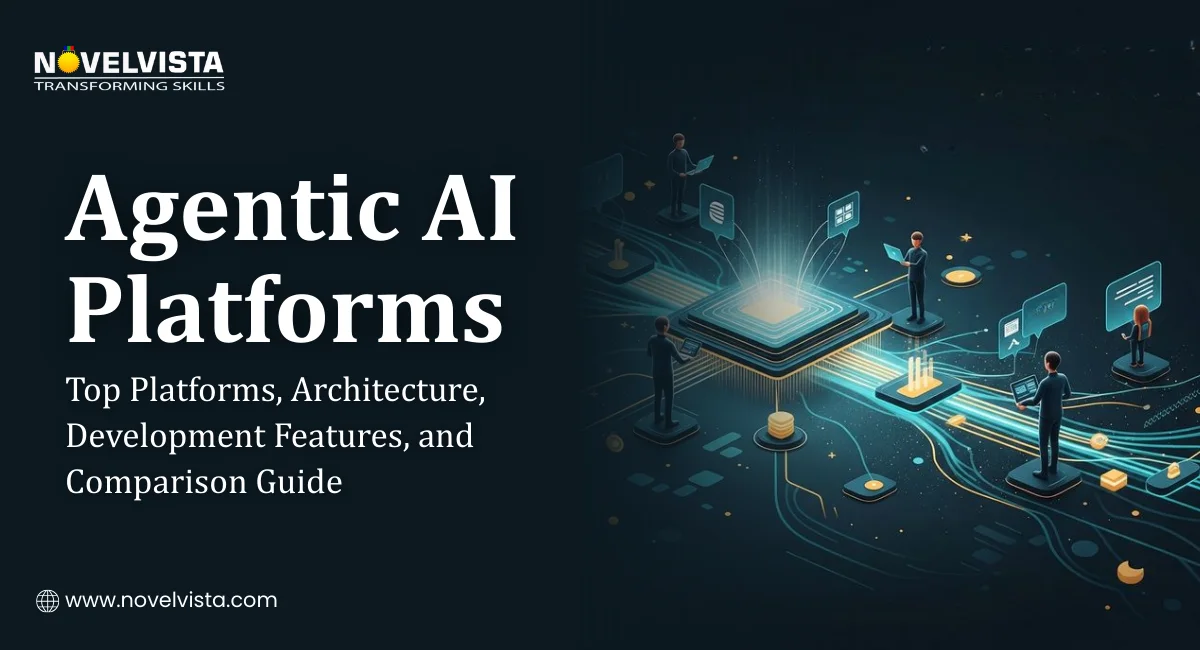
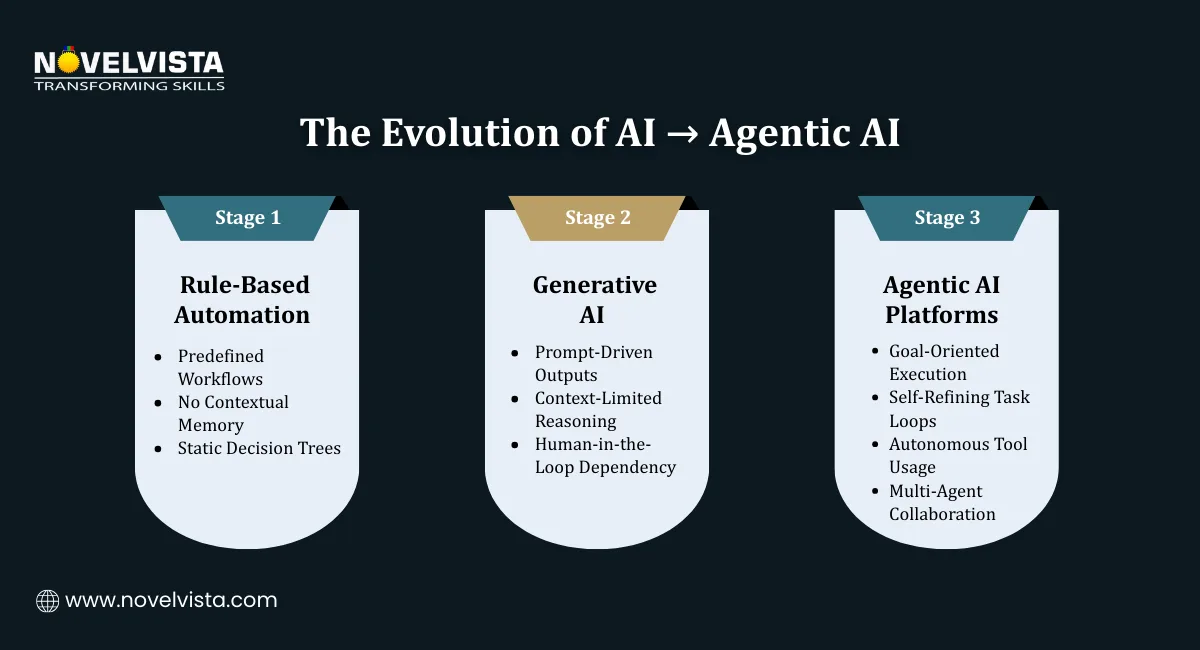
Artificial intelligence is no longer just about chatbots answering questions. Over 77% of enterprises are either using or actively exploring AI-driven automation, and autonomous AI agents are quickly becoming the next competitive edge. Businesses are moving beyond prompt-response systems to AI that can plan, reason, act, and adapt independently.
That shift has given rise to agentic AI platforms systems designed to build, deploy, and manage autonomous AI agents capable of completing multi-step tasks without constant human intervention.
If you’re:
This guide will help you understand everything about agentic AI platforms, from architecture and features to the top agentic AI platforms available today.
Let’s break it down clearly and practically.
Agentic AI platforms are development environments and infrastructure systems designed to enable the creation of autonomous AI agents. Unlike traditional AI models that simply respond to inputs, agentic AI are capable of setting goals, breaking complex tasks into manageable steps, accessing external tools and APIs, storing short-term and long-term memory, and adapting their strategies based on results. In simple terms, a traditional chatbot answers questions, while an agent acts with purpose and direction. An agentic AI platform provides the complete architecture, including orchestration layers, memory systems, reasoning engines, and integration capabilities required to build, deploy, and manage these intelligent, action-driven systems effectively.
These platforms typically support:
The move toward AI agentic platforms is driven by real operational needs rather than experimentation. Organizations today want AI systems that can automate workflows end-to-end, reduce human supervision, integrate seamlessly with enterprise tools, and improve decision speed across departments. From automated IT ticket resolution to AI-powered financial analysis, agentic systems are already being deployed in customer service, DevOps, cybersecurity, HR automation, and supply chain optimization. Unlike static AI tools that only generate outputs, an agentic AI development platform enables dynamic task execution and multi-step reasoning. For example, instead of merely generating a marketing email draft, an agent can research competitors, analyze customer data, draft the email, schedule it, and monitor performance all autonomously and with minimal human intervention.
Understanding agentic AI platform architecture is critical before selecting tools.
Most agentic systems follow a layered structure:
This layer includes large language models (LLMs) or small language models (SLMs) such as those developed by OpenAI or Anthropic. These models provide the core reasoning and language capabilities that enable agentic systems to understand instructions, generate responses, plan tasks, and make context-aware decisions.
Agents require short-term and long-term memory:
Memory allows agents to improve decisions over time.
This layer breaks goals into sub-tasks, allowing the system to manage complex objectives in a structured manner. It enables decision trees, task prioritization, and adaptive workflows, ensuring that the agent can dynamically adjust its approach based on context, progress, and outcomes.
Agents connect with:
This is where real-world action happens.
Handles multi-agent coordination, workflow execution, monitoring, and logging.
A strong agentic AI platform architecture ensures modularity, scalability, and security.
Let’s explore the top agentic AI platforms shaping the ecosystem.
One of the most popular frameworks for building AI agents.
Strengths:
Best for: Developers who want flexibility and customization.
AutoGen enables multi-agent conversations and collaboration.
Strengths:
Best for: Enterprise-scale automation.
Focused on collaborative AI agents working as teams.
Strengths:
Best for: Structured agent teams.
Provides managed infrastructure for building AI agents.
Strengths:
Best for: Rapid production-ready deployment.
Designed for enterprise workflow automation.
Strengths:
Best for: Enterprises using Microsoft stack.
Platform |
Best For |
Customization |
Enterprise Ready |
Free Tier |
LangChain |
Developers |
High |
Medium |
Yes |
AutoGen |
Multi-agent systems |
High |
High |
Yes |
CrewAI |
Lightweight teams |
Medium |
Medium |
Yes |
Copilot Studio |
Enterprise automation |
Low-Code |
Very High |
No |
An effective agentic AI platform comparison should consider scalability, governance, pricing, ecosystem integration, and developer control. Agentic AI Architecture defines the structured framework that enables autonomous agents to plan, reason, integrate tools, and execute complex tasks independently.
When selecting the best agentic AI platform, evaluate:
Does it allow custom workflows and tool integrations?
Can agents collaborate?
Is persistent memory available?
Enterprise-grade access control and compliance.
Cloud-native architecture and API throughput capacity.
A robust AI agentic platform should balance autonomy with control.
If you're experimenting, here are some free agentic AI platform options:
These platforms allow testing without heavy infrastructure investment.
Free tiers help validate proof-of-concept before enterprise deployment.
Choosing the right agentic AI development platform depends on:
For startups: Lightweight frameworks like CrewAI may work well.
For enterprises: Platforms integrated with Microsoft or OpenAI ecosystems may provide better compliance and scalability.
The ideal agentic AI platform is not necessarily the most advanced it’s the one aligned with your operational goals.
AI systems are rapidly moving toward self-healing infrastructure, autonomous cybersecurity agents, AI-driven DevOps, and multi-agent enterprise orchestration. As reasoning models continue to improve, agentic AI platforms will evolve into core infrastructure rather than remaining experimental tools. The real competitive advantage will no longer depend on who has AI, but on who deploys AI agents effectively and at scale.
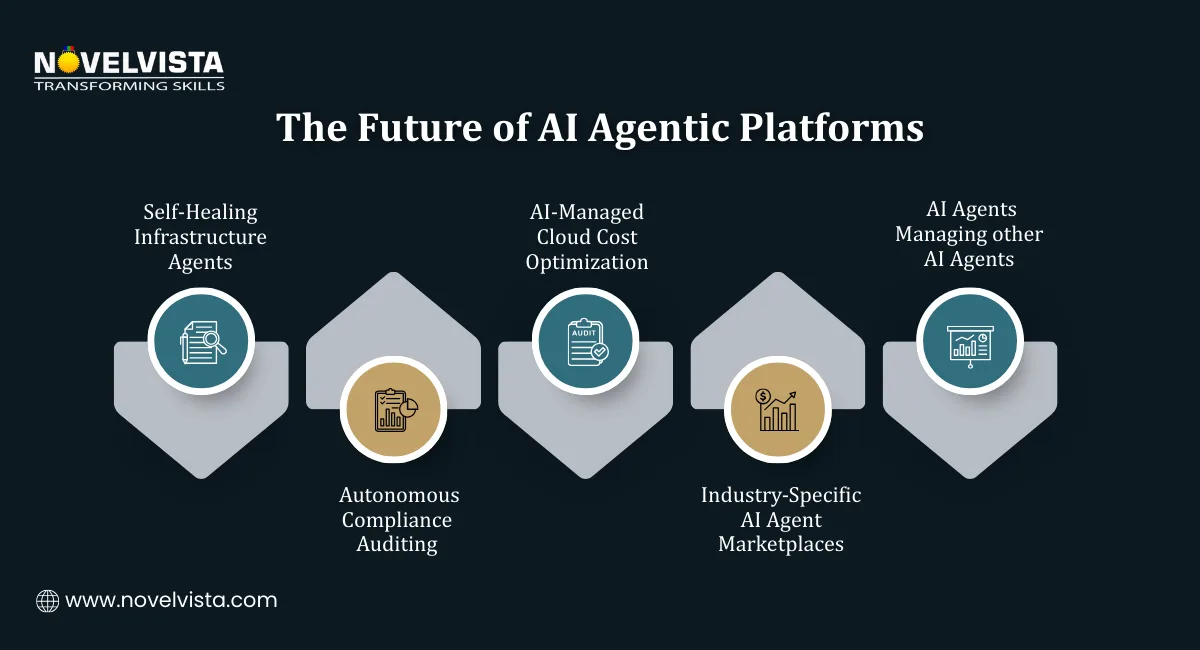
Agentic AI platforms are redefining how automation works. They combine reasoning, memory, tool usage, and orchestration into systems capable of independent action.
Whether you are experimenting with free agentic AI platforms or evaluating enterprise-grade solutions, understanding agentic AI platform architecture and performing a proper agentic AI platform comparison is essential.
The best agentic AI platform is one that empowers your teams to move from passive AI outputs to autonomous execution.
In the next few years, AI agentic platforms will likely become as fundamental as cloud infrastructure is today.

Take the Next Step in Your Agentic AI Journey
Ready to deepen your expertise in agentic AI platforms?
Join NovelVista’s Agentic AI Certification Training and gain practical knowledge of agentic AI platform architecture, multi-agent systems, and real-world deployment strategies. Designed for developers, IT leaders, and automation professionals, this course helps you confidently build and implement scalable AI agent solutions in modern enterprises.
Author Details

Course Related To This blog
Generative AI Certification
Agentic AI Certification
Confused About Certification?
Get Free Consultation Call
Stay ahead of the curve by tapping into the latest emerging trends and transforming your subscription into a powerful resource. Maximize every feature, unlock exclusive benefits, and ensure you're always one step ahead in your journey to success.