Category | AI And ML
Last Updated On 16/07/2026
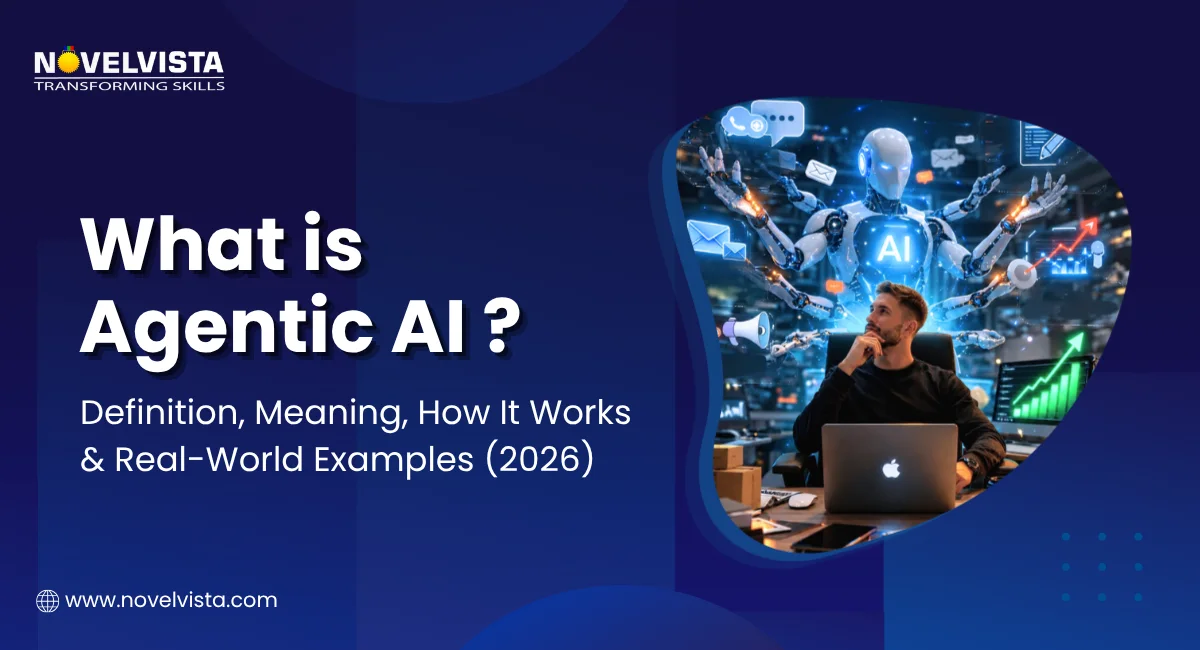
| Synopsis : Agentic AI refers to autonomous AI systems that can pursue goals, make decisions, use tools, and execute tasks with minimal human intervention. Unlike traditional AI or basic chatbots, agentic AI can plan workflows, interact with APIs and enterprise applications, learn from outcomes, and adapt to changing environments. This blog explains what agentic AI means, how it works, the frameworks powering it, real-world enterprise use cases, and why autonomous AI systems are becoming one of the most important technology trends in 2026. |
| Topic | Summary |
| Agentic AI Meaning | AI systems that can plan, act, and achieve goals autonomously |
| How It Works | Uses perception, planning, action, memory, and learning loops |
| Key Frameworks | LangChain, LangGraph, CrewAI, AutoGen, n8n |
| Real-World Use Cases | IT operations, finance, healthcare, customer support, logistics |
| Major Benefits | Faster automation, lower manual effort, scalable workflows |
| Enterprise Trend | Autonomous AI agents are rapidly growing across industries in 2026 |
According to Gartner, agentic AI systems will autonomously resolve 80% of common customer service issues without human intervention by 2029, reducing operational costs by 30%. At the same time, Gartner predicts that 50% of all service requests will be initiated by machine customers powered by intelligent AI agents by 2030. These projections show that AI is rapidly evolving beyond simple automation into systems capable of independent action and decision-making.
Yet, despite billions invested in artificial intelligence, many enterprise AI initiatives still depend heavily on manual oversight. According to the McKinsey State of AI 2025 report, nearly 60% of enterprise AI deployments still require significant human supervision to operate effectively. This gap between automation and true autonomy is exactly why organizations are now asking: what is agentic AI, and how can it transform modern operations?
This guide explains the complete agentic AI meaning, including its definition, key characteristics, real-world examples, how it works, the frameworks powering it, and how professionals can begin building autonomous AI systems in 2026.
The simplest agentic AI definition is this:
Agentic AI refers to autonomous or semi-autonomous AI systems that can pursue goals, make decisions, interact with tools, and adapt to changing environments with limited human intervention.
According to IBM Think (2026), agentic AI is “an AI system that can accomplish a specific goal with limited supervision, consisting of AI agents that mimic human decision-making to solve problems in real time.” This definition highlights the shift from reactive AI systems toward proactive, operational intelligence.
The core agentic AI meaning becomes easier to understand when compared with traditional systems:
Traditional AI systems usually respond to prompts or predefined workflows. Agentic systems, however, can independently break down objectives into tasks, execute actions, monitor results, and improve over time.
For example, consider an HR operations team in a large enterprise. A traditional automation tool may schedule interviews only after receiving manual instructions. An agentic AI system can independently review candidate pipelines, prioritize high-fit applicants, coordinate interviews, follow up with hiring managers, and escalate delays automatically based on hiring goals.
This transition from assistant-style AI to autonomous execution is one of the biggest technological shifts happening across enterprises in 2026.
Understanding the difference between traditional AI, generative AI, and agentic systems is essential because many organizations still confuse these technologies. While all three use artificial intelligence, their capabilities and operational roles are very different.
You can also explore our detailed comparison on Agentic AI vs Generative AI.
| Feature | Traditional AI | Generative AI | Agentic AI |
| Decision-making | Rule-based | Content generation | Autonomous reasoning |
| Memory | Limited or static | Context-window memory | Persistent learning memory |
| Tool use | Minimal | Limited integrations | Active tool execution |
| Human supervision needed | High | Moderate | Low |
| Goal orientation | Task-specific | Prompt-specific | Goal-driven |
| 2026 example | Fraud rule engine | AI content assistant | Autonomous IT operations agent |
Traditional AI systems focus on predefined rules and structured outputs. Generative AI models create content such as text, images, or code based on prompts. Agentic systems go a step further by combining reasoning, planning, memory, and execution into autonomous workflows.
This is the key distinction in the growing discussion around agentic AI vs generative AI. Generative models can create outputs, but autonomous AI agents can make decisions, coordinate actions, and continuously optimize outcomes.
The defining features of agentic systems explain why enterprises increasingly view them as the next stage of enterprise automation.
Agentic systems can operate independently without requiring constant step-by-step instructions.
Instead of waiting for human commands, these systems evaluate situations, choose actions, and execute workflows on their own. In IT operations, for example, autonomous monitoring agents can identify infrastructure failures and automatically trigger remediation workflows before users experience downtime.
AI agent goal-oriented behavior allows systems to focus on achieving outcomes rather than completing isolated tasks.
An agentic sales assistant may receive a target such as “increase customer retention by 10%.” Instead of performing one action, it can analyze churn signals, personalize outreach campaigns, schedule follow-ups, and monitor engagement continuously until the goal is achieved.
Agentic systems can interact with external software, APIs, databases, and enterprise applications.
Modern AI agents integrate directly with cloud platforms, CRMs, ticketing systems, ERP tools, and analytics dashboards. This capability allows them to move beyond conversational AI into operational execution across real business environments.
Unlike static systems, agentic AI can retain context and learn from previous outcomes.
Memory layers often use vector databases and retrieval systems to store historical interactions and operational data. Over time, agents improve recommendations, avoid repeated errors, and optimize workflows based on past experiences.
Agentic systems evaluate multiple possible actions before selecting the best path forward.
For example, a financial operations agent may detect suspicious transactions, compare them against fraud patterns, validate anomalies with external systems, and escalate only high-risk cases for human review. This reasoning capability enables faster and more intelligent decisions.
Many enterprise systems now rely on multi-agent systems where specialized agents collaborate to complete complex tasks.
Frameworks such as LangGraph, CrewAI, and AutoGen enable multiple AI agents to coordinate planning, research, execution, and validation workflows. One agent may gather data, another may evaluate risk, and another may execute operational tasks. This distributed collaboration model is becoming increasingly common in enterprise AI architecture.
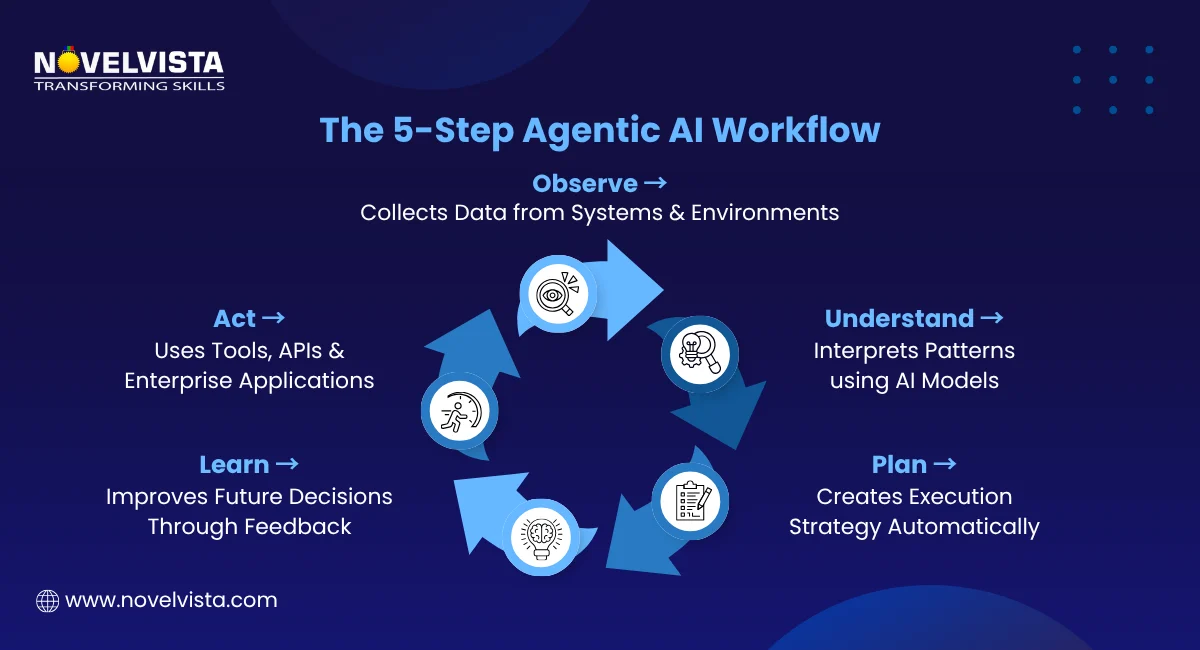
To understand how does agentic AI work, it helps to break the process into a continuous operational loop. These systems combine perception, reasoning, planning, action, and learning into an adaptive cycle.
The system gathers information from APIs, databases, applications, logs, or sensors.
Technologies such as event streams, monitoring systems, and real-time data pipelines help agents continuously observe their environment.
AI models analyze incoming information to understand context and identify patterns.
Large language models (LLMs), semantic search systems, and retrieval-augmented generation pipelines are commonly used during this stage.
The system develops a strategy for achieving a defined objective.
Planning frameworks use reasoning chains, workflow orchestration, and agent coordination logic to determine the best sequence of actions.
The agent executes tasks through enterprise tools and automation platforms.
Frameworks such as LangChain frequently manage action execution by connecting agents to APIs, cloud services, ticketing systems, and business applications.
The system evaluates outcomes and improves future performance.
Memory systems powered by vector databases and feedback loops help agents refine decisions over time and adapt to changing environments.
Several frameworks now dominate enterprise agent development in 2026:
For a deeper look, see our guides to Agentic AI Tools and Agentic AI Frameworks.
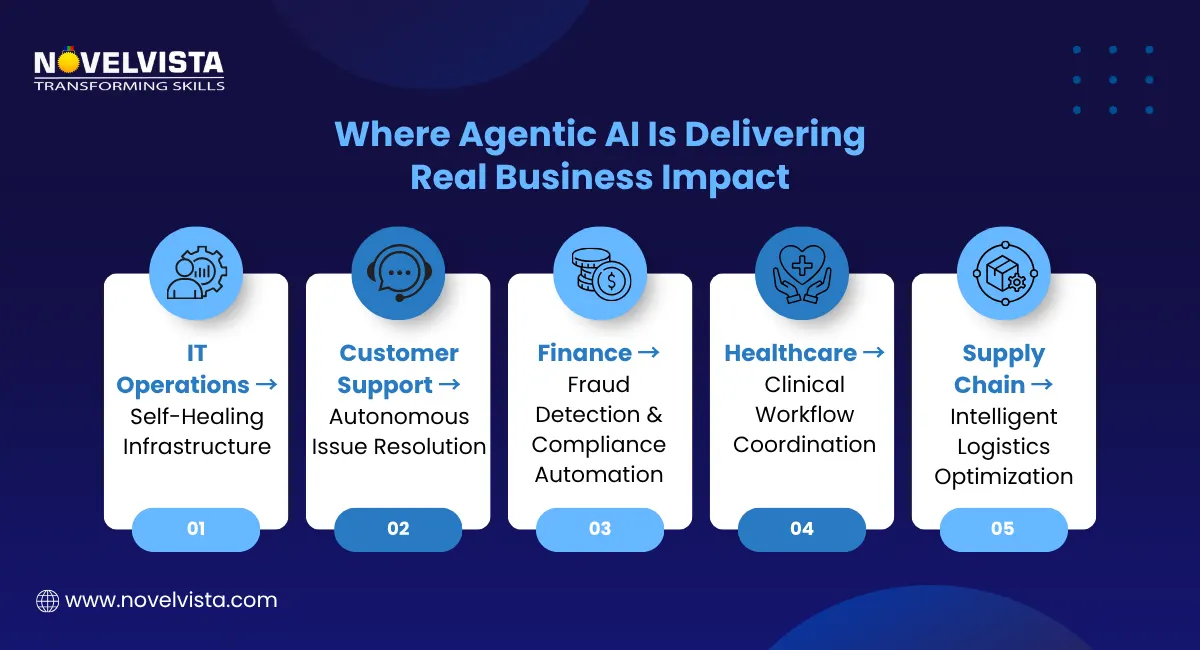
Agentic AI is no longer limited to experimental research environments. Enterprises across IT, finance, healthcare, and customer operations are actively deploying autonomous agents to reduce operational overhead, accelerate decision-making, and improve scalability.
According to Gartner projections, by 2027 over 50% of enterprise knowledge work will involve agentic AI systems. This rapid adoption is being driven by measurable improvements in workflow automation and operational efficiency.
Modern IT operations teams increasingly rely on autonomous agents for cloud monitoring, anomaly detection, incident response, and infrastructure optimization. These systems continuously monitor logs, metrics, and application performance data across distributed environments.
When failures occur, agentic systems can diagnose root causes, restart failed services, scale infrastructure resources, open incident tickets, and trigger remediation workflows automatically. Enterprises using self-healing infrastructure models are reducing downtime while improving response speed across complex cloud ecosystems.
Customer support is one of the fastest-growing areas for agentic deployment. According to Gartner (2025), agentic AI will autonomously resolve 80% of common customer service issues without human intervention by 2029 while reducing operational costs by 30%.
Unlike traditional chatbots, agentic support systems can authenticate users, retrieve account information, process refunds, escalate priority cases, update CRM systems, and follow up with customers automatically. These systems also learn from previous interactions to improve future issue resolution accuracy.
AI-powered software engineering agents are transforming how development teams build and maintain applications. Platforms such as GitHub Copilot Workspace and autonomous coding assistants can now generate code, debug issues, create documentation, write test cases, and recommend deployment strategies with minimal supervision.
Development teams are increasingly using agentic workflows for repetitive engineering tasks such as code reviews, dependency updates, infrastructure provisioning, and CI/CD pipeline management. This allows developers to spend more time on architecture, innovation, and product strategy.
Financial institutions are deploying AI agents for fraud detection, transaction validation, compliance monitoring, and financial operations automation. These systems analyze transaction behavior in real time, identify suspicious activities, validate anomalies, and route high-risk exceptions to compliance teams.
Agentic systems are also improving internal finance operations by automating invoice processing, reconciliation workflows, financial forecasting, and audit preparation. Because these systems continuously learn from operational patterns, they become more accurate over time while reducing manual review workloads.
Healthcare providers are using agentic systems to review patient histories, summarize medical records, recommend care pathways, and coordinate clinical workflows. AI agents can analyze large volumes of medical data faster than traditional administrative systems while helping clinicians prioritize urgent cases.
Hospitals are also experimenting with autonomous scheduling agents, insurance validation systems, and patient follow-up coordination tools. Human oversight remains essential in healthcare environments, but agentic systems are significantly reducing administrative burden and improving operational efficiency across care teams.
Supply chain operations are becoming increasingly dependent on autonomous decision-making systems. Agentic AI platforms can monitor inventory levels, predict shortages, optimize shipping routes, coordinate warehouse operations, and respond to disruptions in real time.
For example, if a supplier delay affects product availability, an agentic system can automatically reroute shipments, identify alternative vendors, notify stakeholders, and adjust procurement plans without waiting for manual intervention. This level of operational autonomy helps enterprises improve resilience while reducing supply chain delays and costs.
This expanded version should push the overall article into the required 2,500–3,000 word range while also strengthening topical authority for SEO.
If you want to check out more real world examples and use cases, you can check out the detailed blog: Agentic AI Examples.
Organizations investing in autonomous systems often experience the benefits of Agentic AI, including measurable operational improvements, but deployment also introduces significant governance challenges.
According to Gartner projections, over 50% of enterprise knowledge work will involve agentic AI systems by 2027. These systems allow organizations to automate complex workflows that previously required constant human coordination.
Agentic AI governance and ethics are becoming critical priorities for enterprise adoption. In 2026, enterprises investing in structured AI governance frameworks including agent audit trails, permission controls, and escalation protocols are deploying agents faster and with fewer incidents. According to McKinsey’s September 2025 analysis of more than 50 enterprise deployments, success with agentic AI requires reimagining entire workflows rather than simply layering agents on top of existing processes.
Responsible deployment depends on maintaining human oversight while allowing agents enough autonomy to create operational value.
In 2026, agentic AI has moved from research paper to enterprise production. Organizations are no longer experimenting only with chatbots or content generation tools. They are deploying autonomous systems capable of planning, acting, learning, and coordinating across complex workflows.
According to Gartner, autonomous agents will resolve the majority of customer service interactions by 2029 while machine customers increasingly initiate transactions independently. These trends signal a major transformation in enterprise operations, software development, customer engagement, and decision-making.
The question for professionals is no longer what is agentic AI it is how quickly can you build with it.
Ready to work with agentic AI systems? The NovelVista GSDC-accredited agentic AI certification course gives you hands-on skills in LangChain, LangGraph, and autonomous agent design without requiring advanced coding experience. Suitable for IT professionals, business leaders, and career changers alike.
Author Details

Course Related To This blog
Generative AI Professional
Agentic AI Certification
Confused About Certification?
Get Free Consultation Call
Stay ahead of the curve by tapping into the latest emerging trends and transforming your subscription into a powerful resource. Maximize every feature, unlock exclusive benefits, and ensure you're always one step ahead in your journey to success.