Category | AI And ML
Last Updated On 26/09/2026
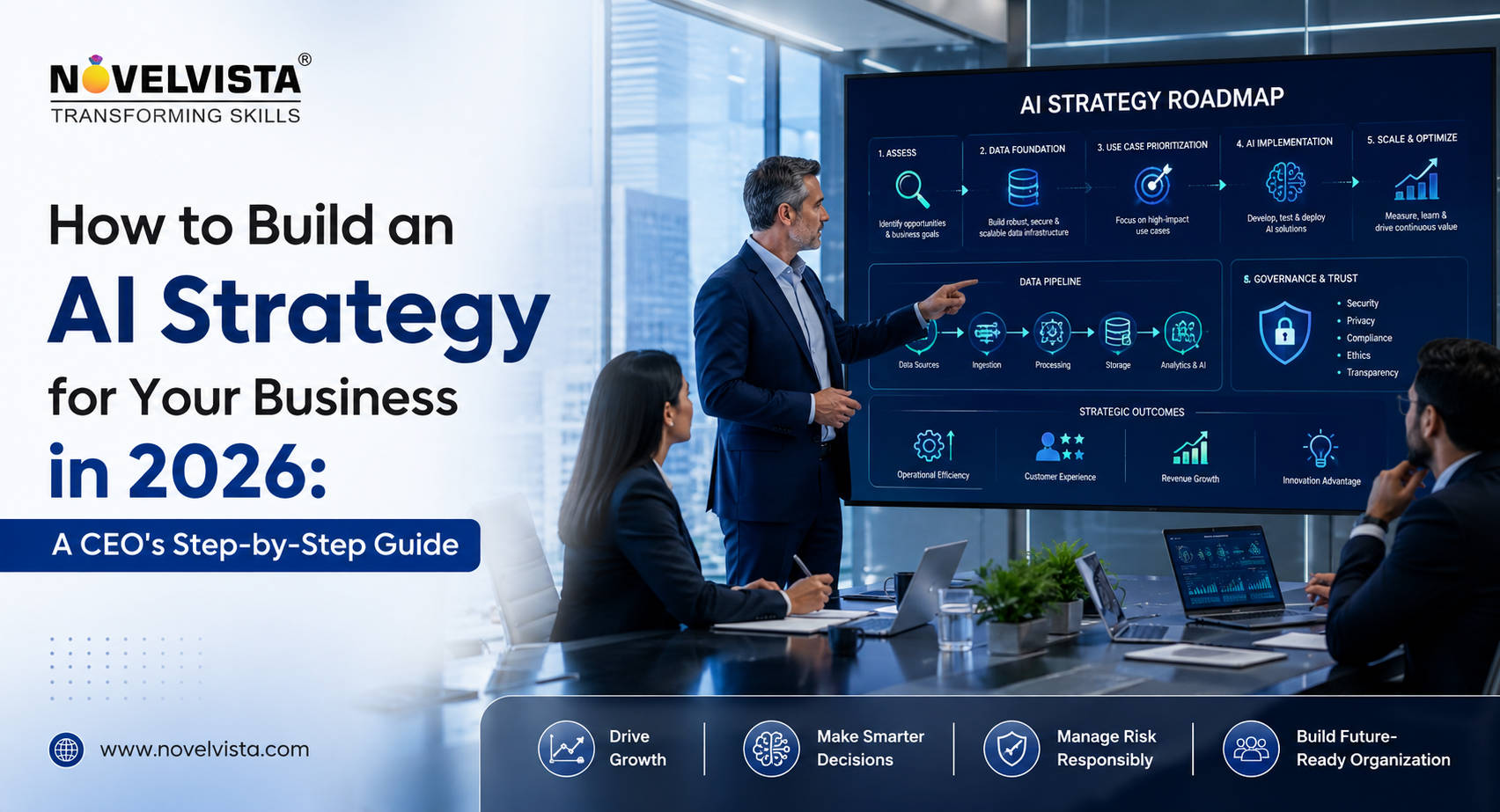
AI strategy for business 2026 is no longer a technology discussion kept inside IT. It is a boardroom priority for CEOs, founders, and business leaders who want measurable growth from artificial intelligence.
This guide explains why CEOs need an AI roadmap now, how to choose the right use cases, how to assess data readiness, how to govern AI risk, how to build workforce capability, and how to convert AI investments into clear business outcomes.
In 2026, the real question is not whether your company should use AI. The sharper question is where AI can create business value faster, safer, and more sustainably than your current operating model.
AI strategy for business 2026 matters because AI has moved from experimentation to execution. Many companies already use AI tools, but only a smaller group can connect those tools to revenue growth, cost reduction, customer experience, and decision velocity.
For CEOs, AI strategy for business 2026 should answer five questions:
A strong AI strategy for business leaders creates clarity before capital is spent.
The first rule of AI strategy for business 2026 is simple: do not start with the model, platform, or vendor. Start with the business problem.
AI should support measurable goals such as reducing customer response time, improving sales forecasting, automating finance workflows, increasing employee productivity, detecting operational risks, and supporting faster executive decisions.
This is where many organizations fail. They invest in AI pilots without connecting them to business KPIs. To understand how to build an AI strategy, leaders must first define outcomes in business language.
Instead of saying, “We need a generative AI chatbot,” say, “We want to reduce customer support resolution time by 30% within six months while maintaining service quality.” That is the difference between AI adoption and AI strategy.
Once business outcomes are clear, the next step in AI strategy for business 2026 is choosing the right use cases. Not every process deserves AI. Some problems can be solved through better process design, automation, or analytics.
AI should be used where it creates a step-change in speed, prediction, personalization, or decision-making.
| Business Area | Possible AI Use Case | Executive Value |
|---|---|---|
| Sales | Lead scoring and revenue forecasting | Higher conversion and better pipeline visibility |
| Customer Service | AI assistants and ticket summarization | Faster response and lower support load |
| HR | Skill gap analysis and workforce planning | Better talent decisions |
| Finance | Invoice anomaly detection and cash-flow prediction | Reduced risk and stronger planning |
| Operations | Demand forecasting and process optimization | Lower cost and improved efficiency |
A practical AI strategy guide for executives should score every use case against impact, feasibility, risk, data readiness, and time to value.
AI strategy for business 2026 cannot succeed if your data is fragmented, duplicated, outdated, or inaccessible.
Before scaling AI, CEOs should ask whether business data is reliable, who owns the data, whether it is secure and compliant, whether systems can integrate with AI tools, and whether teams trust the information they use.
A company with poor data governance should not rush into autonomous AI agents. It should first strengthen data quality, access control, integration, and process discipline.
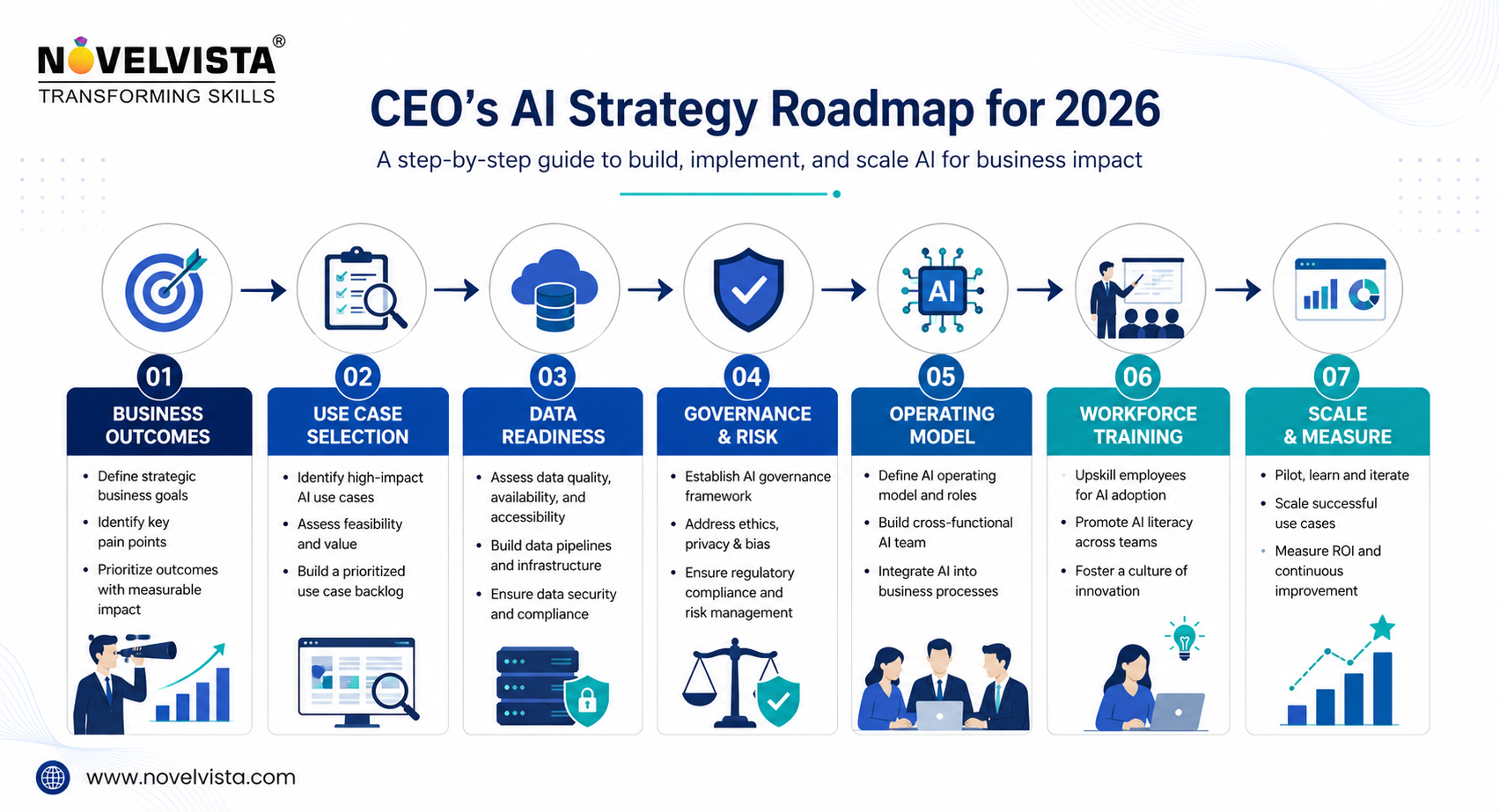
Governance is not a brake on innovation. It is the guardrail that lets AI scale safely. AI strategy for business 2026 must include governance from day one, especially as companies adopt generative AI, agentic AI, and AI-assisted decision-making.
Your governance model should cover data privacy, cybersecurity, bias and fairness, human oversight, vendor risk, model monitoring, regulatory compliance, content accuracy, intellectual property protection, and approval workflows for high-risk AI use cases.
For CEOs, AI strategy for business 2026 should define who approves AI use cases, who monitors risk, who owns business outcomes, and who is accountable when something goes wrong.
A good AI strategy for business 2026 needs an operating model. Otherwise, AI remains a collection of disconnected experiments.
The operating model defines how AI work gets done across the company. It should include an executive sponsor, AI steering committee, business use case owners, data and technology teams, risk reviewers, change management leads, and training owners.
Some companies create an AI Center of Excellence. Others build an AI studio where reusable tools, templates, governance practices, and expert support help teams move faster.
For CEOs, the goal is not to centralize every decision. The goal is to create consistent standards while allowing business teams to innovate safely.
Turning this operating model into a working technical reality needs someone who can design the underlying architecture, data flows, integrations, governance, and scalability. Our AI Solution Architect Certification Course equips technical leaders and architects with exactly these skills, helping CEOs translate AI strategy into a system that can actually be built and scaled.
AI strategy for business 2026 will fail if employees see AI as a threat instead of a capability multiplier.
Executives need to invest in AI literacy across the organization. This does not mean every employee becomes a data scientist. It means teams understand how to use AI responsibly, question AI outputs, protect data, and redesign workflows.
An AI strategy guide for executives should include role-based learning for CEOs, business unit heads, HR leaders, finance leaders, risk teams, product managers, operations managers, and customer-facing teams.
AI strategy for business 2026 is not just a technology roadmap. It is a people transformation roadmap.
The best AI strategy for business 2026 is not a 90-page document that nobody uses. It is a living execution plan.
Start with a few high-impact use cases. Run controlled pilots. Measure results quickly. Then scale the use cases that prove business value.
| Phase | CEO Question | Expected Output |
|---|---|---|
| Discover | Where can AI create measurable value? | Use case shortlist |
| Validate | Do we have the data, process, and ownership? | Feasibility score |
| Pilot | Can this work in a controlled environment? | Proof of value |
| Govern | Can we manage the risk? | Approval and controls |
| Scale | Can this create enterprise impact? | Deployment roadmap |
AI strategy for business 2026 should prioritize measurable outcomes over flashy innovation theater.
Here is a simple 90-day roadmap for CEOs planning AI strategy for business 2026.
This roadmap turns AI strategy for business 2026 into execution, not aspiration.
Even well-funded AI programs fail when leadership skips the basics. AI strategy for business 2026 must remain grounded in value, governance, adoption, and execution.
Avoid these mistakes:
The CEO’s role is to keep AI strategy for business 2026 aligned with the company’s strategic priorities.
AI strategy for business 2026 is about focus. The CEOs who win with AI will not be the ones chasing every tool. They will be the ones who connect AI to business outcomes, govern it responsibly, build workforce confidence, and scale only what delivers measurable value.
The right strategy begins with leadership clarity. It grows through disciplined execution. It becomes sustainable when people, process, data, technology, and governance move together.
For leaders who want to build that capability, NovelVista’s AI for Leaders & Executives course is designed to help CEOs, CXOs, managers, and decision-makers understand AI strategy, use case selection, governance, business value, and enterprise adoption without getting lost in technical complexity.
If your goal is to lead AI transformation with confidence, this course gives you the executive foundation to turn AI strategy for business 2026 into measurable action.
Author Details

Course Related To This blog
Agentic AI Certification
Confused About Certification?
Get Free Consultation Call
Stay ahead of the curve by tapping into the latest emerging trends and transforming your subscription into a powerful resource. Maximize every feature, unlock exclusive benefits, and ensure you're always one step ahead in your journey to success.