Category | AI And ML
Last Updated On 26/06/2026
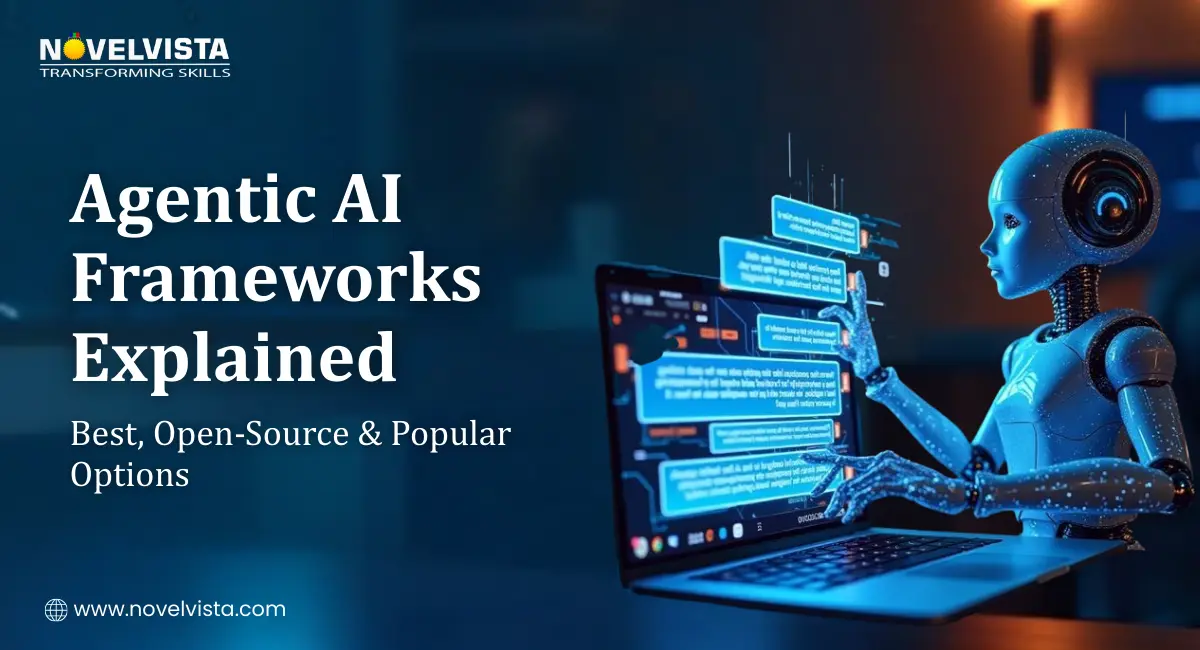
| Synopsis: Agentic AI frameworks are the foundation of autonomous AI systems, enabling agents to plan, reason, remember, use tools, and execute complex workflows. This blog compares leading frameworks such as LangGraph, CrewAI, AutoGen, LlamaIndex, Semantic Kernel, DSPy, and others, highlighting their strengths, use cases, and enterprise readiness. It also explains single-agent vs. multi-agent architectures, the rise of open-source innovation, and how to choose the right framework based on workflow complexity, memory needs, governance requirements, and deployment goals. The article concludes with real-world applications and key trends shaping the future of enterprise AI orchestration. |
| TL;DR | Details |
| What? | Agentic AI frameworks help AI agents reason, plan, remember, and execute tasks autonomously. |
| Top Frameworks | LangGraph, CrewAI, AutoGen, LlamaIndex, Semantic Kernel. |
| Best for Enterprise | LangGraph (stateful workflows) and Semantic Kernel (Azure integration). |
| Best for Multi-Agent AI | CrewAI and AutoGen. |
| Best for Retrieval | LlamaIndex. |
| Key Trend (2026) | Enterprises are moving from prompt chains to autonomous, multi-agent systems. |
| Main Takeaway | Choose a framework based on workflow complexity, memory needs, governance requirements, and deployment scale. |
Artificial intelligence is rapidly shifting from single-prompt chatbots to autonomous systems capable of reasoning, planning, tool usage, and workflow execution. To better understand this evolution, it's important to first explore what is Agentic AI and how autonomous agents differ from traditional AI applications.
According to Gartner, over 40% of enterprise applications will include autonomous AI agents by the end of 2026, while McKinsey estimates that companies deploying AI agent orchestration systems can reduce operational overhead by up to 30% in complex workflows. As organizations move toward multi-agent systems and autonomous AI operations, choosing the right agentic AI framework is becoming a critical architectural decision for engineering and product teams.
This guide explains the best, most popular, and open-source agentic AI frameworks available in 2026, including LangGraph, CrewAI, AutoGen, Semantic Kernel, OpenAI Swarm, DSPy, and more.
An agentic AI framework is a software framework used to build autonomous AI agents that can reason, plan tasks, maintain memory, use external tools, and execute multi-step workflows with limited human intervention. These frameworks provide orchestration layers for managing stateful agent workflows, decision-making, agent memory management, and AI agent orchestration across APIs, databases, and enterprise systems.
Modern agentic systems differ from simple prompt chains because they support long-running execution loops, task decomposition, multi-agent collaboration, and human-in-the-loop AI controls.
Traditional LLM applications usually follow a simple input → output flow. Agentic systems instead operate continuously:
This shift is why agent workflow automation and LLM orchestration platforms are becoming central to enterprise AI architecture.
In short: an agentic AI framework acts as the operating system for autonomous AI agents. It enables reasoning, planning, memory, and tool execution instead of simple one-shot prompt responses.
Early AI automation systems relied heavily on chained prompts. Developers manually connected prompts together to simulate workflows.
This approach created several problems:
Modern agentic AI frameworks solve these limitations by introducing stateful execution and intelligent orchestration.
| Prompt Chains | Agentic Frameworks |
|---|---|
| Linear execution | Dynamic workflows |
| No memory persistence | Stateful memory |
| Manual routing | Autonomous reasoning |
| Static APIs | Dynamic tool discovery |
| Single-step logic | Multi-step planning |
| Weak error handling | Retry and self-correction |
One major reason for adoption is the rise of multi-agent systems.
Instead of using one large AI agent for every task, organizations increasingly deploy specialized autonomous AI agents for:
These agents collaborate through orchestration frameworks such as LangGraph and AutoGen.
According to AIMultiple benchmark testing in early 2026:
This efficiency improvement is one reason enterprises are rapidly moving toward production-ready AI agents.
Modern agentic systems generally fall into four categories. Understanding Agentic AI Architecture is essential for designing scalable orchestration patterns, selecting deployment models, and building resilient enterprise AI systems.
Most enterprise deployments in 2026 use hybrid architectures.
In short: prompt chains are being replaced because they cannot scale autonomous reasoning or long-running workflows effectively. Agentic AI frameworks provide memory, orchestration, planning, and resilience needed for production AI systems.
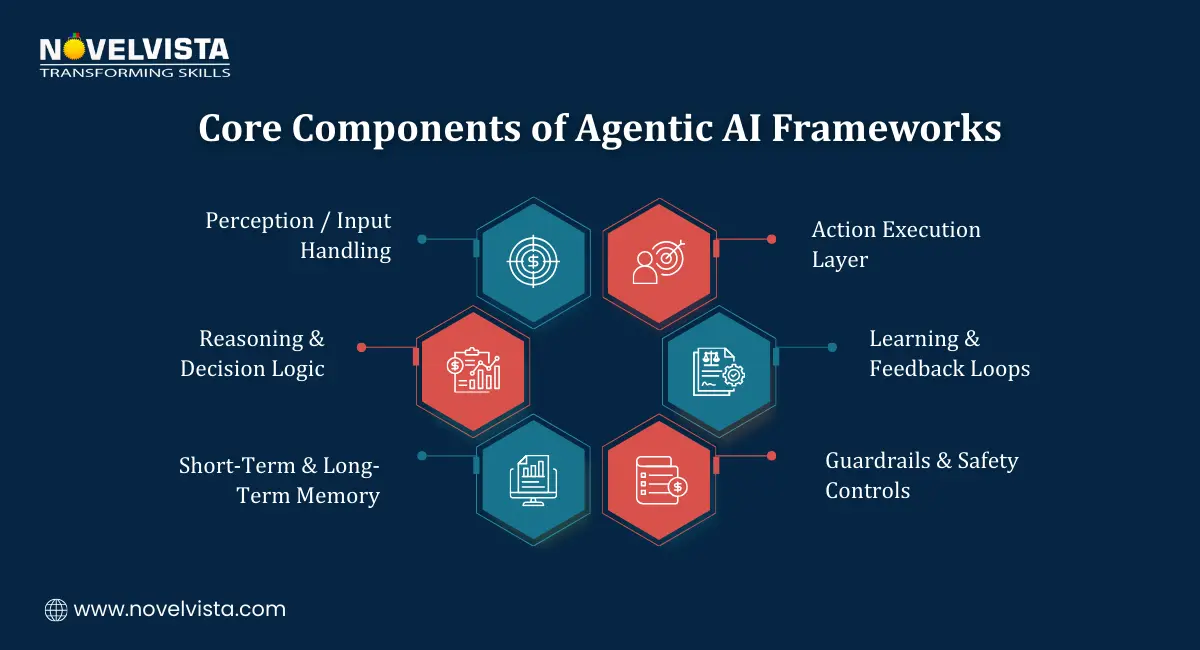
Most popular agentic AI frameworks share several foundational building blocks.
The planning layer enables agents to break high-level goals into smaller executable tasks.
This often includes:
Frameworks commonly implement the ReAct reasoning pattern, which combines reasoning with action execution.
Persistent memory is essential for long-running autonomous agents.
Memory systems typically include:
Strong agent memory management helps reduce hallucinations and repetitive failures.
Modern AI agents must interact with external systems.
Common integrations include:
This layer powers real-world operational execution.
The orchestration layer coordinates:
This is central to AI agent orchestration.
Enterprise AI deployments increasingly require:
These controls improve governance and reduce operational risk.
Guardrails prevent unsafe or unauthorized behavior.
Common mechanisms include:
Summing it up, the best agentic AI framework combines planning, memory, orchestration, and governance into one operational layer. Without these components, autonomous agents become unreliable at scale.
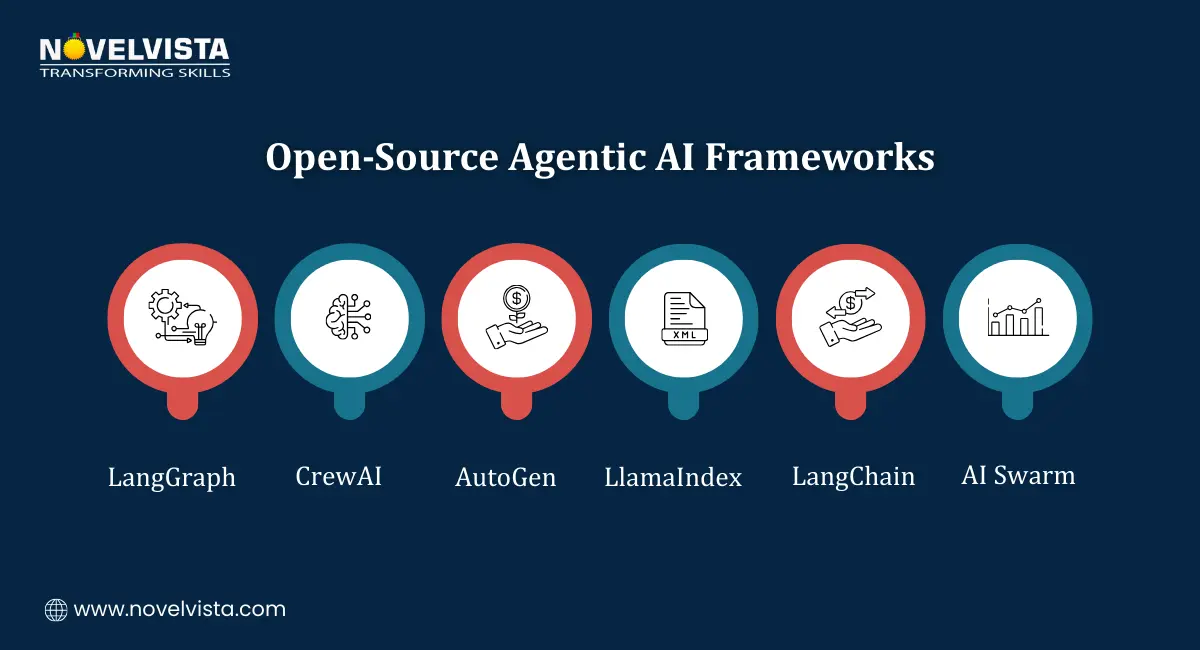
These represent the current top agentic AI frameworks used across enterprise AI deployments in 2026.
LangGraph, CrewAI, and AutoGen dominate enterprise agent orchestration in 2026, while frameworks like DSPy and Semantic Kernel focus on optimization and enterprise integration.
Stop picking frameworks based on hype.
Use a clear decision guide to match LangGraph,
CrewAI, AutoGen, and similar tools to your real use case, without costly rework later.
Best for: Complex multi-step workflows and production-grade AI systems.
Limitation: Steeper learning curve than LangChain.
Used in production by: Enterprise AI teams building persistent workflows.
LangGraph extends LangChain with graph-based orchestration and persistent execution states. It is widely considered the most mature framework for stateful agent workflows in 2026. Teams building long-running AI systems with retry loops, memory persistence, and human approvals increasingly prefer LangGraph over traditional prompt-chain architectures.
Best for: Multi-agent task coordination.
Limitation: Can become complex with large agent hierarchies.
Used in production by: Automation teams and AI workflow startups.
CrewAI focuses heavily on role-based multi-agent systems where specialized agents collaborate on tasks. It is popular for research workflows, autonomous operations, and AI copilots requiring distributed reasoning.
Best for: Agent-to-agent communication workflows.
Limitation: Higher token consumption in large conversations.
Used in production by: Research labs and enterprise experimentation teams.
Microsoft-backed AutoGen enables agents to converse with each other while coordinating tasks dynamically. It is commonly used in collaborative coding systems and planning workflows.
Best for: Knowledge-heavy AI agents.
Limitation: Less workflow flexibility than LangGraph.
Used in production by: Data-intensive enterprise AI teams.
LlamaIndex specializes in connecting LLMs with structured and unstructured enterprise knowledge systems. It performs especially well in retrieval-heavy AI architectures.
Best for: Azure-native enterprise AI applications.
Limitation: Less community momentum outside Microsoft stack.
Used in production by: Large enterprises using Azure infrastructure.
Semantic Kernel integrates AI agents directly with Microsoft enterprise services and supports strong governance workflows.
Best for: Rapid prototyping.
Limitation: Still evolving rapidly in 2026.
Used in production by: Small AI product teams.
Swarm provides simplified orchestration patterns for coordinating modular AI agents with minimal setup.
Best for: Google ecosystem integrations.
Limitation: Ecosystem still maturing.
Used in production by: Teams building on Gemini infrastructure.
Google’s Agent Development Kit focuses on integrating Gemini-based autonomous workflows with cloud-native tooling.
Best for: Prompt optimization and reliability tuning.
Limitation: Less intuitive for workflow orchestration.
Used in production by: AI research and evaluation teams.
DSPy automates prompt engineering optimization and improves reproducibility for complex AI systems.
Best for: Beginners learning AI orchestration.
Limitation: Sequential chains can become difficult to maintain.
Used in production by: Startups and educational projects.
LangChain remains one of the most recognized popular agentic AI frameworks, though many advanced teams now migrate toward LangGraph for stateful execution.
Best for: Fast low-overhead agent deployment.
Limitation: Smaller ecosystem.
Used in production by: Lean engineering teams.
Agno focuses on simplicity and low infrastructure overhead for lightweight AI agents.
Best for: Autonomous software engineering experiments.
Limitation: Experimental maturity.
Used in production by: Research environments.
MetaGPT simulates collaborative software-development teams using coordinated AI agents.
In short, different frameworks solve different orchestration problems. LangGraph leads stateful workflows, CrewAI dominates collaborative agents, and LlamaIndex excels in retrieval-heavy architectures.
An agentic AI framework comparison helps teams understand trade-offs instead of choosing tools based on hype. The table below focuses on how these frameworks behave in real systems.
| Framework | Best For | Control Flow | Memory | HITL Support | Enterprise Fit |
|---|---|---|---|---|---|
| LangGraph | Stateful enterprise workflows | Graph-based | Strong | Yes | High |
| CrewAI | Multi-agent collaboration | Role-based | Moderate | Moderate | High |
| AutoGen | Conversational agents | Conversational | Moderate | Yes | Moderate |
| LangChain | Rapid orchestration | Sequential | Basic | Limited | Moderate |
| LlamaIndex | Retrieval-heavy agents | Retrieval-centric | Strong | Moderate | High |
| Semantic Kernel | Azure enterprise AI | Plugin-based | Strong | Strong | High |
| DSPy | Prompt optimization | Declarative | Limited | Limited | Moderate |
| OpenAI Swarm | Lightweight modular agents | Modular | Basic | Limited | Moderate |
| Google ADK | Gemini orchestration | Modular | Moderate | Moderate | Moderate |
| Agno | Lightweight deployment | Minimal | Basic | Limited | Low |
| MetaGPT | Autonomous engineering experiments | Multi-agent | Moderate | Limited | Low |
Key Takeaway:
No single framework fits every enterprise architecture. The best agentic AI framework depends on orchestration complexity, memory requirements, governance needs, and deployment scale.
Many organizations prefer open source agentic AI frameworks because they reduce vendor lock-in and provide customization flexibility.
| Framework | Open Source | Best Strength | Enterprise Readiness |
|---|---|---|---|
| LangGraph | Yes | Stateful orchestration | High |
| CrewAI | Yes | Multi-agent coordination | High |
| AutoGen | Yes | Conversational agents | High |
| LlamaIndex | Yes | Retrieval workflows | High |
| DSPy | Yes | Prompt optimization | Moderate |
| Agno | Yes | Lightweight agents | Moderate |
| MetaGPT | Yes | Experimental engineering workflows | Low |
Open-source ecosystems are evolving rapidly because enterprises increasingly want control over:
Open-source agentic AI frameworks dominate innovation in 2026 because enterprises want customization, governance control, and vendor independence for autonomous AI deployments.
Choose LangGraph.
Choose CrewAI or AutoGen.
Choose LlamaIndex.
Choose Semantic Kernel.
Choose LangChain or OpenAI Swarm.
One important consideration is single-agent vs multi-agent complexity. Multi-agent systems create better specialization but increase orchestration overhead.
When considering, framework selection should match operational architecture, not hype. Teams should optimize for workflow complexity, governance, memory requirements, and deployment scale.
Recommended framework: LangGraph
Enterprise IT teams use LangGraph for self-healing infrastructure workflows where agents monitor logs, diagnose failures, escalate incidents, and trigger remediation pipelines automatically.
Recommended framework: CrewAI
Research organizations increasingly deploy CrewAI systems where specialized agents gather information, validate sources, summarize findings, and coordinate deliverables collaboratively.
Recommended framework: AutoGen
Conversational coding agents built with AutoGen can coordinate debugging, testing, code generation, and deployment workflows across engineering teams.
Recommended framework: LlamaIndex
Organizations building enterprise search assistants often combine LlamaIndex with vector databases for retrieval-heavy agent architectures.
In short, framework choice depends heavily on operational workload. Retrieval-heavy systems, collaborative agents, and autonomous infrastructure all require different orchestration patterns.
The rapid rise of autonomous AI agents is transforming how organizations build software, automate operations, and orchestrate enterprise workflows. Modern agentic AI frameworks are no longer experimental tooling they are becoming foundational infrastructure for next-generation AI systems.
The biggest trend in 2026 is not simply smarter models. It is smarter orchestration.
Frameworks like LangGraph, CrewAI, AutoGen, Semantic Kernel, and LlamaIndex are enabling enterprises to move from isolated prompts toward persistent, collaborative, and production-ready AI agents capable of real operational execution.
The future of AI belongs to systems that can reason, coordinate, remember, and act autonomously across complex environments.

Ready to build production-ready AI agents and autonomous workflows?
The NovelVista Agentic AI Certification helps professionals learn LangGraph, CrewAI, AutoGen, AI agent orchestration, multi-agent systems, and real-world enterprise AI implementation strategies through hands-on projects and practical workflows. Designed for developers, architects, automation engineers, and business professionals exploring the future of autonomous AI systems.
Author Details

Confused About Certification?
Get Free Consultation Call
Stay ahead of the curve by tapping into the latest emerging trends and transforming your subscription into a powerful resource. Maximize every feature, unlock exclusive benefits, and ensure you're always one step ahead in your journey to success.