Category | Quality Management
Last Updated On 30/01/2026
Modern IT services run on speed, availability, and trust. Yet, despite advanced monitoring tools and automation, service disruptions remain a major challenge. Industry studies show that nearly 60% of IT incidents are repeat incidents, caused by unresolved underlying issues rather than new failures. Even more concerning, recurring service problems can cost organizations millions annually in downtime, lost productivity, and reputational damage.
This is where Problem Management in ISO 20000 becomes critical. Unlike reactive firefighting, ISO 20000 emphasizes identifying root causes, eliminating repeat failures, and driving continual improvement across IT services. For auditors and service leaders alike, problem management is no longer a “nice to have” process; it is a core indicator of IT service maturity.
In this Lead Auditor’s Guide, we explore how ISO 20000 Problem Management works, why Root Cause Analysis in ISO 20000 is essential, and how organizations can meet audit expectations while building stable, resilient IT services.
ISO/IEC 20000 is the international standard for IT Service Management (ITSM). It defines how organizations should plan, deliver, operate, monitor, and continually improve IT services aligned with business needs.
At its core, ISO/IEC 20000 promotes:
Consistent service quality
Risk-based thinking
Continual improvement
Customer-focused service delivery
Within this framework, ISO/IEC 20000 Problem Management plays a vital role. It ensures that organizations do not repeatedly treat symptoms but instead resolve the structural causes of service disruptions.
Problem Management in ISO 20000 is the structured process of identifying, analyzing, and eliminating the root causes of incidents to prevent recurrence. While incident management focuses on restoring services quickly, problem management focuses on long-term service stability.
Reducing the number and impact of recurring incidents
Identifying known errors and workarounds
Preventing future service disruptions
Supporting continual improvement
In simple terms, if incident management asks “How do we fix this now?”, ISO 20000 Problem Management asks “Why did this happen, and how do we ensure it never happens again?”
From an audit perspective, Problem Management in ISO 20000 is a high-impact process because it reveals how effectively an organization controls recurring issues and systemic risks. Repeated incidents, weak corrective actions, or poor root cause analysis in ISO 20000 often indicate deeper gaps in service management. During audits, assessors evaluate whether problems are formally identified and logged, root causes are properly analyzed, corrective actions are implemented and reviewed, and preventive actions effectively reduce future risk. Organizations without a structured ISO 20000 Problem Management approach commonly experience repeated nonconformities, customer dissatisfaction, and unfavorable audit outcomes. In contrast, strong Problem Management in ISO 20000 demonstrates operational control, continual improvement, and a higher level of IT service maturity.
Get a practical, auditor-focused guide—free.
Learn how to fix root causes, not symptoms.
Build repeatable problem management that drives improvement.
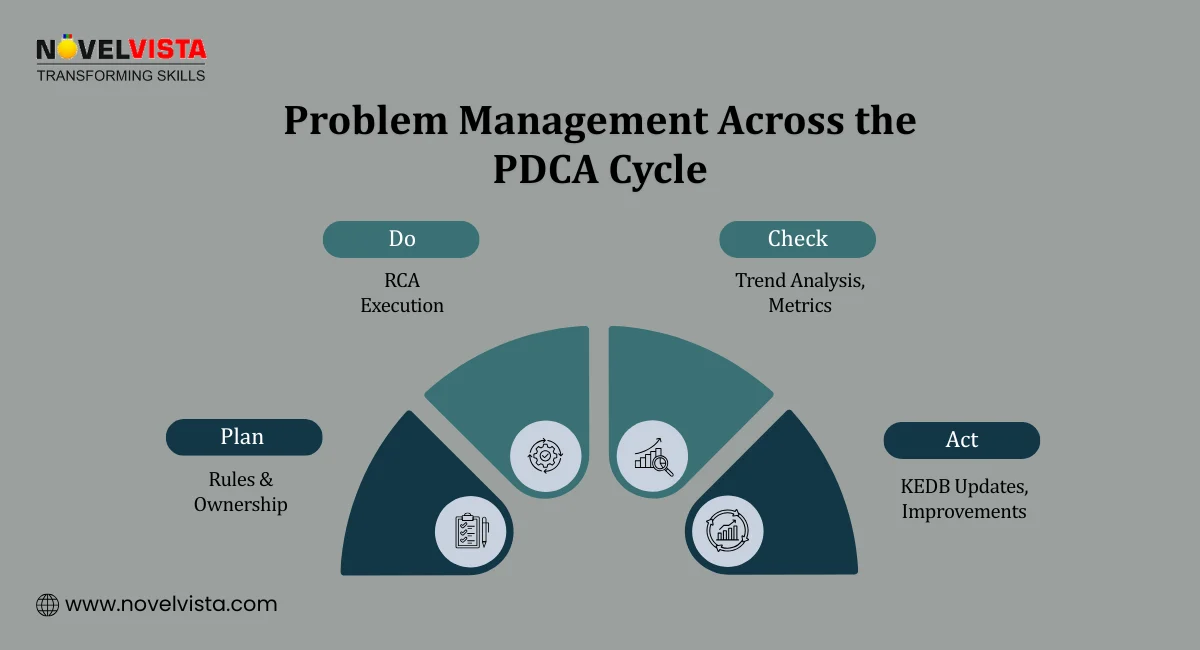
To meet ISO/IEC 20000 requirements, problem management must be systematic and evidence-based.
Problems may arise from:
Major incidents
Trends in recurring incidents
Proactive analysis of service data
Not every incident becomes a problem, but recurring or high-impact incidents should trigger ISO/IEC 20000 Problem Management activities.
In ISO 20000 Problem Management, every identified problem must be formally logged and clearly documented. Problems are then categorized and prioritized based on their risk, frequency, and impact on business services. Accurate and consistent records help track progress and demonstrate control during audits. Proper logging also ensures problems are reviewed systematically rather than handled informally.
This is the heart of problem management. Root Cause Analysis in ISO 20000 ensures that organizations identify the true underlying cause, not just the visible symptom.
In ISO 20000 Problem Management, once the root cause is identified, the issue is recorded as a known error until a permanent solution is implemented. Documented workarounds may be used to minimize service disruption in the interim. Known error management helps reduce the impact of recurring incidents while long-term fixes are planned. It also provides valuable evidence of control during ISO 20000 audits.
In ISO 20000 Problem Management, problems should only be resolved and closed once corrective actions are fully implemented. The effectiveness of these actions must be verified to ensure the issue will not recur. Proper closure confirms that root causes have been addressed, not just symptoms. This step is critical for demonstrating continual improvement during ISO 20000 audits.
Root Cause Analysis in ISO 20000 is more than a technical exercise it is a governance requirement. Auditors often focus here because weak root cause analysis leads to repeat failures and ineffective improvements.
Effective root cause analysis:
Uses factual evidence, not assumptions
Examines process, people, technology, and suppliers
Links findings to corrective and preventive actions
Poor RCA, such as identifying “human error” without deeper analysis, is a common audit finding.
ISO/IEC 20000 does not mandate a specific RCA method, but it expects structured and consistent analysis.
Commonly accepted techniques include:
5 Whys – Simple and effective for process issues
Cause-and-effect (Fishbone) analysis – Useful for complex service failures
Trend analysis – Identifies patterns across incidents
From a Lead Auditor’s perspective, effective ISO 20000 Problem Management is demonstrated through evidence, not intentions.
Auditors typically look for:
Clearly defined problem management procedures
Problem records linked to incidents
Documented root cause analysis reports
Corrective actions with ownership and timelines
Evidence of reduced recurrence
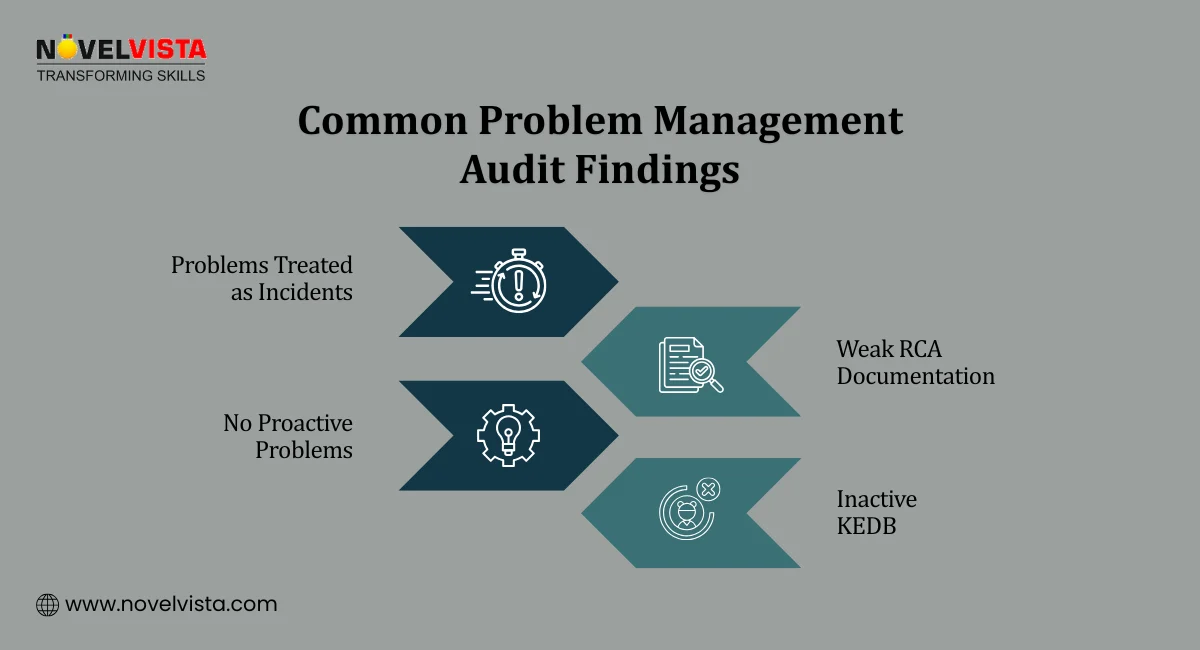
Common nonconformities include:
Problems closed without a verified root cause
Corrective actions that address symptoms only
Lack of trend analysis or follow-up reviews
Despite its importance, many organizations struggle with problem management.
Frequent challenges include:
Treating problem management as extended incident management
Lack of accountability for problem ownership
Incomplete root cause analysis documentation
Weak integration with change management
Overcoming these issues requires cultural change, not just procedural updates.
Organizations that excel in Problem Management in ISO 20000 take a proactive rather than reactive approach. By analyzing incident trends early, assigning clear ownership for root cause analysis, and measuring success through reduced recurrence, they strengthen service stability. Aligning problem management outcomes with business risk ensures meaningful improvements. These best practices support audit compliance while enhancing overall service reliability.
Continual improvement is a core principle of ISO/IEC 20000. ISO 20000 Problem Management feeds this cycle by turning operational failures into improvement opportunities.
Effective problem management:
Prevents repeated service disruptions
Strengthens risk management
Improves customer satisfaction
Builds long-term service resilience
Problem Management in ISO 20000 is not just a corrective process it is a strategic capability that protects service continuity and business value. For Lead Auditors, it offers a clear window into how effectively an organization identifies risk, learns from failures, and drives continual improvement. When supported by robust Root Cause Analysis in ISO 20000, structured problem management goes beyond checklist compliance to deliver lasting service stability. In an environment where downtime is expensive and customer expectations are unforgiving, strong ISO 20000 Problem Management is no longer optional; it is a defining mark of service excellence and operational maturity.

To take your understanding of Problem Management in ISO 20000 and Root Cause Analysis in ISO 20000 from theory to real-world audit practice, the right training makes all the difference. NovelVista’s ISO/IEC 20000:2018 Lead Auditor Certification Training is designed to equip ITSM professionals with hands-on auditing skills, practical service management insights, and globally recognized credentials. The course helps you confidently lead ISO 20000 audits, assess problem management effectiveness, and drive continual service improvement in complex digital environments.
Start your ISO 20000 Lead Auditor journey today!
Author Details

Course Related To This blog
ISO 20000:2018 Lead Auditor
Confused About Certification?
Get Free Consultation Call
Stay ahead of the curve by tapping into the latest emerging trends and transforming your subscription into a powerful resource. Maximize every feature, unlock exclusive benefits, and ensure you're always one step ahead in your journey to success.