Category | Quality Management
Last Updated On 09/02/2026
Most service management failures don’t happen because tools are weak. They happen because teams don’t clearly understand what the ISO/IEC 20000-1 clauses actually expect in practice. Documentation exists, processes exist, but audits still raise gaps.
In ISO/IEC 20000 Lead Auditor training sessions, a common pattern emerges: organizations often document processes correctly but struggle to demonstrate how clauses 4–10 work together as a system during audits.
ISO/IEC 20000-1 is the international standard for building, operating, and improving a Service Management System (SMS). It focuses on how services are planned, delivered, measured, and improved in a controlled and repeatable way. The heart of the standard lies in Clauses 4 to 10, which define all mandatory SMS requirements.
This guide explains the ISO/IEC 20000-1 clauses in plain language. You’ll see what each clause means, why it exists, and how auditors interpret it during real assessments. The goal is simple: make the ISO 20000-1 clauses explained clearly, without turning them into theory.
Clause |
Focus Area |
What It Ensures |
Clause 4 |
Context of the organization |
SMS scope, stakeholders, service boundaries |
Clause 5 |
Leadership |
Accountability, policy, governance |
Clause 6 |
Planning |
Risks, objectives, planned changes |
Clause 7 |
Support |
Resources, competence, documentation |
Clause 8 |
Operation |
Service delivery, control, lifecycle activities |
Clause 9 |
Performance evaluation |
Monitoring, audits, reviews |
Clause 10 |
Improvement |
Nonconformities and continual improvement |
This table gives a quick view of the ISO/IEC 20000-1 clause breakdown, especially useful for audits and exam preparation.
The ISO/IEC 20000-1 clauses from 4 to 10 form the backbone of the Service Management System. Unlike optional guidance, these clauses are mandatory and audited in every certification assessment.
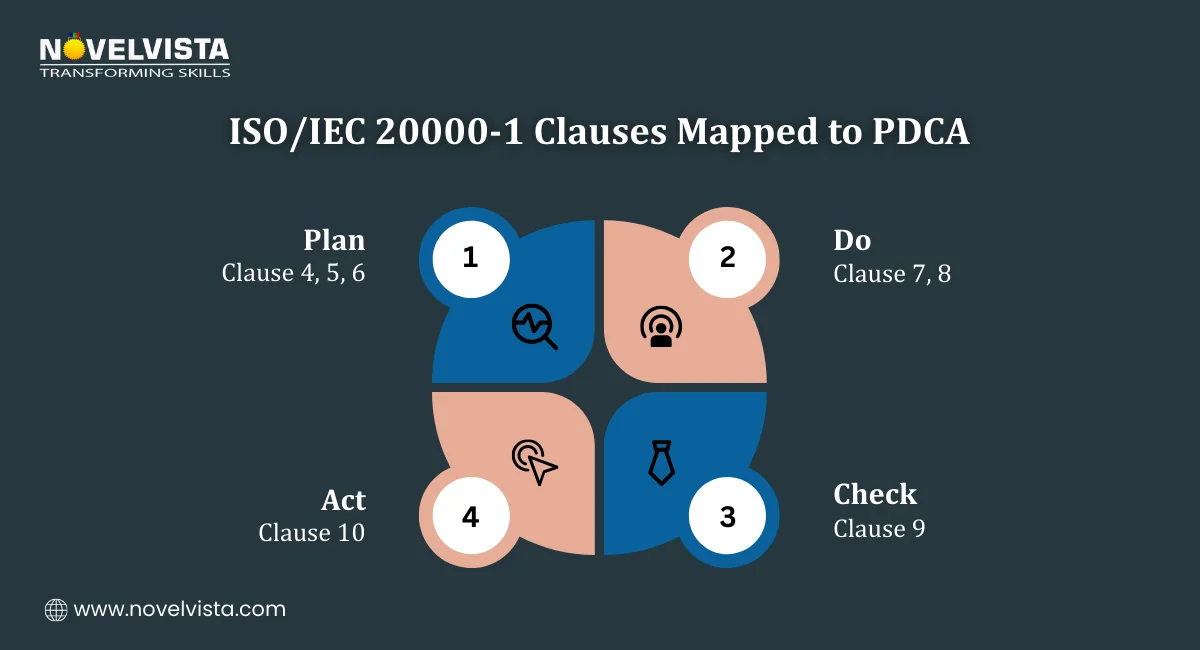
They follow a clear PDCA (Plan–Do–Check–Act) structure:
Auditors don’t review these clauses in isolation. They look for logical flow, consistency, and evidence that the SMS works as a system. Understanding how the ISO 20000-1 clauses fit together is what separates a compliant SMS from a fragile one.
Clause 4 sets the foundation for the entire SMS. Without it, everything else becomes guesswork.
This clause requires organizations to:
In real audits, Clause 4 fails when the scope is copied from templates or doesn’t reflect how services actually operate. Auditors expect clarity on:
A strong Clause 4 implementation makes later clauses easier. It anchors the entire ISO/IEC 20000-1 clause breakdown in reality, not assumptions.
Clause 5 is where many SMS implementations weaken. Service management cannot survive as an “IT-only” activity.
This clause focuses on leadership responsibility and requires top management to:
Auditors look beyond signed policies. They check whether leadership:
Effective leadership evidence typically includes decision records, management review actions, and risk ownership, not just approved policies. A well-implemented Clause 5 ensures service management supports business goals, not just compliance.
Clause 6 turns intent into direction. Once context and leadership are clear, planning defines how the SMS will deal with uncertainty and move toward outcomes.
This clause requires organizations to:
Auditors expect to see clear links between risks, objectives, and actions. Common gaps appear when risks are listed but not addressed, or when objectives exist without metrics. When ISO/IEC 20000-1 clauses are applied correctly, Clause 6 ensures service goals support business priorities, not just operational convenience.
Clause 7 focuses on what enables the SMS to work day to day. Without proper support, even strong plans fail.
Key expectations include:
In audits, Clause 7 is tested through evidence. Training records, communication channels, document controls, and supplier management must reflect actual operations. This part of the ISO 20000-1 clauses often reveals whether the SMS is practical or only documented.
A practical guide for Lead Auditors to audit ISO/IEC 20000-1 beyond checklists, by tracing clause linkages (4–10) and evaluating whether the SMS actually works as a system.
Clause 8 is the operational core of the standard. It defines how services are designed, delivered, transitioned, and supported.
This clause covers:
Auditors review Clause 8 by tracing services end-to-end. They check whether demand is balanced with supply, issues are resolved consistently, and changes are controlled. Strong execution here proves the ISO/IEC 20000-1 clause breakdown is being applied in real service delivery.
Clause 9 ensures the SMS is not running blindly. Measurement and review are essential for control.
Organizations must:
Auditors expect performance data to drive decisions, not just reporting. Metrics should be meaningful, audits should be planned and independent, and management reviews should result in actions. Clause 9 connects operational reality with leadership oversight across the ISO/IEC 20000-1 clauses.
Clause 10 closes the loop. It ensures learning turns into improvement.
This clause focuses on:
Auditors review how issues are identified, corrected, and verified. Superficial fixes are a common failure point. Effective Clause 10 implementation shows maturity and long-term control, which is central to ISO 20000-1 clauses explained clearly during certification audits.
The ISO/IEC 20000-1 clause breakdown is designed as a system, not a checklist:
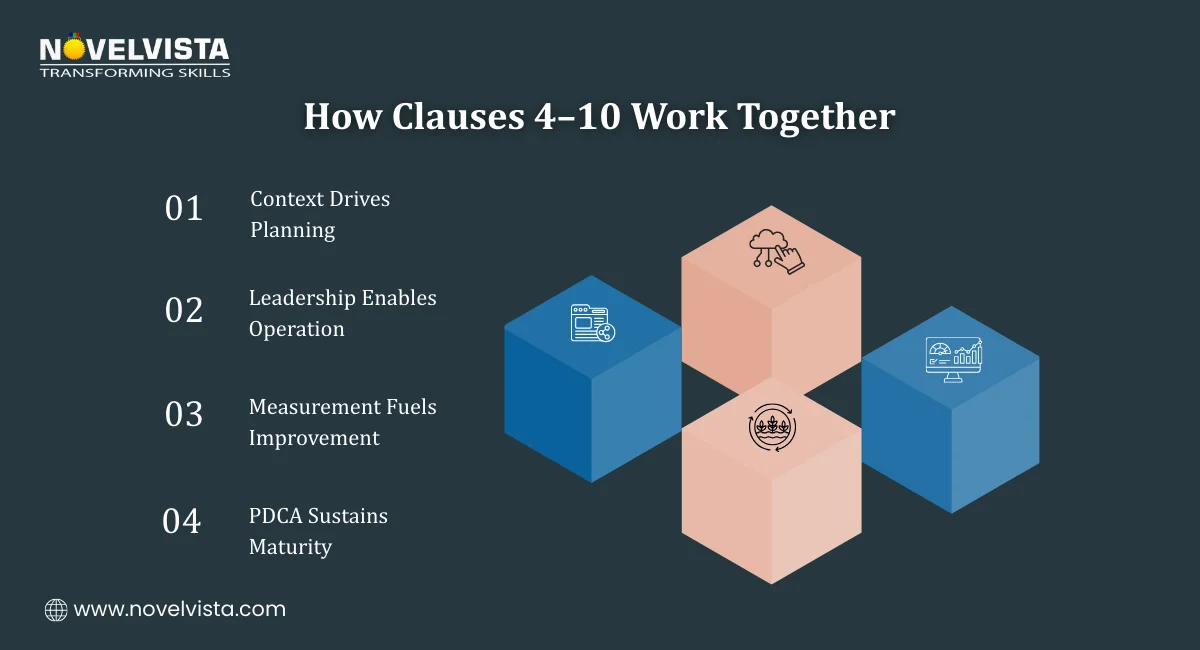
Organizations that treat the ISO/IEC 20000-1 clauses as an interconnected system consistently experience fewer repeat nonconformities and more stable audit outcomes. Understanding how the ISO/IEC 20000-1 clauses connect improves audit readiness and service performance at the same time.
For ISO/IEC 20000 Lead Auditors, understanding the clauses is not about knowing definitions; it’s about knowing where systems usually break and how evidence connects across clauses. Audits rarely fail because a document is missing. They fail because the SMS does not behave like a system.
During audits, lead auditors should look beyond clause-by-clause compliance and assess system integrity. The real question is not “Is this clause addressed?” but “Does this clause support and reinforce the others?”
From a lead auditor’s perspective, the clauses reveal maturity through patterns, not isolated controls.
Key focus areas for lead auditors include:
Clause linkage: Check whether outputs from Clause 4 (context) actively influence Clause 6 (planning) and Clause 8 (operations), rather than existing as static documents.
Leadership evidence (Clause 5): Look for decision-making behavior, not approvals. Management review actions, risk ownership, and prioritization choices matter more than signed policies.
Risk-to-action traceability (Clause 6): Risks should clearly drive objectives, controls, and operational priorities. Gaps here often indicate a paper-based SMS.
Operational consistency (Clause 8): Sample services end-to-end. Inconsistent incident handling, informal change approvals, or weak supplier controls often expose systemic weaknesses.
Effectiveness of improvement (Clause 10): Auditors should verify whether corrective actions actually prevent recurrence, not just close findings.
A strong lead auditor uses the ISO/IEC 20000-1 clauses as a diagnostic tool, not a checklist. When clauses are evaluated as an interconnected PDCA system, audits become more accurate, findings become more meaningful, and certification decisions carry real confidence.
Must Read: ISO 20000 Auditing Challenges and how to overcome them
The ISO/IEC 20000-1 clauses are not standalone requirements. They operate as an integrated management system built on PDCA thinking. A clear understanding of the ISO/IEC 20000-1 clauses, explained simplifies implementation, strengthens audits, and improves service outcomes.
In long-term assessments, continual improvement practices under Clause 10 often distinguish mature service organizations from those maintaining compliance only for certification purposes. Mastery of this structure leads to consistent, value-driven service management rather than reactive compliance.

If you want to move beyond clause knowledge and develop real audit confidence, NovelVista’s ISO 20000 Lead Auditor Certification Training Course is designed for working professionals. The program focuses on clause interpretation, audit scenarios, evidence evaluation, and risk-based judgment. You’ll gain practical skills to plan, conduct, and lead ISO/IEC 20000 audits with clarity and control.
Author Details

Course Related To This blog
ISO 20000:2018 Lead Auditor
Confused About Certification?
Get Free Consultation Call
Stay ahead of the curve by tapping into the latest emerging trends and transforming your subscription into a powerful resource. Maximize every feature, unlock exclusive benefits, and ensure you're always one step ahead in your journey to success.