Category | Quality Management
Last Updated On 02/02/2026

Many audits look solid on paper. Policies are signed. Objectives are documented. Charts are framed on the wall. Yet when auditors start auditing Clause 5, things often fall apart. Leadership commitment sounds rehearsed, decisions feel distant, and ownership quietly disappears.
In Lead Auditor training sessions, Clause 5 is consistently described as the most uncomfortable and most revealing part of an audit. Many learners share that this is where textbook auditing stops working, and real professional judgment becomes essential.
That’s because auditing Clause 5 is not about checking documents. It’s about verifying how top management actually leads the Quality Management System in daily decisions. This article shows how to audit leadership involvement through interviews, evidence, and behavior, so audits reflect reality, not titles or templates.
Clause 5 exists for one simple reason: a QMS cannot work without leadership ownership. The standard makes it clear that top management is accountable for the effectiveness of the system, not just its existence.
When auditing Clause 5, auditors are expected to confirm that leadership:
This responsibility cannot be delegated away. While tasks can be assigned, accountability stays with top management. That’s why auditors must engage directly with senior leaders, not only quality managers.
Audits that avoid leadership conversations often miss the most important signals about how the QMS actually functions.
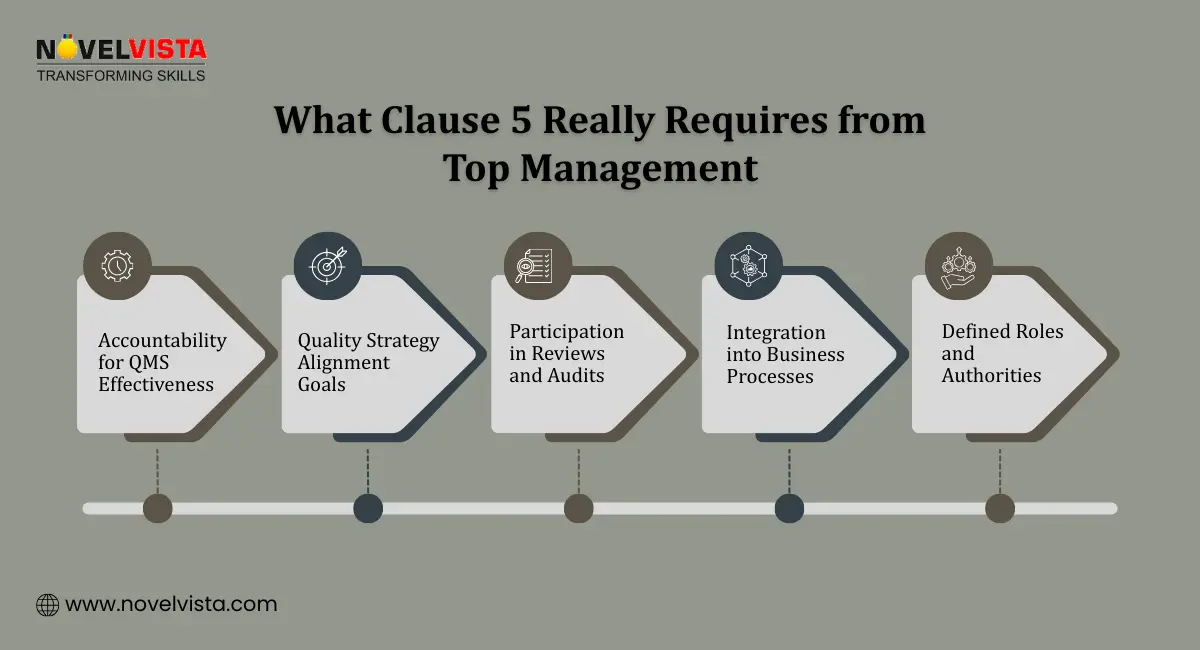
To audit effectively, you need clarity on what Clause 5 truly expects, not just what’s written, but what it means in practice.
Key requirements include:
Top management must be able to explain:
During auditing Clause 5, vague answers like “the quality team handles that” are immediate red flags.
The quality policy must:
Auditors should verify whether leadership decisions reflect the policy, or if it exists only as a compliance statement.
Clause 5.3 requires clarity. Auditors should confirm:
Clear structure supports real leadership control.
A strong indicator during auditing Clause 5 is whether quality requirements are built into:
In certification audits discussed during training, weak Clause 5 evidence is a common root cause behind repeated nonconformities. Auditors are trained to treat unclear leadership accountability as a system-level risk, not a minor gap.
Auditors often ask, “What evidence should I really trust?” Real leadership commitment evidence goes beyond signed documents.
Strong examples include:
The key test is influence. If leadership actions shape outcomes, the evidence is meaningful.
When auditing Clause 5, always ask: Did leadership just approve this, or did they drive it? That question separates formality from real commitment.
Interviews are the most powerful tool when auditing Clause 5. But only if they are handled well. Auditor training places strong emphasis on interview technique for Clause 5 because poorly framed questions often produce rehearsed answers. Well-structured, decision-focused questions consistently reveal true leadership involvement.
Here are practical management interview tips auditors rely on:
Senior leaders have limited time. Early scheduling ensures:
Preparation shows professionalism and sets the tone.
Good management interview tips focus on how decisions are made, not awareness.
Instead of “Are you aware of the QMS?” ask:
Generic answers hide weak involvement. Ask for:
Specific examples expose real behavior.
When leadership is involved, answers are:
Hesitation or deflection often points to delegation rather than ownership.
One of the most important steps in auditing Clause 5 is verification.
After interviews:
This is where leadership commitment evidence proves its value. Statements without supporting evidence should always be challenged.
Strong audits connect:
That connection defines audit credibility.
Clear reporting makes or breaks an audit. Explore our blog on ISO 9001 report writing to learn how to document findings clearly, align with standards, and deliver reports that stand up to scrutiny.
When auditing Clause 5, the quality of your questions matters more than the number of questions. Senior leaders won’t respond well to checklist-style audits. What works are focused, decision-based C-suite audit questions.
Some high-impact questions include:
1. “How do you ensure the QMS supports the organization’s strategic goals?”
Follow up by asking for a recent example where quality influenced a business decision.
2. “What role did you personally play in reviewing audit findings?”
This question helps distinguish oversight from delegation.
3. “How were risks, opportunities, or customer feedback reflected in recent management decisions?”
Strong leaders can link quality outcomes to real actions.
These C-suite audit questions help validate ownership, accountability, and integration. When answers are vague or redirected to others, it often signals weak leadership involvement.
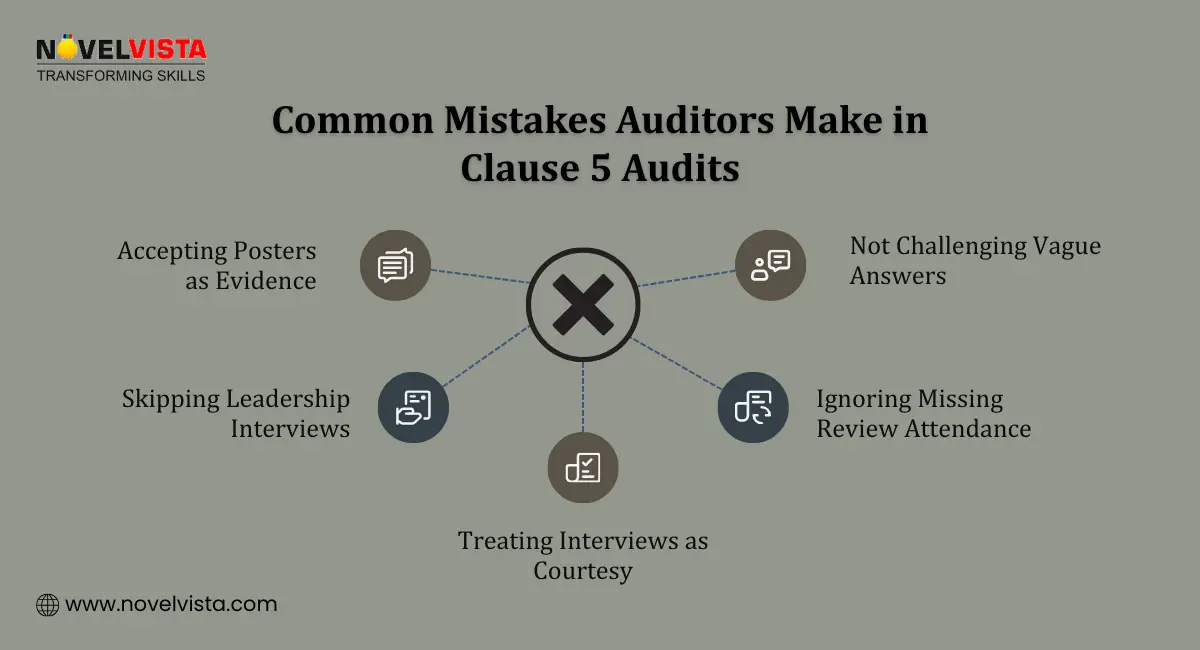
Even experienced auditors can miss important signals when auditing Clause 5. These common mistakes reduce audit effectiveness.
Posters, policies, and slogans are not proof. Without communication and application, they don’t count as leadership commitment evidence.
Low attendance, rushed reviews, or delayed actions are major warning signs. Auditors should question why leadership presence is inconsistent.
Some audits rush leadership interviews at the end. This weakens evidence gathering and limits meaningful discussion.
If employees cannot describe how leadership supports quality, commitment is likely superficial, even if documents say otherwise.
In classroom discussions, auditors often admit that Clause 5 interviews are rushed due to time pressure. Training highlights that this shortcut usually weakens the entire audit conclusion, even when other clauses look strong.
Strong audits go beyond files and folders. When auditing Clause 5, verification must extend into behavior and outcomes.
Effective ways to verify commitment include:
Comparing leadership statements with operational evidence
Do KPIs, priorities, and actions align with what leaders say?
Sampling employee awareness
Can employees explain leadership support for quality objectives?
Checking resource allocation
Budgets, staffing, and time investment reveal true priorities.
Tracking improvement ownership
Are continual improvement actions initiated, reviewed, and closed by leadership?
This deeper validation turns leadership commitment evidence into something tangible and defensible during audits.
Audit leadership the right way. Use decision-based questions, evidence expectations, and red flags to assess real top management commitment, not just signed policies.
Auditing Clause 5 is about validating leadership behavior, not confirming job titles or signatures. Real commitment shows up in decisions, priorities, and follow-through—not policies alone.
Strong audits rely on:
When auditors focus on ownership, integration, and accountability, Clause 5 becomes one of the most valuable parts of the audit. That’s where credible audits are built and where leadership commitment truly reveals itself.
The Clause 5 approach described here reflects how leadership commitment is evaluated in real ISO 9001 certification audits, not just how the clause is written in the standard.
If you want to audit leadership commitment with confidence and handle Clause 5 interviews like a professional, NovelVista’s ISO 9001 Lead Auditor Certification Training is the right next step. The course focuses on real audit scenarios, management interviews, evidence evaluation, and decision-based auditing. It helps you move beyond theory and build the practical judgment needed to conduct credible audits, raise meaningful findings, and succeed as a Lead Auditor.

Author Details

Course Related To This blog
ISO 9001:2015 Lead Auditor Training and Certification
Confused About Certification?
Get Free Consultation Call
Stay ahead of the curve by tapping into the latest emerging trends and transforming your subscription into a powerful resource. Maximize every feature, unlock exclusive benefits, and ensure you're always one step ahead in your journey to success.