Category | Quality Management
Last Updated On 16/12/2025
Every year, thousands of businesses face unexpected disruptions—from cyberattacks to natural disasters to supply chain breakdowns. According to global studies, over 40% of organizations never recover after a major disaster, and the average cost of downtime continues to rise, now exceeding USD 5,600 per minute. In such a high-risk environment, business continuity has become an essential part of modern organizational strategy, not a checkbox activity.
This brings us to one of the most common questions organizations ask: What is the real difference between ISO 22301 vs ISO 22313? If you’re a business continuity manager, auditor, risk professional, compliance officer, or simply someone trying to make your organization more resilient, understanding these two standards will help you design, implement, and sustain a strong BCMS.
Before comparing directly, it’s important to understand what each standard actually does.
ISO 22301 is the international requirements standard for designing and implementing a Business Continuity Management System (BCMS). It contains mandatory clauses, essential controls, and structured activities that organizations must follow if they want to prepare for disruptions and achieve formal certification. In other words, ISO 22301 is the rulebook that auditors use to determine whether your business continuity program meets global expectations.
It outlines everything from risk assessment and business impact analysis to operation-specific continuity strategies, documentation controls, internal audits, management reviews, and continuous improvement. Because it focuses on requirements, ISO 22301 is direct, concise, and designed to be measurable. Organizations use it to build a foundation of compliance and demonstrate resilience to customers, regulators, and partners.
While ISO 22301 tells you what you need to do, ISO 22313 explains how you can do it. It is a guidance document that supports the implementation of ISO 22301, offering practical insights, examples, interpretations, and recommendations. Unlike ISO 22301, ISO 22313 is not certifiable. Instead, it acts as a detailed handbook for implementers and internal teams who need clarity on applying business continuity principles in the real world.
ISO 22313 expands on concepts like risk evaluation, BCMS documentation, recovery strategies, exercises, testing, monitoring, and improvement. Because of its descriptive nature, organizations often rely on ISO 22313 to interpret clauses that may seem brief or abstract in ISO 22301.
Together, these two standards make the comparison more about complementing each other instead of choosing one over the other.
To make the comparison easier, here is a concise table that highlights how ISO 22301 vs ISO 22313 differ in purpose, nature, and application:
Aspect |
ISO 22301 |
ISO 22313 |
Purpose |
Requirements |
Guidance |
Type |
Mandatory standard |
Non-mandatory guide |
Certification |
Yes |
No |
Use Case |
Audits & compliance |
Implementation & interpretation |
Approach |
What must be done |
How it can be done |
Audience |
Auditors, compliance teams |
Implementers, BCMS practitioners |
Structure |
Concise and strict |
Detailed and explanatory |
Although these are often discussed as two separate documents, the truth is that organizations benefit most when both are used together.
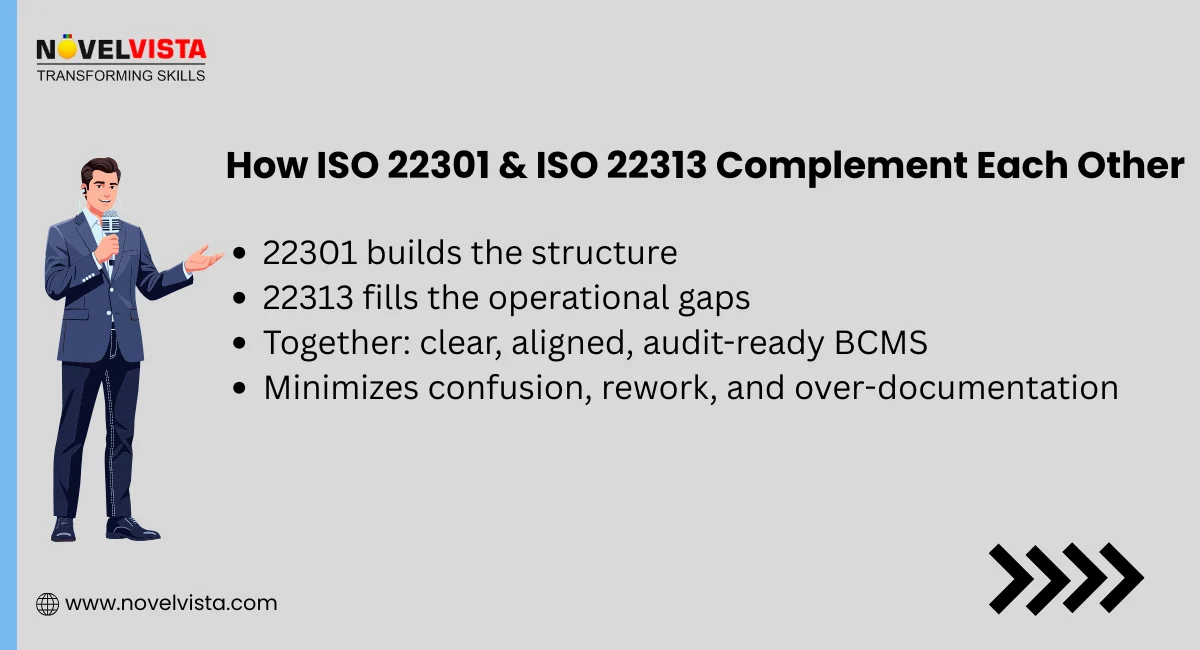
Most organizations struggle not because they don’t understand ISO 22301, but because they don’t know how to interpret or apply it effectively. This is where ISO 22313 becomes essential. ISO 22301 sets the boundaries and expectations, while ISO 22313 provides the practical roadmap that helps you reach those expectations smoothly.
Organizations preparing for audits rely heavily on ISO 22301 because auditors evaluate them strictly against its requirements. However, the internal teams who design continuity plans, conduct BIAs, or coordinate recovery testing usually depend on ISO 22313 to ensure their implementation is both meaningful and efficient.
Therefore, understanding ISO 22301 vs ISO 22313 is not about selecting one—it’s about knowing how to use both to create a mature, reliable BCMS.
The best way to apply ISO 22301 vs ISO 22313 is to treat ISO 22301 as your blueprint and ISO 22313 as your practical manual. When establishing your BCMS, use ISO 22301 to define the structure and mandatory processes. Then, refer to ISO 22313 to fill in the gaps, clarify concepts, and align implementation with global best practices.
A simple example illustrates this well: ISO 22301 states that you must perform a Business Impact Analysis (BIA). ISO 22313, however, explains different BIA methodologies, the type of questions to ask, the importance of prioritizing activities, and ways to interpret results. Together, they ensure both compliance and effectiveness.
Another area where ISO 22301 vs ISO 22313 work together is documentation. ISO 22301 specifies what documents and records must exist. ISO 22313 explains how to structure them, what language to use, and how to make them practical. This combination prevents over-documentation—a common mistake in BCMS implementations.
Whether you're preparing for certification or building resilience, here’s a simplified implementation path:
1. Define BCMS Scope: Identify what’s included—locations, processes, teams.
2. Conduct Risk Assessment & Business Impact Analysis: Identify disruptions, impacts, and recovery priorities.
3. Develop Continuity Strategies: Decide how you will continue operations during disruption.
4. Build Detailed Plans
5. Train, Test & Exercise: A BCMS succeeds only when people know their roles.
6. Monitor & Improve: Use internal audits, lessons learned, and regular reviews.
7. Prepare for ISO 22301 Certification
This is where the ISO 22301 vs ISO 22313 difference plays a direct role:
If you're evaluating ISO 22301 vs ISO 22313 to decide which one your organization should use, the answer is simple: both. ISO 22301 provides the global standard you must meet, while ISO 22313 offers the context, clarity, and practical direction needed to achieve those requirements. Together, they help build a BCMS that is not only compliant but also truly resilient. Professionals who master ISO 22301 not only strengthen organizational resilience but also enhance their career prospects, with many reporting a higher ISO 22301 salary due to their expertise in business continuity and audit management.

Understanding ISO 22301 vs ISO 22313 is essential for any organization serious about business continuity. The requirements in ISO 22301 give you the structure, while the guidance in ISO 22313 helps you implement that structure effectively. When organizations use both standards in harmony, they build a stronger BCM culture, reduce disruptions, and enhance long-term resilience. Mastering ISO 22301 vs ISO 22313 is one of the most effective steps you can take toward a future-ready continuity strategy.
Ready to strengthen your expertise in business continuity and become the professional organizations rely on during disruptions?
Join NovelVista’s ISO 22301 Lead Auditor Certification Training and gain hands-on auditing skills, practical BCMS insights, and globally recognized credentials. Designed for risk managers, continuity planners, auditors, and resilience leaders, this program helps you confidently assess BCMS effectiveness, interpret ISO 22301 requirements, and guide organizations toward true operational resilience.
Start your ISO 22301 auditor journey today!
Author Details

Course Related To This blog
ISO 22301:2019 Lead Auditor
Confused About Certification?
Get Free Consultation Call
Stay ahead of the curve by tapping into the latest emerging trends and transforming your subscription into a powerful resource. Maximize every feature, unlock exclusive benefits, and ensure you're always one step ahead in your journey to success.