NovelVista logo

How to Measure IT Service Performance Using ISO 20000 KPIs

Category | Quality Management

Last Updated On 29/12/2025
How to Measure IT Service Performance Using ISO 20000 KPIs | Novelvista

Many IT teams feel their services are “working,” yet customers still complain about delays, outages, and weak service experience. That’s usually because decisions are made based on guesses instead of data. This is where ISO 20000 KPIs make a real difference. They help organizations bring structure to IT service performance measurement, align services with business needs, and support Clause 9 requirements for monitoring, evaluation, and continual improvement.

This guide walks you through the right metrics, dashboards, governance approach, and how to turn data into meaningful action for ISO 20000 service performance success.

Understanding ISO 20000 KPIs for ITSM Performance

Before choosing numbers to track, it’s important to understand what ISO 20000 KPIs really represent. They are not just “reports for auditors.” They are ITSM KPIs and metrics that show whether services actually deliver value to customers and the business.

  • ISO/IEC 20000 KPIs help measure how well the Service Management System is performing
     
  • They ensure services are not only delivered but delivered reliably, consistently, and efficiently
     
  • These indicators must always align with SLAs, business expectations, and service value

Strong ISO 20000 service performance means less firefighting, more control, and better decision-making backed by real numbers instead of assumptions. In our ISO 20000 training programs, one of the strongest learning outcomes is helping teams differentiate between “nice to have numbers” and real ISO 20000 service performance indicators. 

The KPIs shared in this guide are structured around how mature ITSM environments actually operate, ensuring that measurement supports value, governance, and decision-making, not just compliance.

Service Level Management KPIs for ISO 20000 Service Performance

Service Level Management is one of the most visible areas of IT service performance measurement. These ISO 20000 KPIs directly reflect user experience, reliability, and trust.

Key ISO 20000 KPIs to monitor include:

  • SLA Compliance Rate: Shows how often you meet agreed service targets. A consistently strong SLA percentage builds customer confidence and proves service reliability.
     
  • Service Availability (Uptime): Measures how available your services are during agreed periods. This KPI directly affects business continuity and customer satisfaction.
     
  • Customer Satisfaction (CSAT) / NPS: Reflects how users actually feel about services. Numbers alone don’t tell the full story; this KPI adds real human feedback into decision-making.

These ITSM KPIs and metrics help organizations maintain strong ISO 20000 service performance by keeping service assurance transparent and measurable.

Incident and Problem Management ISO 20000 KPIs

If incidents are frequent, unresolved, or poorly handled, service performance suffers quickly. That’s why Incident and Problem Management KPIs are essential within ISO 2000 KPIs tracking.

Important IT service performance measurement indicators include:

  • MTTR (Mean Time to Resolve): Shows how quickly issues are resolved. Lower MTTR means faster recovery and less business disruption.
     
  • First Response Time & First Contact Resolution Rate: Indicates how quickly users receive help and how many issues are solved on the first attempt, which directly improves experience.
     
  • Incident Volume & Trend Analysis: Helps identify recurring problems, weak areas, and improvement priorities.

Global ITSM best practices, including ISO/IEC 20000 guidance, consistently highlight SLA compliance, availability, MTTR, and customer sentiment as essential indicators of real service performance. These metrics directly support Clause 9 expectations for monitoring, evaluation, and continual improvement, which is why they remain core in mature IT environments.

Change Management ISO/IEC 20000 KPIs

Strong Change Management ensures stability while supporting growth and innovation. Poor change control, however, leads to outages, business loss, and trust issues.

Key ISO 20000 KPIs here include:

  • Change Success Rate: Shows how many approved changes are deployed without a negative impact. Higher success means better planning and risk handling.
     
  • Change Failure Rate: Tracks how many changes cause incidents or rollbacks. This helps evaluate risk control and process discipline.
     
  • Emergency Change Percentage: Too many emergency changes usually indicate weak planning or poor governance.

These KPIs protect ISO 20000 service performance by reducing risk and ensuring controlled transformation.

Operational, Capacity, and Efficiency KPIs

Beyond incidents and SLAs, organizations must also track performance, cost efficiency, and workload health to ensure mature IT service performance measurement.

Useful ITSM KPIs and metrics include:

  • Capacity Utilization: Checks whether infrastructure and resources are being used effectively without overloading systems.
     
  • Cost per Ticket: Helps evaluate the financial efficiency of service operations and support optimization decisions.
     
  • Backlog Load / Resolution Speed: Shows whether work is being handled efficiently or piling up, which impacts user trust and service experience.

Together, these ISO 20000 KPIs prove not only compliance but also operational effectiveness and smart resource usage.

How to Implement IT Service Performance Measurement Using ISO 20000 KPIs

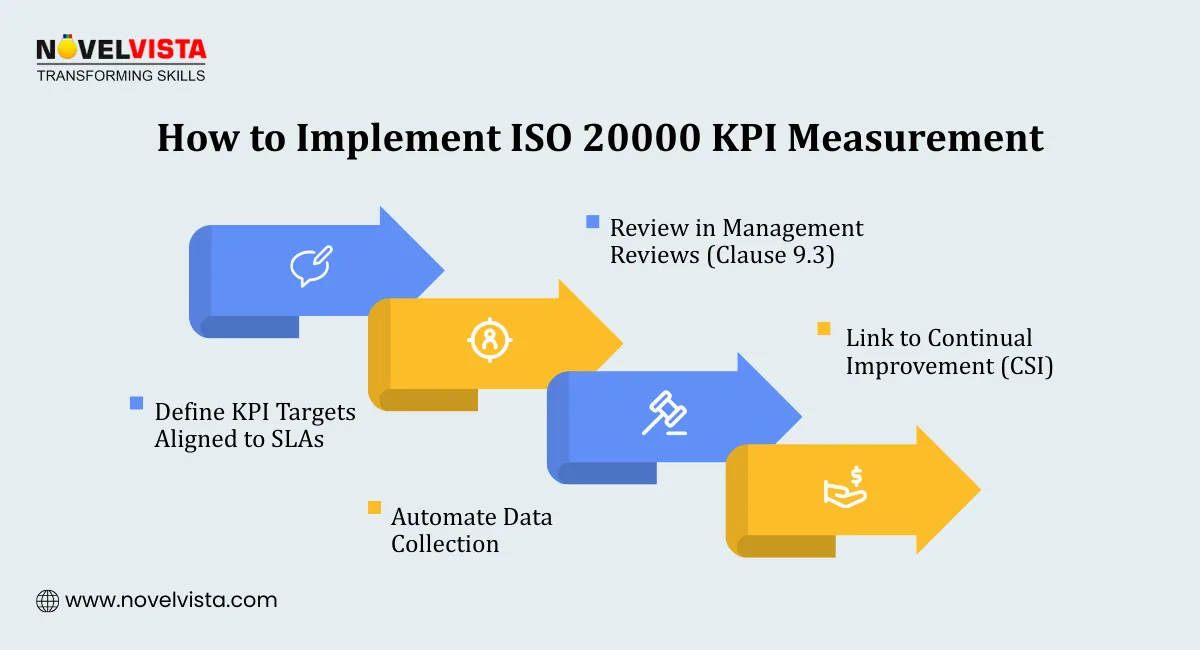
To make ISO 20000 KPIs actually useful, they must be implemented in a planned and disciplined way. Here’s a simple, practical approach that works in real organizations:
How to Implement ISO 20000 KPI Measurement

  • Define KPI targets aligned to SLAs: Every KPI should directly support business goals and SLA expectations. Random metrics don’t help; meaningful alignment does.
     
  • Automate KPI data collection through ITSM tools: Using tools like ServiceNow, Jira, ManageEngine, or Power BI avoids manual reporting errors and keeps IT service performance measurement accurate and timely.
     
  • Review outcomes in management review meetings: Clause 9.3 expects a structured performance evaluation. Leadership should actually discuss results, gaps, risks, and improvement areas.
     
  • Link KPI results to Continual Service Improvement: If ISO 20000 service performance dips, there should be CSI actions, ownership, deadlines, and measurable corrections.

This approach ensures ITSM KPIs and metrics do not stay as dashboards alone but actually drive decisions and better service quality.

ITSM KPIs and Metrics Analysis Best Practices

Tracking ISO 20000 KPIs is important. But analyzing them correctly is what truly strengthens governance and value delivery.

  • Use trend-based assessment: Instead of looking at single reports, study monthly and quarterly patterns to identify real stability or decline in ISO 20000 service performance.
     
  • Do root cause analysis when trends drop: If MTTR increases or SLA compliance drops, go beyond reporting and understand why it happened. This keeps IT service performance measurement meaningful.
     
  • Benchmark performance where relevant: Compare internally across departments or externally against industry standards to understand whether your numbers actually represent strong performance.
Make KPI insights part of every decision: When IT, management, and leadership rely on ITSM KPIs and metrics, service maturity naturally improves.

What Auditors Look for in ISO 20000 KPIs

Lead auditors don’t just want to see dashboards. They want proof that ISO 20000 KPIs drive real control and improvement. Typically, they check:

  • Evidence of structured performance monitoring: Regular reports, dashboards, and documented reviews.
     
  • Clear linkage between KPIs, SLAs, OLAs, and supplier outputs: Every performance number should tie back to service expectations.
     
  • Proof of corrective actions: If performance drops, auditors expect to see investigations, actions, and verification of effectiveness.
     
  • KPI accuracy and consistency: Data should be trustworthy, traceable, and aligned with ITSM tools.

This shows whether IT service performance measurement is a genuine management practice or just a compliance checkbox.

ISO 20000 KPI Toolkit & Measurement Framework


Stop measuring noise. Learn which KPIs
auditors actually expect—and how to
use them to prove real ITSM improvement.


How KPI Governance Strengthens Certification

Strong KPI governance does more than tick Clause 9 requirements. It builds confidence and long-term value.

  • Stronger ISO 20000 compliance: Well-managed ISO 20000 KPIs prove disciplined monitoring and governance maturity.
     
  • Better audit experience: When KPI data is structured and reliable, audits become smoother, faster, and more credible.
     
  • Higher business trust: Management trusts decisions more when they are driven by consistent ITSM KPIs and metrics.
Visible maturity: Good KPI governance directly reflects a strong ISO 20000 service performance culture.

Benefits of Using ISO 20000 KPIs for ITSM Performance

When organizations use ISO 20000 KPIs correctly, they see real, measurable benefits:

  • Better SLA success and commitment reliability
     
  • Reduced incidents, faster resolution, and fewer disruptions
     
  • Smarter decisions through real data instead of assumptions
     
  • Higher business confidence through transparency

These benefits prove that IT service performance measurement is not just compliance work; it is business value work.

Common Pitfalls in ISO 20000 Service Performance Measurement

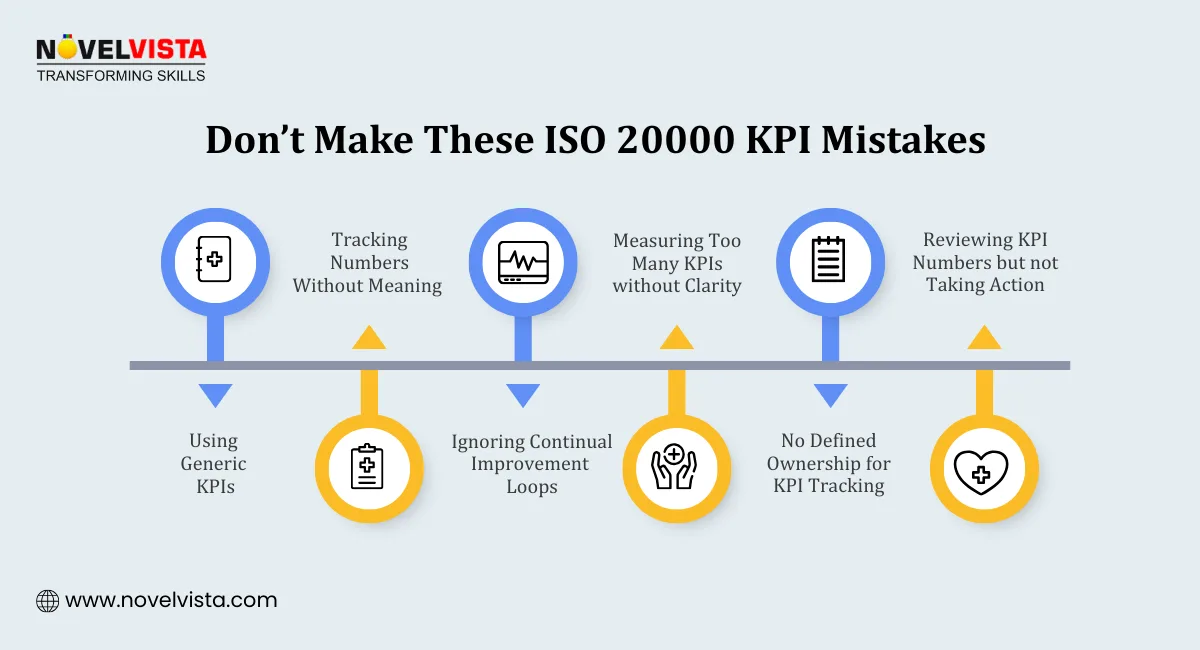
Many organizations struggle not because they lack tools, but because they misuse ISO 20000 KPIs. Some common mistakes include:
Don’t Make These ISO 20000 KPI Mistakes

  • Using generic metrics instead of business-focused ones
     
  • Collecting numbers without understanding meaning
     
  • Tracking KPIs but ignoring Continual Service Improvement actions
     
  • Not aligning KPIs with SLAs, OLAs, or real outcomes

Avoiding these pitfalls keeps ISO 20000 service performance meaningful and impactful.

Conclusion

Meaningful ISO 20000 KPIs are the heart of strong IT service performance measurement. When they align with business goals, get reviewed regularly, and trigger real improvements, organizations see stronger reliability, higher trust, and better ISO 20000 service performance outcomes. The real goal is not just tracking numbers, but using ITSM KPIs and metrics to build service excellence and long-term confidence.

Everything shared here aligns with real audit expectations, ITSM governance reviews, and practical KPI frameworks used in modern IT service environments. These recommendations are built to help IT teams prepare confidently, not just for certification, but for reliable performance management.

Become A Certified ISO 20000 Lead Auditor And Elevate Your ITSM Audit Authority

Next Step

If you want to understand KPI governance deeply and assess ISO 20000 service performance with confidence, NovelVista’s ISO 20000 Lead Auditor Certification is a great step forward. It helps you master audit techniques, KPI evaluation, governance assessment, and real-world implementation insights so you can lead audits effectively and strengthen organizational ITSM maturity.

Frequently Asked Questions

While both frameworks share common metrics, ISO 20000 KPIs are specifically designed to provide objective evidence of compliance during audits, focusing on the effectiveness of the entire management system.

Organizations should monitor KPIs continuously, but formal reviews must occur during scheduled management meetings to ensure performance aligns with changing business objectives and identified service improvement opportunities throughout the year.

Certification is possible if the organization demonstrates it has identified the failure, analyzed the root cause, and implemented corrective actions to address the performance gap as required by the standard.

No single metric is paramount, but SLA compliance is often considered critical because it directly measures the organization’s ability to meet its primary service commitments to the business customers.

Data must be recorded in a clear, consistent format that shows trends over time, including the methodology used for measurement, the target thresholds, and any resulting actions taken.

Author Details

Mr.Vikas Sharma

Mr.Vikas Sharma

Principal Consultant

I am an Accredited ITIL, ITIL 4, ITIL 4 DITS, ITIL® 4 Strategic Leader, Certified SAFe Practice Consultant , SIAM Professional, PRINCE2 AGILE, Six Sigma Black Belt Trainer with more than 20 years of Industry experience. Working as SIAM consultant managing end-to-end accountability for the performance and delivery of IT services to the users and coordinating delivery, integration, and interoperability across multiple services and suppliers. Trained more than 10000+ participants under various ITSM, Agile & Project Management frameworks like ITIL, SAFe, SIAM, VeriSM, and PRINCE2, Scrum, DevOps, Cloud, etc.

Confused About Certification?

Get Free Consultation Call

Sign Up To Get Latest Updates on Our Blogs

Stay ahead of the curve by tapping into the latest emerging trends and transforming your subscription into a powerful resource. Maximize every feature, unlock exclusive benefits, and ensure you're always one step ahead in your journey to success.
Topic Related Blogs