NovelVista logo

The Lead Auditor’s Role in an Integrated Management System (IMS): ISO 9001, 14001 & 45001

Category | Quality Management

Last Updated On 09/02/2026
The Lead Auditor’s Role in an Integrated Management System (IMS): ISO 9001, 14001 & 45001 | Novelvista

Many organizations run ISO 9001, ISO 14001, and ISO 45001 side by side, but audit them as if they live in separate worlds. That’s where confusion, repetition, and audit fatigue begin. An integrated management system audit fixes this by looking at how shared processes actually work together, not how clauses are filed in manuals.

Instead of three disconnected audits, one integrated management system audit evaluates quality, environmental, and OH&S controls in a single, logical flow. This approach reduces duplication, saves time, and gives a clearer picture of real risks. At the center of this model is the IMS auditor, who applies judgment, process thinking, and a unified lens across all standards.

This guide explains how lead auditors plan, execute, and report IMS audits using a unified audit approach that goes beyond checklist compliance.
What Makes an IMS Audit Different from Standalone Audits

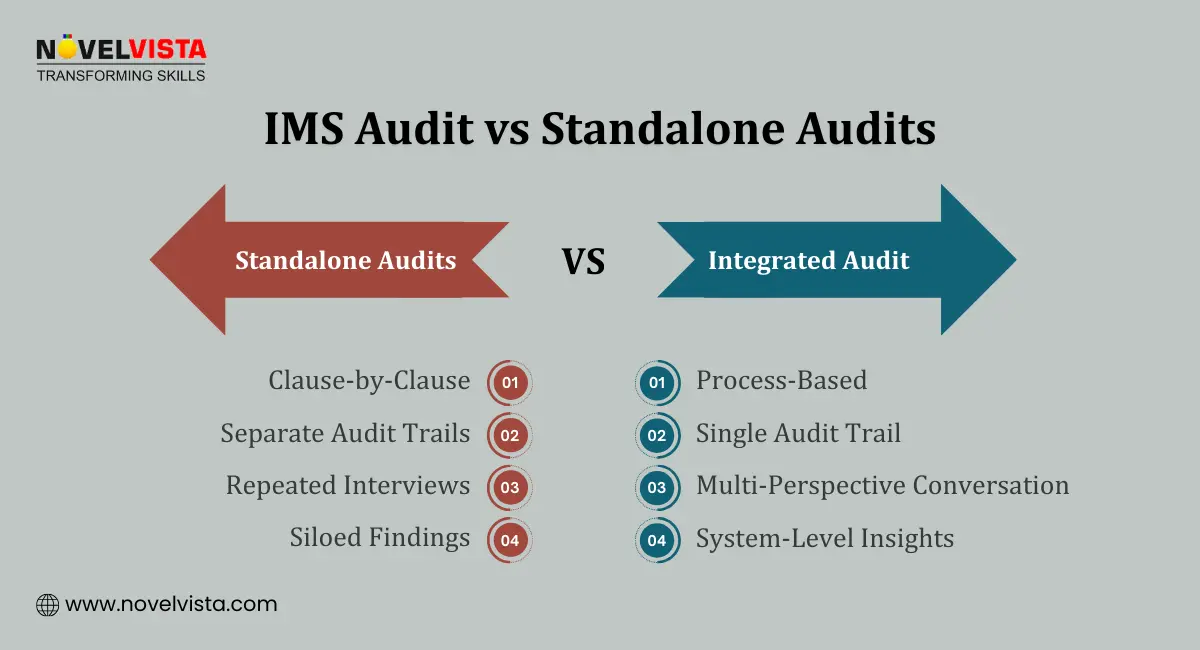
IMS Audit vs Standalone Audits

A traditional audit often follows clauses in order. An IMS audit doesn’t. The integrated management system audit is process-based by design. It focuses on how work is done and how risks are managed across systems.

Key differences include:

  • Auditing processes once, not three times
     
  • Evaluating shared High-Level Structure clauses, such as:
     
    • Context of the organization
    • Leadership and commitment
    • Planning and risk-based thinking
       
  • Reviewing how quality, environmental, and OH&S risks interact
     

For an IMS auditor, the goal is not to “tick off” ISO 9001, 14001, and 45001 separately, but to see whether the system works as a whole. This is where the unified audit approach becomes essential.

The Lead Auditor’s Responsibility in an Integrated Management System Audit

In an integrated management system audit, the lead auditor’s role is more demanding than in a single-standard audit. You’re not just checking compliance, you’re controlling complexity.

Key responsibilities include:

  • Defining a clear audit scope that covers all three standards
  • Setting audit objectives that reflect system effectiveness, not document completeness
  • Mapping common and standard-specific requirements
  • Ensuring consistent interpretation of shared clauses
  • Managing audit time, depth, and focus areas
     

An effective IMS auditor understands where requirements overlap and where they must be treated separately. Lead auditors handling integrated audits frequently report that success depends on preparation quality. When overlaps and boundaries are defined early, audit execution becomes focused instead of fragmented.

Planning an IMS Audit Using a Unified Audit Approach

Good IMS audits are won during planning. A unified audit approach starts with one integrated audit plan, not three parallel ones.

During planning, the lead auditor should:

  • Identify shared processes such as:
     
    • Risk management
    • Competence and training
    • Operational controls
       
  • Allocate audit time based on risk and complexity, not the number of standards
  • Decide where evidence can support multiple standards at once
  • Brief the audit team clearly on multi-standard expectations
     

This planning stage sets the tone for the entire integrated management system audit. When done right, it prevents overlap and keeps the audit focused on what truly matters.
Preparation Phase: What Lead Auditors Review Before the Audit

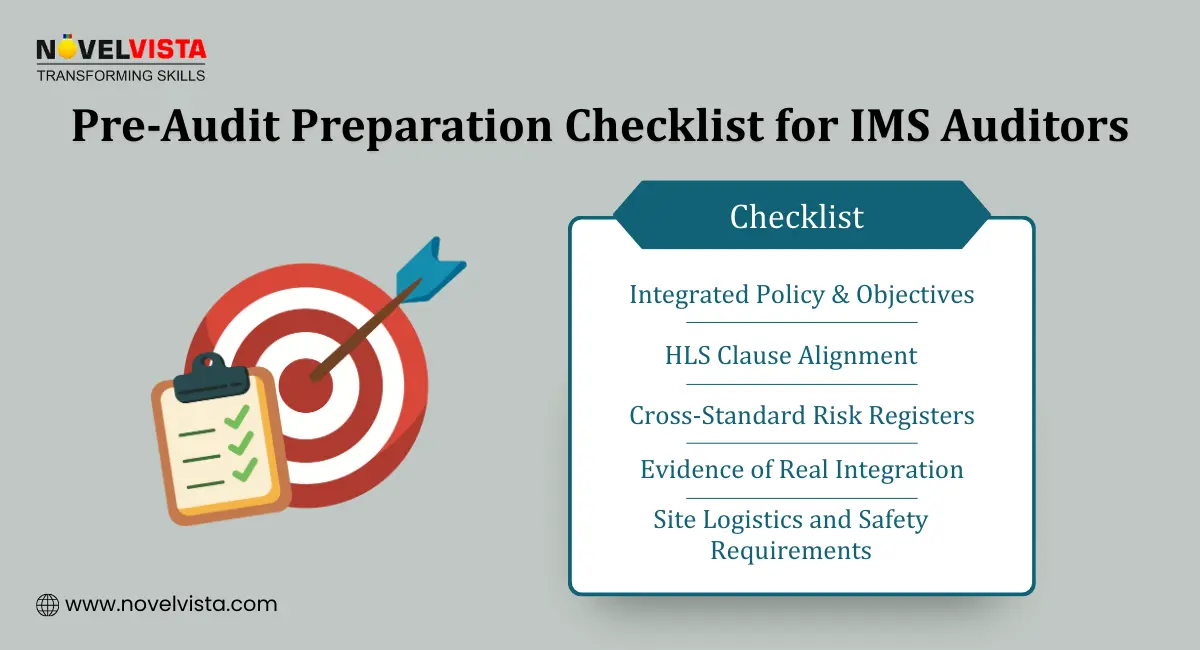
Pre-Audit Preparation Checklist for IMS Auditors

Before stepping on-site, an IMS auditor reviews how well integration actually works in practice.

Key preparation activities include:

  • Reviewing integrated policies and objectives for HLS alignment
  • Checking whether systems are truly integrated or just “merged on paper.”
  • Understanding how risks and opportunities are identified across:
     
    • Quality
    • Environmental impact
    • Health and safety
       
  • Confirming audit logistics such as site access, PPE, and key records
     

In real IMS audits, gaps often appear where systems are “integrated on paper” but managed separately in practice. Early document and risk review helps auditors identify these disconnects before site execution begins. This preparation ensures the integrated management system audit tests reality, not assumptions.

Executing the Integrated Management System Audit

Execution is where an integrated management system audit either delivers real insight or turns into a rushed checklist. The key rule for an IMS auditor is simple: audit each process once, but evaluate it through multiple lenses.

Evidence is collected through:

  • Interviews with process owners and operational staff
  • Site observations across work areas and activities
  • Sampling of documents and records
     

For every process reviewed, the auditor validates:

  • Product or service quality controls (ISO 9001)
  • Environmental impact controls (ISO 14001)
  • Health and safety risk controls (ISO 45001)
     

Instead of jumping between standards, the integrated management system audit follows the process flow. Findings are then linked clearly to the relevant standard(s). A skilled IMS auditor maintains a clean audit trail while keeping the discussion practical and focused.

Reporting and Follow-Up in an IMS Audit

Reporting in an integrated management system audit should be as integrated as the audit itself. One consolidated report replaces multiple standalone reports, making results easier to understand and act on.

A strong IMS audit report includes:

  • Conformities demonstrating effective integration
  • Nonconformities with clear reference to applicable standards
  • System-level observations highlighting improvement opportunities
     

During the closing meeting, the IMS auditor explains how findings affect overall system performance, not just clause compliance. Follow-up focuses on verifying corrective actions and confirming that improvements are implemented across quality, environmental, and OH&S controls.

This clarity is a major advantage of the unified audit approach.

Skills Lead Auditors Need for IMS Audits

Not every auditor is ready to lead an integrated management system audit. IMS auditing demands broader skills and sharper judgment.

Key capabilities include:

  • Strong working knowledge of ISO 9001, ISO 14001, and ISO 45001
  • Ability to think in systems rather than individual standards
  • Clear communication with audit teams and management
  • Risk-based judgment to balance depth and coverage
  • Confidence to manage scope without over-auditing
     

Auditors transitioning from single-standard to IMS audits often need to unlearn checklist habits and strengthen judgment-based evaluation, especially when interpreting shared High-Level Structure clauses.


Also Read: Effective Communication Techniques for Lead Auditors

The Practical IMS Audit Playbook


Learn how to audit ISO 9001, ISO 14001, and ISO 45001 together, without repeating questions or writing separate findings. Audit processes once and map evidence across standards with confidence.


Common Challenges in Integrated Audits (and How Lead Auditors Handle Them)

Integrated audits bring efficiency, but they also introduce challenges if not handled carefully.

Common issues include:

  • Missing standard-specific requirements due to over-integration
  • Poor time allocation across high-risk processes
  • Audit teams lacking multi-standard competence
     

Lead auditors address these risks by:

  • Using process maps to guide audit flow
  • Applying risk-based sampling
  • Maintaining clear links between findings and each standard
     

A disciplined, integrated management system audit avoids shortcuts while still delivering efficiency.

Why the Unified Audit Approach Delivers Better Audit Outcomes

When applied correctly, the unified audit approach delivers results that standalone audits rarely achieve.

Key benefits include:

  • Reduced duplication and audit fatigue
  • A holistic view of risks and controls
  • Better use of audit time and resources
  • Clear insight into system performance, not just compliance
     

For organizations, this means fewer audits with better outcomes. For the IMS auditor, it means stronger credibility and greater professional impact.
Conclusion: The IMS Auditor’s Impact Beyond Compliance

Become A Certified ISO 9001 Lead Auditor And Audit Integrated Management Systems Confidently

A strong integrated management system audit does more than confirm conformity. It shows how well an organization manages quality, environmental, and OH&S risks as one system.

The IMS auditor plays a critical role in turning integration into real value. By applying a unified audit approach, auditors move beyond paperwork and help organizations strengthen governance, risk control, and continual improvement.

Integrated audits done well don’t just meet standards; they improve how the business operates.

Next Step: Build Confidence as an IMS Lead Auditor

If you want to lead audits with confidence and understand how quality systems perform in real environments, NovelVista’s ISO 9001 Lead Auditor Certification Training Course is a strong next step. The program focuses on process-based auditing, risk thinking, and real audit scenarios aligned with ISO 9001 requirements. You’ll build practical audit judgment, improve reporting skills, and gain the credibility needed to lead internal, supplier, and certification audits effectively.

Frequently Asked Questions

Lead auditors explain that integration reduces time by auditing shared requirements like management reviews and internal audits just once, effectively cutting total audit days and minimizing operational disruptions across the organization.

Yes, a failure in a unified process like document control or training can trigger nonconformities across all integrated standards simultaneously because the underlying system supports quality, environmental, and safety requirements together.

Lead auditors typically provide one comprehensive report that covers all standards, though they must clearly identify which specific clause or standard each finding relates to for proper corrective action tracking and certification.

Auditors look for how the organization has harmonized these needs within their processes, ensuring that the highest or most stringent requirement is met to satisfy all applicable standards without creating procedural contradictions.

Annex SL provides a common high-level structure for all modern ISO standards, allowing auditors to use a consistent framework to evaluate core elements like leadership, risk management, and performance evaluation across the entire system.

Author Details

Mr.Vikas Sharma

Mr.Vikas Sharma

Principal Consultant

I am an Accredited ITIL, ITIL 4, ITIL 4 DITS, ITIL® 4 Strategic Leader, Certified SAFe Practice Consultant , SIAM Professional, PRINCE2 AGILE, Six Sigma Black Belt Trainer with more than 20 years of Industry experience. Working as SIAM consultant managing end-to-end accountability for the performance and delivery of IT services to the users and coordinating delivery, integration, and interoperability across multiple services and suppliers. Trained more than 10000+ participants under various ITSM, Agile & Project Management frameworks like ITIL, SAFe, SIAM, VeriSM, and PRINCE2, Scrum, DevOps, Cloud, etc.

Confused About Certification?

Get Free Consultation Call

Sign Up To Get Latest Updates on Our Blogs

Stay ahead of the curve by tapping into the latest emerging trends and transforming your subscription into a powerful resource. Maximize every feature, unlock exclusive benefits, and ensure you're always one step ahead in your journey to success.
Topic Related Blogs
 
Lead Auditor’s Role in Integrated Management System Audit | ISO 9001, 14001, 45001