NovelVista logo

Auditing Organizational Knowledge: How Lead Auditors Should Assess Clause 7.1.6

Category | Quality Management

Last Updated On 21/01/2026
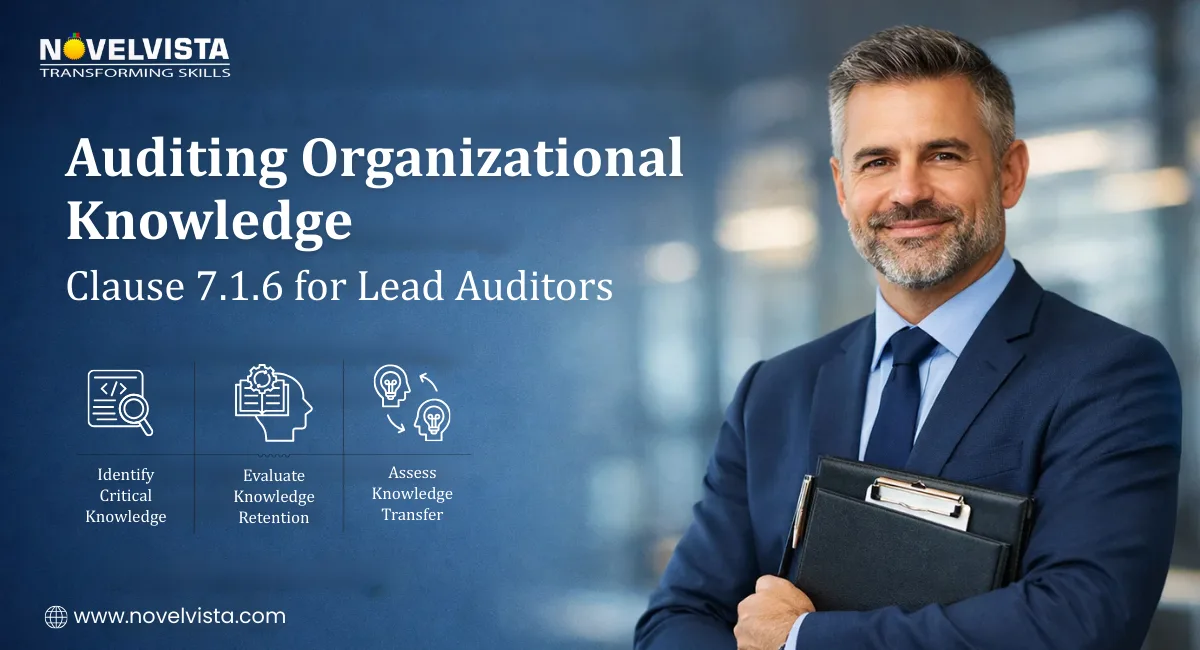
Auditing Organizational Knowledge: How Lead Auditors Should Assess Clause 7.1.6 | Novelvista

Audits often fail for reasons no checklist can catch. Processes look compliant. Documents are updated. Yet performance drops the moment a key person leaves. This is exactly why auditing organizational knowledge has become a serious focus area in ISO 9001 audits.

In lead auditor training and real certification audits, one recurring pattern appears: organizations often pass documentation checks, but struggle when auditors probe how knowledge is retained beyond individuals. Clause 7.1.6 findings frequently surface only after key staff exit or roles change.

Clause 7.1.6 pushes auditors to look beyond documents and ask harder questions. Is knowledge actually available when needed? Is it shared, protected, and retained? Or is the organization one resignation away from disruption? This guide explains how auditors should approach auditing organizational knowledge, what Clause 7.1.6 really expects, and how to assess knowledge risks with confidence.

Understanding Clause 7.1.6 from an Audit Perspective

Clause 7.1.6 requires organizations to determine, maintain, retain, and update the knowledge needed to operate processes and achieve conformity. Certification bodies increasingly expect auditors to demonstrate how clause 7.1.6 links to operational risk, succession planning, and business continuity rather than limiting assessment to documented procedures.

For auditors, this means verifying more than availability. When reviewing clause 7.1.6, auditors must confirm:

  • Knowledge is deliberately identified
  • Knowledge is accessible to the right people
  • Knowledge is protected against loss
  • Knowledge evolves with business needs

Importantly, clause 7.1.6 covers both:

  • Explicit knowledge, such as procedures, work instructions, and systems
  • Tacit knowledge, such as experience, know-how, and problem-solving skills

Auditors must evaluate whether tacit knowledge is understood, shared, and retained or trapped in individuals. This is where many organizations fall short.

Before confirming organizational knowledge, it’s essential to understand the organization itself. Explore our Guide on auditing organizational context to see how auditors evaluate internal and external factors accurately.

What Lead Auditors Should Look for When Auditing Organizational Knowledge

Effective auditing organizational knowledge focuses on how knowledge supports real work, not how much documentation exists.

Lead auditors should look for:

Evidence of Intentional Knowledge Management

  • Clear identification of critical knowledge areas
  • Links between knowledge and key processes
  • Ownership for maintaining knowledge

Support for Process Effectiveness

  • Employees can access the needed knowledge without delay
  • Knowledge supports consistent outcomes
  • Lessons learned are reused, not forgotten

Protection of Intellectual Capital

  • Controls that prevent loss of key expertise
  • Structured handovers during role changes
  • Awareness of proprietary methods and know-how

Early Warning Signs of Knowledge Risk

  • High dependency on a few individuals
  • Poor onboarding or training practices
  • Siloed teams with limited sharing

These signals are central to auditing organizational knowledge and often reveal more risk than document reviews alone.
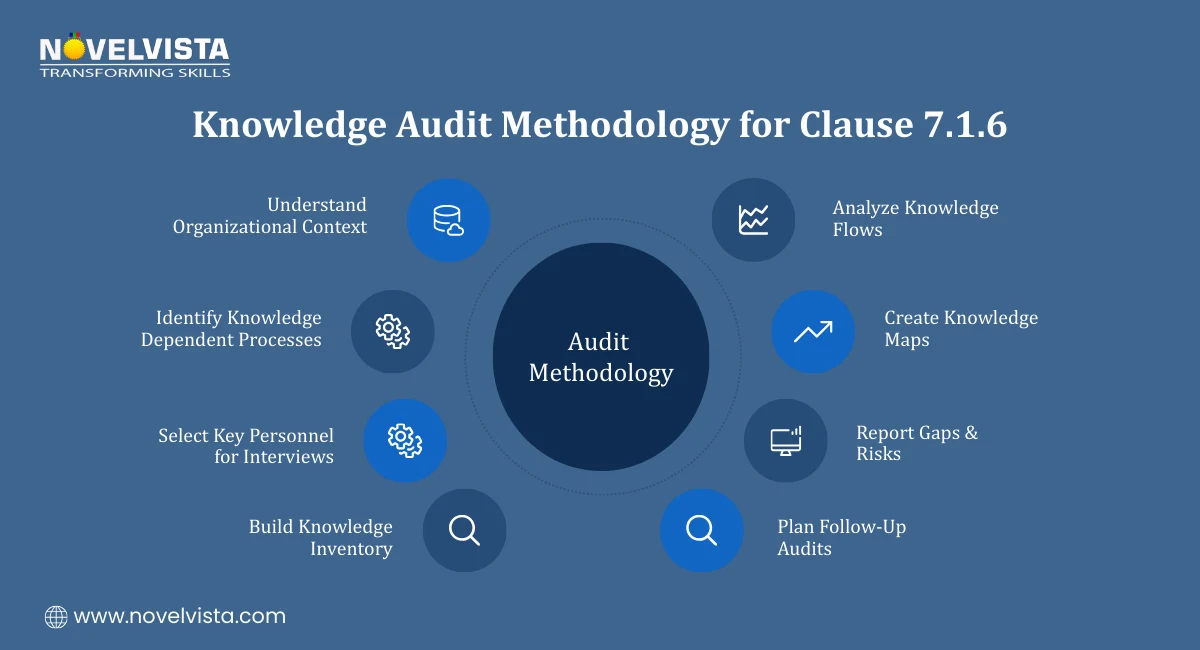
Knowledge Audit Methodology for Clause 7.1.6

Knowledge Audit Methodology for Clause 7.1.6

A strong audit approach to clause 7.1.6 requires structure, not guesswork. Lead auditors should follow a clear methodology focused on risk and impact. 

Understand Organizational Context

  • Business mission and strategy
  • Culture and leadership priorities
  • Areas where knowledge drives performance

Identify Knowledge-Critical Processes

  • Processes with high expertise dependency
  • Activities where errors have a high impact
  • Roles with unique or specialized knowledge

Select Key Personnel for Validation

  • Process owners
  • Subject matter experts
  • New and experienced employees

Build a Knowledge Inventory

  • Identify where knowledge resides
  • Capture both explicit and tacit knowledge
  • Use interviews and questionnaires

Analyze Knowledge Flows

  • How knowledge is shared
  • Where breakdowns occur
  • How updates are communicated

Create Knowledge Maps

  • Visualize ownership and access
  • Identify vulnerabilities and bottlenecks

Report Findings Clearly

  • Link gaps to process risks
  • Highlight improvement opportunities
  • Avoid vague observations
A risk-based audit approach works best for clause 7.1.6. Focusing on high-impact, knowledge-dependent processes allows auditors to identify vulnerabilities that generic sampling would otherwise miss. This structured approach strengthens auditing organizational knowledge and supports defensible audit conclusions.

Core Audit Components for Clause 7.1.6 Compliance

When assessing clause 7.1.6, auditors should focus on a few core components rather than scattered evidence.

Knowledge Assets

  • Documents, systems, and people holding critical knowledge
  • Clarity on what knowledge is essential

Knowledge Flows

  • Training, mentoring, and informal sharing
  • Breakdowns caused by silos or poor communication

Knowledge Gaps

  • Undocumented expertise
  • Duplication or inaccessibility

Future Knowledge Needs

  • Alignment with strategy and innovation
  • Preparation for growth or change

Process Support

  • Tools and behaviors enabling retention
  • Leadership support for sharing
These components help auditors evaluate whether knowledge management is resilient or fragile.

Intellectual Property and Knowledge Protection in Audits

While auditing organizational knowledge, Lead Auditors often uncover risks that go beyond quality performance. This is where clause 7.1.6 overlaps with intellectual property audit considerations.

Organizations may not label it as “IP,” but proprietary methods, designs, formulas, customer insights, and unique process know-how are all forms of protected knowledge. Auditors should evaluate whether this knowledge is:

  • Identified as critical
  • Access-controlled
  • Protected from loss or misuse

During ISO 9001 audits, weak protection of proprietary knowledge is increasingly raised as a systemic risk, especially in industries with high turnover, outsourcing, or contractor involvement. An effective intellectual property audit perspective helps auditors assess whether:

  • Key expertise is leaving with employees
  • Contractors or partners have uncontrolled access
  • Sensitive knowledge is shared informally without safeguards
Unmanaged intellectual capital is both a quality risk and a business risk. During auditing organizational knowledge, auditors should flag weak IP protection as a serious vulnerability, even if documentation appears complete.

Auditor Tools and Techniques for Knowledge Audits

Auditing knowledge requires different techniques from auditing procedures. Documents alone rarely tell the full story.

Effective tools and techniques include:

Interviews

  • Ask how work actually gets done
  • Explore where people go when things go wrong
  • Identify reliance on individual experience and tacit knowledge

Surveys and Questionnaires

  • Validate the consistency of knowledge across teams
  • Identify gaps between formal training and real practice

Process Walkthroughs

  • Observe how knowledge is applied in real time
  • Spot informal workarounds and undocumented expertise

Knowledge Flow Mapping

  • Visualize how knowledge moves across roles and departments
  • Identify hidden dependencies and single points of failure

Control Evaluation

  • Assess whether controls reduce knowledge loss risk
  • Verify handover, mentoring, and succession practices

Strong reporting during auditing organizational knowledge should clearly link knowledge gaps to process performance and operational risk. This strengthens audit credibility and usefulness.

Auditing Organizational Knowledge – Lead Auditor Toolkit

Learn how to audit Clause 7.1.6 beyond documents. Identify critical and tacit knowledge gaps that often cause audit failures, before they’re missed in real audits.

Risks Addressed Through Auditing Organizational Knowledge

When done properly, auditing organizational knowledge directly reduces several high-impact risks.

Key risks addressed include:

  • Brain drain risk: Loss of critical expertise due to resignation, retirement, or reassignment.

  • Decision-making risk: Poor or delayed decisions caused by inaccessible or outdated knowledge.

  • Audit and compliance risk: Weak evidence of conformity with clause 7.1.6 during certification or surveillance audits.

  • Operational continuity risk: Disruptions caused by undocumented processes or unshared know-how.

By assessing both explicit and tacit knowledge, auditors help organizations build resilience instead of reacting after failures occur.

Actionable Audit Checklist for Clause 7.1.6

This checklist is designed for Lead Auditors conducting auditing organizational knowledge, not for operational teams.
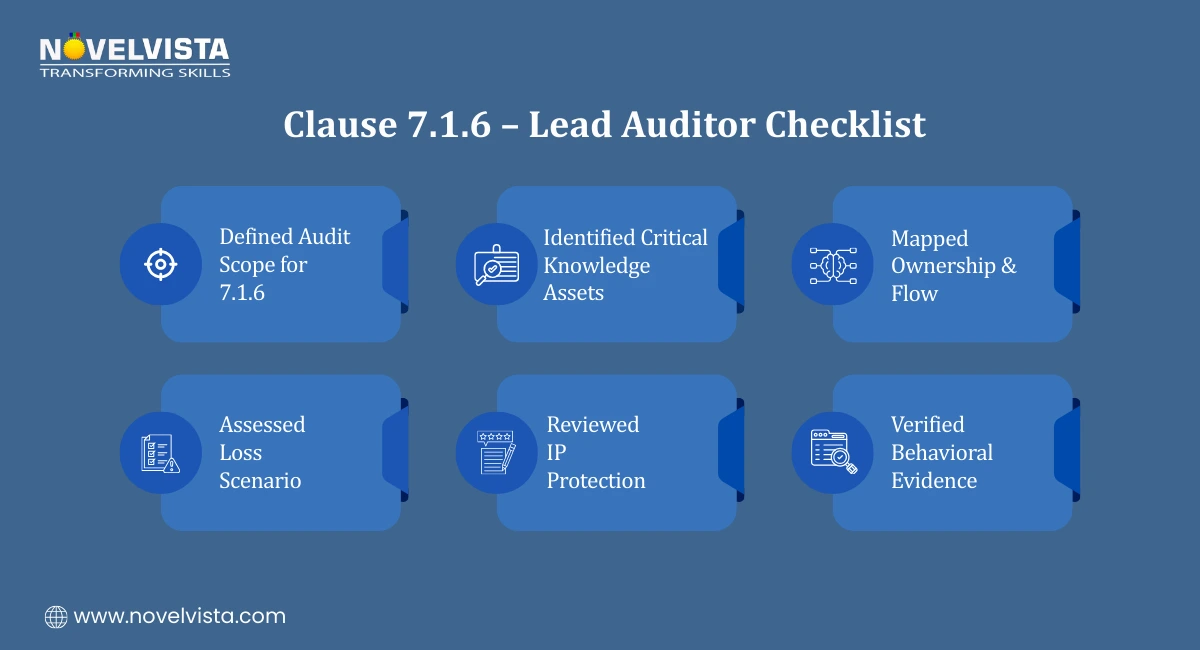
Clause 7.1.6 – Lead Auditor Checklist

Audit Preparation

  • Define audit scope specific to clause 7.1.6
  • Identify processes where knowledge dependency is high

Evidence Collection

  • Identify critical knowledge assets
  • Verify ownership and accessibility
  • Assess the use of tacit knowledge in daily operations

Risk Assessment

  • Evaluate knowledge loss scenarios
  • Review turnover, succession, and transfer mechanisms

Protection and Control

  • Review intellectual capital safeguards
  • Apply intellectual property audit thinking where relevant

Validation

  • Interview multiple roles for consistency
  • Cross-check documented and behavioral evidence

This approach ensures that auditing organizational knowledge delivers insight, not just observations.

Conclusion

Clause 7.1.6 is not a documentation requirement; it is a capability and resilience requirement. Organizations that treat it lightly often face hidden risks that surface only after disruption. Clear, evidence-backed observations on organizational knowledge help management prioritize corrective actions and demonstrate genuine conformity with clause 7.1.6 during audits.

Effective auditing organizational knowledge requires judgment, curiosity, and a willingness to look beyond written procedures. Lead Auditors who assess knowledge flows, tacit knowledge, loss risks, and protection mechanisms deliver far greater audit value than those who rely on checklists alone.

When knowledge is managed intentionally, quality systems become stronger, more stable, and more future-ready.
Become A Certified ISO 9001 Lead Auditor And Audit Organizational Knowledge Effectively

Next Step: Strengthen Your Lead Auditor Judgment

If you want to confidently assess Clause 7.1.6 and handle complex areas like knowledge risk and intellectual property audit considerations, NovelVista’s ISO 9001 Lead Auditor Certification Course is a strong next step. The program focuses on real audit scenarios, evidence-based judgment, and advanced interviewing techniques, helping you move beyond clause reading and deliver audits that truly add value.

Frequently Asked Questions

A successful audit identifies where critical insights reside and ensures that valuable expertise flows freely between departments to support long-term business goals and sustainable organizational growth.

Lead auditors suggest using structured interviews and storytelling sessions to transform personal experiences into accessible resources that benefit the entire team and prevent loss during staff transitions.

While dedicated platforms help organize data, the most effective audits focus on human interactions and cultural habits rather than relying solely on complex technological tools or software.

Audits should occur whenever significant structural changes happen or at regular intervals to ensure that institutional memory remains accurate, relevant, and aligned with evolving industry standards.

Every level of the hierarchy must engage because frontline workers often possess practical insights that executives might overlook, ensuring a comprehensive view of the entire intellectual landscape.

Author Details

Mr.Vikas Sharma

Mr.Vikas Sharma

Principal Consultant

I am an Accredited ITIL, ITIL 4, ITIL 4 DITS, ITIL® 4 Strategic Leader, Certified SAFe Practice Consultant , SIAM Professional, PRINCE2 AGILE, Six Sigma Black Belt Trainer with more than 20 years of Industry experience. Working as SIAM consultant managing end-to-end accountability for the performance and delivery of IT services to the users and coordinating delivery, integration, and interoperability across multiple services and suppliers. Trained more than 10000+ participants under various ITSM, Agile & Project Management frameworks like ITIL, SAFe, SIAM, VeriSM, and PRINCE2, Scrum, DevOps, Cloud, etc.

Confused About Certification?

Get Free Consultation Call

Sign Up To Get Latest Updates on Our Blogs

Stay ahead of the curve by tapping into the latest emerging trends and transforming your subscription into a powerful resource. Maximize every feature, unlock exclusive benefits, and ensure you're always one step ahead in your journey to success.
Topic Related Blogs