Category | Quality Management
Last Updated On 08/01/2026
Many quality systems look neat during an audit, yet fall apart when business conditions change. That’s exactly why auditing Clause 4 matters so much. It tells an auditor whether the QMS is built on real business understanding or just copied templates.
In ISO 9001 Lead Auditor training programs, Clause 4 consistently creates the most confusion. Many participants arrive confident about procedures but struggle to explain organizational context during mock audits. This gap shows why auditing Clause 4 separates checklist audits from audits that truly test system maturity.
This guide explains how auditors verify ISO 9001 context evidence in a practical way. It walks through how context, stakeholders, scope, and processes are checked during audits using tools that actually make sense in real organizations.
Clause 4 is where auditors form their first strong opinion about a management system. When auditing Clause 4, auditors are not looking for fancy documents. They want proof that the organization understands its business environment and has built the QMS around it.
If context is weak, everything else, risks, objectives, controls becomes weak too. Strong ISO 9001 context evidence shows that quality objectives are linked to strategy, risks are realistic, and processes support real business needs.
That’s why Clause 4 often sets the tone for the entire audit.
From an auditor skill-building perspective, Clause 4 demands judgment, not memorization. Auditors must evaluate relevance, not completeness. Training exercises show that strong auditors connect context directly to leadership decisions, risk planning, and process design instead of treating Clause 4 as documentation review.
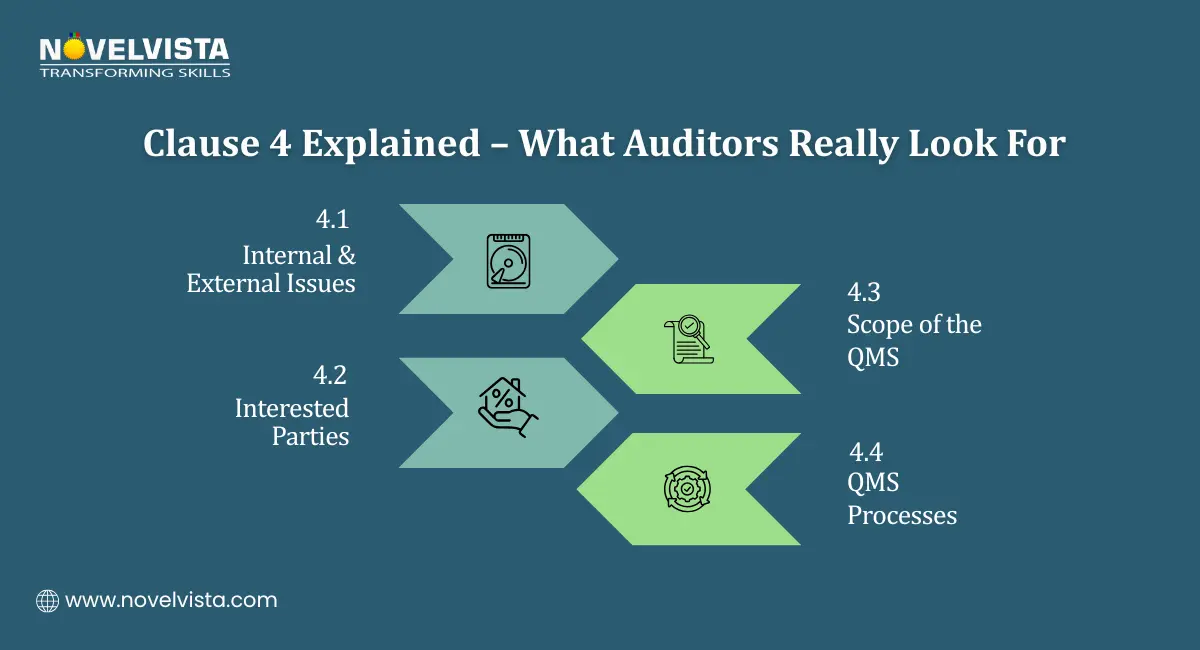
It asks four simple but powerful questions:
When auditing Clause 4, auditors evaluate how well these answers connect to leadership decisions, risk-based thinking, and QMS effectiveness. This is not a documentation-heavy Clause, it is leadership-driven.
Organizations that treat Clause 4 as paperwork usually struggle to defend their system during audits.
Clause 4.1 checks whether the organization truly understands what affects its performance.
Auditors often expect to see a PESTLE analysis audit used to structure external issues. This helps verify that political, economic, social, technological, legal, and environmental factors are considered properly.
At the same time, tools like SWOT analysis QMS are reviewed to confirm that strengths, weaknesses, opportunities, and threats are not generic. During auditing Clause 4, auditors look for clear links between SWOT findings, risk planning, and quality objectives.
Clause 4.2 goes beyond listing stakeholders. Auditors want to know whether the organization understands which parties matter and why.
Common interested parties include:
During auditing Clause 4, auditors verify:
Strong ISO 9001 context evidence shows that stakeholder needs influence planning, objectives, and operational controls not just a one-time list created for certification.
The scope defines where the QMS applies and where it doesn’t. Many audit issues start here.
When auditing Clause 4, auditors confirm that the scope:
Auditors also verify that scope decisions are supported by outputs from Clause 4.1 and 4.2. This means internal issues, external factors, and stakeholder needs must logically explain why the scope is defined the way it is.
Expected ISO 9001 context evidence includes:
A weak scope usually signals weak context understanding.
Clause 4.4 is where context turns into action. When auditing Clause 4, auditors want to see whether the organization has clearly defined how work actually flows.
Auditors review whether processes are:
Process mapping does not need to be complex. Simple flowcharts or SIPOC-style diagrams often work well. What matters is clarity. Auditors check whether process interactions make sense and whether controls are placed where risks actually exist.
Strong ISO 9001 context evidence here includes:
Auditor training consistently shows that process maps reveal more than procedures. When auditors trace process inputs, outputs, and risks back to organizational context, hidden gaps surface quickly. This skill is essential for verifying whether Clause 4 truly drives how work is performed.
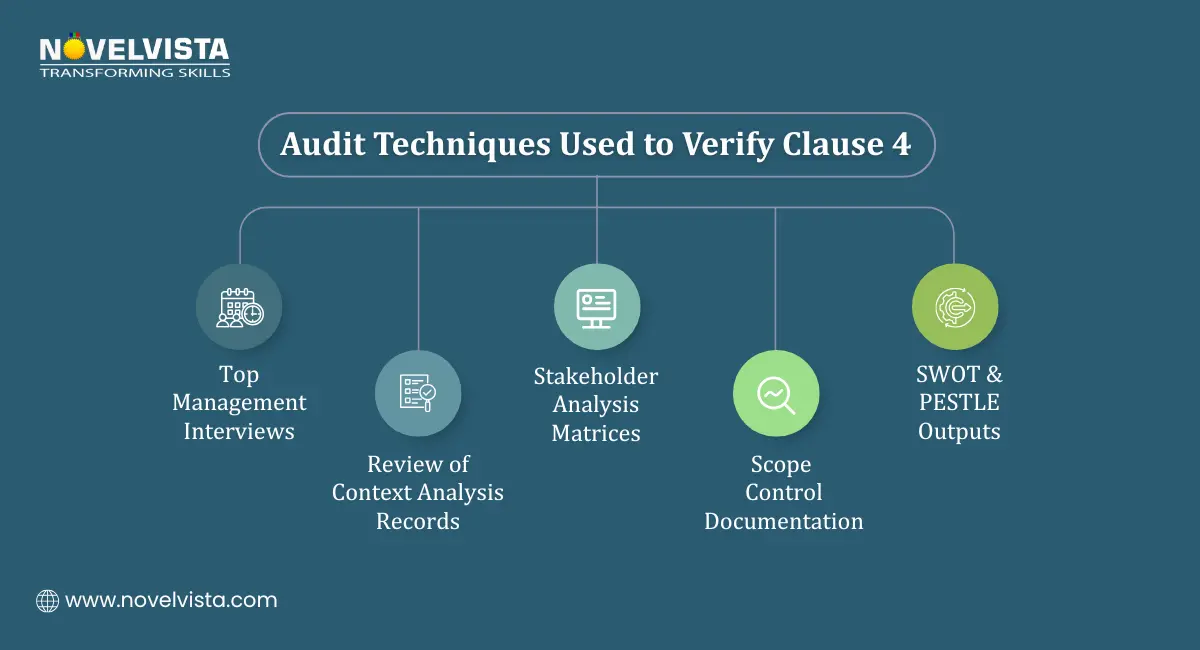
Effective auditing Clause 4 relies more on conversations and logic than paperwork.
Common audit techniques include:
This approach ensures ISO 9001 context evidence reflects real thinking, not static files.
Some findings appear again and again during auditing Clause 4.
Common nonconformities include:
These gaps often lead to larger ISO 9001 context evidence failures across planning and improvement Clauses.
Preparing for auditing Clause 4 does not require heavy documentation. It requires consistency and relevance.
Practical preparation steps include:
Organizations that do this rarely struggle to explain their QMS during audits.
Audit ISO 9001 clause by clause with confidence. Get structured checklists, templates, and reports mapped to each clause, so nothing is missed during planning or execution.
Strong auditing Clause 4 focuses on alignment, not paperwork. When context is clear, scope makes sense, stakeholders are understood, and processes are defined properly, the entire QMS becomes more effective.
Good ISO 9001 context evidence shows that the organization understands its environment and uses that understanding to guide decisions. Auditors and organizations alike should treat Clause 4 as a strategic input, not a checklist item.
These audit techniques are based on real certification audits, internal audit simulations, and auditor role-play exercises used in professional training environments, not theoretical models. They reflect how experienced auditors actually verify ISO 9001 context evidence in diverse industries.
If you want to confidently assess organizational context and avoid superficial audits, NovelVista’s ISO 9001 Lead Auditor Certification Course is a strong next step. The program builds a deep understanding of Clause 4, risk-based thinking, audit techniques, and real-world evidence evaluation. It helps professionals move beyond checklists and conduct audits that genuinely improve business performance.

Author Details

Course Related To This blog
ISO 9001:2015 Lead Auditor Training and Certification
Confused About Certification?
Get Free Consultation Call
Stay ahead of the curve by tapping into the latest emerging trends and transforming your subscription into a powerful resource. Maximize every feature, unlock exclusive benefits, and ensure you're always one step ahead in your journey to success.