Category | Quality Management
Last Updated On 23/02/2026
Did you know that over 1 million organizations worldwide are certified to ISO 9001, yet many still struggle with managing risks effectively? Studies show that nearly 60% of business disruptions stem from risks that were identified but not properly managed.
So here’s the real question:
If you are a quality manager, internal auditor, ISO consultant, or compliance professional, this guide is for you.
Auditing clause 6.1 of ISO 9001 goes far beyond ticking boxes. It challenges organizations to embed risk awareness into daily operations. This blog will help you understand the difference between traditional risk management and risk-based thinking and how to audit it effectively.
Let’s go beyond the surface.
Clause 6.1 of ISO 9001 requires organizations to determine risks and opportunities that could impact the Quality Management System (QMS). But here’s where many get confused.
It does not demand a formal risk management framework like ISO 31000. Instead, it expects integration of risk awareness into processes.
When auditing clause 6.1 of ISO 9001, auditors assess:
The focus is not on paperwork. The focus is on thinking.
This shift replaced the old preventive action clause from ISO 9001:2008. Instead of reacting, organizations must proactively consider risk. The Role of an ISO 9001 Lead Auditor is to assess QMS compliance and ensure effective implementation of ISO 9001 requirements
Traditional risk management typically relies on structured tools such as risk registers, formal scoring matrices, periodic risk reviews, and even dedicated risk committees to evaluate and control uncertainties. It is often documentation-driven and handled at scheduled intervals. In contrast, risk-based thinking is integrated directly into everyday operations. Instead of being a separate activity, it influences planning, guides decision-making, and strengthens process control as part of the organization’s ongoing Quality Management System approach.
Under ISO 9001:2008, preventive action was a separate clause. Organizations often created documents that few people used.
With ISO 9001:2015, preventive action vs risk became integrated. Risk-based thinking is preventive action built into the system.
Here’s a quick comparison:
|
Traditional Risk Management |
Risk-Based Thinking |
|
Separate risk register |
Integrated into processes |
|
Periodic reviews |
Continuous awareness |
|
Compliance-driven |
Strategy-driven |
|
Focus on threats |
Focus on risks and opportunities |
When auditing clause 6.1 of ISO 9001, the goal is not to check for a risk register. It is to verify risk-based thinking evidence within real operations.
Many organizations overcomplicate clause 6.1. Let’s simplify it.
Auditors look for three main things:
Are QMS risks identified during planning?
For example:
Evidence may include:
Auditing clause 6.1 of ISO 9001 requires tangible proof that risk thinking influences decisions.
Organizations often ignore opportunity management. But clause 6.1 treats opportunities equally with risks.
Examples include:
Effective opportunity management shows maturity in your QMS.
Master risk-based thinking with clear, audit-ready guidance
Learn how to evaluate and verify Clause 6.1 effectively
Strengthen compliance while improving real business resilience
If you’re conducting an audit, here’s a structured approach:
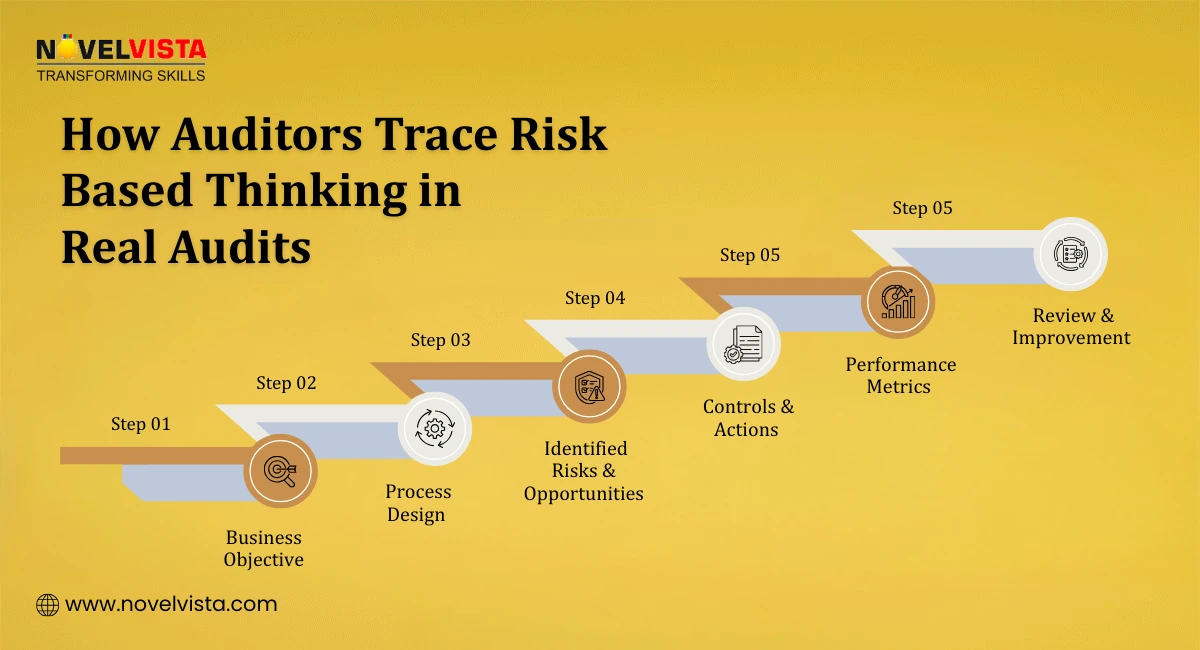
Review Organizational Context begins with evaluating Clause 4 outputs, including identified internal and external issues that may impact the Quality Management System. During auditing clause 6.1 of ISO 9001, it is essential to verify whether QMS risks are clearly linked to these contextual factors. Auditors should assess if the organization has logically connected its operational, regulatory, and market-related challenges to defined risks and corresponding actions.
Evaluate Risk Identification Methods by examining how the organization determines risks within its processes. During auditing clause 6.1 of ISO 9001, auditors should ask how risks are identified, whether risk assessment is performed during planning activities, and who is responsible for managing QMS risks. Clear accountability and structured risk assessment during planning demonstrate effective risk-based thinking evidence.
Examine Action Plans by reviewing each identified risk and the corresponding action taken to address it. During auditing clause 6.1 of ISO 9001, auditors should assess whether the action is proportionate to the level of QMS risks identified and whether its effectiveness is evaluated over time. Demonstrating measurable results provides strong risk-based thinking evidence and confirms that risk treatment is not merely documented but actively managed.
Verify Integration by confirming that risk-based thinking evidence is embedded across the Quality Management System rather than treated as a standalone activity. During auditing clause 6.1 of ISO 9001, auditors should ensure that risks are reflected in quality objectives, operational controls, supplier evaluation processes, and change management practices. Strong integration demonstrates that QMS risks are actively considered in decision-making and day-to-day operations.
ISO 9001 becomes powerful when it connects risks to real business performance.
Risk often sounds negative. But opportunity management transforms compliance into strategy.
Consider this example:
A manufacturing company identifies frequent minor defects. Instead of only treating this as a risk, they invest in automation. Result?
Opportunity management turns risk awareness into competitive advantage.
When auditing clause 6.1 of ISO 9001, always ask:
Organizations that only focus on threats miss half the value of the clause.
Let’s address practical gaps auditors frequently observe.
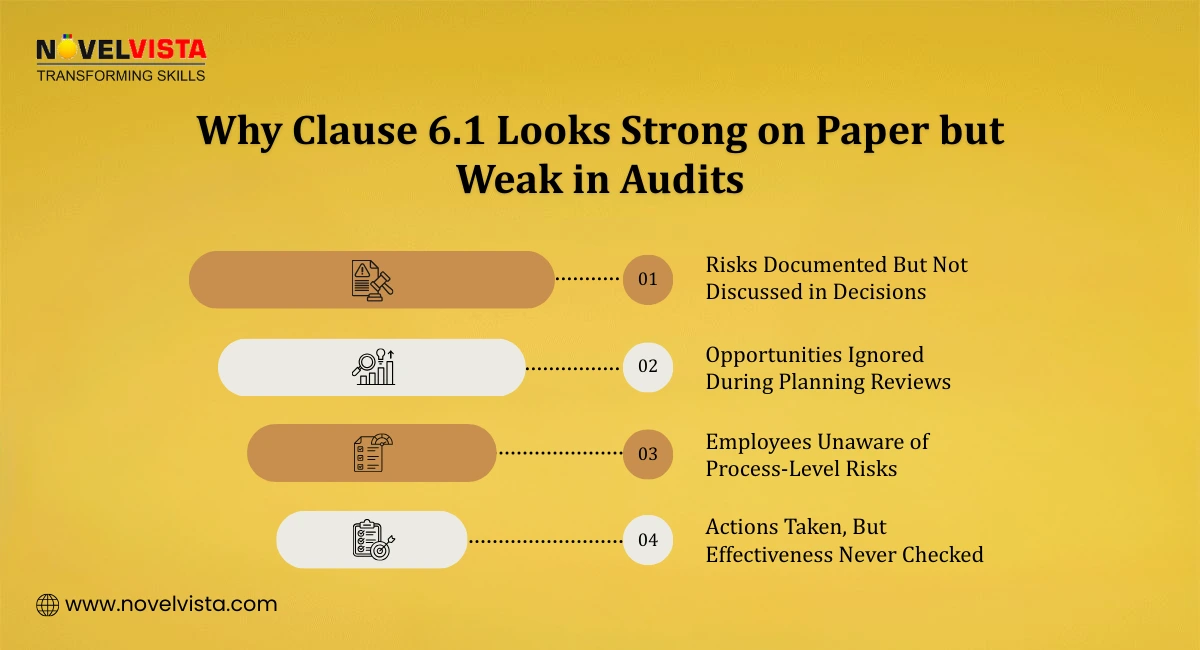
Creating complex risk registers without implementation.
Some organizations still treat risk separately instead of embedding it in processes.
Without KPIs or review mechanisms, risk-based thinking evidence becomes weak.
Opportunities are documented but never pursued.
Effective auditing clause 6.1 of ISO 9001 focuses on system integration — not paperwork.
Organizations that genuinely implement risk-based thinking improve resilience, reduce nonconformities, strengthen stakeholder confidence, and enhance decision-making. QMS risks are not merely operational concerns; they directly impact customer trust, brand reputation, and overall profitability. Effective auditing clause 6.1 of ISO 9001 ensures the system remains proactive rather than reactive, transforming ISO 9001 from a basic certification exercise into a powerful business management tool.
Auditing clause 6.1 of ISO 9001 is not about checking files — it is about assessing whether risk awareness truly shapes how an organization thinks, plans, and performs. The evolution from preventive action vs risk marks a fundamental shift in modern quality management, moving from reactive correction to proactive, system-wide risk-based thinking embedded in planning, operations, supplier management, and continual improvement.
When organizations treat QMS risks as strategic drivers rather than compliance obligations, they build resilience, protect customer trust, and unlock measurable business value. Strong opportunity management combined with effective risk mitigation creates not just conformity — but competitive advantage.
If you are auditing clause 6.1 of ISO 9001, focus on what really matters:
✔ Verify integration across processes
✔ Look for practical risk-based thinking evidence
✔ Align QMS risks with strategic objectives
✔ Confirm actions are effective and measurable
Move beyond documentation. Move beyond the checklist. Audit for performance, sustainability, and real organizational impact.
Ready to elevate your quality management auditing capabilities?
Join NovelVista’s ISO 9001 Lead Auditor Certification Training and gain practical auditing skills, real-world QMS insights, and globally recognized credentials that strengthen your professional credibility. Designed for quality managers, internal auditors, consultants, and compliance professionals, this course empowers you to confidently conduct audits, evaluate risk-based thinking evidence, and effectively perform auditing clause 6.1 of ISO 9001 in modern business environments.
If you’re serious about mastering QMS risks, understanding preventive action vs risk in depth, and leading impactful audits — this is your next strategic step.
Start your ISO 9001 Lead Auditor journey today!

Author Details

Course Related To This blog
ISO 9001:2015 Lead Auditor Training and Certification
Confused About Certification?
Get Free Consultation Call
Stay ahead of the curve by tapping into the latest emerging trends and transforming your subscription into a powerful resource. Maximize every feature, unlock exclusive benefits, and ensure you're always one step ahead in your journey to success.