Category | Project Management
Last Updated On 03/02/2026
At some point in your project management journey, you hit a pause. You want a certification, but the question isn’t whether to get one, it’s CAPM vs PMP. And that choice can feel confusing.
Both certifications come from PMI. Both look valuable on a resume. Yet they are built for very different stages of a career. Picking the wrong one can mean wasted time, money, or effort.
In project management training programs, we regularly see professionals hesitate at this stage. Some choose CAPM too late, and others attempt PMP too early. The right choice becomes clear once experience level and role expectations are evaluated honestly.
This guide breaks down CAPM vs PMP in a clear, practical way. By the end, you’ll know which certification fits your experience level, career goals, and return on investment, without overthinking it.
The CAPM vs PMP debate usually comes down to one simple question:
Are you entering project management, or are you already leading projects?
Many professionals struggle here because job descriptions, online advice, and salary numbers often mix the two. That leads to confusion between PMP vs CAPM, even though the certifications serve different purposes.
This article clears that up by explaining:
Who CAPM is really for
Who PMP is designed for
How to decide between CAPM or PMP based on where you are today
Once you see the difference clearly, the choice becomes much easier.
The Certified Associate in Project Management (CAPM®) is an entry-level certification offered by PMI. It is designed for people who want to enter project management but don’t yet have hands-on experience leading projects.
Key things to know about CAPM:
No prior project management experience is required
Eligibility requires 23 hours of project management education
The exam focuses on fundamentals, terminology, and basic concepts
CAPM is ideal for:
Students and fresh graduates
Professionals switching careers
Team members who support projects but don’t lead them yet
CAPM follows PMI’s global standards and terminology, making it a trusted entry-level credential for organizations that value structured project management fundamentals.
In the CAPM vs PMP discussion, CAPM represents the starting point. It helps you understand how projects are structured and prepares you for junior project roles.
The Project Management Professional (PMP®) is PMI’s advanced and globally recognized certification. It is built for professionals who already manage or lead projects.
To qualify for PMP, you need:
36–60 months of project leadership experience (depending on education)
35 hours of project management education
The ability to handle complex, scenario-based exam questions
PMP is often called the gold standard in project management because it:
Emphasizes leadership and decision-making
Covers agile, hybrid, and predictive approaches
It is preferred for senior and high-responsibility roles
In any PMP vs CAPM comparison, PMP clearly targets professionals who are ready to take ownership of projects, budgets, and teams.
Here’s a clear comparison to help visualize the difference:
| Aspect | CAPM | PMP |
| Experience Required | 0 years | 3–5 years |
| Education Hours | 23 hours | 35 hours |
| Exam Format | 150 questions, foundational | 180 questions, scenario-based |
| Exam Cost | ~$300 | ~$555 (exam only) |
| Renewal | 15 PDUs / 3 years | 60 PDUs / 3 years |
| Average Salary | ~$77,000 | ~$120,000 |
From an exam design standpoint, the gap between CAPM and PMP is intentional. CAPM validates knowledge readiness, while PMP validates applied judgment under complex project conditions.
When choosing CAPM vs PMP, experience level is the biggest deciding factor. CAPM helps you enter the field, while PMP helps you grow into leadership roles.
Understanding the strengths and limits of each option makes the CAPM vs PMP decision practical instead of confusing.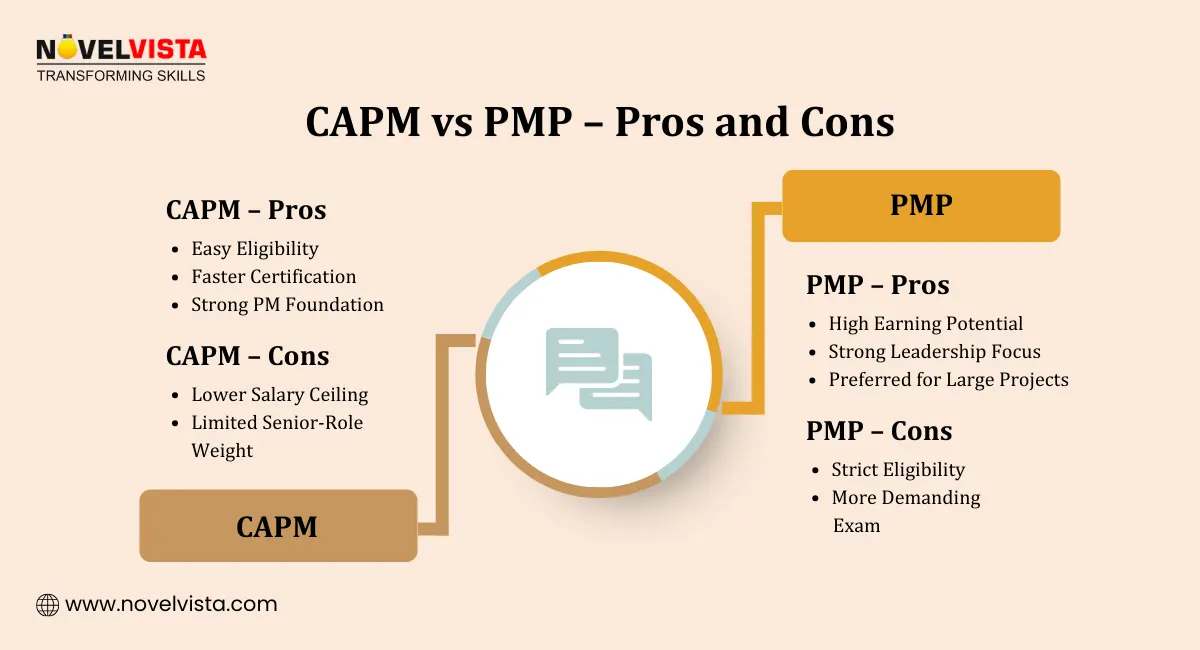
Low entry barrier with no prior project management experience required
Faster eligibility and quicker certification timeline
Strong foundation in project management concepts and terminology
Ideal first step in the CAPM vs PMP career journey
Suitable for students, fresh graduates, and career switchers
Lower salary ceiling compared to PMP-certified professionals
Limited recognition for senior or leadership-heavy roles
Less suitable for complex, high-value project environments
Often requires upgrading later as careers progress
Works best as a short-term step in a CAPM or PMP Certification path
Globally recognized credential with strong employer demand
Higher earning potential and better long-term ROI
Focuses on leadership, decision-making, and real-world judgment
Preferred for large, complex, and high-stakes projects
Strong credibility in most PMP vs CAPM comparisons
Must Read: How much will PMP would benefit you in 2026
Strict eligibility requirements delay certification for beginners
Requires 3–5 years of real project leadership experience
The exam is demanding and heavily scenario-based
Preparation requires significant time and effort
Not ideal as a first certification for newcomers
PMP preparation demands a mindset shift from execution to leadership. Candidates who succeed usually prepare by thinking in terms of outcomes, trade-offs, and organizational impact rather than task completion.
Stop comparing blindly. Use a simple,
experience-based guide to choose
CAPM or PMP for your role and career goals.
Choosing between CAPM and PMP becomes easier when matched with your current experience and goals.
Have little or no project management experience
Are you a student, a graduate, or changing careers
Want to enter project management roles quickly
Need a structured foundation before handling complex projects
Already manage or lead projects
Handle teams, budgets, and stakeholders
Aim for senior or leadership positions
Want long-term career growth and salary increase
Many professionals don’t stay stuck in the CAPM vs PMP decision. They start with CAPM, gain experience, and later move to PMP when ready.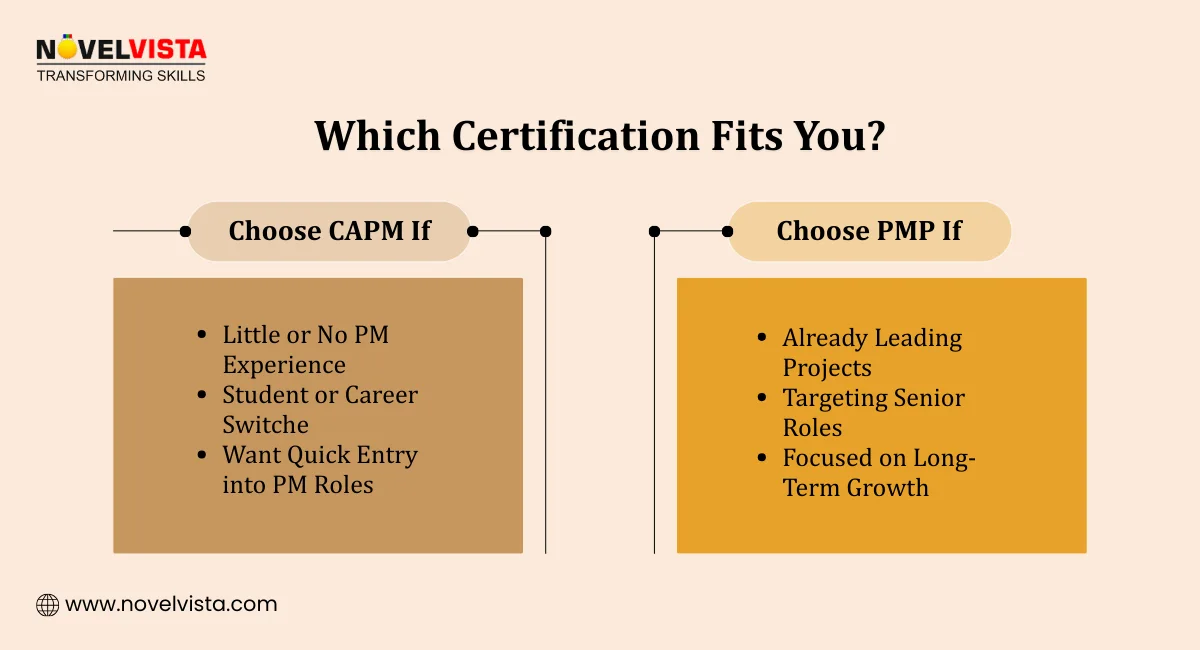
When cost and return are compared side by side, the difference between CAPM and PMP becomes clearer.
Exam cost: ~$225–300
Training cost: Lower and shorter duration
Faster return through entry-level roles
Best for early-career professionals
Exam cost: ~$405–555
Preparation cost: Higher due to exam depth
Strong long-term ROI with higher salary potential
Better value for experienced professionals
Short-term affordability favors CAPM, while long-term financial growth clearly favors PMP.
Read our in-depth report of CAPM vs PMP salary and ROI to understand which certification delivers better value for your experience level and long-term career goals.
The preparation style further highlights why CAPM vs PMP serve different career stages.
Project management fundamentals
Process understanding and terminology
Completion of 23-hour education requirement
Knowledge-based exam approach
Scenario-based decision-making
Agile, hybrid, and predictive approaches
Stakeholder and leadership judgment
Practice-driven learning, not memorization
This difference explains why PMP vs CAPM exams feel very different in difficulty and mindset.
Stay updated with the latest changes, read our blog on PMP exam updates for 2026 to understand what’s new, what’s changed, and how it affects your preparation strategy.
The CAPM vs PMP choice is about timing, not superiority.
CAPM builds the base and opens doors to project roles
PMP strengthens leadership credibility and earning power
If you’re starting out, CAPM makes sense.
If you’re already leading projects, PMP is the smarter investment.
The right CAPM or PMP Certification matches where you are today and supports where you want to go next. 
Author Details

Confused About Certification?
Get Free Consultation Call
Stay ahead of the curve by tapping into the latest emerging trends and transforming your subscription into a powerful resource. Maximize every feature, unlock exclusive benefits, and ensure you're always one step ahead in your journey to success.