Category | Project Management
Last Updated On 19/08/2026
Projects don’t fail just because teams ignore planning. They fail because risks show up quietly, grow unnoticed, and hit delivery at the worst possible time. That’s why risk management in project management is not a side activity; it’s a daily discipline that protects timelines, budgets, and trust.
This article explains how risk management in project management actually works in real projects. It connects risk categories, planning, analysis, tools, and registers into one clear, practical system that teams can apply from day one.
In our project management training programs, we consistently see that risks are rarely ignored; most are simply underestimated until they become issues. Teams that actively track risks early recover faster when plans change.
| Area | What Strong Projects Do |
| Risk thinking | Starts early and continues throughout |
| Risk types | Categorized clearly, not mixed together |
| Planning | Uses a defined risk management plan |
| Analysis | Focuses on priority, not paperwork |
| Control | Uses a live risk register, not static files |
Every project operates under uncertainty. Requirements change, people leave, budgets tighten, vendors delay, and technology behaves in unexpected ways. Risk management in project management provides a structured way to deal with this uncertainty instead of reacting to it.
When teams ask, how do you manage risk in project management?, the answer is simple in principle:
Identify risks early
Understand their impact
Decide how to respond
Monitor continuously
What separates successful teams is consistency. They don’t treat risk as a one-time workshop. They build it into planning, execution, and review cycles using a clear risk management plan in project management and a visible risk register.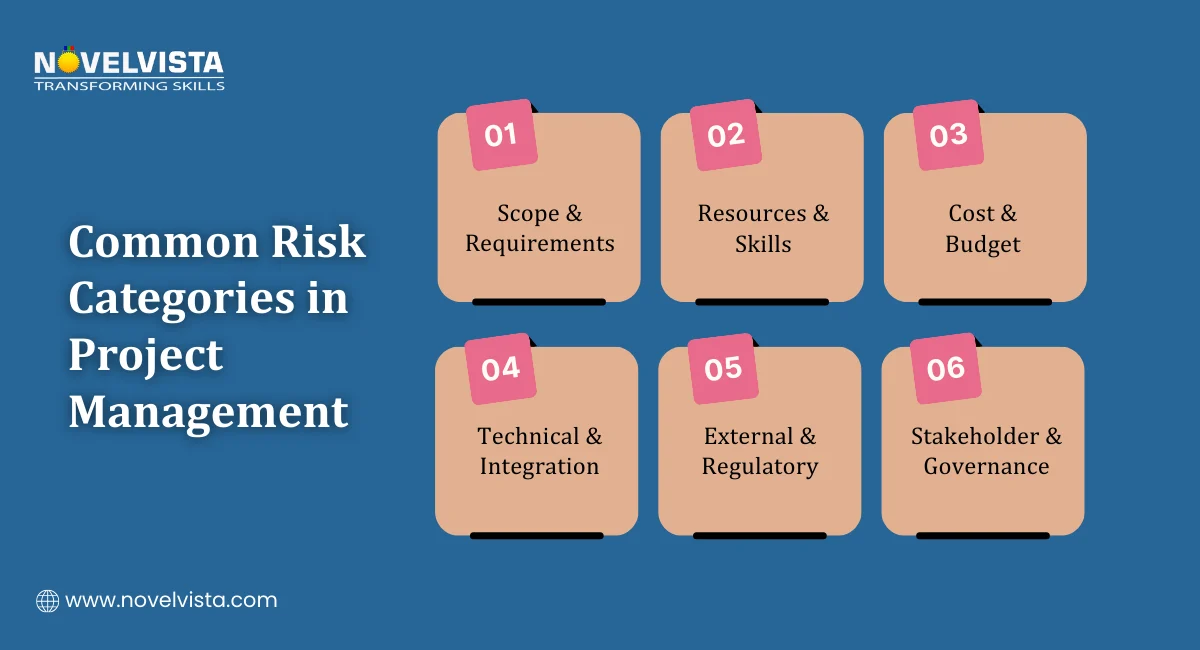
Across real projects, categorizing risks early helps teams avoid mixing delivery problems with strategic or external risks, which often delays the right response. Grouping risks helps teams respond faster and avoid confusion.
Common risk categories in project management include:
Scope risks: unclear requirements, frequent changes, scope creep
Resource risks: skill gaps, key resource dependency, availability issues
Cost risks: inaccurate estimates, funding delays, inflation impacts
Technical risks: integration failures, system performance issues
External risks: vendors, regulations, market, or political changes
Stakeholder risks: decision delays, conflicting priorities, poor engagement
Many teams use a Risk Breakdown Structure (RBS) to organize these categories. This improves visibility and ensures no major risk area is ignored. Clear categorization makes risk management in project management more focused and easier to communicate.
A risk management plan in project management (also known as a risk plan in project management) defines how risks will be managed, not what the risks are.
This plan sets the rules of the game. It usually defines:
The risk identification and assessment approach
Roles and responsibilities (Project Manager, Risk Owner, Sponsor)
Probability and impact scoring scales
Reporting frequency and review points
Escalation and governance thresholds
Tools and templates to be used
Without this plan, risk handling becomes inconsistent. With it, decisions are faster and clearer. The plan ensures that risk management in project management stays structured even when projects move fast or conditions change.
A clearly defined risk management plan in project management creates alignment between the project manager, sponsors, and stakeholders on how much risk is acceptable.
Effective risk management in project management is not a single activity. It runs throughout the project lifecycle and adapts as conditions change. The process below is simple, repeatable, and used in real projects.
This step defines how risk will be handled before identifying any risks.
Teams typically:
Decide on the tools, templates, and data sources to use
Define probability and impact thresholds
Align the risk approach with project goals and constraints
This step directly applies the risk management plan in project management and keeps risk handling consistent across the project.
Risk identification is about surfacing uncertainties early, not predicting everything perfectly.
Common techniques include:
Team brainstorming sessions
Lessons learned from past projects
Checklists and historical data
SWOT analysis
Delphi technique for expert input
FMECA for technical or engineering projects
Strong teams revisit identification regularly because new risks emerge as projects evolve.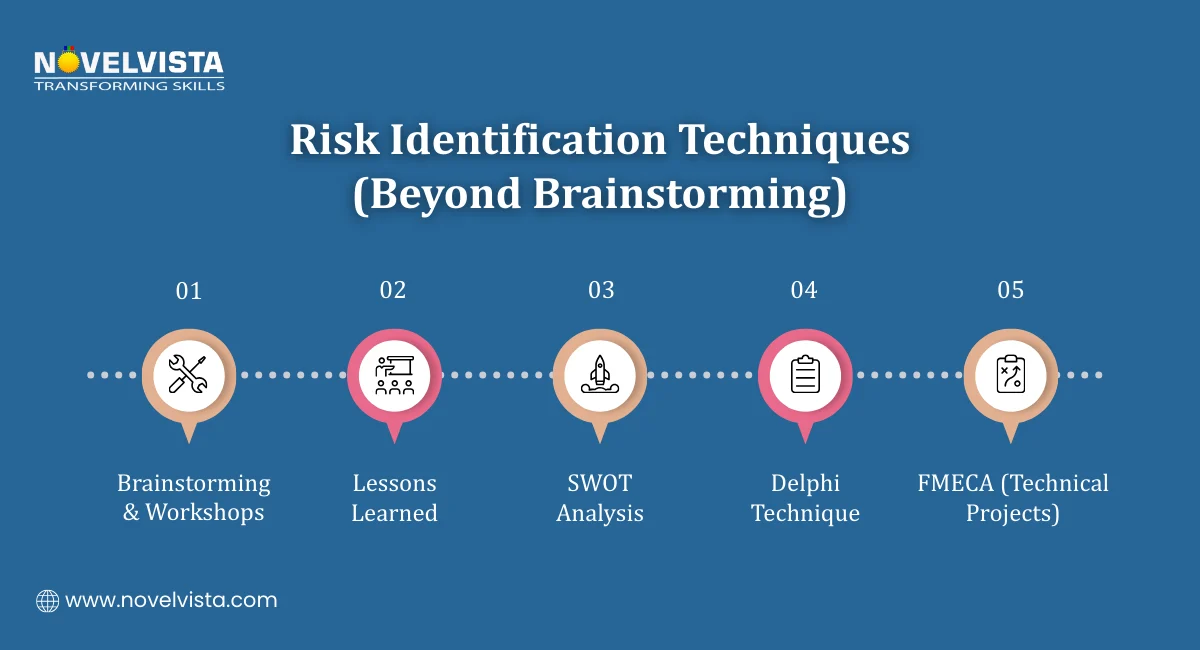
Not all risks deserve equal attention. Risk analysis in project management helps teams focus on what matters most.
This is usually done in two ways:
Qualitative analysis: Ranking risks as high, medium, or low
Quantitative analysis: Using probability × impact scoring
Risk matrices and scoring models help prioritize exposure. The goal is clarity, not complexity. Well-executed risk analysis in project management prevents teams from overreacting to low-impact risks. Also, Effective risk analysis in project management prioritizes decision-making clarity over complex calculations that teams struggle to maintain.
Once risks are prioritized, teams decide how to respond.
For threats:
Avoid
Mitigate
Transfer
Accept
For opportunities:
Exploit
Enhance
Accept
Each response should have:
A clear owner
Defined triggers
Planned contingency actions
This step answers a common question teams ask: how do you manage risk in project management? By planning responses before issues occur.
Risks don’t stay still, and neither should responses.
Teams monitor risks by:
Reviewing them in status meetings
Tracking response effectiveness
Updating probability or impact scores
Closing risks that are no longer relevant
This continuous review keeps risk management in project management practical and current.
The risk register in project management is the central place where all risk information is captured and maintained. It is not just a document, it’s a working control tool. In practice, projects with a visible and frequently updated risk register experience fewer last-minute escalations during delivery.
A well-maintained register usually includes:
Risk ID and clear description
Category and root cause
Probability, impact, and priority score
Assigned risk owner
Planned response strategy
Current status and review dates
The risk register in project management evolves as the project progresses and supports transparency, audits, and informed decision-making.
Identify, document, and track project risks
systematically. Assign ownership, assess impact,
and control risks early, before small issues turn
into costly project failures.
Teams don’t need complex systems to manage risk well. The choice of risk management tools in project management usually depends on project size, risk exposure, and how mature the team is. What matters most is that the tools are easy to use and updated regularly.
Commonly used tools include:
The most effective risk management tools in project management are the ones teams actually use and maintain. Overly complex tools often lead to outdated data and poor engagement, which weakens risk control instead of strengthening it.
Must Read: Top 5 Project Management Tools that Project Managers Use in 2026 to increase their efficiency by 80%
Projects that handle risk well tend to follow a few consistent habits:
Start risk management in project management during planning, not after execution begins
Review risks regularly instead of treating them as static lists
Communicate risk status clearly to stakeholders
Scale the approach based on project size and exposure
For small projects, a simple list may be enough. For large or high-risk initiatives, detailed analysis, tools, and registers are essential. Organizations with mature risk practices integrate project risk reviews into governance and steering committee discussions, not just project meetings.
Strong risk management in project management is not about eliminating uncertainty. It’s about being prepared for it. With a clear risk management plan in project management, structured risk analysis in project management, the right risk management tools in project management, and a well-maintained risk register, teams protect outcomes and improve delivery confidence.
This guidance reflects common practices observed across multiple industries and aligns with globally accepted project management standards and frameworks.
The most successful projects treat risk as a continuous discipline, not a one-time exercise.
Next Step: Strengthen Your Project Risk Skills
If you want to manage project risks with confidence and structure, NovelVista’s Project Management Professional (PMP) Certification Training is a strong next step. The program helps professionals master planning, risk control, stakeholder management, and delivery techniques used in real projects. It’s ideal for those who want to move beyond theory and apply disciplined risk management in day-to-day project work.
A risk is a potential future event that may affect the project if it occurs, whereas an issue is a problem that has already occurred and requires immediate action to resolve.
Projects cannot eliminate every risk, as they involve uncertainties and external factors beyond a manager’s control. Therefore, proactive risk management is more practical than complete risk elimination.
Project managers prioritize risks by assessing their likelihood and potential impact, often using a risk matrix to identify high-priority threats that could significantly affect project objectives.
Mitigation focuses on proactively reducing the likelihood or potential impact of a risk, while contingency involves having a pre-planned response ready to implement if the risk actually occurs.
Engaging stakeholders brings diverse perspectives to risk identification, builds trust through transparent communication, and supports collaborative decisions and effective resource allocation.
Author Details

Course Related To This blog
PMP Training Certification
Confused About Certification?
Get Free Consultation Call
Stay ahead of the curve by tapping into the latest emerging trends and transforming your subscription into a powerful resource. Maximize every feature, unlock exclusive benefits, and ensure you're always one step ahead in your journey to success.