Category | Project Management
Last Updated On 27/02/2026
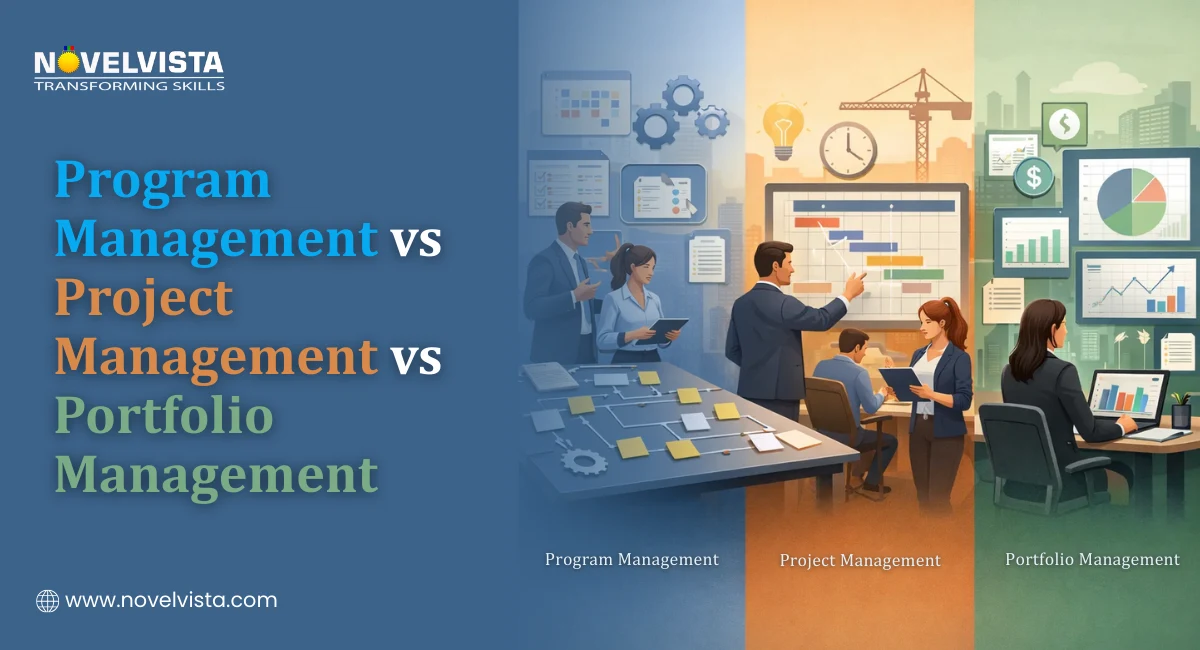
Ask ten professionals about program management vs project management, and you’ll likely hear ten different answers. Some think they are the same. Others mix them up with portfolio management. The confusion is common, and it affects both career growth and business results.
In project management training programs, we regularly see professionals stalled in their careers simply because they operate at one level while being evaluated at another. Clarity on this hierarchy often unlocks faster growth.
In reality, project vs program vs portfolio management form a clear hierarchy. Each level plays a different role in how organizations plan, execute, and grow. This guide breaks down those differences in simple terms so you can understand where you fit and how these layers work together.
TL;DR – Quick Hierarchy Overview
| Level | Focus | Core Question | Success Measure |
| Project | Delivery | Did we build it correctly? | On-time, on-budget |
| Program | Alignment | Are related projects delivering benefits? | Benefits realized |
| Portfolio | Strategy | Are we investing in the right initiatives? | Strategic value & ROI |
Many professionals debate program management vs project management without realizing that both sit inside a larger structure. When portfolio management is added to the picture, things become clearer.
Here’s the simple breakdown:
Project management focuses on delivering a defined output.
Program management ensures related projects move in the same strategic direction.
Portfolio management decides which initiatives should even begin.
Understanding the difference between project management vs program management helps organizations avoid overlap, confusion, and misaligned expectations.
When teams blur these roles, projects drift, programs lose focus, and portfolios lack direction.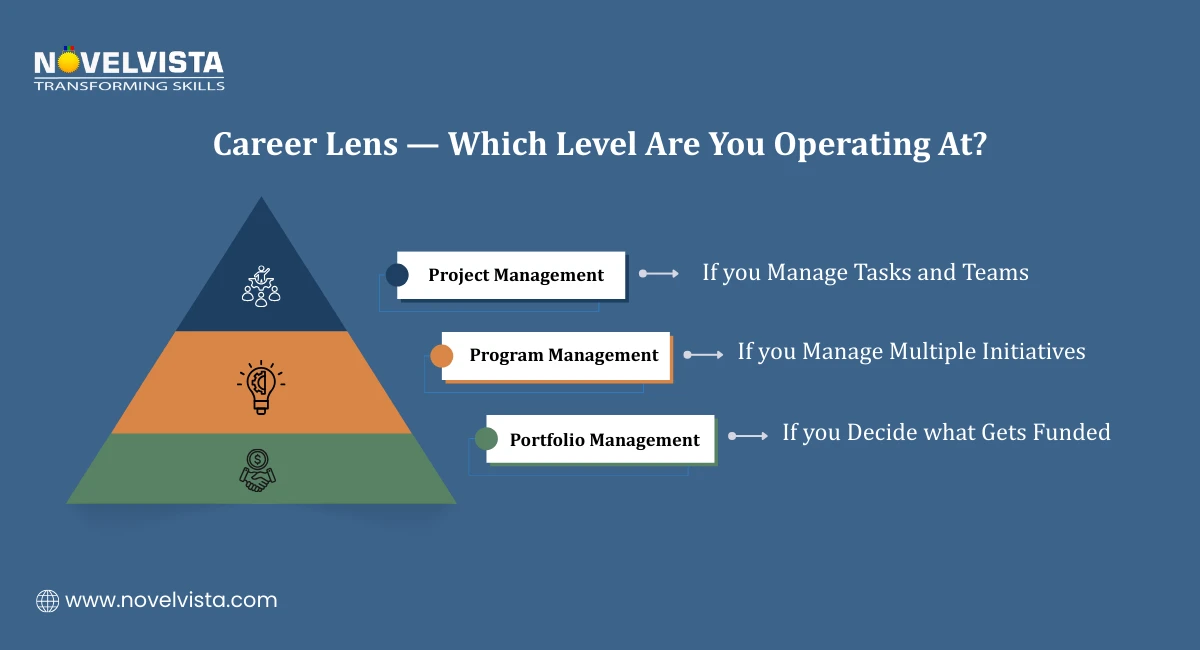
Project management is the execution engine. It focuses on delivering one defined output within agreed constraints.
A project typically has:
A clear start date
A defined end date
Specific objectives
Measurable deliverables
For example:
Building a company website
Launching a mobile app
Implementing a payroll system
Success in project vs program management discussions often starts here. Project managers are measured by:
On-time completion
On-budget delivery
Meeting defined scope and quality requirements
In the comparison of program management vs project management, project management is tactical. It handles scheduling, risk control, team coordination, and stakeholder communication at the execution level. Most delivery risks flagged during audits trace back to unclear project ownership rather than a lack of technical skill.
To get a clear understanding of fundamentals, explore our beginner-friendly guide on What Is Project Management and how it drives successful outcomes.
Program management operates one level above individual projects.
Unlike a single project, a program:
Includes multiple related projects
Manages interdependencies
Focuses on long-term benefits
May evolve over time
Consider a digital transformation initiative. It may include:
Website redesign
ERP implementation
CRM deployment
Cloud migration
Each is a project. Together, they form a program.
In program vs project management, the program manager ensures all projects align with a broader objective. They monitor risks across projects, adjust priorities, and track benefits rather than just deliverables.
This is where the difference between project management and program management becomes clear. One focuses on outputs. The other focuses on outcomes.
Portfolio management sits at the top of the structure.
It doesn’t manage tasks or interdependencies. It manages investment decisions.
Portfolio management answers:
Which projects and programs should we fund?
How should resources be allocated?
Which initiatives deliver the highest strategic value?
Unlike project or program roles, portfolio management:
Has no fixed end date
Operates across the entire organization
Focuses on long-term strategy
This is where project vs program vs portfolio management becomes fully visible. Portfolio management decisions are typically reviewed by senior leadership or boards, which is why traceability to strategy and value is non-negotiable.
Understand how project managers prioritize work,
handle pressure, make decisions, and balance
stakeholders daily. So you know what the role
actually demands in practice.
Here’s a simplified view to remove confusion around program management vs project management and its broader context.
| Aspect | Project Management | Program Management | Portfolio Management |
| Scope | Single deliverable | Multiple related projects | All programs & projects |
| Timeframe | Fixed start & end | Ongoing / extended | Indefinite, strategic |
| Focus | Execution & control | Alignment & benefits | Prioritization & ROI |
| Success Metric | On-time & on-budget | Benefits realization | Strategic objective achievement |
This table clarifies project vs program vs portfolio management in a practical way rather than theoretical definitions.
Role confusion is one of the most common root causes behind delayed decisions and duplicated reporting across large initiatives. Once the hierarchy is clear, the day-to-day work at each level becomes easier to understand. This is where program management vs project management stops being theory and starts becoming operational.
Project managers stay close to execution. Their work is hands-on and detail-focused.
They typically:
In project vs program management, the project manager’s responsibility ends when the agreed deliverable is completed and accepted.
To understand what project managers actually do day to day, read our detailed guide on the Roles and Responsibilities of a Project Manager.
Program managers operate across multiple projects. They look beyond individual deadlines and focus on long-term value.
Their responsibilities include:
This is where the difference between project management vs program management becomes visible. Program managers are less concerned with task lists and more focused on outcomes.
Portfolio managers work at the decision-making level.
They typically:
In program vs project management, portfolio management answers the “why,” while programs handle the “how,” and projects handle the “what.”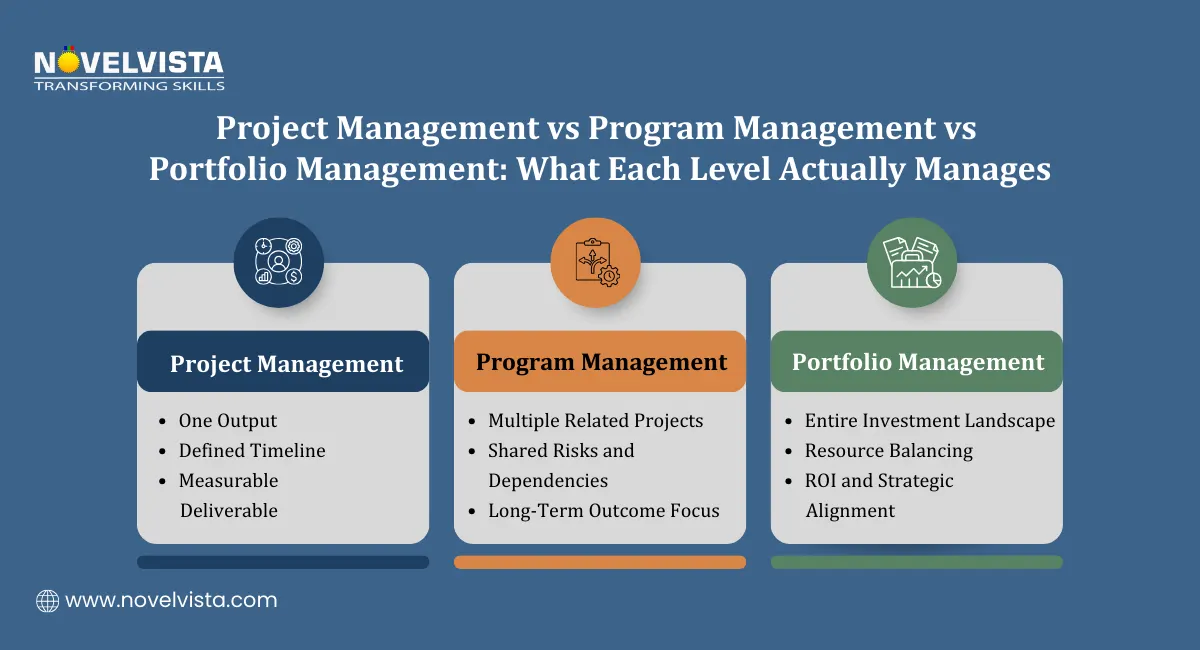
Confusion often arises when organizations use the wrong approach for the wrong situation. Knowing when to apply each level avoids role overlap and wasted effort.
Use Project Management when:
Use Program Management when:
Use Portfolio Management when:
Choosing the right level prevents confusion between project vs program management responsibilities and improves results.
Even though responsibilities differ, all three roles rely on a shared foundation of skills.
Common skills include:
Leadership and decision-making
Clear communication
Risk and issue management
Stakeholder engagement
What changes is the scope and depth of those skills. As you move from project to program to portfolio, the focus shifts from execution to alignment to strategy.
This progression explains why professionals often move upward in the hierarchy as their experience grows.
Let’s look at a simple example that shows project vs program vs portfolio management working as a system.
Project: Building a mobile application
Program: Launching a full app ecosystem (development, marketing, integrations, support)
Portfolio: Managing all innovation initiatives across business units
Each layer supports the next. Without projects, nothing gets delivered. Without programs, projects lose direction. Without portfolios, effort is spent on the wrong priorities.
This example highlights how program management vs project management is about coordination, not competition.
Global standards and frameworks consistently treat project, program, and portfolio management as complementary, not interchangeable disciplines. Understanding program management vs project management is more than a terminology exercise. It directly affects how work is planned, delivered, and measured.
A simple way to check where you operate:
If you manage deliverables → you’re in project management
If you manage outcomes across projects → you’re in program management
If you decide what gets funded → you’re working at the portfolio level
Clarity around program vs project management leads to better execution, stronger alignment, and better business results.
Next Step: Strengthen Your Project Management Skills with NovelVista
If you want to build strong execution skills and advance your project management career, NovelVista’s Project Management Professional (PMP) Certification Training is a practical next step. The program focuses on real-world project planning, risk handling, stakeholder management, and delivery excellence. It’s designed for professionals who want structured knowledge, confidence in execution, and globally recognized credentials.
Author Details

Course Related To This blog
PMP Training Certification
Confused About Certification?
Get Free Consultation Call
Stay ahead of the curve by tapping into the latest emerging trends and transforming your subscription into a powerful resource. Maximize every feature, unlock exclusive benefits, and ensure you're always one step ahead in your journey to success.