Category | Project Management
Last Updated On 25/08/2026
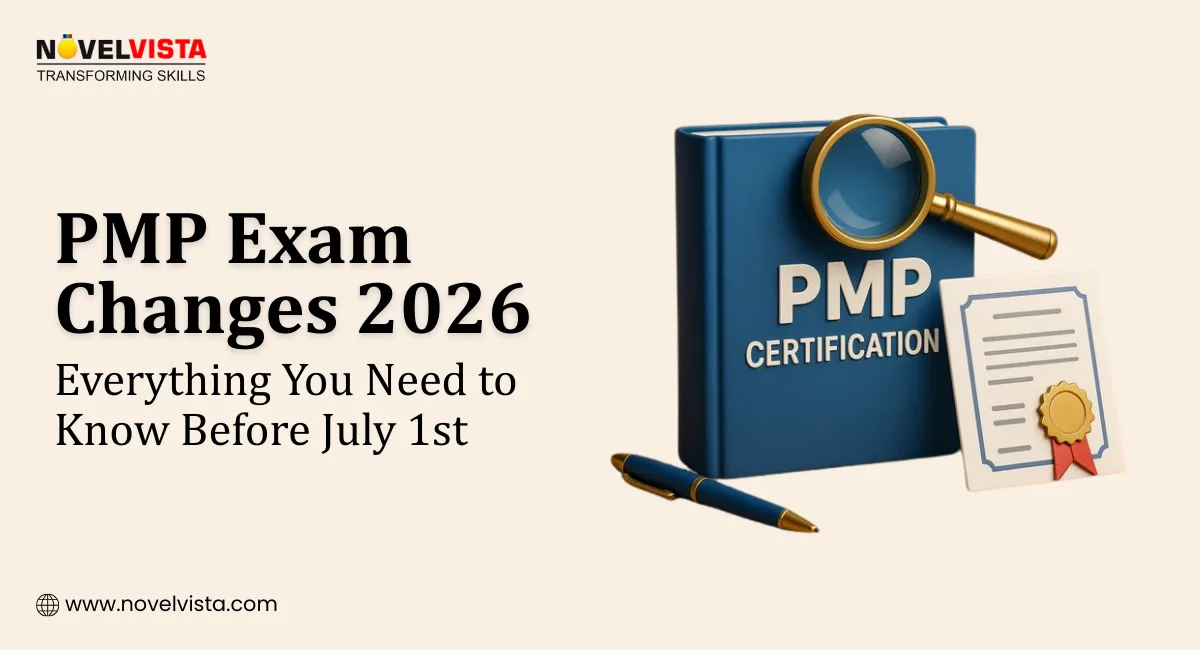
The Project Management Professional (PMP) certification has never been static it evolves as the project profession evolves. In 2026, PMP is taking a decisive step forward, reshaping the exam to reflect how projects are actually delivered in today’s complex, value-driven environments. This isn’t just an update to content; it’s a shift toward outcomes, strategic thinking, and real-world decision-making.
As organizations expect project managers to balance leadership, delivery, and business impact, the PMP Exam Changes 2026 are designed to validate those exact capabilities. With a pilot exam in January 2026, updated learning resources releasing in April, and the fully revised exam launching in July 2026, now is the time to plan your certification path carefully.
If you’re preparing for PMP or asking should I take PMP before July 2026, this guide walks you through what’s changing, what’s staying, and how the transition affects your exam strategy using only officially published information from the Project Management Institute (PMI).
Keeping up with changing times, the PMP exam is being updated to align with the future of the project profession. The 2026 update emphasizes real-world impact, value delivery, and broader business awareness.
These changes reinforce PMP’s role as a certification that validates not just knowledge but professional judgment, leadership, and strategic contribution.
Understanding the PMP exam timeline is essential for planning your certification journey, especially with major changes coming in 2026. As you adapt your study strategy to the updated testing standards, explore our detailed timeline breakdown to discover How Long Does It Take to get PMP Certification.
The PMP Exam Changes 2026 go beyond a syllabus update. PMI has rebalanced focus areas, domain weightage, and the overall exam philosophy.
The new PMP exam 2026 reflects modern project realities by aligning certification content with how projects are actually executed and evaluated today. It introduces emerging focus areas such as AI and sustainability, while placing a stronger emphasis on stakeholder engagement across the project lifecycle. The exam now evaluates how project managers apply AI for predictive analytics, risk forecasting, and automated scheduling in real-world scenarios. Most importantly, the exam moves beyond simple task completion and traditional constraints, shifting its focus toward outcomes and value delivery. This evolution ensures that PMP remains aligned with how organizations now define success, not just by scope, schedule, and budget, but by the real value projects deliver to the business and stakeholders.
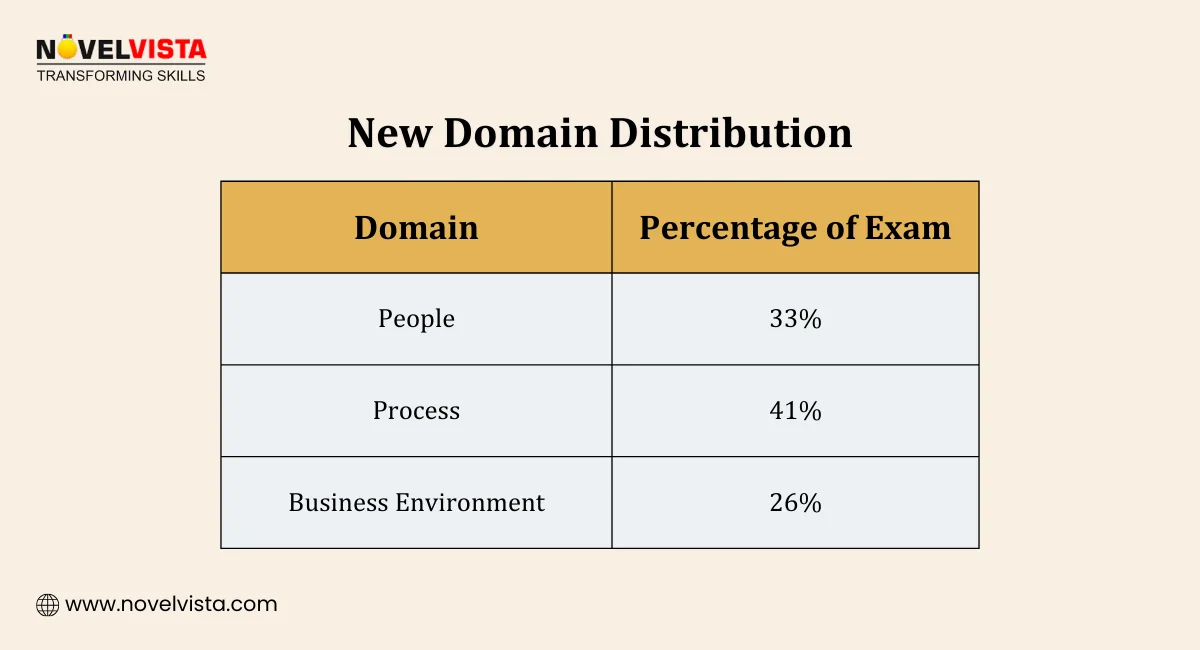
One of the most significant changes in the PMP exam 2026 is the rebalanced domain weightage, as defined in the revised Examination Content Outline (ECO). The updated structure redistributes focus across three core domains: People, which now accounts for 33% of the exam and emphasizes leadership and stakeholder engagement; Process, making up 41%, which continues to assess project execution and delivery practices; and Business Environment, expanded to 26%, highlighting governance, compliance, and strategic alignment. Together, these domains form a balanced framework that reflects the evolving role of project managers in delivering both results and business value.
What Changed from Earlier Versions
This major increase in the Business Environment domain highlights PMI’s focus on governance, compliance, risk, and organizational strategy.
The Examination Content Outline (ECO) confirms that PMP reflects real-world diversity in project delivery approaches.
Approach Distribution
Even though Agile and Hybrid make up about 60% of the content, PMI no longer tests them separately. In the 2026 exam, you’ll get one long scenario, followed by several questions. These questions may switch between different approaches like Agile, Hybrid, or Predictive.These approaches are not isolated to specific domains. Instead, predictive, agile, and hybrid methods appear across all three domains, reinforcing flexibility and professional judgment.
The exam structure remains familiar, but the experience becomes more practical.
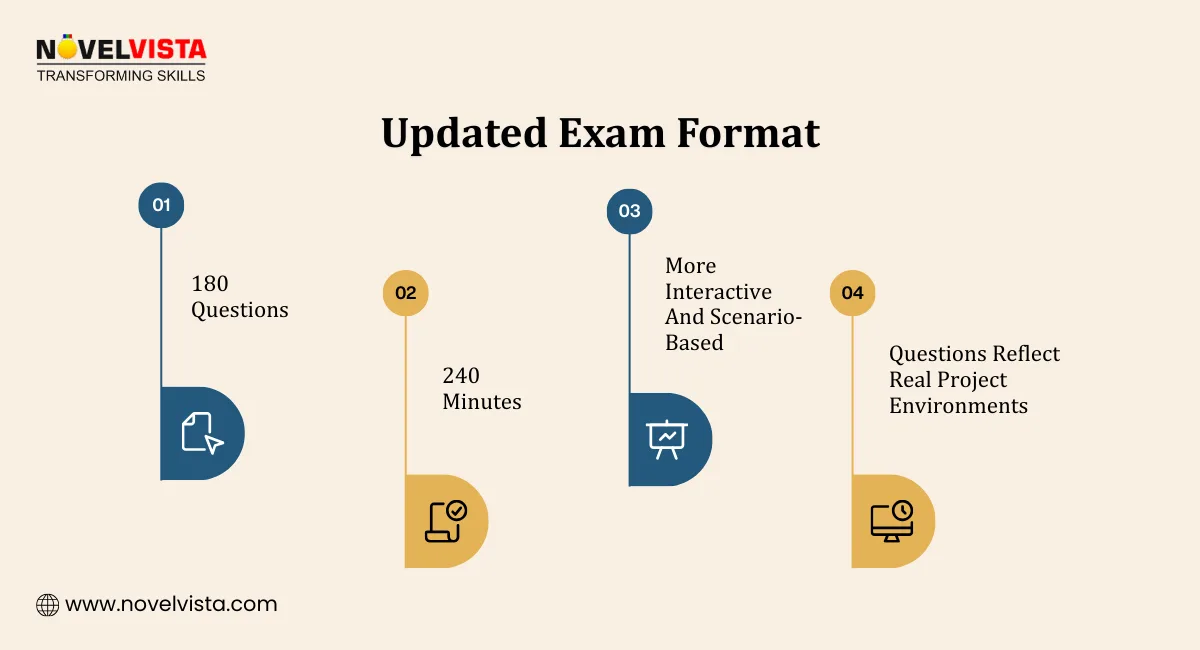
The PMP exam format remains familiar while evolving to better reflect real-world practice. The exam consists of 180 questions to be completed within 240 minutes, with a stronger focus on interactive and scenario-based questions. These questions are designed to mirror real project environments, requiring candidates to apply judgment, analyze situations, and make informed decisions. As a result, the exam tests not just what you remember, but how you think, prioritize, and respond as a project professional.
PMI has updated eligibility to align globally across degrees, apprenticeships, and training programs, while extending flexibility.
Experience Window
Education & Experience Paths
All experience must be non-overlapping and in a professional project setting.
The Examination Content Outline (ECO) defines what is tested on the PMP exam and how.
Domains: High-level knowledge areas
Tasks: Core responsibilities of a project manager
Enablers: Examples illustrating how tasks are performed
Every PMP exam includes questions covering all tasks within each domain, while strictly adhering to domain-level weightage.
Focuses on leadership, collaboration, and stakeholder alignment.
Key themes include:
Developing and promoting a shared vision
Managing conflicts and leading diverse teams
Engaging and aligning stakeholders
Planning communication and enabling knowledge transfer
This domain emphasizes leadership behaviors that drive trust and alignment.
Still the largest domain, but now more value-driven.
Key focus areas:
Integrated project planning and delivery
Scope, schedule, quality, and resource management
Value-based delivery and sustainability considerations
Financial planning, procurement, and project closure
The process domain now explicitly connects execution with business value.
The fastest-growing domain in the PMP exam changes 2026.
Core areas include:
Project governance and compliance
Risk management and change control
Managing external business environment changes
Continuous improvement and organizational change support
This domain reflects the strategic role project managers play within organizations. Discover how the PMP Exam Changes 2026 can open doors to high-demand PMP jobs and advance your project management career.
PMI’s view of project success has evolved, and the updated Examination Content Outline (ECO) reflects this shift in thinking. Project success is no longer judged solely by traditional measures such as schedule, budget, and scope. Instead, PMI defines success in terms of stakeholder value, the achievement of desired outcomes, and delivering an impact that is worth the effort and expense. This modern perspective on success is deeply embedded throughout the new PMP exam 2026, ensuring the certification evaluates a project manager’s ability to create meaningful and sustainable value. Explore the key benefits of PMP certification and how it can elevate your project management career.
The PMP Exam Changes 2026 represent a meaningful evolution of the certification one that mirrors how project management is practiced in today’s value-driven, dynamic business environments. With a stronger emphasis on leadership, strategic alignment, stakeholder value, and real-world decision-making, the new PMP exam reinforces the role of project managers as drivers of outcomes, not just executors of plans.
Whether you choose to take the current exam before July 2026 or prepare for the updated version, the key is informed planning. Understanding the revised Examination Content Outline (ECO), domain weightage, exam format, and eligibility criteria allows you to align your preparation with PMI’s expectations and your career goals.
Ultimately, PMP remains a globally respected credential now strengthened to reflect modern project realities. By preparing with clarity and purpose, you position yourself not just to pass the exam, but to demonstrate the leadership, judgment, and value-focused mindset that the future of project management demands.
Ready to prepare confidently for the PMP Exam 2026?
NovelVista’s PMP Certification Training is designed to help you build the leadership, strategic, and value-driven mindset emphasized in the new PMP exam. With practical exam-focused guidance, real-world project scenarios, and alignment with PMI’s latest Examination Content Outline (ECO), the course supports both current and future PMP aspirants. Whether you plan to take the exam before July 2026 or prepare for the updated version, this training helps you strengthen your project management expertise and progress with clarity and confidence.
Start your PMP certification journey today.
Author Details

Course Related To This blog
PMP Training Certification
Confused About Certification?
Get Free Consultation Call
Stay ahead of the curve by tapping into the latest emerging trends and transforming your subscription into a powerful resource. Maximize every feature, unlock exclusive benefits, and ensure you're always one step ahead in your journey to success.