NovelVista logo

Why Choose ITIL (Version 5) Certification? Jobs, Roles, and Salary Benefits Explained

Category | IT Service Management

Last Updated On 05/02/2026

Why Choose ITIL (Version 5) Certification? Jobs, Roles, and Salary Benefits Explained | Novelvista

Many professionals feel it before they can clearly explain it. Their role hasn’t changed on paper, but expectations have. Work now cuts across teams, tools, and responsibilities. Decisions matter more than processes. Outcomes matter more than activity.

This is where ITIL (Version 5) enters the conversation.

Employers are looking for people who understand how services deliver value, how coordination works, and how improvement happens without slowing everything down. ITIL (Version 5) responds to this shift with clearer, role-based certification paths that reflect how work is actually done today.

This article breaks it down simply:

  • What ITIL (Version 5) certification benefits are and what it really adds for professionals
  • Which ITIL (Version 5) job and roles tend to value it most
  • How it connects to career growth, increases ITIL (Version 5) career opportunities, and pays in practical terms

What ITIL (Version 5) Actually Adds for Professionals

ITIL (Version 5) does not replace ITIL v3 or ITIL 4. It builds on them. What changes is not the purpose of service management, but how clearly it connects to real responsibilities.

Earlier versions helped establish structure and shared language. ITIL (Version 5) refines that foundation and makes it easier to apply in day-to-day work.

How ITIL (Version 5) moves closer to real roles

ITIL (Version 5) shifts learning away from generic progression and closer to responsibility-based growth. This matters because most professionals do not work in neat silos anymore.

ITIL (Version 5) places emphasis on:

  • Managing services and products together: Many teams already handle platforms, tools, and services as one combined offering. ITIL (Version 5) reflects this reality.
     
  • End-to-end ownership: Responsibility does not stop at handoffs. ITIL (Version 5) supports thinking across planning, delivery, support, and improvement.
     
  • Change and improvement across teams: Work flows across teams and partners. ITIL (Version 5) helps professionals operate in this space without adding unnecessary control.

The key takeaway is simple: ITIL (Version 5) is less about learning theory and more about supporting how people actually work.

This makes it easier for professionals to explain their role, justify their decisions, and step into broader responsibilities.

Roles That Commonly Value ITIL (Version 5) Certification

ITIL (Version 5) is not meant for one specific job title. It supports roles that involve coordination, ownership, and accountability. Below are roles where ITIL (Version 5) is commonly valued, along with why it fits.

Common roles and how ITIL (Version 5) supports them

  • IT Service Manager: Focuses on overseeing service delivery, improvement, and alignment with business needs. ITIL (Version 5) supports structured decision-making and visibility across services.
     
  • Service Delivery Manager: Responsible for outcomes, not just operational metrics. ITIL (Version 5) helps shift focus from ticket handling to value delivery.
     
  • Product or Platform Owner: Coordinates services across teams and suppliers. ITIL (Version 5) supports lifecycle thinking and shared accountability.
     
  • IT Operations Manager: Balances stability with ongoing change. ITIL (Version 5) helps manage this balance without rigid control.
     
  • Process or Value Stream Owner: Works to improve flow and reduce delays. ITIL (Version 5) provides a clear view of how work moves from demand to outcome.
     
  • Change or Improvement Lead: Guides structured change initiatives. ITIL (Version 5) supports consistent improvement without unnecessary disruption.
     
  • Digital Service Manager: Manages services in modern, fast-moving environments. ITIL (Version 5) aligns service thinking with current delivery models.

These roles benefit from ITIL (Version 5) because it supports coordination, visibility, and informed decision-making, not just task execution.

ITIL (Version 5) Certification Benefits: Salary Insights

It’s important to say this clearly: ITIL (Version 5) does not automatically increase your salary. Certifications don’t work that way.

What ITIL (Version 5) does change is access.

How ITIL (Version 5) influences pay in practice

ITIL (Version 5) supports movement into roles that:

  • Carry broader responsibility
  • Involve ownership of outcomes
  • Sit closer to decision-making

These roles typically sit in higher pay bands because of their scope, not because of the certification name.

Where the salary impact usually appears

Salary impact often shows up:

  • During internal role changes or promotions
  • When moving from operational to ownership roles
  • During job switches where scope and responsibility increase

For example:

  • A support-focused role at ₹8 LPA may move into a service coordination role at ₹12–14 LPA
  • A delivery-focused role at $75k may step into a service ownership role at $90k–105k

ITIL (Version 5) supports these transitions by helping professionals explain their readiness clearly.

A useful way to think about it:
Certification supports eligibility, not entitlement.

How ITIL (Version 5) Aligns with Career Progression

One reason ITIL (Version 5) stands out is how clearly it maps to real career movement. It does not push everyone toward the same end goal. Instead, it supports growth based on how responsibilities usually expand over time.

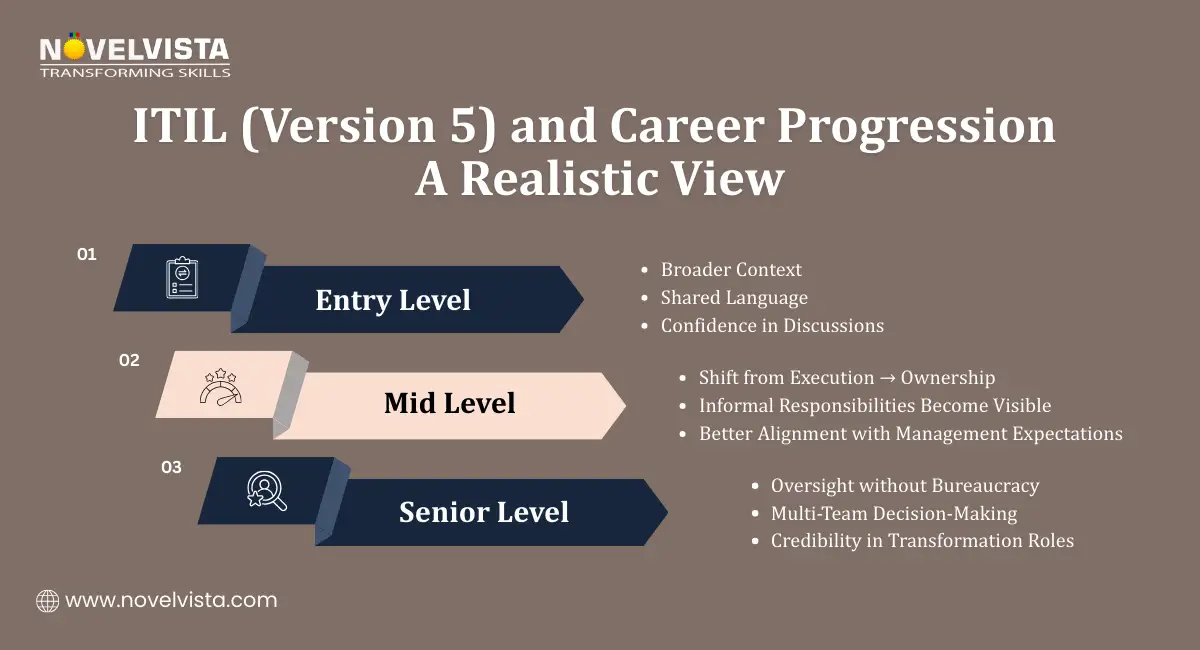
Entry-level professionals

At the early stage, most professionals are still focused on execution. The challenge here is not lack of effort, but lack of context. ITIL (Version 5) helps by giving a shared language and a broader view of how work fits together.

At this level, ITIL (Version 5) supports:

  • Understanding how services operate beyond individual tasks
  • Seeing how teams, tools, and processes connect
  • Participating more confidently in service-related discussions

In many markets, entry-level service roles typically fall in the range of ₹4–7 LPA or $45k–65k annually, depending on geography. ITIL (Version 5) doesn’t change this overnight, but it helps professionals move out of purely task-based roles faster.

Mid-level professionals

Mid-level roles often come with a shift in expectations. Professionals are no longer measured only by output, but by coordination, reliability, and ownership.

This is where ITIL (Version 5) becomes more visible in day-to-day work.

ITIL (Version 5) supports mid-level professionals by:

  • Helping them move from execution to ownership
  • Giving structure to responsibilities that were previously informal
  • Making their contribution easier to explain to management

Roles at this level, such as Service Delivery Manager or Process Owner, often sit around ₹10–18 LPA or $70k–95k annually. ITIL (Version 5) helps professionals become eligible for these roles by aligning skills with scope, not by adding theory.

Senior professionals and leaders

At senior levels, the focus shifts again. The work is less about doing and more about direction, oversight, and consistency across teams.

ITIL (Version 5) supports senior professionals by:

  • Strengthening oversight without adding bureaucracy
  • Supporting decisions that affect multiple teams
  • Providing a clear structure for improvement initiatives

Senior service and transformation roles often fall in the ₹20–35 LPA or $100k–140k+ annually range. At this level, ITIL (Version 5) helps by reinforcing credibility and readiness, not by teaching basics.

Across all levels, ITIL (Version 5) acts as a bridge. It supports growth without forcing professionals to switch domains or abandon earlier experience.How ITIL (Version 5) Aligns with Career Progression
Why Employers Are Paying Attention to ITIL (Version 5)

Employers are not looking for more certificates on paper. They are looking for people who can manage complexity without creating friction.

From a hiring and management perspective, ITIL (Version 5) signals a few useful things.

What employers tend to value

  • Clear role-based skill development: Easier to match people to responsibilities.
     
  • Better coordination across teams: Reduces handoff issues and misalignment.
     
  • Continuity with existing practices: No need to dismantle what already works.
     
  • Support for evolving delivery models: Helps teams adapt without chaos.

Because of this, ITIL (Version 5) is often seen as a sign that a professional can handle broader responsibility, especially in service-heavy environments.

Download: ITIL (Version 5) Career Roadmap

Get a clear, role-based view of how ITIL (Version 5) supports real career growth. Understand where you are today, what skills matter next, and how to progress, without rushing into unnecessary certifications.
Is ITIL (Version 5) Worth It for You?

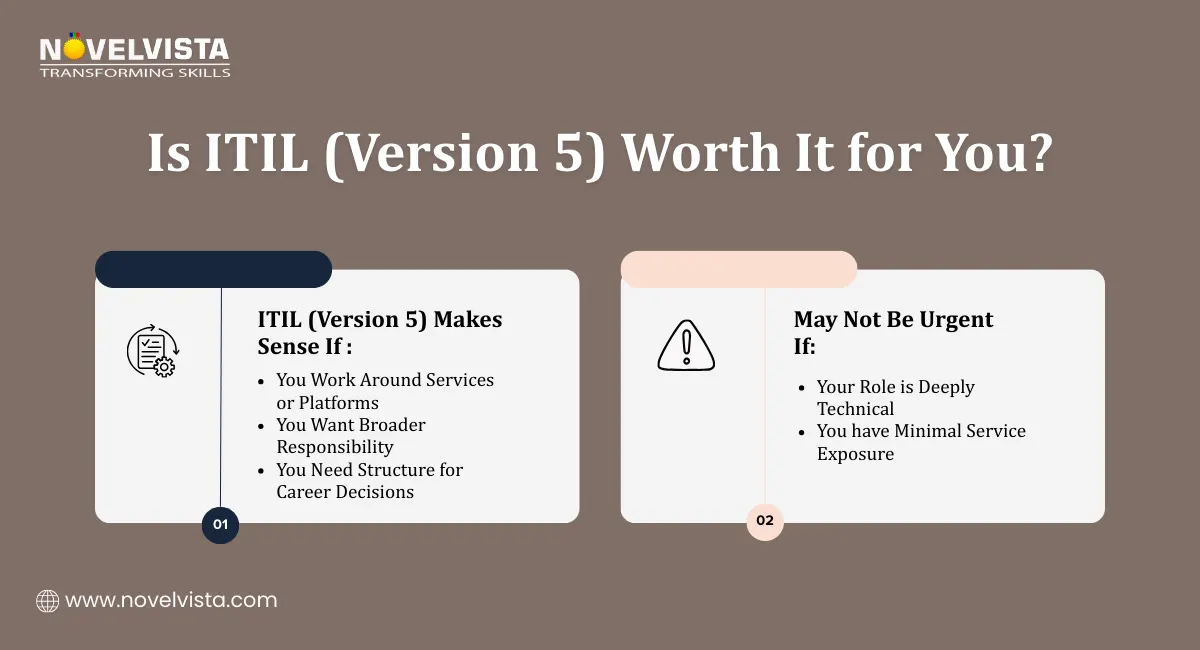
ITIL (Version 5) makes sense if:

  • Your role touches services, platforms, or delivery
  • You want to move beyond task-focused work
  • You need structure to support career decisions

It may not be urgent if:

  • Your role is purely technical
  • You have limited exposure to service coordinationIs ITIL (Version 5) Worth It for You?

The value of ITIL (Version 5) comes from using it as a career tool, not collecting it as a badge.
Maximize your ITIL (Version 5) Certification benefits by following our ITIL (Version 5) Certification Path to get mastery over ITSM

Conclusion: Why Choose ITIL (Version 5) Certification

ITIL (Version 5) is not about chasing the latest version. It is about staying relevant as roles, expectations, and delivery models continue to evolve.

For professionals working around services and products, ITIL (Version 5) benefits include clearer positioning, better alignment with real responsibilities, and long-term ITIL (Version 5) career opportunities. It builds on what you already know instead of asking you to start over.

Used thoughtfully, ITIL (Version 5) becomes a steady step forward, not a risky leap.

This blog provides a solid foundation for understanding the shift toward ITIL (Version 5). However, because it introduces a new evolution in service management, candidates often have specific logistical and strategic questions.

Your Next Step

If you’re considering ITIL (Version 5) as your next move, structured guidance can save you time and confusion. NovelVista’s ITIL Foundation (Version 5) certification training course is designed to translate the framework into practical understanding, not just exam readiness. The course focuses on role relevance, real service scenarios, and clear explanations, helping you build confidence in how ITIL (Version 5) applies to your work today and supports your long-term career direction.

Choose ITIL (version 5) Certification

Frequently Asked Questions

ITIL (Version 5) does not invalidate previous certifications but builds upon them. It refines the practices you have already learned to better align with modern, cross-functional team structures and digital outcomes.

While ITIL 4 introduced the Service Value System, ITIL (Version 5) focuses more on role-based applications. It reduces theoretical complexity to help professionals apply service management directly within their specific job responsibilities.

Typically, PeopleCert provides transition paths or bridge modules for high-level certificate holders. You should check the current official guidance to see if your specific credits allow for an accelerated upgrade path.

Yes, ITIL (Version 5) is specifically designed to coexist with fast-paced methodologies. It emphasizes fluid coordination and value streams, ensuring that service management supports speed rather than acting as a bureaucratic bottleneck.

The modules focusing on service ownership and end-to-end value delivery are most beneficial. These tracks provide the structural tools needed to manage outcomes and stakeholder expectations rather than just technical metrics.

No certification guarantees a raise, but ITIL (Version 5) increases your eligibility for higher-paying leadership roles. It acts as a signal to employers that you can manage the complexity of modern services.

Most candidates can complete the training and pass the exam within two to five days of dedicated study, depending on their existing familiarity with service management principles and previous versions.

You can certainly start with the ITIL Foundation (Version 5). It is designed to be accessible for newcomers while providing a more practical starting point than the academic approach of older versions.

Author Details

Mr.Vikas Sharma

Mr.Vikas Sharma

Principal Consultant

I am an Accredited ITIL, ITIL 4, ITIL 4 DITS, ITIL® 4 Strategic Leader, Certified SAFe Practice Consultant , SIAM Professional, PRINCE2 AGILE, Six Sigma Black Belt Trainer with more than 20 years of Industry experience. Working as SIAM consultant managing end-to-end accountability for the performance and delivery of IT services to the users and coordinating delivery, integration, and interoperability across multiple services and suppliers. Trained more than 10000+ participants under various ITSM, Agile & Project Management frameworks like ITIL, SAFe, SIAM, VeriSM, and PRINCE2, Scrum, DevOps, Cloud, etc.

Confused About Certification?

Get Free Consultation Call

Sign Up To Get Latest Updates on Our Blogs

Stay ahead of the curve by tapping into the latest emerging trends and transforming your subscription into a powerful resource. Maximize every feature, unlock exclusive benefits, and ensure you're always one step ahead in your journey to success.
Topic Related Blogs
 
Why Choose ITIL (Version 5) Certification? Jobs, Roles & Salary