Category | DevOps
Last Updated On 25/08/2026
Modern applications are expected to be available almost all the time. Users want fast responses, reliable transactions, seamless logins, and services that keep working even when something goes wrong behind the scenes.
But here is the difficult question: how do engineering teams keep software reliable while still releasing new features quickly?
A team can monitor servers. It can create alerts. It can hire operations engineers. It can automate deployments. Yet, if reliability is treated as something that is checked only after a failure, problems will continue to repeat.
This is where SRE, or Site Reliability Engineering, comes in.
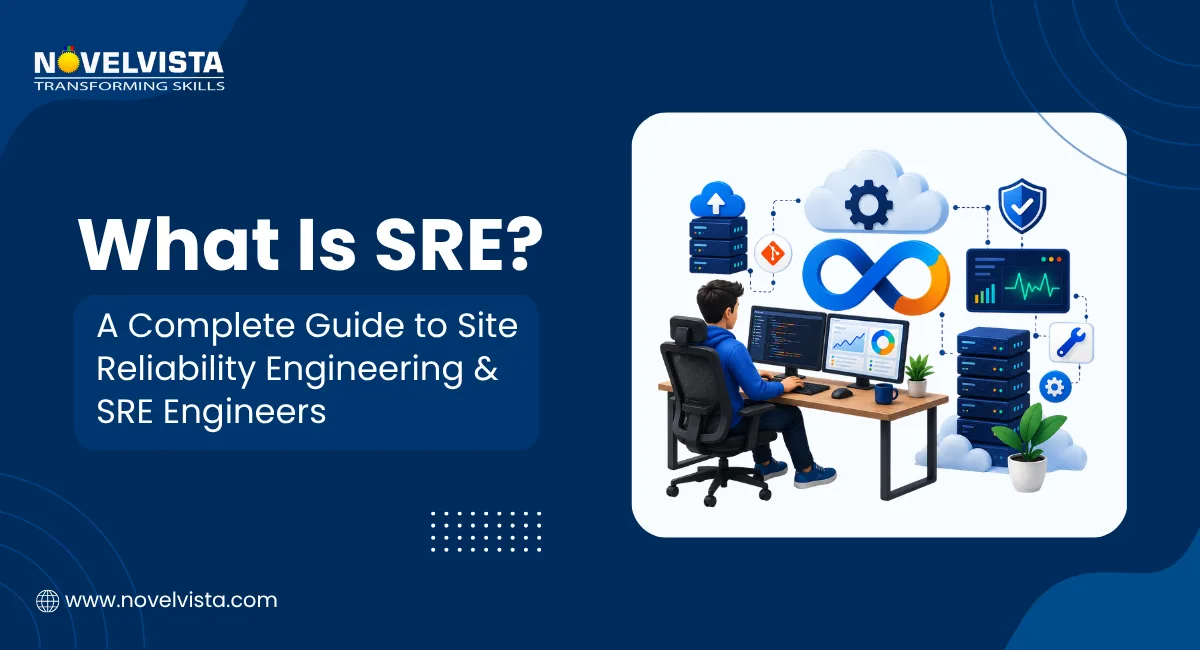
So, what is SRE exactly? In simple terms, SRE is an engineering approach to operating reliable software systems. It combines software engineering, automation, monitoring, incident management, and measurable reliability objectives to keep production systems dependable while allowing development teams to move quickly.
Google describes SREs as engineers who apply computer science and engineering principles to computing systems, particularly large and distributed systems.
Interestingly, SRE does not aim for perfect reliability at any cost. Google explicitly notes that 100% reliability is generally the wrong target because the final fraction of availability can require disproportionate effort while providing little additional user value.
That idea is central to understanding what is SRE and why organizations increasingly use it.
What is SRE? Site Reliability Engineering is a discipline that uses software engineering practices to solve operational and reliability problems.
Instead of relying heavily on manual operations, SRE teams automate repetitive work, establish measurable service objectives, monitor production systems, manage incidents, and continuously improve system resilience.
The basic idea is simple:
Build reliable systems through engineering rather than relying on manual intervention.
SRE originated at Google and has since become an important approach for organizations operating cloud applications, distributed systems, SaaS platforms, APIs, microservices, and other business-critical digital services.
The Google SRE model focuses on several foundational practices, including SLOs, monitoring, alerting, reducing toil, simplicity, incident response, and continuous improvement.
What is SRE Engineering? It is the practical application of Site Reliability Engineering principles to software systems.
An SRE engineer may write automation scripts, improve deployment processes, design monitoring systems, investigate production incidents, build resilient infrastructure, or work with developers to make applications easier to operate.
The important distinction is that SRE is not simply "operations with a different name." It applies engineering thinking to operational challenges.
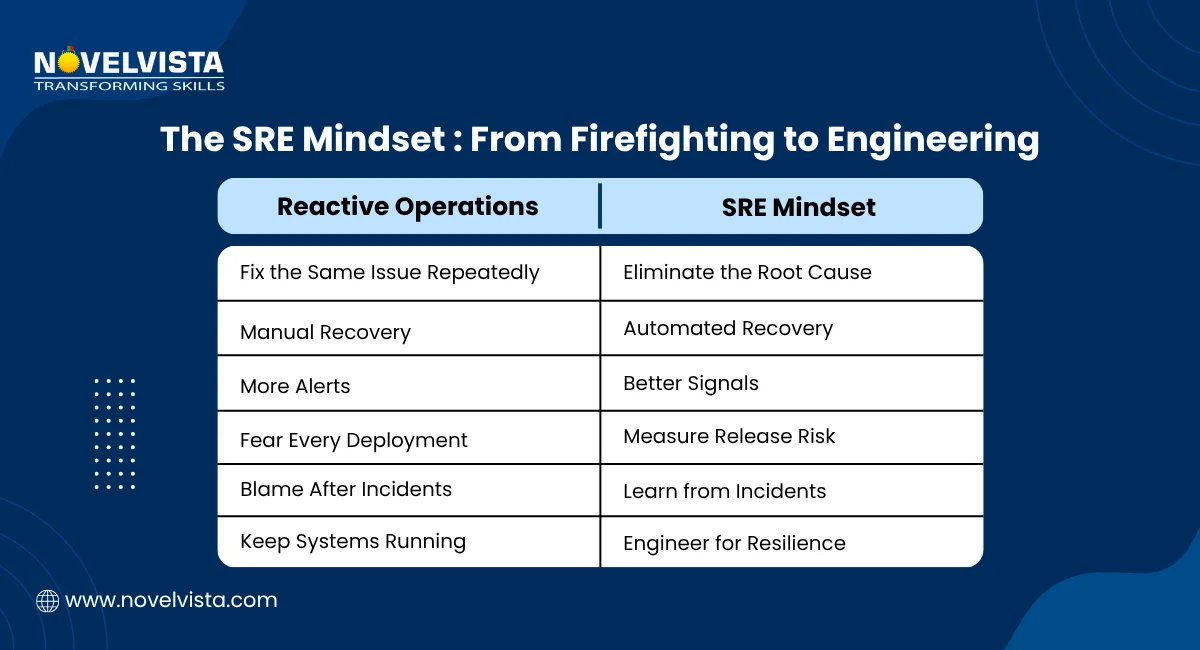
For example, instead of repeatedly fixing the same production issue manually, an SRE engineer asks:
This approach turns recurring operational problems into engineering opportunities. This shift in thinking is at the heart of successful SRE adoption. Instead of treating reliability as a checklist of operational tasks, teams need to develop an engineering mindset that prioritizes automation, resilience, continuous improvement, and learning from failure. To explore this approach in more detail, read our guide on The SRE Mindset
What is Site Reliability Engineering SRE from a business perspective?
It is a way to balance two goals that often compete with each other:
Development teams want to release new features. Reliability teams want to reduce risk and production failures. Without a common framework, these priorities can easily conflict.
SRE introduces measurable reliability targets and error budgets to create a data-driven balance.
Google explains that error budgets help resolve the tension between development velocity and service stability. When the service remains within its reliability target, teams can continue releasing changes. When the error budget is exhausted, the focus shifts toward improving reliability.
Area | Traditional Approach | SRE Approach |
Reliability | Often treated as an operational responsibility | Shared engineering responsibility |
Monitoring | Infrastructure-focused | User and service focused |
Incidents | Fix the immediate problem | Fix, learn, and prevent recurrence |
Automation | Helpful but optional | Core engineering practice |
Releases | Based mainly on schedules | Balanced against reliability |
Failure | Something to avoid at all costs | Something to measure and learn from |
Operations | Manual intervention | Automation and engineering |
This is why what is SRE cannot be answered simply as "a role that maintains servers." SRE represents a broader engineering philosophy.
So, what is an SRE in practical terms?
An SRE, or Site Reliability Engineer, is an engineer responsible for improving the reliability, availability, performance, and operational efficiency of software services.
The exact responsibilities depend on the organization, but common SRE responsibilities include:
An SRE therefore needs both software engineering skills and operations knowledge.
Common technical areas include Linux, networking, cloud platforms, scripting, programming, containers, Kubernetes, CI/CD, observability, databases, infrastructure as code, and distributed systems.
However, technical knowledge alone is not enough. SRE engineers also need strong problem-solving, communication, incident management, and analytical skills.
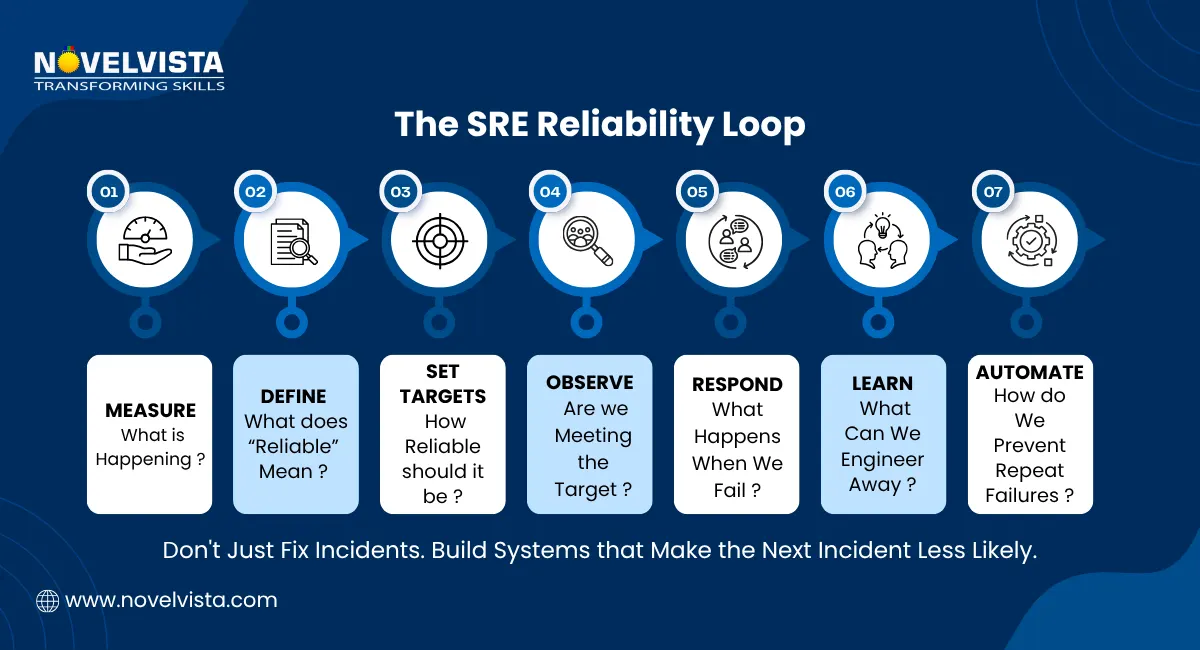
Understanding what is SRE becomes much easier when you look at the typical SRE feedback loop.
The first step is determining what reliability means for users.
For one application, reliability might mean successful transactions. For another, it could mean fast API responses or accurate search results.
SRE does not simply measure whether a server is running. It asks whether the service is delivering the experience users expect.
A Service Level Indicator (SLI) is a quantitative measurement of service performance.
Common SLIs include:
Google recommends defining SLIs around outcomes that matter to users rather than relying solely on infrastructure metrics.
A Service Level Objective (SLO) defines the target for an SLI.
For example:
99.9% of API requests should complete successfully within the defined measurement period.
The SLO provides a measurable reliability target.
An error budget represents the amount of unreliability a service can tolerate while still meeting its SLO.
If a service has a 99.9% availability SLO, its error budget is 0.1%.
For one million requests, that could mean up to 1,000 failed requests within the measurement period before the budget is exhausted. Google uses this model to connect reliability decisions with release velocity.
Monitoring provides visibility into system behavior.
But SRE is not about creating thousands of alerts.
Effective alerting should help engineers identify meaningful conditions that require action. Google recommends thinking about monitoring outputs in terms of pages, tickets, and logs, depending on the urgency of the required response.
When something goes wrong, SRE teams investigate, mitigate, restore service, and document what happened.
The goal is not simply to get the application working again.
The larger goal is to understand why the failure occurred and how similar failures can be prevented.
Incident reviews and postmortems help identify weaknesses in architecture, processes, monitoring, deployment, or automation.
This creates a continuous improvement cycle. This feedback loop is supported by several core practices that help organizations build reliability into their systems rather than treating it as an afterthought. Understanding these foundational areas can make it easier to see how SRE works across development, operations, monitoring, and incident management. For a deeper breakdown, explore the 5 Pillars of SRE
A common question after learning what is SRE is whether SRE and DevOps are actually the same thing.
They are closely related, but they are not identical.
DevOps is a broader culture and set of practices designed to improve collaboration between development and operations while enabling faster and more reliable software delivery.
SRE provides a more specific engineering approach for achieving reliability.
DevOps | SRE |
Broad organizational philosophy | Specific engineering discipline |
Focuses on collaboration and delivery | Focuses heavily on reliability and operations |
Encourages automation | Uses automation to reduce toil |
Promotes CI/CD | Measures release risk through reliability objectives |
Encourages shared responsibility | Uses SLOs and error budgets to operationalize reliability |
In practice, organizations can use both DevOps and SRE together.
What is SRE Engineer work actually like day to day?
There is no single routine because SRE teams operate across different environments. However, a typical SRE engineer may spend time on:
Engineering:
Writing automation, improving infrastructure, developing internal tools, and removing repetitive manual work.
Observability:
Building dashboards, monitoring SLIs, analyzing latency, error rates, and system behavior.
Incident response:
Investigating outages, coordinating recovery, and identifying technical causes.
Reliability improvements:
Improving redundancy, scalability, deployment safety, fault tolerance, and recovery mechanisms.
Collaboration:
Working with developers, architects, security teams, product managers, and infrastructure teams.
A useful principle is that SRE engineers should spend less time performing repetitive manual tasks and more time engineering systems that eliminate those tasks.
Modern businesses increasingly depend on digital services. A payment failure, unavailable API, slow application, or broken authentication flow can directly affect customers and revenue.
SRE helps organizations approach these risks systematically.
The benefits include:
SRE also changes how organizations think about failure.
Instead of asking, "How do we make sure nothing ever fails?" the better question becomes:
"What level of failure can our users tolerate, and how should we respond when we exceed it?"
That shift is one of the most important principles behind Site Reliability Engineering.
If you are learning what is SRE, understanding its terminology is essential.
Term | Meaning |
SLI | Measurement of a service's performance |
SLO | Target level of service reliability |
SLA | Formal service commitment, often involving customers |
Error Budget | Allowed amount of unreliability |
Toil | Repetitive operational work that can often be automated |
MTTR | Mean Time to Recovery/Repair |
Availability | Percentage of time or requests a service is usable |
Latency | Time required to process a request |
Incident | An event that negatively affects service reliability |
These metrics allow teams to move from vague statements such as "the system seems reliable" to measurable engineering objectives.
A successful SRE Engineer typically combines several technical and professional capabilities.
An SRE should also understand:
Incident response often requires communication under pressure. Therefore, collaboration, documentation, decision-making, and clear communication are equally important.
Organizations do not need to transform everything overnight.
A practical starting point is:
Google's SRE guidance emphasizes that SLOs should be agreed upon by relevant stakeholders and actually used for decision-making rather than becoming another reporting KPI.
This is an important distinction. Measuring reliability is not the same as engineering for reliability.
As organizations adopt cloud-native architectures, microservices, Kubernetes, distributed applications, and AI-powered systems, reliability engineering is becoming increasingly complex.
SRE practices are also expanding beyond traditional infrastructure.
Modern reliability teams increasingly need to consider:
The core principle, however, remains the same: use engineering, automation, measurement, and learning to build dependable services.
So, what is SRE?
Site Reliability Engineering is an engineering discipline that brings software development principles into production operations. It helps organizations measure reliability, automate operational work, manage incidents, reduce toil, and balance system stability with development velocity.
An SRE engineer is not simply responsible for keeping servers online. The role is about building systems and processes that make reliability measurable, repeatable, scalable, and continuously improvable.

For professionals looking to build practical skills in reliability engineering, the SRE Foundation Training & Certification from NovelVista can be a useful next step for developing a structured understanding of SRE principles and practices.
For organizations running critical digital services, SRE provides a practical answer to a difficult challenge: How do you move fast without breaking the experience your customers depend on?
That is ultimately what makes Site Reliability Engineering SRE valuable in modern software engineering.
What is SRE? It is an engineering approach that helps teams build and operate reliable software systems through automation, monitoring, measurable objectives, and continuous improvement.
An SRE engineer is a professional who focuses on software reliability, availability, performance, automation, monitoring, and production operations.
What is SRE Engineering? It means applying software engineering techniques to operational and reliability challenges, including automation, incident management, observability, and scalability.
Site Reliability Engineering SRE is used to improve service reliability while allowing development teams to release software efficiently and safely.
SRE is a specific engineering discipline focused heavily on reliability, while DevOps is a broader approach to collaboration, automation, and software delivery. Organizations can use both together.
Author Details

Confused About Certification?
Get Free Consultation Call
Stay ahead of the curve by tapping into the latest emerging trends and transforming your subscription into a powerful resource. Maximize every feature, unlock exclusive benefits, and ensure you're always one step ahead in your journey to success.