- SRE Architect Job Description Explained
- SRE Architect Roles and Responsibilities
- Essential Skills Required for an SRE Architect
- SRE Architect Salary and Market Demand
- SRE vs Cloud Architect: Full Comparison
- Career Path: How to Become an SRE Architect
- Future Trends and Challenges for SRE Architects
- Conclusion: Is the SRE Architect Role Right for You?
Let’s start with something simple. Think about the number of outages, performance drops, or scaling issues teams try to fix after the damage is already done. Now picture someone who designs systems that avoid those problems in the first place. That’s where the sre architect steps in.
The sre architect is the senior brain behind reliable, scalable, and smooth-running production systems. Their job is to keep things working even when traffic spikes, something breaks, or a new feature rolls out. This blog will walk you through what the job really involves, the skills you need, how it differs from cloud roles, the growth path, and what the market pays.
SRE Architect Job Description Explained
A solid sre architect job description is all about building systems that stay healthy even when the unexpected happens. Here’s what this role usually covers:
- Designs complete reliability systems: They create the blueprint for reliability by planning how services should behave under load, during failures, and while scaling. Their design sets the foundation for uptime and smooth performance.
- Builds high-performing and secure environments: They plan how production systems should be deployed, secured, and optimized so applications run safely and smoothly in real-world conditions.
- Works across teams to improve engineering standards: They guide developers, DevOps, and SRE teams, helping them follow patterns that increase stability and reduce operational stress.
This part of the sre architect job description shows how much ownership the role carries.
SRE Architect Roles and Responsibilities
When talking about sre architect roles and responsibilities, the work goes far beyond responding to incidents. They are responsible for designing how the entire system behaves. Here are the main areas:
- Building and defining SLIs and SLOs: They decide which service indicators matter, how to measure them, and where to set targets that balance speed and stability for reliable operations.
- Driving automation across operations: They remove manual work by automating deployment, monitoring, rollbacks, alerts, and scaling, so teams spend less time fighting fires and more time improving systems.
- Strengthening observability: They put the right logs, traces, metrics, and dashboards in place so problems can be spotted early and understood quickly when they occur.
- Managing incidents and performance improvements: They oversee how incidents are handled, how services recover, and how long-term fixes are implemented to prevent the same issue from returning.
- Leading reliability strategy: They guide teams on how to design services that grow without breaking, ensuring reliability is part of every major technical decision.
These items capture the heart of sre architect roles and responsibilities and show why the position demands deep technical experience.
Am I Ready for an SRE Career?
Check your readiness for an SRE role in minutes.
Assess your skills in monitoring, automation, cloud, CI/CD,
and incident response with total clarity.
Essential Skills Required for an SRE Architect
To succeed as a sre architect, a strong mix of technical and strategic skills is needed. Here are the most important ones:
- Programming skills (Python, Go): Helps build tools, automation, and custom scripts for reliability tasks like health checks, error tracking, and automated fixes without manual involvement.
- Containerization and orchestration (Kubernetes, Docker): Used to design scalable and stable environments where services can recover fast and scale automatically when demand increases.
- Infrastructure as Code tools (Terraform, Ansible): Ensures complete environments can be created and updated safely, making infrastructure changes predictable and easy to review.
- Cloud platforms (AWS, GCP, Azure): Understanding cloud services, networking, and scaling patterns helps build systems that run reliably across huge distributed environments.
- Monitoring and observability (Prometheus, Grafana): These tools help track system health, spot issues early, and make data-driven decisions about performance and reliability.
- CI/CD pipelines (Jenkins, GitHub Actions, GitLab CI): Allows stable and automated delivery of features, reducing deployment risks and speeding up safe releases.
- Networking and security fundamentals: Helps design systems that are safe, fast, and compliant with the required standards without increasing operational load.
- Chaos engineering and fault tolerance: Encourages testing failure scenarios in controlled ways to strengthen systems and make them more resilient over time.
These skills together create a strong technical backbone for anyone aiming to grow into a senior sre architect role.
SRE Architect Salary and Market Demand

Let’s talk about numbers, because the SRE Architect salary is one of the biggest reasons this role is in such high demand. With organizations running massive distributed systems, companies pay premium salaries to professionals who can keep everything fast, stable, and scalable.
SRE Architect Salary: Top Countries (Annual Averages)
Country |
Average Salary (Local Currency) |
Equivalent in INR |
United States |
USD $150,000 – $220,000 |
₹1.27 – 1.86 crore |
United Kingdom |
GBP £70,000 – £100,000 |
₹75 – 108 lakh |
Germany |
EUR €90,000 – €130,000 |
₹82 – 118 lakh |
Australia |
AUD $150,000 – $200,000 |
₹86 – 114 lakh |
Canada |
CAD $120,000 – $160,000 |
₹75 – 100 lakh |
India |
INR ₹40 – 80 lakh |
INR ₹40 – 80 lakh |
Note: Salaries may go higher for cloud-native companies, product giants, and SRE-heavy environments.
Salary data comes from Payscale. Our trainers also share live market feedback, confirming the strong demand and competitive salaries for SRE architects with cloud, automation, and leadership skills.
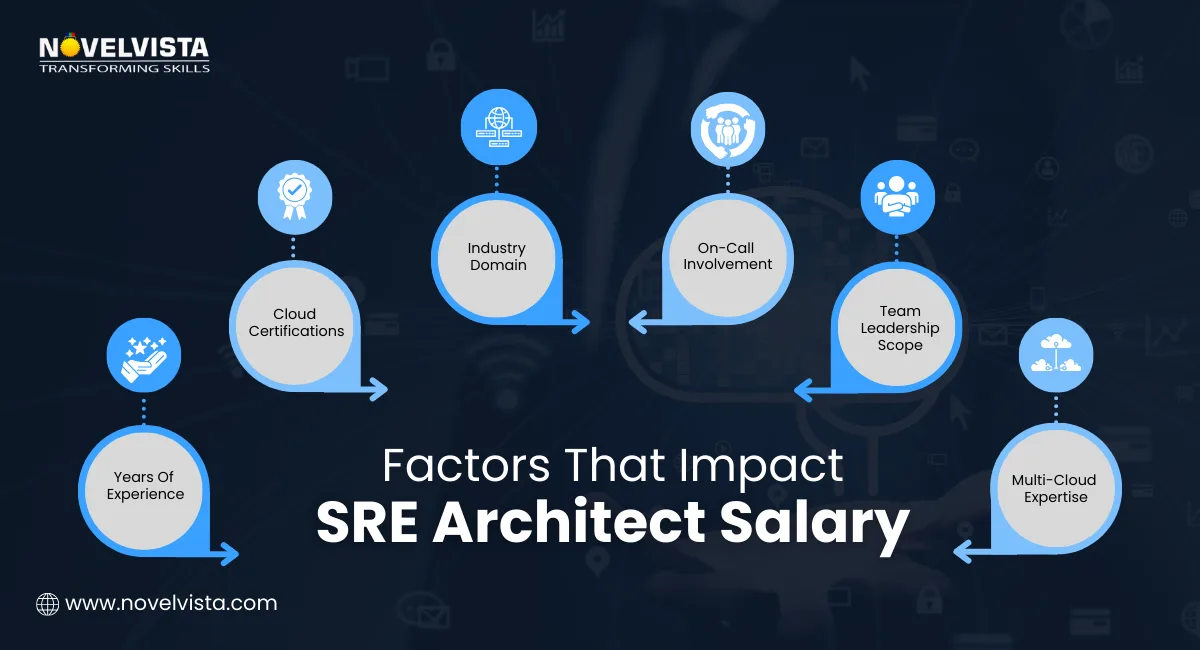
Factors That Increase SRE Architect Salary
Several skills can push your salary into the top bracket:
- Strong cloud expertise (AWS, Azure, GCP)
- Kubernetes and container orchestration mastery
- Automation, scripting, and reliability engineering experience
- Hands-on work with large-scale, distributed systems
- Certifications from recognized bodies like GSDC
- Ability to lead SRE teams and define reliability strategies
The demand keeps rising because companies want fewer outages, smoother deployments, faster recovery, and systems that scale without surprises.
Curious about what SRE engineers earn across different regions and skill levels? Take a look at our detailed guide on SRE Engineer Salary to see real numbers, trends, and factors that influence pay.
SRE vs Cloud Architect: Full Comparison
Key Area |
SRE Architect |
Cloud Architect |
Primary Focus |
Prioritize reliability of systems |
Focus on cloud strategy, design, and architecture |
Metrics & KPIs |
SLIs, SLOs, error budgets |
Usage, cost, architecture health |
Tools Used |
Observability, automation, performance monitoring |
Cloud-native services, architecture design tools |
Daily Tasks |
Improve uptime, optimize operations |
Build cloud structures, migration planning |
Team Involvement |
Work closely with engineering teams |
Align with leadership and cloud operations teams |
Reliability Ownership |
Responsible for system reliability |
Ensures design soundness |
Cloud Strategy Depth |
Moderate focus on cloud practices |
Deep involvement in multi-cloud strategy |
Cost Optimization |
Focus on resource efficiency |
Drive budgeting and cost optimization efforts |
Incident Handling |
Respond to incidents, guide recovery |
Provide architectural guidance during incidents |
On-Call Work |
Active participant in on-call rotations |
Less involvement in on-call duties |
This comparison reflects insights from real-world SRE and cloud teams we’ve trained. Understanding the differences helps professionals focus on reliability engineering rather than cloud design alone, supporting more strategic career planning.
Career Path: How to Become an SRE Architect
The journey to becoming a sre architect often starts in DevOps, SRE, or cloud engineering roles. Here's a step-by-step path:
- Start in DevOps or SRE roles: Gain hands-on experience with automation, monitoring, incident management, and cloud deployments. Understanding operational challenges is key.
- Focus on reliability engineering skills: Build expertise in SLIs, SLOs, error budgets, chaos engineering, and observability. These are the foundations of every SRE architect role.
- Get certified: Certifications like SRE Practitioner Certification and cloud architecture certificates (AWS Certification Solution Architect) strengthen your profile and marketability.
- Gain exposure to large-scale systems: Work on complex production environments to understand performance, scaling, and reliability requirements.
- Step into architecture and leadership: Lead reliability initiatives, mentor junior engineers, and design system-level reliability strategies. These experiences make you ready for a full sre architect role.
Future Trends and Challenges for SRE Architects

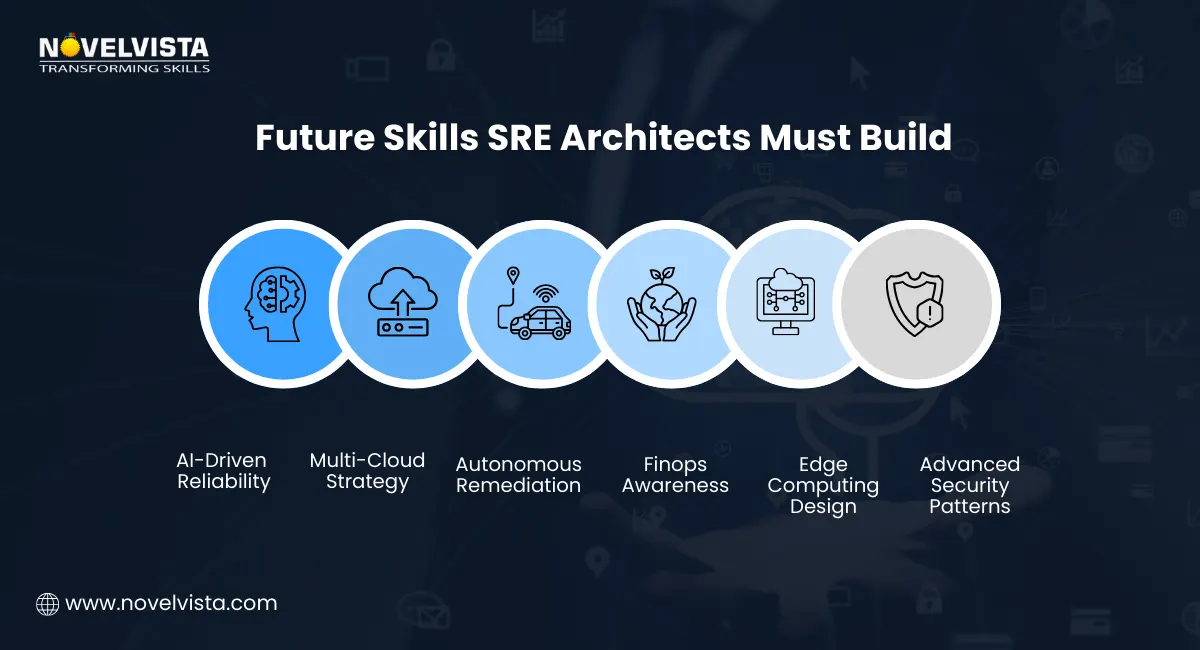
The world of SRE is evolving fast. Professionals need to be aware of upcoming trends:
- SRE market growth: The global SRE market is expanding rapidly, estimated at $5.5 billion in 2025, with projections reaching $15 billion and a CAGR of 18–23% through 2033. Organizations are investing heavily in reliability engineering to support complex IT infrastructures and scalable digital services. (Source: Data Insight Market)
- Toil and workload challenges: SREs spent a median of 30% of their time on toil in 2024, marking the first increase in five years. Despite AI expectations, repetitive work persists due to platform engineering gaps, highlighting the ongoing need for efficiency improvements. (Source: Business Wire)
- Performance and reliability focus: Over half of organizations (53%) now consider poor performance as damaging as downtime. SRE architects are shifting focus toward user experience, adopting SLO-based reliability metrics alongside traditional outage measures. (Source: Business Wire)
- Emerging future trends: AI/ML adoption is surging for predictive analytics, anomaly detection, and incident automation. SRE architects also navigate multi-cloud strategies, chaos engineering for resilience, Shift Left practices, and advanced observability in cloud-native environments.
These trends are drawn from industry reports, cloud provider roadmaps, and insights from global SRE communities. Awareness of AI/ML reliability, multi-cloud complexity, and automation adoption equips architects to remain ahead in a rapidly evolving field.
Conclusion: Is the SRE Architect Role Right for You?
The sre architect role is perfect for professionals who enjoy designing systems that just work, even under pressure. It combines hands-on technical skills, strategic thinking, and leadership. The position offers high sre architect salary potential, exciting growth paths, and the chance to influence cloud-native and DevOps-driven organizations. If you love reliability, automation, and building scalable systems, this role is worth aiming for.
All insights shared here come from a combination of verified industry data, certified training programs, and our practical experience mentoring SRE professionals. Following these guidelines ensures learners gain skills that are relevant, actionable, and aligned with modern reliability engineering practices.
Next Step
Ready to level up your SRE skills and career? NovelVista’s SRE Foundation Certification Training Course and it’s further step, that is SRE Practitioner Certification Training Course equips you with hands-on knowledge in automation, observability, CI/CD, and reliability engineering. Learn how to design scalable, fault-tolerant systems and gain practical expertise that complements your SRE or cloud experience. This training helps you step confidently into roles like SRE Architect and handle real-world reliability challenges with efficiency and skill.

Frequently Asked Questions
Author Details
Mr.Vikas Sharma
Principal Consultant
I am an Accredited ITIL, ITIL 4, ITIL 4 DITS, ITIL® 4 Strategic Leader, Certified SAFe Practice Consultant , SIAM Professional, PRINCE2 AGILE, Six Sigma Black Belt Trainer with more than 20 years of Industry experience. Working as SIAM consultant managing end-to-end accountability for the performance and delivery of IT services to the users and coordinating delivery, integration, and interoperability across multiple services and suppliers. Trained more than 10000+ participants under various ITSM, Agile & Project Management frameworks like ITIL, SAFe, SIAM, VeriSM, and PRINCE2, Scrum, DevOps, Cloud, etc.
Confused About Certification?
Get Free Consultation Call