Category | DevOps
Last Updated On 19/02/2026
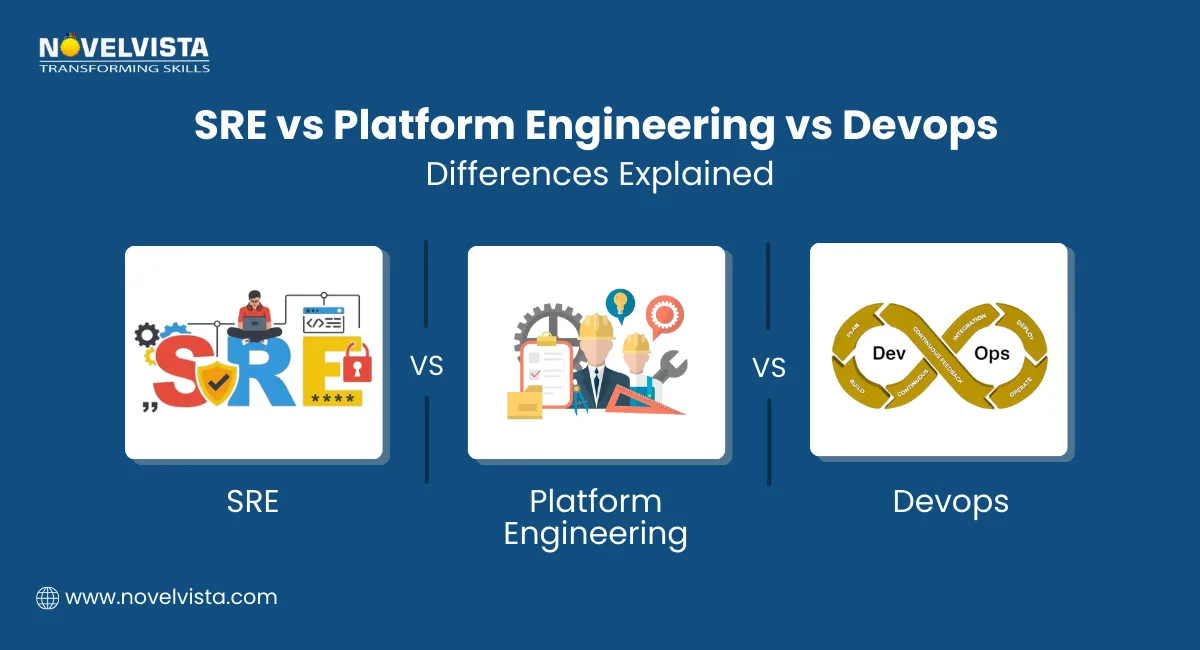
Every tech team wants to move faster without watching their systems fall apart under pressure. Yet the more tools they add and the more deadlines they chase, the harder it gets to understand who’s actually responsible for what. One person says, “we need DevOps,” another says, “we should follow SRE,” and someone else suggests, “let’s build a platform team.” The result? Confusion, overlapping efforts, and workflows that feel heavier instead of simpler.
This blog clears that fog. You’ll get a clear, practical breakdown of Platform Engineering, DevOps, and SRE—what each one does, how they fit together, and why teams often mix them up. No jargon, no textbook definitions. Just a straightforward guide that helps you see how these three approaches shape speed, reliability, and scalability in real teams.
Platform engineering is all about building the foundation that developers rely on. Think of it as creating a self-service internal platform where teams can deploy code, manage infrastructure, and access tools without friction. The main idea is to empower developers by providing standardized, automated workflows, so they can focus on writing code instead of managing environments.
Platform engineering is often the backbone that makes DevOps at scale possible, giving organizations the tools they need to accelerate software delivery.
DevOps is more of a culture and methodology than a specific toolset. It breaks down the silos between development and operations teams, fostering collaboration throughout the software lifecycle. DevOps focuses on creating an environment where code moves to production faster and more safely.
When comparing DevOps vs Platform Engineering vs SRE, DevOps sets the stage. It’s the cultural glue that ensures teams work together effectively.
SRE applies software engineering principles to operations. Its focus is reliability: uptime, performance, and resilience. SRE takes operational tasks, automates them, and ensures systems remain stable even under high demand.
When thinking about Platform Engineering vs SRE vs DevOps, SRE is the operational safety net. While DevOps accelerates delivery and Platform Engineering empowers developers, SRE guarantees that systems stay reliable.
Quickly compare roles, skills, and career growth paths,
so you can choose the right one for your future.
Understanding the distinctions can be tricky, but here’s a simple breakdown:
Aspect |
Platform Engineering |
DevOps |
SRE |
Primary Focus |
Build internal platforms, enable self-service, reduce developer friction |
Streamline collaboration between Dev + Ops for faster delivery |
Maintain reliability, uptime, and performance |
Core Goal |
Developer empowerment, consistency, and scalable environments |
Faster releases with automation and shared ownership |
Reliable, resilient, and predictable systems |
Scope |
Tooling, automation frameworks, internal platforms |
Culture, processes, automation across the lifecycle |
Reliability engineering, incident response, risk management |
Key Practices |
IDPs, platform APIs, IaC, automated workflows |
CI/CD, IaC, collaboration models, and monitoring |
SLOs/SLIs, error budgets, incident runbooks, post-mortems |
Typical Responsibilities |
Build and maintain developer platforms, standardize infra, and reduce cognitive load |
Improve delivery pipelines, enable automation, break team silos |
Ensure service reliability, manage incidents, automate ops |
Team Nature |
Enablement team providing shared services |
Cross-functional cultural approach |
Specialized engineering team within operations |
Tools Commonly Used |
Backstage, Terraform, Kubernetes, Crossplane |
Jenkins, GitLab CI, Docker, Ansible, Prometheus |
Grafana, PagerDuty, Sentry, and Chaos Engineering tools |
Skill Set Required |
Infra design, automation, platform architecture, APIs |
CI/CD, scripting, automation, collaboration, cloud skills |
Reliability engineering, monitoring, chaos testing, automation |
Where It Fits |
Large teams with multiple development groups; scaling organizations |
Any team modernizing delivery pipelines |
High-traffic, production-critical systems needing reliability |
Strengths |
Reduces friction, standardizes workflows, and improves scalabilit |
Accelerates delivery, improves efficiency, brings dev + ops together |
Ensures uptime, reduces failure impact, and strengthens resilience |
Challenges |
High upfront investment; needs strong architecture |
Cultural resistance requires a mindset shift |
Balancing innovation vs reliability requires deep expertise |
Outcome |
Faster onboarding + consistent environments |
Faster deployment + better collaboration |
Reliable services + predictable performance |
When it comes to SRE vs DevOps vs Platform Engineering, you can see the roles complement each other rather than compete. One ensures speed, one ensures reliability, and one provides the infrastructure to make both happen.
Different approaches rely on different toolsets to do their magic. Picking the right tools ensures teams can deliver, scale, and maintain systems effectively.
These tools let platform teams create self-service environments so developers don’t get blocked waiting for resources.
DevOps relies on these tools to streamline the lifecycle, ensuring code goes from development to production safely and quickly.
These tools aren’t picked by chance; they’re the same ones trusted by leading companies worldwide. For example, Spotify uses Backstage for its developer portal, Kubernetes is the go-to choice for managing workloads at scale, and many SRE teams depend on Grafana, Prometheus, and Chaos Engineering to test system resilience before issues affect users.
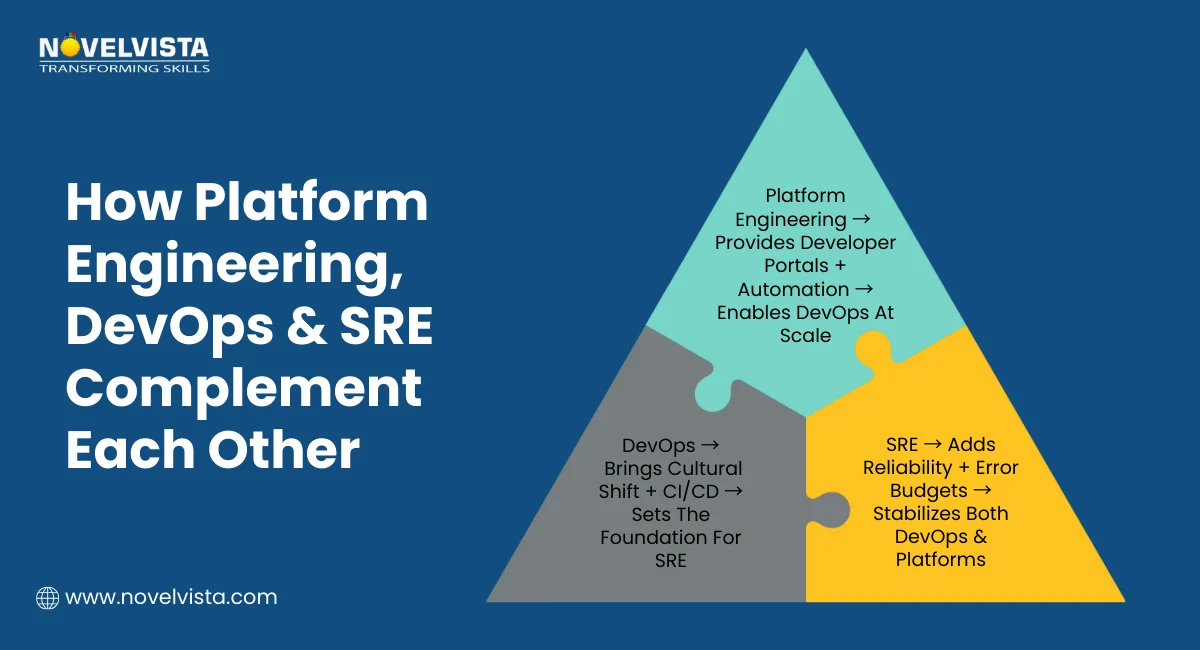
These three approaches are not competitors — they complement each other.
Example: A growing startup starts with a DevOps culture, adding CI/CD pipelines for faster releases. As the system grows, they hire SREs to monitor uptime and automate incident response. Once multiple teams scale, platform engineers build self-service internal platforms to streamline workflows, reducing friction and boosting developer productivity.
In essence, DevOps vs Platform engineering vs SRE is about collaboration, reliability, and enablement, all in one ecosystem.
For Platform Engineering vs DevOps vs SRE, the combination is powerful: speed from DevOps, reliability from SRE, and empowerment from Platform Engineering.
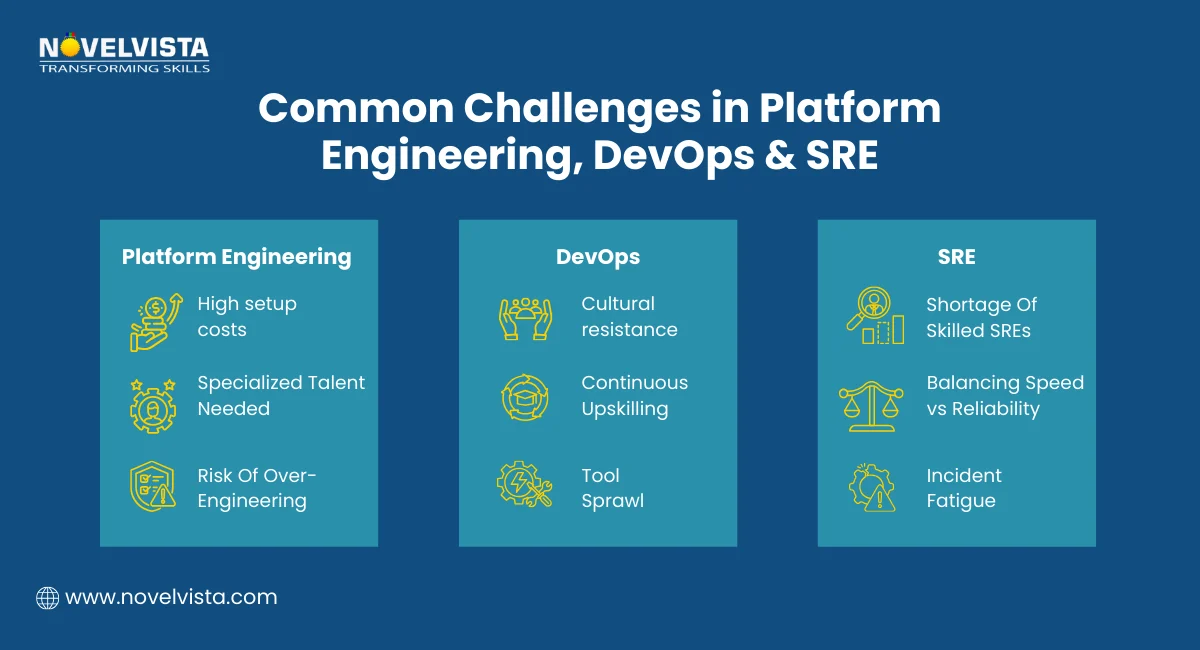
Knowing these challenges helps teams plan better and implement solutions successfully.
Building strong, scalable, and reliable systems isn’t about choosing between Platform Engineering, DevOps, and SRE; it’s about knowing how they fit together. Each brings its own strengths: DevOps speeds up delivery, SRE protects reliability, and Platform Engineering gives teams the tools to move without friction. When all three work in sync, organizations ship faster, recover quicker, and grow with confidence.
If you’re aiming to step into roles that shape modern engineering teams, now is the right time to level up. Strengthen your reliability and automation skills with NovelVista’s SRE Certification and position yourself as the expert who can keep systems running smoothly at scale.
Don’t just keep your IT systems running, master them. Enroll in NovelVista’s SRE Certification and gain practical expertise in system reliability, incident management, automation, and cloud operations. Transform into the IT professional every modern organization is looking for, stay ahead of industry trends, and become a driving force in the evolving world of IT. Secure your spot today and future-proof your career!

Author Details

Confused About Certification?
Get Free Consultation Call
Stay ahead of the curve by tapping into the latest emerging trends and transforming your subscription into a powerful resource. Maximize every feature, unlock exclusive benefits, and ensure you're always one step ahead in your journey to success.