Category | AI And ML
Last Updated On 15/07/2026
Artificial intelligence didn’t quietly evolve, it accelerated. In boardrooms, data centers, and product labs across the world, AI has moved from experimental pilots to mission-critical systems. Today, more than 77% of enterprises are actively using or evaluating AI, and the global market is projected to surpass $1.5 trillion by 2030. But the real disruption isn’t just scale- it’s capability.
We’re witnessing a shift from AI that responds to AI that acts.
Businesses are no longer satisfied with chatbots that generate answers or models that predict trends. They want systems that can interpret goals, design execution plans, integrate with enterprise tools, and deliver outcomes with minimal supervision. They want autonomy. And that’s exactly where agentic AI enters the conversation.
So the question isn’t just curiosity-driven anymore, it’s strategic: how does agentic AI work, and why are forward-thinking organizations investing in it now?
If you’re an IT leader looking to reduce operational friction, a developer building next-generation AI systems, or a business decision-maker evaluating intelligent automation at scale, this guide is for you. Understanding how agentic AI development does agentic AI work is quickly becoming a foundational requirement for digital transformation, operational resilience, and competitive advantage.
Let’s unpack it clearly, practically, and step by step.
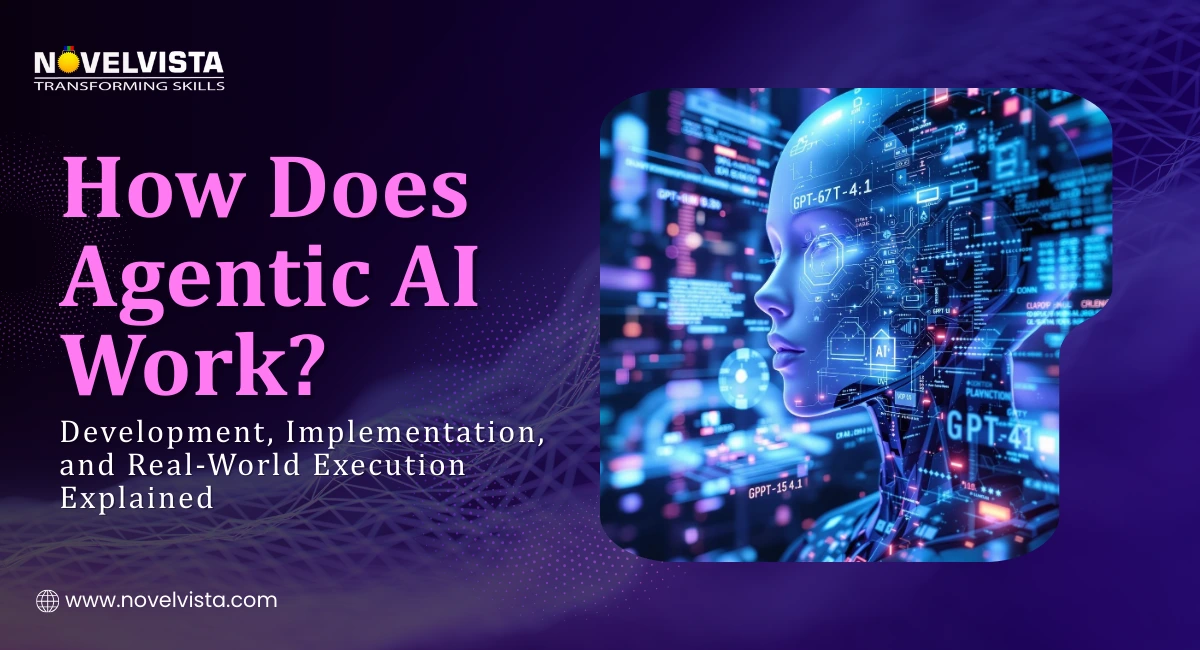
Before diving deep into how does agentic AI work, we must first answer: what is agentic AI and how does it work compared to traditional AI?
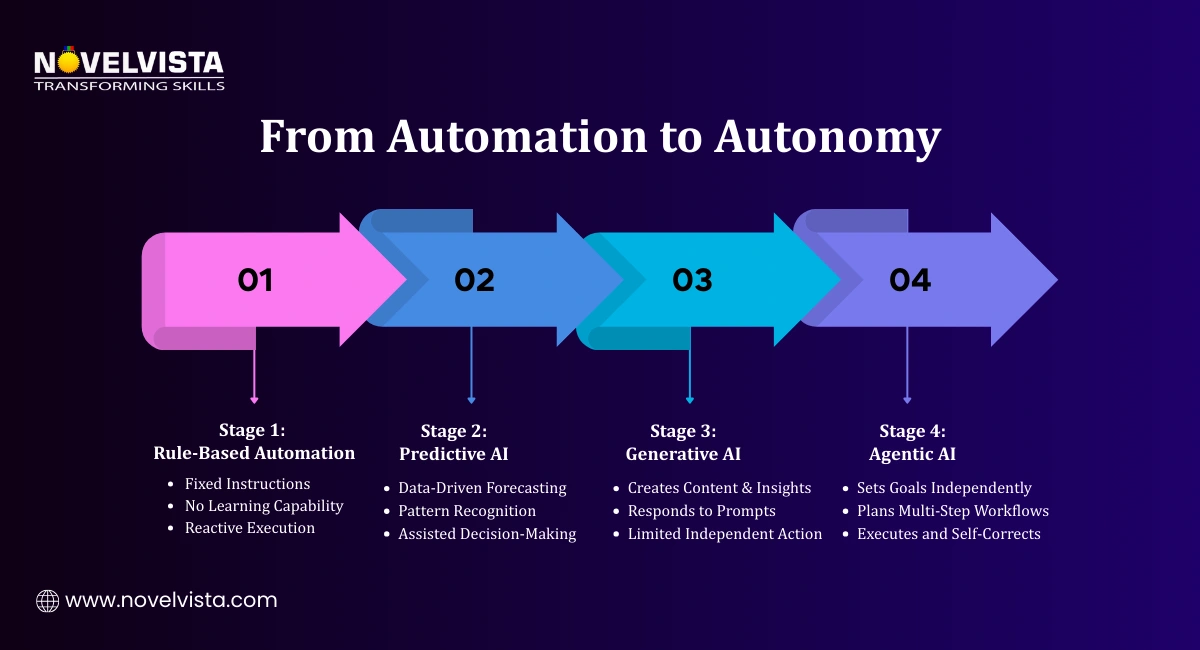
Traditional AI systems respond to inputs. Generative AI creates content based on prompts. But agentic AI goes further, it sets goals, plans actions, uses tools, adapts to feedback, and works toward outcomes autonomously.
Think of it this way:
Instead of just answering questions, what agentic AI systems can analyze a goal like “reduce cloud costs by 20%,” break it into tasks, gather data, execute optimizations, and continuously improve the results.
So when people ask, agentic AI how it works, the answer lies in autonomy, reasoning, and execution, not just response generation.
Now let’s directly address the central question: how does agentic AI work at a technical level?
At its core, agentic AI operates through five major components:
Every agent starts with an objective. This could be optimizing infrastructure, resolving IT tickets, or improving customer response time. The system translates high-level business goals into actionable subtasks.
Unlike simple AI models, agentic systems maintain short-term and long-term memory. This enables contextual understanding across tasks, improving decision accuracy.
A reasoning model creates structured action plans. It decides what to do first, which tools to use, and how to measure success.
Agentic AI doesn’t work in isolation. It connects with CRMs, cloud platforms, DevOps tools, databases, and enterprise software to execute tasks in real time.
After execution, the system evaluates outcomes against predefined goals, KPIs, or success criteria. It analyzes what worked, what didn’t, and identifies performance gaps using real-time data and contextual signals. If results fall short of expectations, the agent adjusts its strategy, updates its plan, and re-executes creating a continuous improvement cycle rather than a one-time action.
This structured cycle explains how agentic AI works in real-world enterprise environments.
A critical part of understanding how agentic AI works is examining the agentic AI decision-making process.
Here’s how it unfolds:
The AI collects data from various sources, such as logs, user input, APIs, and monitoring systems.
It analyzes context using large language models and logic frameworks.
The system creates a multi-step execution plan.
It interacts with connected tools and systems to implement decisions.
The AI evaluates results and adjusts strategy if needed.
This loop makes the agentic AI decision-making process dynamic rather than static. Unlike rule-based automation, it adapts continuously.
A step-by-step roadmap to design and deploy goal-driven AI systems
Practical frameworks for governance, scalability, and measurable ROI
Real-world implementation insights for IT leaders and AI professionals
Understanding agentic AI development is crucial for organizations planning adoption.
Start with clearly measurable and outcome-driven goals such as reducing MTTR, automating employee onboarding, or optimizing logistics workflows. The objective should align with broader business KPIs like cost efficiency, service reliability, or customer experience. A well-defined goal ensures the agent is built with purpose, boundaries, and measurable success criteria from the beginning.
Select LLMs or hybrid AI models that align closely with your specific use case, data sensitivity, and performance requirements. Consider factors such as reasoning capability, context window size, domain adaptability, and integration flexibility. The right foundation model directly impacts how effectively your agent can plan, analyze, and execute complex tasks.
Define how the agent will structure short-term and long-term memory to retain context across tasks and sessions. Establish orchestration logic that determines how the agent plans, sequences actions, and interacts with multiple tools or sub-agents. Incorporate safety controls, access permissions, and validation checkpoints to ensure reliable, secure, and compliant execution.
Design structured workflows that translate agent decisions into real-world actions across enterprise systems. Integrate APIs, databases, cloud platforms, and internal tools so the agent can retrieve data, trigger processes, and update records autonomously. Ensure workflows include validation steps and exception handling to maintain reliability during execution.
Run the agent in sandbox or staging environments to simulate real-world scenarios, including edge cases, unexpected inputs, and system failures. Evaluate its reasoning accuracy, decision consistency, and response time under different conditions. Validate compliance, security controls, and fail-safe mechanisms before moving to full-scale production deployment.
Establish clear guardrails to ensure data privacy, regulatory compliance, and ethical AI usage across all agent operations. Define role-based access controls, audit logging mechanisms, and approval workflows for sensitive actions. Proactively address bias mitigation, risk assessment, and accountability frameworks to maintain trust and operational integrity.
Strong agentic AI development ensures your system moves beyond experimentation into production-grade performance.
Once built, the next phase is agentic AI implementation.
Successful implementation depends on:
Cloud-native environments, scalable compute, and secure API frameworks.
Agentic AI must connect with ITSM platforms, ERP systems, monitoring tools, and collaboration software.
Since agents act autonomously, role-based access control and monitoring are essential.
Teams must understand how to collaborate with AI agents instead of resisting automation. Modern Agentic AI Frameworks provide the architectural foundation for building autonomous systems that can plan, execute, and continuously optimize complex enterprise workflows.
Effective agentic AI implementation focuses not just on technology but also on people and processes.
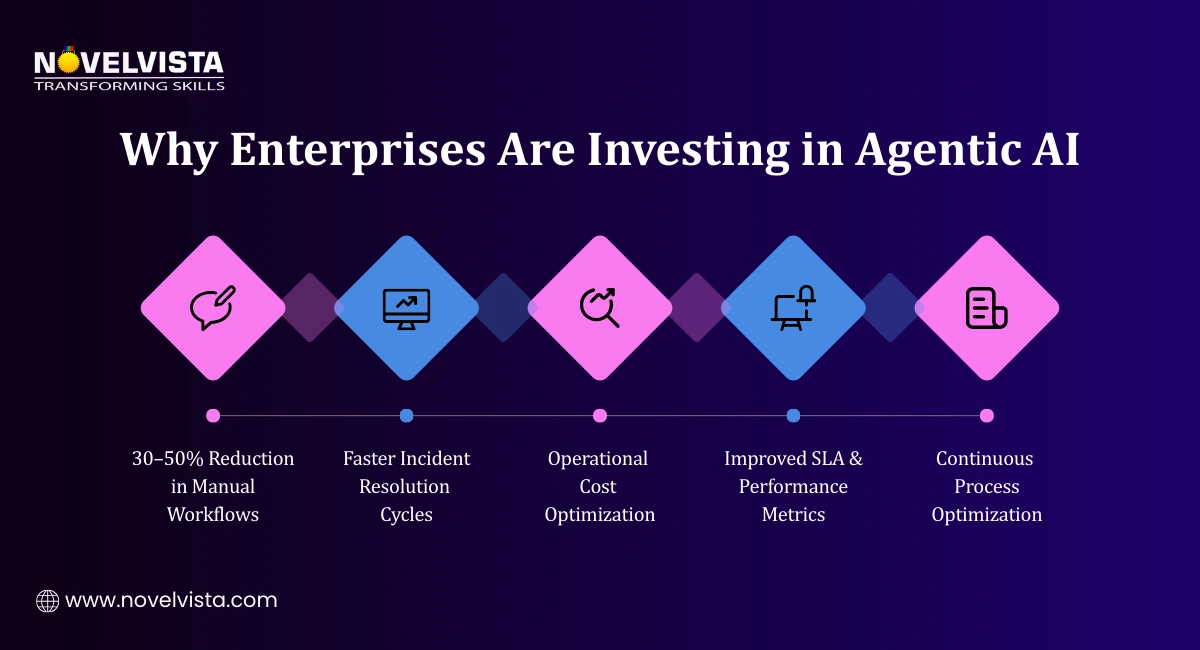
To truly grasp how does agentic AI work, let’s examine practical applications:
AI agents detect incidents, diagnose root causes, and execute remediation scripts autonomously.
Agents resolve tickets, escalate complex issues, and personalize responses.
Automated fraud detection systems analyze transactions and take preventive actions.
Agents monitor inventory levels and automatically adjust procurement strategies.
These examples show how agentic AI works beyond theoretical frameworks it operates in production environments today.
Despite its potential, organizations must consider:
Understanding what agentic AI is and how it works also means acknowledging its limitations.
Observability tools, audit logs, and human-in-the-loop systems remain essential.
As enterprises move from AI experimentation to real-world autonomy, understanding how does agentic AI work becomes a strategic necessity. Organizations that master the principles behind agentic AI development and enterprise-level agentic AI implementation gain more than automation; they gain scalable decision intelligence, operational agility, and measurable business impact.
The future of digital transformation will be shaped by systems that plan, act, and continuously optimize outcomes. Those who truly understand how does agentic AI works won’t just implement smarter tools, they will build adaptive, goal-driven ecosystems that lead the next wave of innovation.
Ready to deepen your understanding of how agentic AI works and apply it strategically in real-world environments?
Join NovelVista’s Agentic AI Certification and gain practical insights into autonomous AI systems, hands-on development frameworks, and enterprise-ready implementation strategies. Designed for IT leaders, AI developers, and automation professionals, this course empowers you to confidently architect, implement, and govern agentic AI at scale, unlocking tangible business value and future-ready skills.
Start your agentic AI mastery journey today!
Author Details

Confused About Certification?
Get Free Consultation Call
Stay ahead of the curve by tapping into the latest emerging trends and transforming your subscription into a powerful resource. Maximize every feature, unlock exclusive benefits, and ensure you're always one step ahead in your journey to success.