Category | AI And ML
Last Updated On 15/07/2026
Artificial Intelligence is evolving faster than ever. According to reports from organizations like Gartner, by 2028 nearly 33% of enterprise software applications will include AI-driven autonomous capabilities, up from less than 5% just a few years ago. Meanwhile, McKinsey & Company estimates that AI could contribute up to $4.4 trillion annually to the global economy.
But here’s the real question:
The answer lies in agentic AI technology.
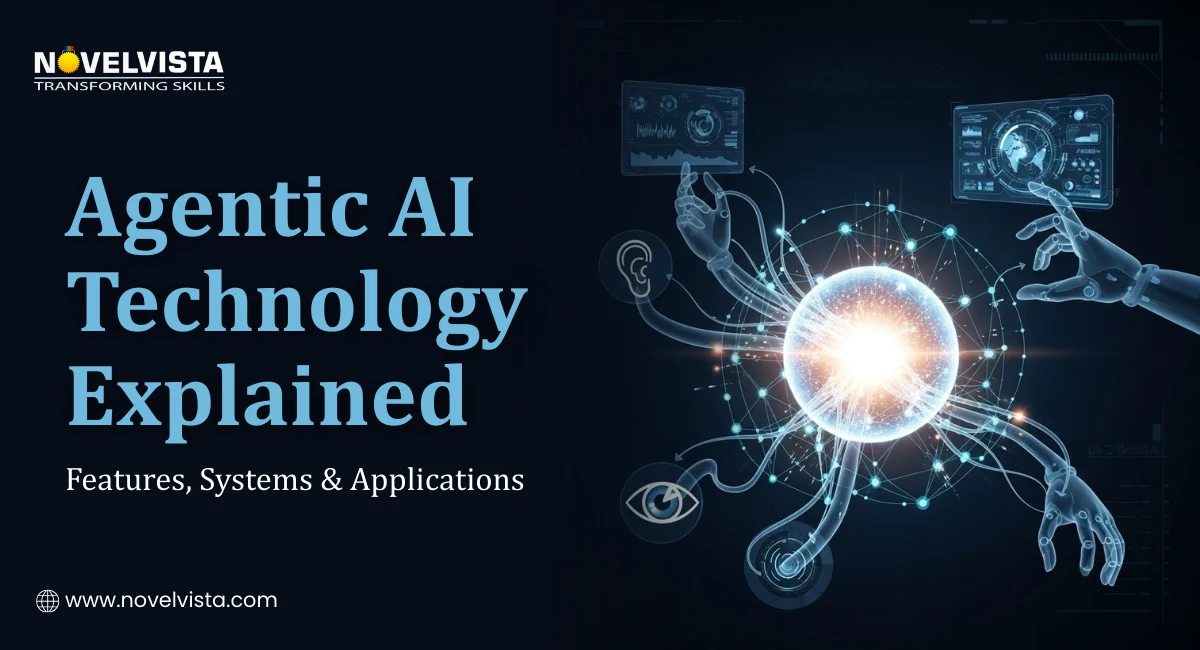
This emerging field represents the next evolution of AI systems, systems that don’t just respond to prompts but act autonomously to achieve objectives. Whether you're a tech professional, enterprise decision-maker, AI enthusiast, or strategist preparing for digital transformation, understanding agentic AI technology is becoming essential.
In this guide, we'll explore what agentic AI technology is, how autonomous AI systems work, their key features, real-world applications, recent advancements, challenges, and what the future holds for this rapidly evolving technology.
TL;DR :
Topic | Summary |
|---|---|
| Agentic AI Technology? | AI systems that autonomously plan, reason, make decisions, and execute tasks. |
| Key Features | Goal-oriented behavior, planning, memory, learning, and autonomous decision-making. |
| How It Works | Uses perception, reasoning, planning, execution, and feedback loops to achieve objectives. |
| Applications | Healthcare, finance, IT operations, manufacturing, customer service, and enterprise automation. |
| Why It Matters | Enables intelligent automation, improves efficiency, and supports smarter business decisions. |
At its core, agentic AI technology refers to AI systems designed to function as autonomous agents capable of independent action. If you're new to the concept, understanding what is Agentic AI provides a solid foundation before exploring its advanced technologies. Unlike traditional AI models that rely heavily on human prompts or operate within rigid, predefined rules, agentic AI technology can set goals, plan multi-step actions, make informed decisions, learn from outcomes, and adapt continuously within dynamic environments. In simple terms, traditional AI answers questions, generative AI creates content, but agentic AI technology acts. For example, while a chatbot simply responds to user queries and a generative AI model may draft an email, an agentic AI system goes several steps further by identifying customer churn risks, creating personalized retention emails, scheduling follow-ups, and analyzing response metrics, all autonomously. This transition from reactive assistance to proactive execution defines the next wave of AI evolution driven by intelligent, goal-oriented systems.
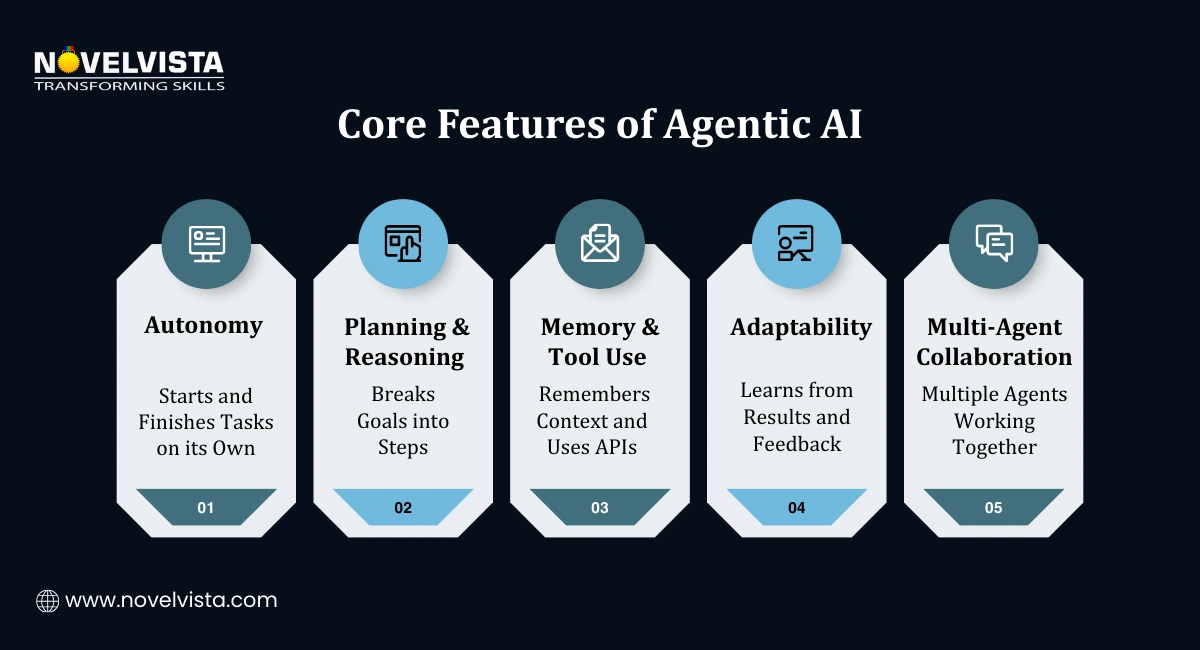
To truly understand agentic AI technology, we must explore the agentic AI features that differentiate it from other AI systems.
One of the key features of agentic AI is goal-driven functionality. These systems operate with defined objectives and dynamically adjust their actions to achieve them.
Unlike rule-based automation, autonomous agentic AI evaluates multiple pathways before selecting optimal actions. It uses reasoning frameworks and contextual awareness.
The characteristics of agentic AI include advanced planning capabilities. These systems break complex goals into smaller tasks and execute them sequentially.
Agentic AI maintains short-term and long-term memory. It learns from interactions and improves performance over time, a critical differentiator from static automation.
Modern agentic AI autonomous technology interacts with APIs, databases, IoT systems, and enterprise software environments to gather contextual signals.
These capabilities collectively enable AI to behave less like a tool and more like an intelligent digital operator.
So how do agentic AI autonomous systems actually work?
These systems are typically built with multiple interconnected components:
In contrast to simple automation scripts, autonomous agentic AI adapts when unexpected scenarios arise.
For example:
Traditional automation:
If X happens → Do Y.
Agentic system:
If X happens → Evaluate A, B, C → Choose best option → Execute → Monitor → Improve.
This dynamic loop is transforming enterprise software design.
The past two years have seen significant recent developments in agentic AI technology, with innovations rapidly moving from research labs into real-world production environments. Major agentic AI advancements in the technology sector include multi-agent collaboration systems, AI-driven cybersecurity monitoring, autonomous DevOps optimization, intelligent robotic process automation (RPA 2.0), and AI agents managing cloud infrastructure. Organizations are increasingly embedding agentic AI technology applications into ERP systems, customer relationship platforms, and smart supply chains to enhance operational efficiency. Powered by large language models combined with advanced reasoning engines, these systems no longer just generate outputs, they execute complex workflows end-to-end with minimal human intervention. How Does Agentic AI Work? A clear breakdown of the goal-setting, reasoning, planning, and autonomous decision-making processes that power intelligent agentic AI systems.
Learn how Agentic AI systems think, plan, and
act autonomously.
Explore real-world enterprise use cases transforming business operations.
Gain practical insights to build future-ready AI skills.
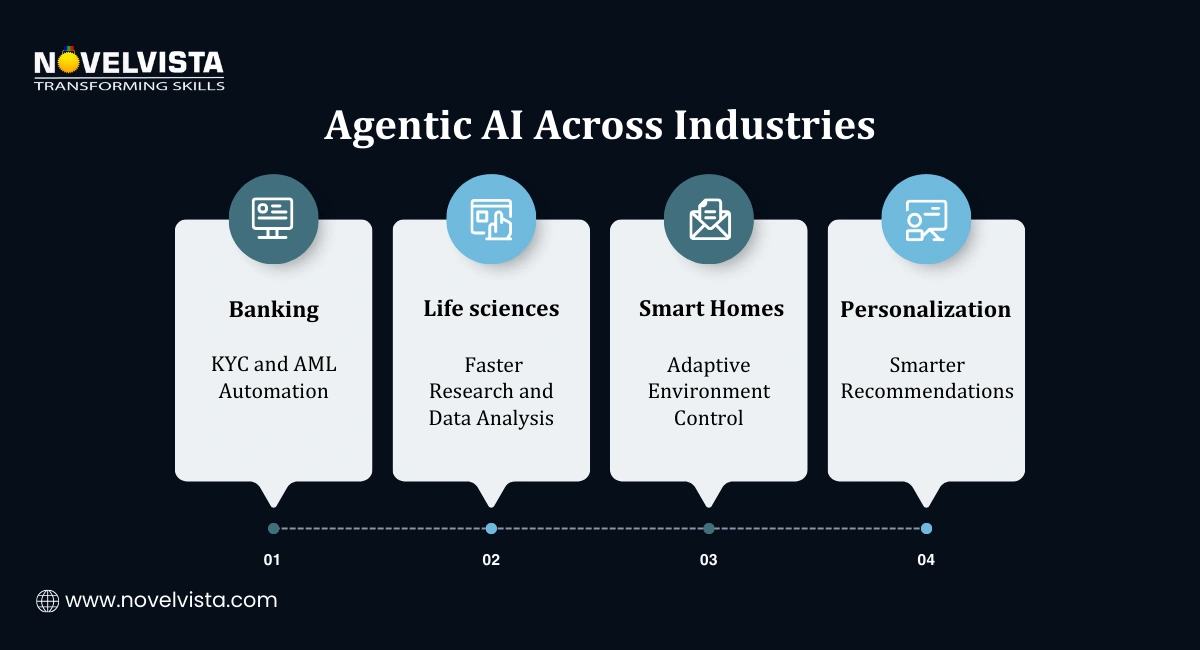
Let’s explore practical agentic AI use cases in technology across industries.
Agentic AI monitors patient data, identifies risk patterns, schedules interventions, and optimizes treatment plans autonomously.
AI agents detect fraud in real time, rebalance investment portfolios, and manage compliance checks using agentic AI autonomous systems.
In IT environments, agentic AI autonomous technology predicts outages, allocates resources, and auto-remediates incidents without human escalation.
AI agents handle full customer journeys from inquiry to resolution improving personalization and response time.
Autonomous AI monitors machinery, predicts maintenance needs, and optimizes production schedules dynamically.
These examples show how agentic AI technology applications go far beyond chatbots or analytics dashboards. Benefits of Agentic AI include smarter autonomous decision-making, improved operational efficiency, faster execution of complex tasks, and scalable intelligent automation across industries.
Despite rapid growth, agentic AI technology presents serious challenges.
Who is responsible if an AI agent makes a flawed decision?
Autonomous reasoning systems must be explainable to maintain trust.
AI systems acting independently can amplify bias if not properly governed.
Autonomous agents interacting with enterprise systems introduce new cybersecurity vulnerabilities.
As agentic AI advancements in technology sector continue, strong AI governance frameworks and ethical oversight become critical.
The future of agentic AI technology is not about replacing humans but augmenting their capabilities in increasingly intelligent environments. We are entering an era where digital coworkers operate alongside human teams, multi-agent ecosystems collaborate across enterprises, and AI manages operational complexity while humans focus on strategic decisions. As recent developments in agentic AI technology continue to accelerate, early adopters will gain a strong competitive edge. We can expect deeper integration of AI-powered enterprise resource planning, autonomous cybersecurity defense systems, self-optimizing supply chains, and AI-driven strategic decision support. Ultimately, the evolution of agentic AI autonomous systems represents a fundamental structural shift in how modern technology functions and delivers value.
The rise of agentic AI technology marks one of the most transformative shifts in the history of artificial intelligence. We are evolving from tools that merely assist to systems that act independently from automation to true autonomy, and from reactive AI to proactive intelligence. Understanding the key features of agentic AI, the characteristics of agentic AI, and practical agentic AI use cases in technology is now essential for tech professionals and business leaders alike. As agentic AI autonomous technology continues to reshape industries, organizations that adopt it strategically and responsibly will lead the next decade of innovation. The future is not just intelligent it is agentic.

If this deep dive into agentic AI technology has sparked your interest, it’s time to move from understanding to implementation. Join NovelVista’s Agentic AI Certification Training and gain practical expertise in designing, managing, and governing agentic AI autonomous systems. This industry-aligned program equips you with real-world insights into agentic AI features, system architecture, risk management, and enterprise-grade agent deployment strategies.
Designed for AI professionals, IT leaders, architects, and digital transformation strategists, this certification helps you confidently implement agentic AI technology applications and stay ahead in a rapidly evolving tech landscape.
Start your Agentic AI certification journey today!
Author Details

Confused About Certification?
Get Free Consultation Call
Stay ahead of the curve by tapping into the latest emerging trends and transforming your subscription into a powerful resource. Maximize every feature, unlock exclusive benefits, and ensure you're always one step ahead in your journey to success.