Category | AI And ML
Last Updated On 26/09/2026
Software testing is at a breaking point.
According to industry reports, over 70% of software teams struggle with maintaining automated test suites. Nearly 40% of production defects still escape into live environments despite heavy investment in test automation. And with DevOps accelerating release cycles to weekly or even daily deployments, traditional testing approaches simply cannot keep up.
So here’s the real question:
This is where Agentic AI testing enters the picture.
If you’re a QA engineer, test architect, DevOps leader, AI enthusiast, or software engineering manager looking to modernize your testing strategy, this guide is for you. Today, we explore how agentic ai testing is redefining how modern software is validated, optimized, and released.
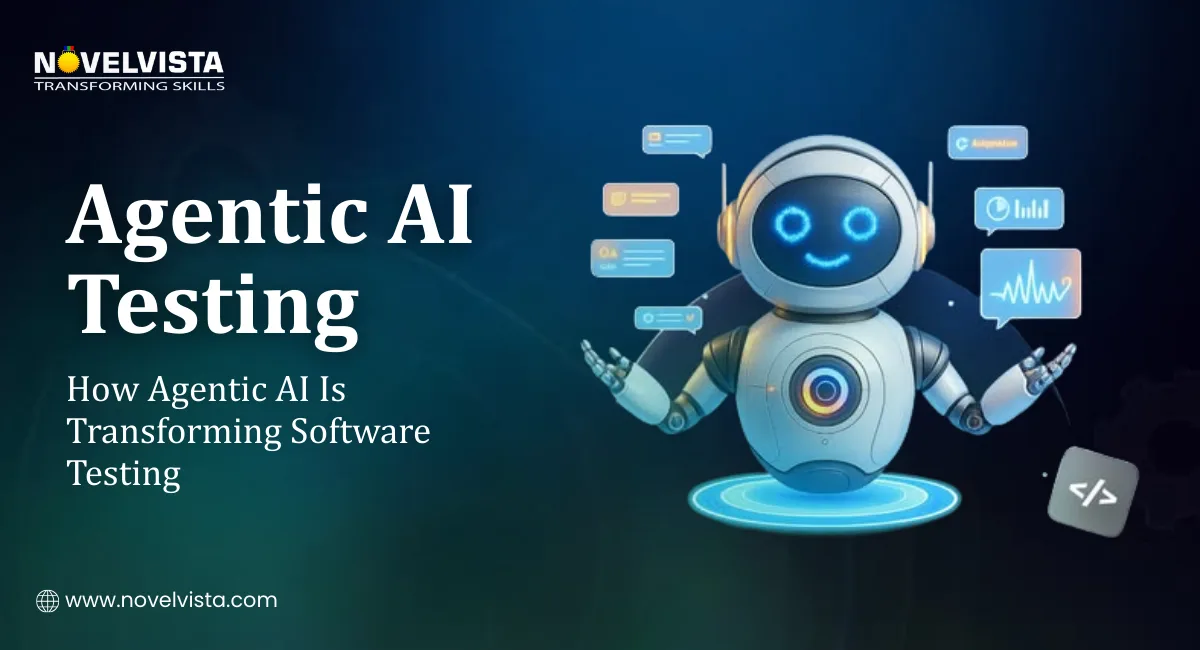
At its core, agentic ai testing refers to AI-driven testing systems that operate as autonomous agents rather than passive tools.
Unlike traditional automation scripts that execute predefined instructions, agentic systems:
In simple terms, traditional automation follows rules.
Agentic AI acts with intent.
Modern applications are no longer monolithic systems. They are microservices-driven, API-heavy, cloud-native, and continuously deployed, operating in highly dynamic environments. With CI/CD pipelines pushing updates multiple times a day, manual intervention becomes a bottleneck, slowing innovation and increasing the risk of defects slipping into production.
Traditional frameworks depend heavily on deterministic logic. But modern systems are dynamic. This mismatch is exactly why agentic ai software testing is gaining traction.
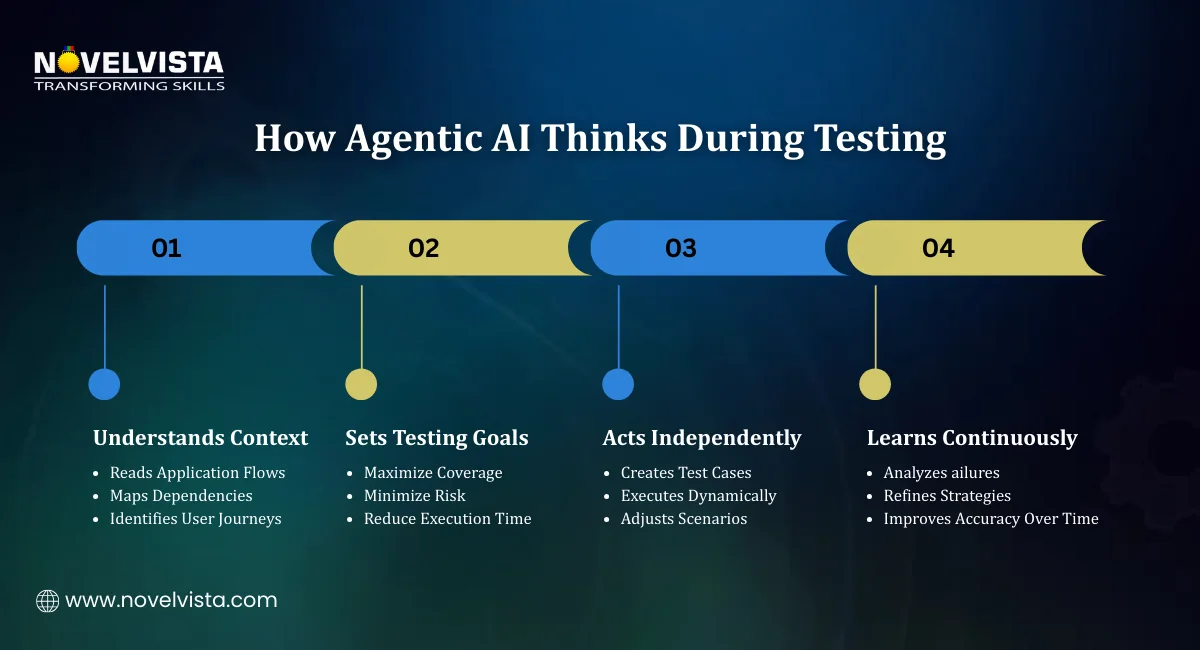
Let’s break it down step by step.
Instead of scripting specific steps, you define objectives like Validate checkout flow, Ensure login security, and Test API resilience. The agent decides how to achieve these goals autonomously, selecting paths, generating scenarios, and adapting to changes in real time. This makes agentic ai for software testing outcome-oriented rather than script-oriented, focusing on results instead of rigid instructions.
Agentic systems analyze:
They then generate and prioritize test cases dynamically.
This dramatically improves test coverage and reduces blind spots.
Imagine a button ID changes. In traditional automation, the test fails immediately because it relies on fixed locators and predefined scripts. With Agentic AI, the system identifies semantic similarities, understands context, and adapts automatically without human intervention. This is what makes agentic ai in testing resilient and intelligent in dynamic environments.
Self-healing testing is one of the strongest advantages of agentic ai testing. The system detects broken locators, finds alternative paths, updates test logic automatically, and documents changes without requiring manual fixes. This intelligent adaptability reduces maintenance overhead significantly while ensuring test stability in rapidly changing applications.
Unlike static scripts, agentic systems improve over time by continuously learning from production bugs, refining risk models, optimizing regression scope, and predicting failure-prone areas. This ongoing evolution enables smarter decision-making and ensures testing becomes more proactive, adaptive, and aligned with real-world application behavior.
This is where agentic ai for testing becomes a strategic business enabler, not just a technical tool. The Benefits of Agentic AI include autonomous decision-making, adaptive learning, reduced operational overhead, and enhanced efficiency across complex digital systems.
Let’s look at measurable impact.
Autonomous test generation reduces dependency on manual scripting.
Instead of running everything, AI prioritizes high-risk areas.
Contextual reasoning uncovers edge cases humans miss.
Self-healing reduces script rework.
Predictive analytics guide quality decisions.
When implemented properly, agentic ai software testing transforms QA from a cost center into a strategic accelerator.
CI/CD Pipelines
Agentic systems integrate directly into DevOps workflows, triggering intelligent test suites based on code commits.
Microservices & APIs
Distributed systems introduce inter-service dependencies. Agentic AI detects impact areas automatically, strengthening agentic ai in software testing for complex architectures.
Exploratory Testing
Human exploratory testing is powerful but limited by time.
Agentic AI mimics exploratory behavior at scale, identifying unexpected interaction patterns.
Performance & Security Testing
By learning normal behavioral baselines, agentic models can flag anomalies in performance and security parameters.
This makes Agentic AI for software testing applicable beyond functional testing.
Discover how autonomous testing improves release confidence
Learn practical steps to adopt agentic systems in your QA workflow
Build future-ready skills to lead in AI-driven software quality
Feature |
Traditional Automation |
Agentic AI Testing |
|---|---|---|
Script Dependency |
High |
Low |
Adaptability |
Limited |
High |
Self-Healing |
No |
Yes |
Risk-Based Prioritization |
Manual |
Autonomous |
Learning Capability |
Static |
Continuous |
Maintenance Effort |
High |
Reduced |
The shift from automation to autonomy is the defining change. An Agentic AI Framework provides a structured architecture for building autonomous, goal-driven systems that can reason, adapt, and execute tasks with minimal human intervention.
Traditional automation executes.
Agentic systems decide.
Despite its promise, agentic ai testing is not plug-and-play.
Clear validation policies must exist to avoid over-reliance.
Agentic models depend on clean, representative training data.
Test engineers evolve into:
Legacy environments may require architectural modernization.
The goal is not replacing testers it’s augmenting them.
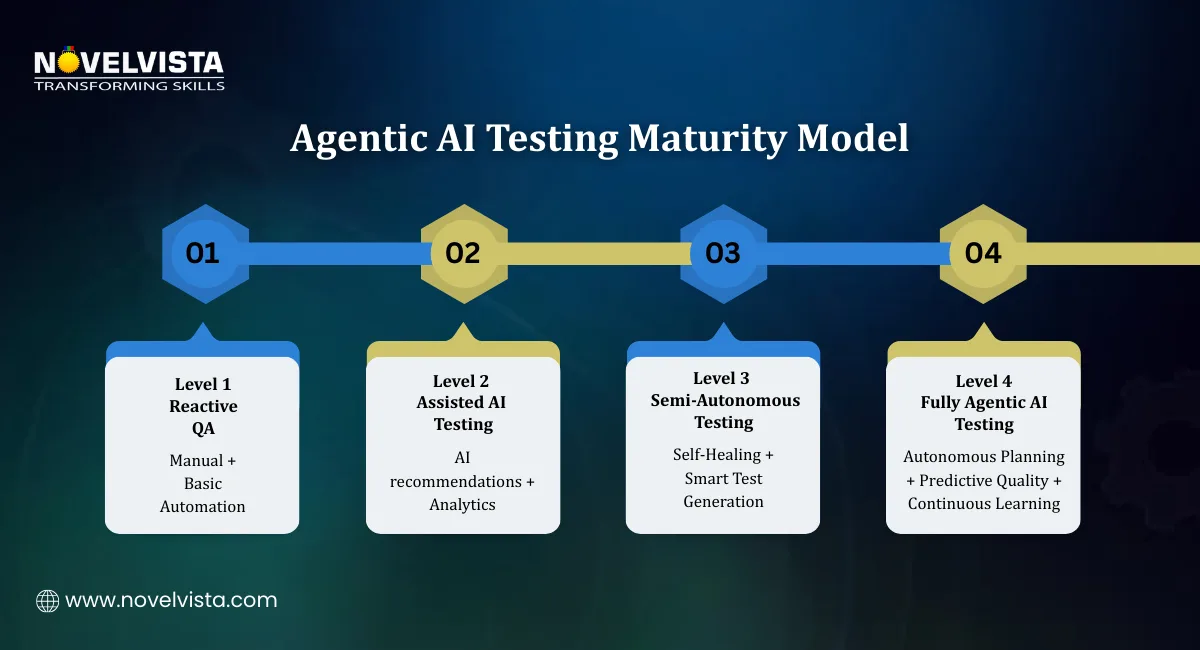
The trajectory is clear.
As applications become more intelligent, testing must become equally intelligent. Agentic AI in testing represents the next maturity phase of QA evolution.
We’re moving from:
Manual Testing → Automation
Automation → AI Assistance
AI Assistance → Agentic Autonomy
Organizations adopting agentic AI software testing today will gain a competitive edge tomorrow. As AI continues to reshape software quality, understanding the broader Future of AI in Testing can help professionals prepare for the evolving demands of modern software testing.
Because the future of software quality is not reactive.
It is autonomous, adaptive, and predictive.
Software complexity is accelerating, release cycles are compressing, and user expectations have never been higher. In this high-velocity digital environment, traditional automation alone can no longer sustain modern quality demands. That is why agentic ai testing is not just an emerging trend — it is a fundamental transformation in how software quality is engineered. By combining autonomy, contextual reasoning, self-healing capabilities, and continuous learning, agentic ai for testing shifts QA from reactive defect detection to proactive quality intelligence. It empowers teams to move faster without sacrificing reliability, to innovate without increasing risk, and to scale without multiplying manual effort. The conversation is no longer about whether AI will reshape testing it already is. The real question is whether your organization will lead this transformation with confidence or struggle to keep pace in an autonomous future.

Ready to build real expertise in this transformative domain?
Join NovelVista’s Agentic AI Certification Training and gain practical implementation skills, real-world testing insights, and industry-recognized credentials designed for QA leaders, DevOps professionals, and AI-driven engineering teams. This course equips you to confidently design, supervise, and implement agentic ai testing strategies in modern software environments.
Start your Agentic AI journey today!
Author Details

Confused About Certification?
Get Free Consultation Call
Stay ahead of the curve by tapping into the latest emerging trends and transforming your subscription into a powerful resource. Maximize every feature, unlock exclusive benefits, and ensure you're always one step ahead in your journey to success.