Category | AI And ML
Last Updated On 16/07/2026
Agentic AI delivers measurable benefits across five areas: faster decision-making, lower operational costs, 24/7 execution without fatigue, improved accuracy in high-stakes processes like fraud detection and compliance, and predictive rather than reactive operations. Businesses report up to 90% reduction in manual intervention, HR teams up to 57% cost savings, and banks use it for real-time fraud detection and compliance monitoring. Unlike traditional automation, Agentic AI systems plan, act, and adjust on their own, turning static workflows into self-correcting ones.
TL;DR :
Area | What Changes in Practice |
|---|---|
Business | Workflows run end-to-end with minimal manual touch |
Operations | Systems respond instantly to demand and disruption |
HR | Hiring, staffing, and engagement become predictive |
Customer Service | The majority of issues were resolved without agents |
Banking & CRM | Fraud, reporting, and personalization run in real time |
Scale | 24/7 execution without fatigue or delays |
Agentic AI represents a shift from task-based automation to decision-capable systems. Instead of waiting for triggers, these systems decide what needs to happen next and act on it.
One of the most visible benefits of Agentic AI is scale without slowdown. Organizations report:
(Source: The AI Service company, Google Cloud)
This matters because modern businesses operate across cloud platforms, data streams, and global teams. Humans alone cannot manage that complexity in real time. Agentic AI fills that gap by handling execution while people focus on direction and judgment.
Read More: What Is Agentic AI?
The benefits of Agentic AI for businesses show up first in how work actually flows. Traditional automation handles steps. Agentic systems handle outcomes.
In enterprise use cases we analyze during training labs, the biggest gains appear when Agentic AI controls end-to-end workflows rather than isolated steps.
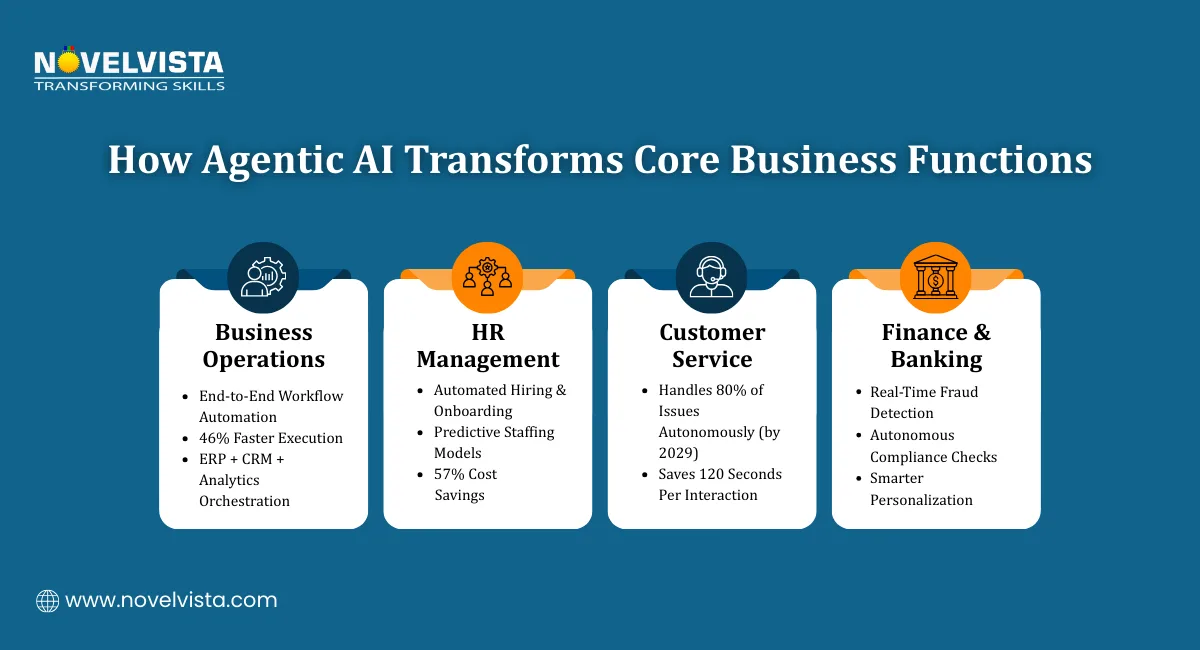
Marketing and content teams, for example, see workflows execute around 46% faster because campaigns, performance tracking, and optimization happen automatically. Budgets adjust based on results, not after reports are reviewed.
These Agentic AI benefits reduce cost, improve ROI, and keep execution aligned with strategy, without micromanagement.
A practical executive guide to unlocking measurable
ROI with autonomous AI systems
Proven frameworks to scale decision intelligence across business functions
Real-world case insights for IT leaders,
transformation heads, and AI professionals
When teams look closely at day-to-day execution, the top benefits of Agentic AI in business operations are measurable and immediate.
Agentic systems don’t wait for tickets. They watch operations constantly. When performance dips, they act. Rerouting tasks, reallocating resources, or triggering fixes.
Multi-agent setups work especially well in:
Operational autonomy only works when agents are governed by clear objectives, limits, and feedback loops. Without these, speed increases but reliability drops.
That’s why these environments require constant coordination, something traditional automation struggles to handle at scale.
The benefits of Agentic AI in HR management go far beyond resume screening or chatbots.
Autonomous HR systems now handle:
Another major change is personalization. Employee journeys adapt in real time based on feedback, engagement signals, and performance data. This directly reduces attrition and improves satisfaction.
Many HR teams report up to 57% cost savings, freeing them to focus on leadership development, culture, and long-term planning. These are not experimental gains, they are practical Agentic AI benefits already in use.
Customer service is where autonomy delivers instant value. The benefits of Agentic AI in customer service include handling issues from start to finish without escalation.
In customer service scenarios evaluated during our workshops, agentic systems reduce resolution time only when agents are empowered to close cases, not just route them.
By 2029, up to 80% of customer issues are expected to be handled autonomously. Straight-through processing saves around 120 seconds per interaction, improving both speed and satisfaction.
Customers get faster answers. Support teams handle fewer repetitive cases. Everyone benefits.
Few sectors feel the impact faster than finance. The benefits of Agentic AI for banks and fintechs are closely tied to risk control, compliance, and personalization.
Autonomous systems now manage:
They also forecast costs, optimize transaction flows, and adapt decisions instantly. Personalization improves across digital channels without slowing operations.
These benefits of Agentic AI help financial institutions move faster while maintaining trust, accuracy, and regulatory alignment.
Customer data has always been valuable. What changes with autonomy is how fast and intelligently that data is used. The benefits of Agentic AI in CRM systems come from systems that don’t wait for reports or prompts.
Banks and fintechs use autonomous reconciliation and reporting to reduce manual oversight. Data is checked, corrected, and summarized continuously, not at month-end. Agentic CRM systems perform best when predictive actions are continuously validated against real customer outcomes, not static models.
Fintech adoption is accelerating fast. By 2026, nearly 40% of fintech applications are expected to embed Agentic AI directly into CRM and customer intelligence layers. These benefits of Agentic AI translate into faster engagement, better personalization, and more accurate decision-making.
Operations is where autonomy shows its flexibility. The benefits of Agentic AI in manufacturing and service industries come from systems that adjust instantly when conditions change.
The benefits of Agentic AI in manufacturing help plants respond to equipment health, supply delays, and order changes without manual intervention.
The benefits of Agentic AI in hotel operations include:
When suppliers change, staff availability drops, or demand spikes unexpectedly, agentic systems adapt immediately. This flexibility is what makes these benefits of Agentic AI stand out in operations-heavy industries.
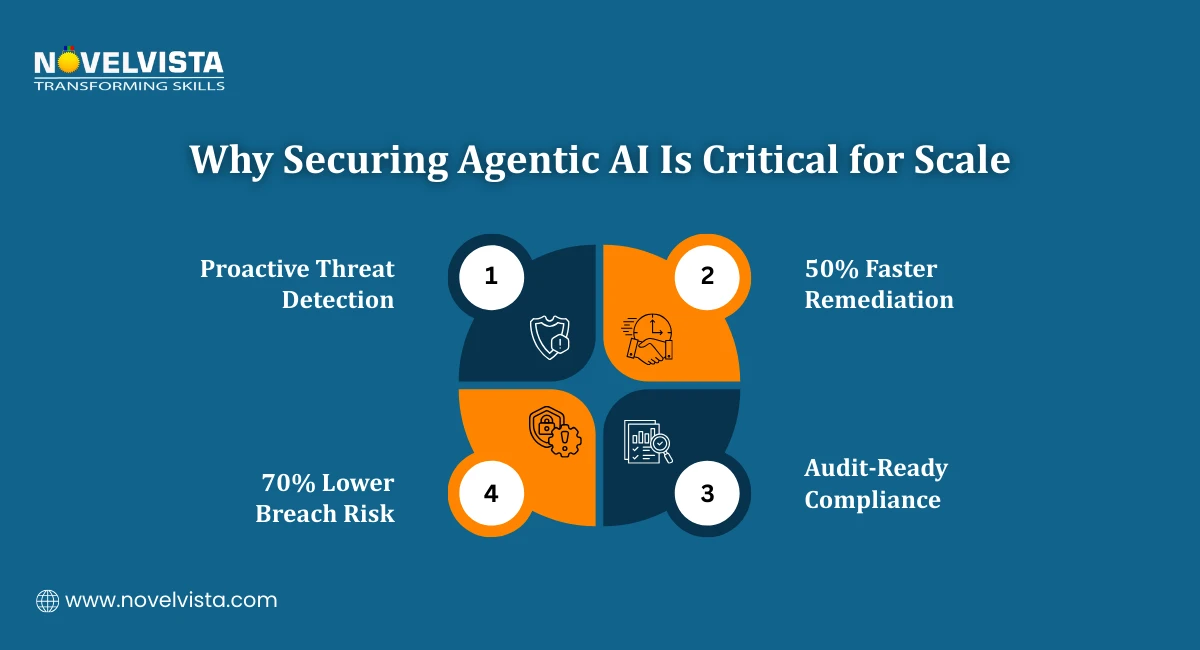
From a governance perspective, autonomy without continuous monitoring introduces unacceptable operational and regulatory risk. That’s why the benefits of securing an Agentic AI lifecycle are just as important as performance gains.
Secured agentic systems include:
(Source: Google Cloud)
The benefits of securing the Agentic AI lifecycle also include trust. Teams can scale autonomous decision-making confidently, knowing governance, controls, and visibility remain intact.
Agentic AI delivers value differently depending on the industry, but the pattern is consistent: less delay, fewer errors, and smarter decisions.
Sector |
Core Agentic AI Benefits |
Practical Examples |
|---|---|---|
Business Operations |
Workflow automation, real-time decisions |
Inventory, procurement |
HR |
Staffing prediction, onboarding |
Scheduling, feedback loops |
Banking |
Fraud detection, CRM intelligence |
Reporting, personalization |
Operations |
Supply chain agility, maintenance |
Manufacturing, hospitality |
Across all these areas, the benefits of Agentic AI come from autonomy that works quietly in the background while teams focus on higher-value work.
These insights reflect patterns observed across real enterprise pilots, production systems, and certification-aligned training environments.
Also Read: Agentic AI in Healthcare
The impact of Agentic AI is no longer limited to experimentation or niche use cases. The benefits of Agentic AI now span business efficiency, customer experience, risk reduction, and operational resilience. With forecasts pointing to 40% enterprise adoption, autonomy is becoming a core capability rather than a future concept.
Organizations that approach Agentic AI with the right balance of autonomy, security, and scale unlock sustainable ROI. Those who delay risk falling behind systems that can already plan, act, and improve on their own.
Next Step: Build Real Agentic AI Skills with NovelVista
If you want to move beyond theory and understand how autonomous systems work in real business environments, NovelVista’s Agentic AI Professional Certification is a strong next step. The course covers agent design, orchestration, governance, and practical use cases across industries. You’ll gain hands-on insight into how Agentic AI delivers measurable outcomes, helping you confidently apply these systems in business, operations, and digital transformation roles.
Author Details

Confused About Certification?
Get Free Consultation Call
Stay ahead of the curve by tapping into the latest emerging trends and transforming your subscription into a powerful resource. Maximize every feature, unlock exclusive benefits, and ensure you're always one step ahead in your journey to success.