Category | AI And ML
Last Updated On 13/02/2026
Most AI systems still stop at answers.They generate responses, but they don’t execute tasks or manage goals over time. This is where Agentic AI architecture changes the game. Instead of one-off responses, it enables systems that reason, plan, act, and learn over time.
Across Agentic AI training labs, we consistently see teams underestimate how much architecture determines whether agents behave reliably under real workloads.
This article breaks down what is Agentic AI architecture, how it actually works under the hood, and why it’s becoming the backbone of real-world AI workflows, not demos or chat windows.
TL;DR – Agentic AI Architecture in One View
|
Area |
Key Reality |
|
Core Idea |
AI systems that act, not just reply |
|
Architecture |
Perception → Reasoning → Memory → Action → Feedback |
|
Key Difference |
Long-running, goal-driven workflows |
|
Patterns |
Single agent, multi-agent, tool-reason-act |
|
Value |
Scalable, auditable, production-ready AI |
So, what is Agentic AI architecture in simple terms?
Agentic AI architecture refers to autonomous, goal-driven systems where AI doesn’t just generate text, it decides what to do next, executes actions, checks results, and adapts. These systems usually rely on large language models (LLMs), but the model is only one part of the design.
In an Agentic AI system architecture, the AI:
Receives signals from the real world
Plans steps to achieve a goal
Uses tools or systems to act
Reviews outcomes
Improves future decisions
This is a major shift from prompt-response models. Instead of asking, “What should I say?”, the system asks, “What should I do now?”
That shift is why Agentic AI architecture is being adopted for automation, operations, analytics, customer workflows, and decision support.
Traditional GenAI is great at producing content. But it has limits.
Traditional GenAI
Single-turn or short-context interactions
Outputs text, images, or code
No memory beyond the prompt
No responsibility for outcomes
Agentic AI Systems
Long-running workflows
Multi-step reasoning and decisions
Tool usage and system interaction
Outcome evaluation and adjustment
Most production failures in early agent deployments occur because systems lack a clear separation between reasoning, execution, and verification.
In Agentic AI architecture, the system follows a sense–plan–act–reflect loop. This allows it to complete tasks that require multiple decisions, retries, and coordination.
That’s why enterprises are moving toward Agentic AI system architecture for use cases where reliability, sequencing, and accountability matter more than creativity alone.
Also Read: Agentic AI vs Generative AI
In practical implementations, missing or weak components, especially memory or orchestration, are the most common causes of unstable agent behavior.
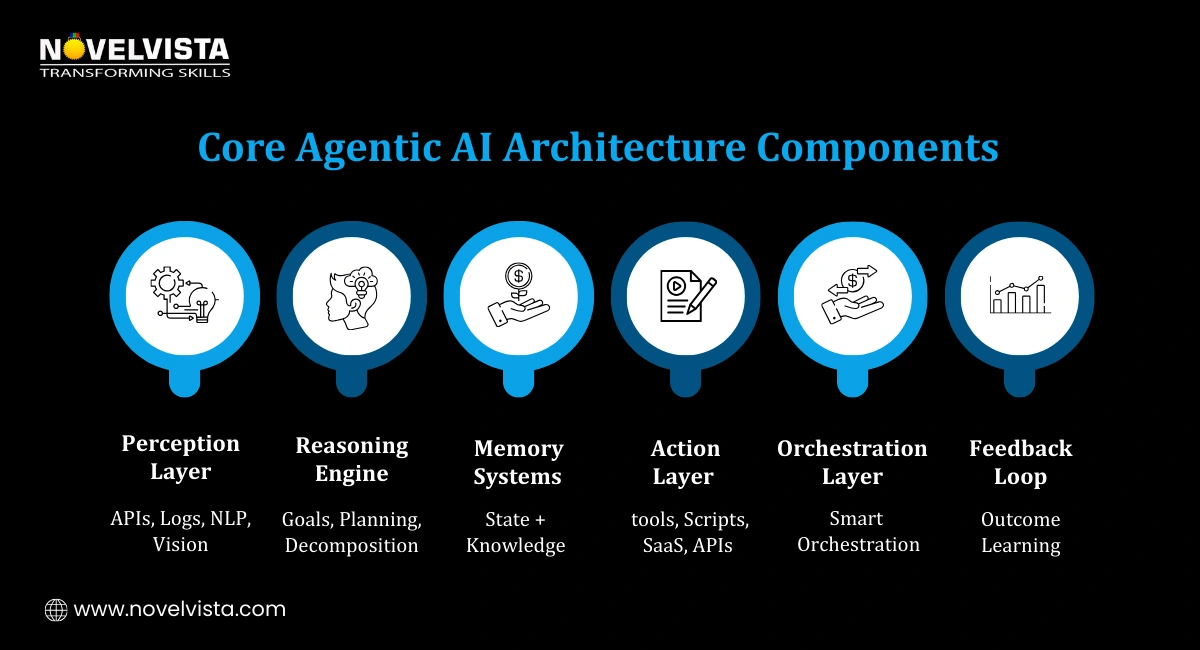
To understand how these systems work, you need to look at the building blocks. These are the Agentic AI architecture components that appear in almost every real implementation.
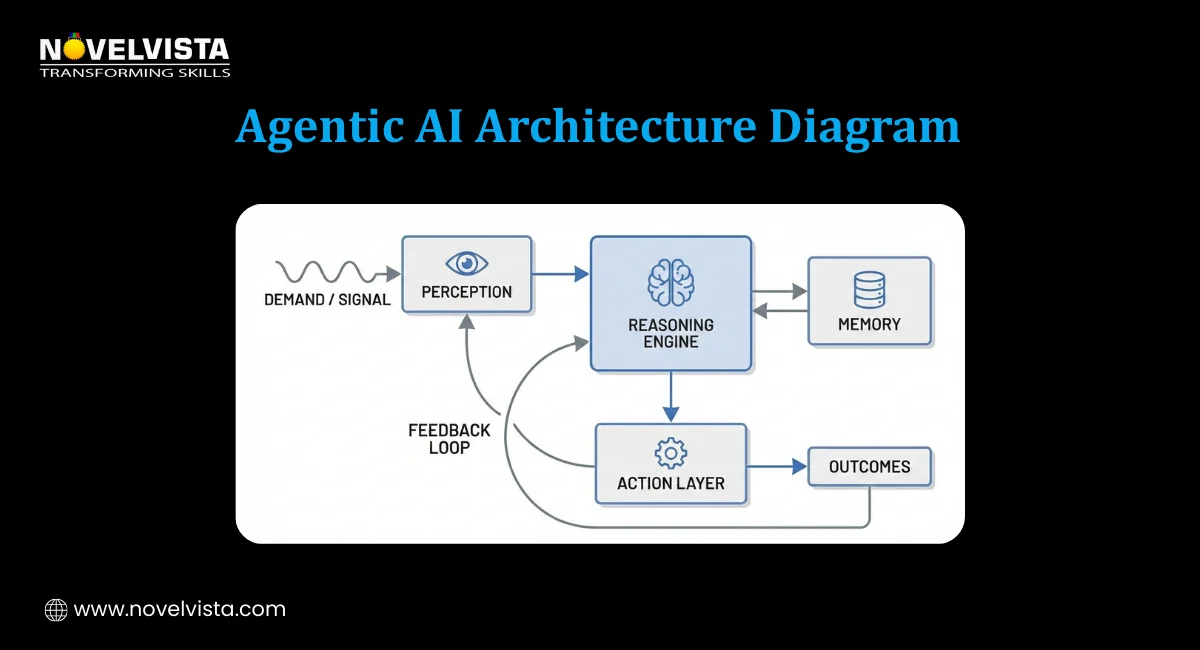
Together, they are often represented in an Agentic AI architecture diagram showing a continuous flow rather than a straight line.
1. Perception Layer
The perception layer is how the agent “sees” the world.
It collects signals from:
APIs and databases
Logs and events
User inputs (text, voice)
Vision systems or sensors
Raw data is converted into structured signals that the reasoning engine can understand. Without this layer, the agent has no awareness of what’s happening.
In any Agentic AI architecture diagram, perception is always the entry point.
2. Cognitive / Reasoning Engine
This is where thinking happens.
The reasoning engine, often powered by an LLM, is responsible for:
Understanding goals
Breaking objectives into steps
Choosing what to do next
Making decisions under uncertainty
It doesn’t act directly. It plans. That separation is key to scalable Agentic AI architecture designs.
3. Memory Systems
Memory is what prevents agents from repeating mistakes.
Most Agentic AI architecture components include two memory types:
Short-term memory: Maintains task state and context
Long-term memory: Stores past actions, outcomes, and knowledge
Memory allows continuity across time. In an Agentic AI architecture diagram, memory usually sits beside the reasoning engine, feeding context back into decisions.
4. Action and Tool Execution Layer
This layer turns plans into real-world impact.
It executes actions using:
APIs
Scripts and code interpreters
SaaS tools
Internal systems
This is where Agentic AI architecture moves beyond conversation and starts delivering outcomes.
5. Orchestration Layer
As systems grow, coordination becomes critical.
The orchestration layer:
Manages workflow order
Handles retries and failures
Coordinates multiple agents
Controls escalation paths
In complex setups, the Agentic AI architecture diagram shows orchestration as the backbone connecting all components.
6. Feedback and Learning Loop
No action is complete without evaluation.
This loop:
Compares outcomes to goals
Identifies gaps or failures
Feeds results back into memory
This is what allows continuous improvement. It’s also why Agentic AI architecture supports learning over time, not just execution.
Once the core building blocks are clear, the next question is how to arrange them. These recurring layouts are known as Agentic AI architecture patterns, and each one fits a different level of complexity.
1. Single-Agent Architecture Pattern
A single agent handles perception, planning, execution, and feedback.
Works well for focused workflows
Easier to debug and control
Lower cost and setup effort
This pattern is common in early implementations of Agentic AI architecture, especially where tasks are linear and well-defined.
2. Multi-Agent Architecture Pattern
In this setup, one coordinator agent assigns work to multiple specialist agents.
One agent plans
Others execute domain-specific tasks
Results are combined and reviewed
This pattern is used in fraud analysis, customer operations, analytics, and routing systems. In an Agentic AI architecture diagram, you’ll often see agents working in parallel with a central orchestrator.
3. Three-Tier Agentic Model
This pattern separates concerns clearly:
Foundation layer: Memory, knowledge, data
Reasoning layer: Planning and decisions
Autonomous layer: Agents, tools, execution
This layered view is popular in enterprise Agentic AI architecture designs because it improves scalability and governance.
4. Tool–Reason–Act Pattern
This pattern keeps thinking and doing separately.
Reasoning decides what to do
Tools handle how to do it
Actions are logged and reviewed
This structure improves observability and safety. Many teams adopt this when moving from prototypes to production.
5. Vertical, Horizontal, and Hybrid Structures
Vertical: Hierarchical command and control
Horizontal: Peer agents collaborating
Hybrid: A mix of both
When reviewing real deployments, most teams start with a single-agent pattern and evolve toward hybrid multi-agent structures as complexity grows. Most large systems end up hybrid. These Agentic AI architecture patterns help teams scale without losing control.
Validate agentic AI designs by identifying mandatory components,
hidden gaps, and governance risks before unreliable agents break workflows,
security, or scalability.
An agentic system works as a continuous loop, not a one-time response. This is why teams often use an Agentic AI architecture diagram to explain how decisions turn into actions and learning.
The flow is simple and repeatable:
Perception: A signal enters the system, such as a user request, alert, or data change. The input is converted into structured information that the agent can understand.
Reasoning: The agent decides what needs to be done, breaks the goal into steps, and chooses the next action.
Memory: Past actions, constraints, and current task state are checked to avoid repeating mistakes.
Action: The agent executes the plan using APIs, tools, or workflows.
Feedback: Results are evaluated and fed back into memory to improve future decisions.
This perception–reason–act–feedback loop aligns closely with how reliable autonomous systems are designed in other engineering disciplines.
Check Out: The Best Open-Source Agentic AI Frameworks in 2026
Several platforms are commonly used to build and run Agentic AI architecture in production.
LangChain and LangGraph: Used for orchestration, tool routing, and graph-based execution.
Google Cloud (ADK): Provides enterprise agent design patterns and runtime controls.
Akka: Supports scalable agent coordination and streaming workloads.
CrewAI: Enables role-based, collaborative multi-agent workflows.
Kore.ai: Offers structured agent blueprints for enterprise use cases.
Salesforce and IBM: Demonstrate production deployment patterns for agents in business systems.
These tools don’t replace architectural thinking. They support it.
Building agentic systems introduces new challenges.
Unpredictable outputs: LLM responses can vary
Cost and latency: Long-running workflows add overhead
Security and access control: Agents touch many systems
Observability: Tracing decisions across steps is hard
These challenges are why strong design and clear Agentic AI architecture components matter from day one.
In training environments, teams that adopt guardrails and orchestration early progress faster than those focused only on agent intelligence. Teams that succeed with Agentic AI architecture usually follow a few practical rules:
Use orchestration layers to control execution paths
Implement durable memory with retention rules
Add guardrails, approvals, and audit logs
Start narrow before scaling to multi-agent systems
These practices turn experiments into reliable systems.
Agentic AI moves systems from talking to acting. A well-designed Agentic AI architecture enables AI that plans, executes, evaluates, and improves over time. Agentic AI architecture is increasingly treated as core infrastructure, similar to workflow engines or distributed systems, rather than experimental AI tooling.
Understanding Agentic AI architecture components, flows, and Agentic AI architecture patterns is what separates demos from production-ready platforms. As adoption grows, architecture clarity becomes the foundation for trust, scale, and real business impact.

Next Step: Build Real-World Agentic AI Skills
If you want to design, evaluate, or deploy agent-based systems confidently, NovelVista’s Agentic AI Professional Certification Course helps you move beyond theory. The program covers architecture patterns, orchestration design, memory strategies, and governance practices using real examples. It’s built for professionals who want to create reliable, scalable agentic systems, not just experiments.
Author Details

Confused About Certification?
Get Free Consultation Call
Stay ahead of the curve by tapping into the latest emerging trends and transforming your subscription into a powerful resource. Maximize every feature, unlock exclusive benefits, and ensure you're always one step ahead in your journey to success.