Category | Quality Management
Last Updated On 17/02/2026

Many management systems look clean on paper, but repeat the same problems every year. That gap becomes obvious when auditing clause 10.2. This clause doesn’t care how well issues are written up; it tests whether organizations actually learn from failures and stop them from happening again.
In lead auditor training sessions, we repeatedly see Clause 10.2 cited as the reason recurring nonconformities remain unresolved across audit cycles.
This guide explains auditing clause 10.2 from a lead auditor’s point of view. It shows what the clause really expects, how auditors evaluate corrective actions end to end, and what separates real improvement from checkbox compliance.
| Focus Area | What Auditors Expect |
| Nonconformities | Prompt reaction and proper control |
| Root Cause | Logical analysis, not guesswork |
| Corrective Action | Actions that remove causes, not symptoms |
| Verification | Evidence that actions actually worked |
| Maturity Signal | Learning and prevention, not repetition |
Across ISO standards like ISO 9001, ISO 27001, and ISO 45001, Clause 10.2 deals with corrective action. For lead auditors, auditing clause 10.2 is one of the clearest ways to judge system maturity.
This clause shows whether an organization:
Organizations often meet documentation requirements but fail in execution. Clause 10.2 exposes that gap clearly. That’s why lead auditors rely on this clause to assess continual improvement, not just compliance.
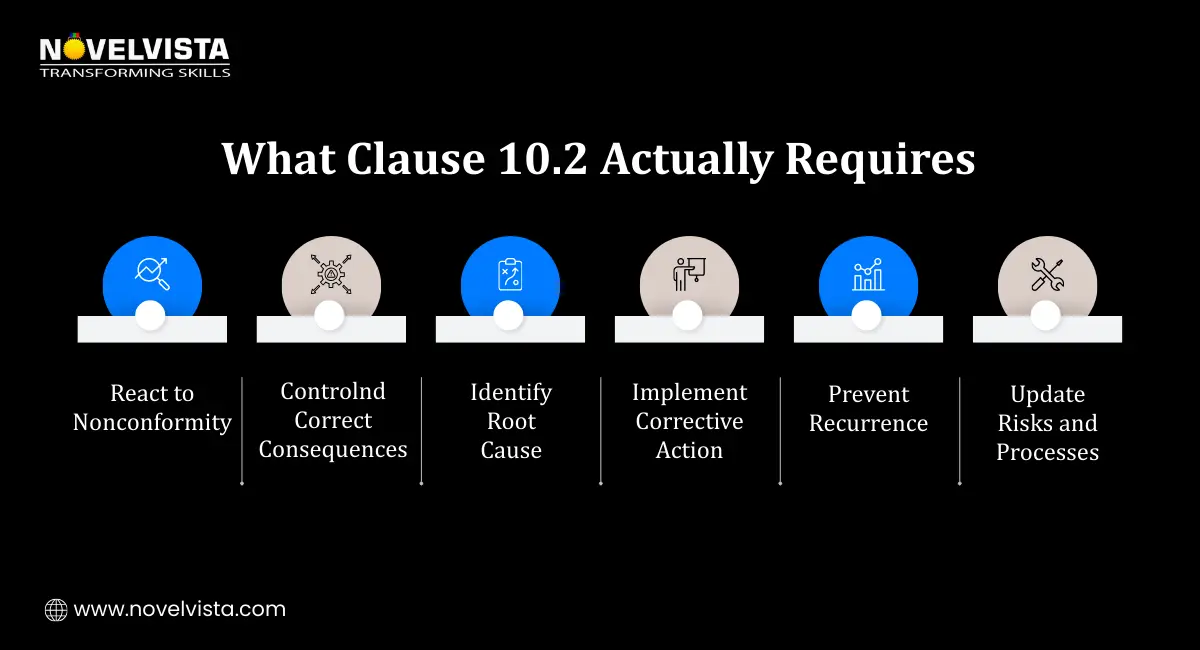
Clause 10.2 sets out a clear sequence of actions. Auditors should always assess these steps as a connected flow, not isolated activities.
Organizations are required to:
ISO standards intentionally structure Clause 10.2 as a sequence, and auditors are expected to assess it as an end-to-end process, not as separate activities.
When auditing clause 10.2, the key question is simple:
Did the organization only fix the problem, or did it fix the system that allowed the problem?
Experienced auditors never look at corrective actions in isolation. Auditing clause 10.2 means reviewing the entire nonconformity lifecycle.
Common entry points include:
From there, auditors trace:
The audit focus stays on process consistency, not one-off fixes. A single well-written corrective action means nothing if similar issues keep appearing elsewhere.
A structured checklist helps auditors stay objective and consistent while reviewing Clause 10.2.
Auditors should verify that records contain:
Auditors should check whether a proper root cause analysis audit method was used, such as:
The focus should be on system causes, not blaming individuals.
Review whether:
Effective root cause analysis focuses on process and system weaknesses rather than individual mistakes, which is a key audit expectation under Clause 10.2.
This is where many systems fall apart. Actions may be written and closed, but corrective action verification is what proves value. Lead auditors must confirm that actions were not only planned but actually carried out.
During auditing clause 10.2, auditors verify that:
Evidence should clearly show that actions address causes, not symptoms. If a form was changed but the process stayed the same, corrective action verification fails. Auditors should always ask, “What is different now because of this action?”
CAPA effectiveness is not proven on the closure date. It is proven over time. This is a core expectation when auditing clause 10.2.
During surveillance audits, repeat findings in the same area usually indicate that earlier corrective actions were closed prematurely.
Lead auditors typically review:
If the same issue appears again, auditors expect:
True effectiveness means the system learned. Without that, closure dates mean very little.
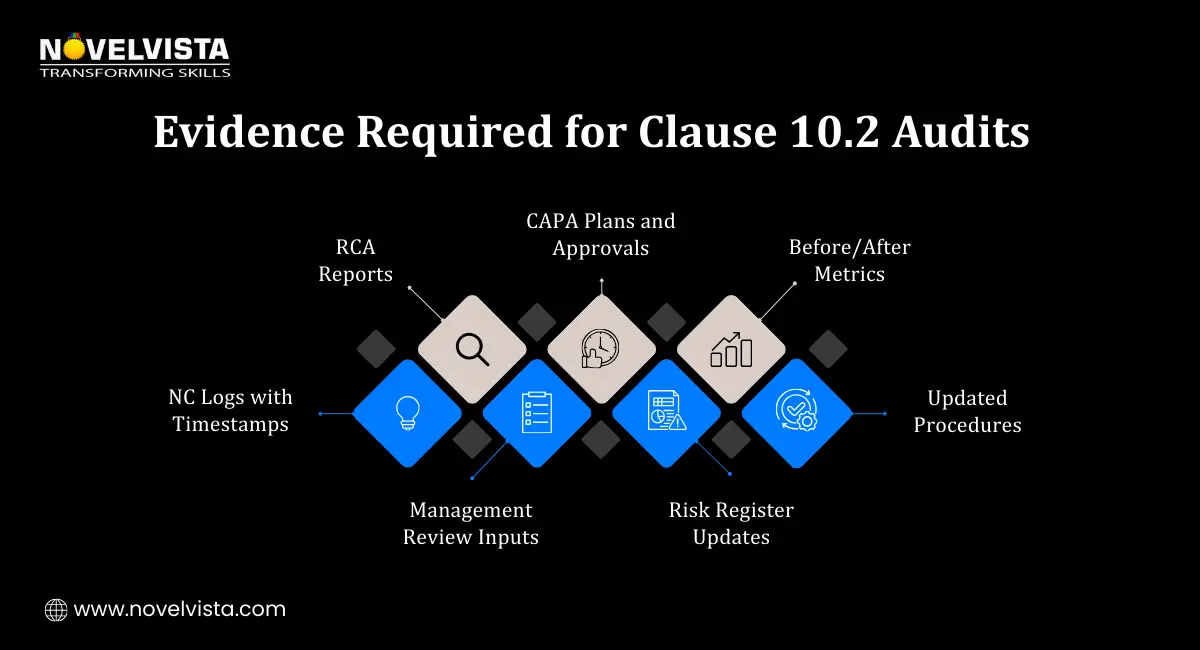
Strong evidence makes audits smooth. Weak evidence leads to uncomfortable discussions.
Auditors usually expect timestamped and traceable records, such as:
For corrective action verification, auditors also look for:
Good systems also show links to continual improvement, such as:
This level of linkage shows that auditing clause 10.2 is part of system governance, not a side activity.
Experienced auditors often ask open questions to test understanding, not memory. Common examples include:
Open-ended audit questions are designed to test understanding of the corrective action process, not recall of clause wording.
Some mistakes appear again and again during the auditing clause 10.2. Knowing them helps auditors spot risk quickly.
Typical red flags include:
When these patterns exist, auditors usually conclude that the management system reacts, but does not improve.
Organizations that perform well under Clause 10.2 usually follow a few simple habits:
These practices make auditing clause 10.2 predictable, evidence-driven, and far less stressful for everyone involved.
Learn how auditors evaluate RCA beyond templates and tools. Understand what makes a root cause acceptable, what triggers red flags, and how to separate real system causes from audit-safe stories.
Clause 10.2 clearly shows whether an organization learns from failure or repeats it. Strong corrective action verification and proven CAPA effectiveness signal a living management system, not a checklist exercise.
Organizations that consistently verify corrective action effectiveness tend to show measurable improvement across audit cycles.
For lead auditors, auditing clause 10.2 is where compliance ends, and maturity begins. When this clause works well, continual improvement becomes real, measurable, and visible across the system.
If you want to audit corrective actions with confidence and consistency, NovelVista’s ISO 9001 Lead Auditor Certification Training is a strong next step. The program helps professionals understand audit thinking, evidence evaluation, root cause assessment, and effectiveness verification in real situations. It is designed for auditors who want clarity, credibility, and practical skills, not just exam knowledge.

Author Details

Course Related To This blog
ISO 9001:2015 Lead Auditor Training and Certification
Confused About Certification?
Get Free Consultation Call
Stay ahead of the curve by tapping into the latest emerging trends and transforming your subscription into a powerful resource. Maximize every feature, unlock exclusive benefits, and ensure you're always one step ahead in your journey to success.