Category | Quality Management
Last Updated On 02/01/2026
Small businesses deal with uncertainty every single day — cash flow pressure, supplier delays, cyber risks, customer dependency, staffing challenges, and unexpected disruptions. But unlike large enterprises, most SMEs don’t have endless budgets, complex tools, or big consulting teams to handle risks. That’s where ISO 31000 for SMEs steps in. It gives small businesses a practical, low-cost, and flexible way to manage risks without overwhelming their teams or finances.
This guide explains how ISO 31000 works for SMEs, why it suits smaller organizations, what benefits it brings, and how you can use it in real life without heavy investment.
Before diving deeper, let’s keep one thing clear: ISO 31000 is not another expensive certification burden. It’s simply an international risk management guideline that helps organizations handle uncertainty in a structured way. If you’re still wondering what is ISO 31000, it is essentially a practical risk management guideline that helps SMEs identify uncertainties early, make informed decisions, and build resilience without complex systems or high costs.
It provides principles and guidance on identifying risks, evaluating them, and handling them smartly.
It helps leaders make better decisions instead of reacting under pressure every time something goes wrong.
It protects business continuity, revenue, reputation, and daily operations.
And here’s the best part.
ISO 31000 is not a certification standard, so there is:
No certification cost
No compulsory audits
No heavy documentation pressure
That automatically makes ISO 31000 for SMEs budget-friendly and realistic. You can adopt it at your own pace, using tools you already have, and shape it to match your size and structure.
When applied properly, ISO 31000 small business adoption helps companies:
Protect assets and cash flow
Build trust with clients and partners
Support growth with confidence
Prepare better for disruptions
So instead of being “extra work,” ISO 31000 actually supports survival and smarter growth.
To make ISO 31000 easy for small businesses to understand, let’s break it into three simple building blocks:
Principles → Framework → Process
The principles form the foundation. For SMEs, they are more practical than theoretical.
Integration into normal operations: Risk management should not sit in a file. It should blend into daily decisions like supplier selection, pricing, hiring, purchasing, IT protection, and planning.
Customization for small teams: You don’t need enterprise-style complexity. ISO 31000 allows SMEs to scale the approach to match team size, maturity, and structure.
Inclusive decision-making: Risk awareness should not be limited to top management. Teams, managers, and key staff members should be part of discussions.
Commitment to continual improvement: Risk management is not a one-time task. SMEs improve gradually, learn from mistakes, and get stronger over time.
These principles make ISO 31000 for SMEs realistic and usable instead of complicated and expensive.
Think of the framework as the “support system” that keeps risk management alive in your company.
Leadership commitment: Owners, founders, or directors must believe in structured risk management. Without leadership support, it becomes paperwork.
Design and integration: Risk management should align with business goals, revenue growth, operational stability, and customer trust, not exist as a separate box-ticking task.
Implementation: This is where SMEs actually start applying risk practices, identifying risks, assessing them, and taking simple actions to control or reduce them.
Evaluation and improvement: Over time, check what is working and what needs adjustment. Improve maturity step by step
The focus is simple: embed risk thinking into daily business routines.
Now let’s talk about the actual working process. This is what SMEs will use day-to-day. For SMEs navigating daily uncertainty, these risk management guidelines provide a structured yet flexible way to identify threats, assess impact, and respond confidently without adding complexity or cost.
Discuss risks openly. Bring clarity so everyone understands threats and responsibilities.
Know what matters most — finances, key customers, core operations, supply chain, people, and technology.
Spot the risks → understand their impact → decide which risks need immediate attention and which can be monitored.
Decide whether to reduce, accept, avoid, or transfer the risk. For SMEs, this often means:
Adding controls
Improving processes
Setting backups
Making safer choices
Track outcomes, learn lessons, and improve. Small businesses thrive when risk handling becomes routine.
This makes ISO 31000 for SMEs very practical — it fits everyday real-world problems rather than theoretical risk models. Through multiple ISO 31000 awareness and implementation programs we’ve delivered, the most effective SME approach has always been practicality, not perfection. Small businesses don’t need complex frameworks — they succeed when ISO 31000 is adapted to their size, resources, and business reality. This is exactly how the framework is designed to work.
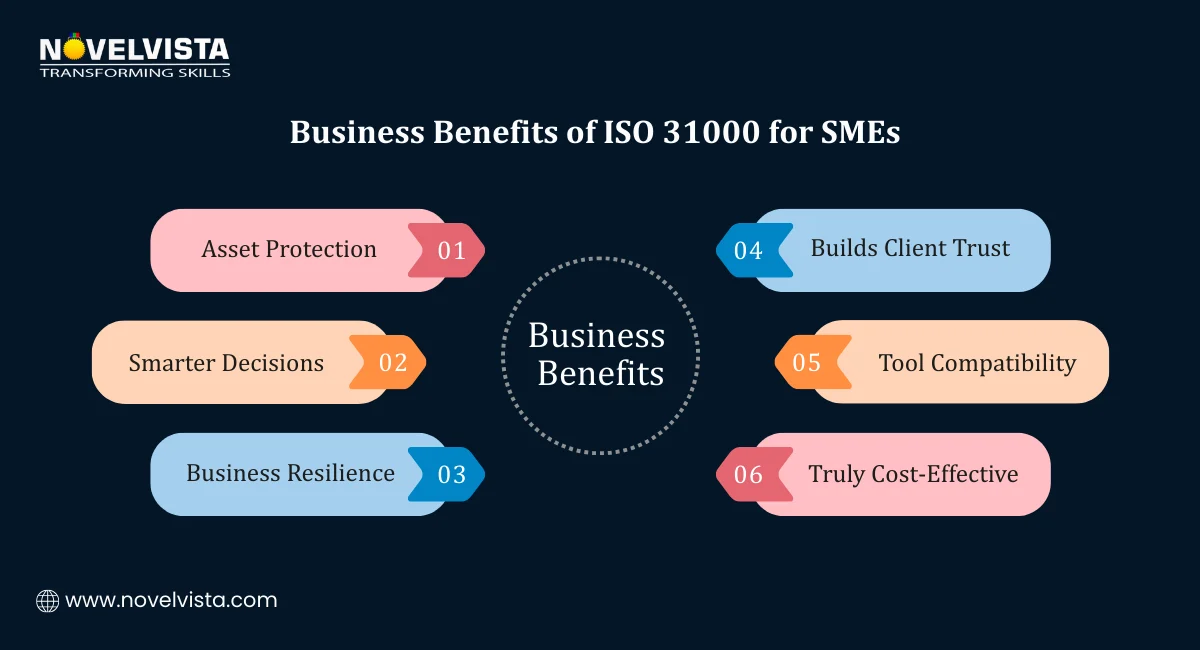
When SMEs apply ISO 31000 correctly, the results are not just “nice to have” — they create real business strength.
This is why ISO 31000 small business adoption is growing worldwide — it delivers value without becoming a burden.
Understand risk management without complex frameworks
Learn practical steps to identify, assess, and reduce business risks
Build confident, low-cost risk practices that actually work
Theory only helps when it turns into real outcomes, and that’s where ISO 31000 for SMEs truly proves its value. Many small businesses use it quietly every day, sometimes without even realizing they’re aligning with it. It works because it fits real business challenges rather than forcing a corporate-style system.
Here’s how ISO 31000 small business adoption works in real life:
Many organizations we’ve trained and guided have witnessed measurable outcomes after aligning with ISO 31000 principles, fewer disruptions, stronger financial control, clearer business decisions, and better operational resilience. These results reflect what international risk management standards consistently highlight: structured risk thinking strengthens long-term business survival.
Small businesses always want strong risk management, but practical hurdles often slow them down. ISO 31000 for SMEs recognizes this reality instead of pretending every company has big budgets and large teams.
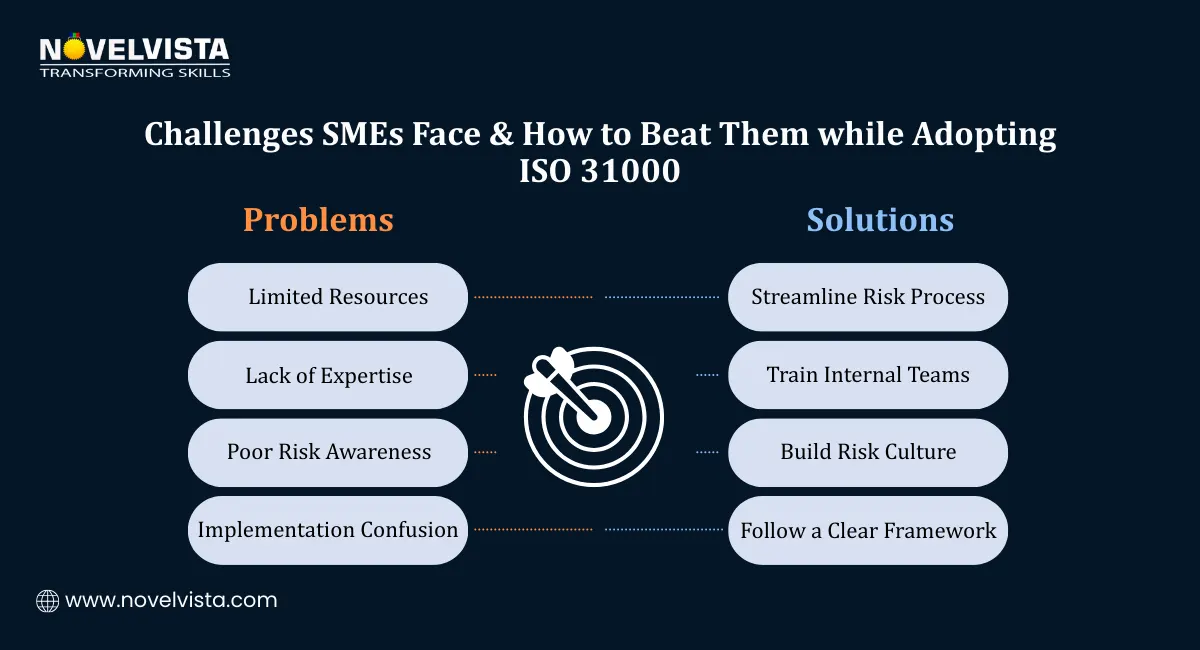
Common challenges include:
Time and Resource Limitations: SMEs usually operate with lean staff. Risk management feels like “extra work.” The solution is a phased rollout. Start small, focus only on important risks, and slowly expand.
Perception That Risk Management Is Only for Big Companies: Many believe frameworks belong only to large enterprises. In reality, ISO 31000 for SMEs is designed to be lightweight, simple, and scalable. It is built exactly for small and medium businesses.
Lack of Trained People: Not every SME has risk experts. The solution is awareness, simple internal discussions, and using easy tools like spreadsheets rather than complex software.
In real SME environments, risk management often fails not because leaders don’t care, but because systems feel complicated or resource-heavy. When SMEs shift to phased implementation, simple documentation, and team awareness instead of large transformations, ISO 31000 becomes practical, manageable, and genuinely helpful.
Practical ways to manage these challenges:
Roll out in phases instead of big transformations
Train teams gradually instead of expensive full programs
Track meaningful KPIs like reduced incidents, better response speed, and fewer financial shocks
Follow low-cost ISO 31000 implementation ideas, such as checklists, templates, and quick review cycles
When SMEs understand that ISO 31000 is flexible, the hesitation slowly disappears.
Small businesses don’t need complicated and expensive systems to manage risk. They need something real, workable, and affordable. That’s exactly what ISO 31000 for SMEs delivers. It supports stability, smarter decisions, stronger resilience, and long-term growth without heavy investments or corporate-style complexity.
With the right mindset, simple structure, and a low-cost ISO 31000 implementation approach, SMEs can build a powerful risk culture that protects revenue, builds confidence, and prepares the business to handle uncertainty confidently.
Everything shared here is based on real SME learning experience, training insights, and the way organizations actually adopt ISO 31000 in real life. The goal is to help SMEs build meaningful, affordable risk management practices they can maintain confidently — not add more burden or unnecessary complexity.

If you want to understand ISO 31000 deeply and apply it practically in your organization, NovelVista’s ISO 31000 Risk Manager Certification Course is a great step. The training helps you learn structured risk management, real-world application, and professional techniques to support business continuity, smarter decision-making, and long-term business strength. It’s perfect for SME owners, managers, consultants, and risk professionals aiming to add real value.
Author Details

Course Related To This blog
Certified ISO 31000:2018 Risk Manager
Confused About Certification?
Get Free Consultation Call
Stay ahead of the curve by tapping into the latest emerging trends and transforming your subscription into a powerful resource. Maximize every feature, unlock exclusive benefits, and ensure you're always one step ahead in your journey to success.